In short ⚡
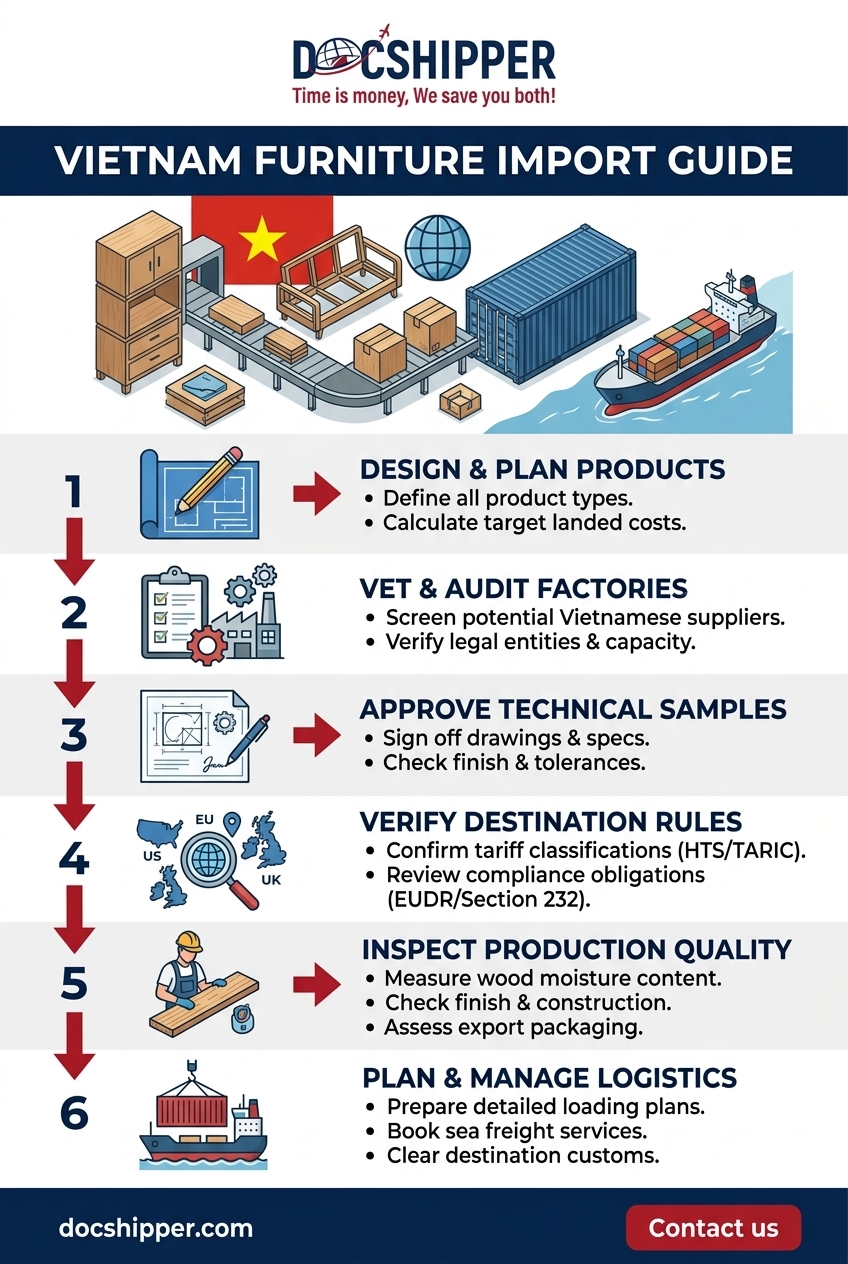
Importing Furniture from Vietnam: Complete Guide starts with selecting the right product and factory, then verifying destination requirements, approving specifications, inspecting production, planning sea freight, and preparing accurate customs documents. Vietnam exported USD 9.4 billion of wooden furniture in 2025, but landed cost, compliance, quality, and packaging must be assessed before ordering. The essential steps are:- Define each SKU, material, finish, dimensions, packaging format, destination, and applicable product category.
- Set a landed-cost target covering factory price, freight, inspection, duties, tariffs, brokerage, taxes, and delivery.
- Shortlist and audit Vietnamese manufacturers by verifying their legal entity, factory, capacity, materials, quality records, and export experience.
- Approve technical samples and document the bill of materials, moisture requirements, finish, hardware, tolerances, assembly instructions, and packaging.
- Check the destination’s tariff classification and compliance rules, including US HTS and Section 232, EU TARIC and EUDR, or UK Global Tariff and origin conditions.
- Inspect production and finished goods, prepare the FCL or consolidation plan, verify shipping documents, and clear customs with accurate classification and origin information.
Key topics include Vietnam’s furniture-export advantages, factory vetting, destination-specific tariffs and compliance, quality control, sea-freight planning, and the complete first-import process.
Looking for a Reliable Shipping & Sourcing Partner?


Why import furniture from Vietnam in 2026
Vietnam exported USD 9.4 billion of wooden furniture in 2025 and supplied 45.3% of US wooden furniture imports during January to August 2025. The country is therefore a serious sourcing base for retailers, hospitality businesses and interior brands seeking an alternative to China, but the right product, factory and destination rules must be assessed together.
Vietnam’s main strengths are its established wood-processing industry, export-oriented factories and experience with solid wood, veneer, case goods and outdoor furniture. Its limitations include factory minimum order quantities, production lead times, dependence on imported raw materials for some products and the need to control moisture, finishing and packing carefully.
The market shift is visible in the available trade data. Vietnam’s share of US wooden furniture imports increased from 40.5% to 45.3% between January-August 2024 and January-August 2025, while China’s share fell from 15.7% to 10.4%. China still has a much larger manufacturing base, but Vietnam can be attractive when diversification, product specialization and tariff exposure are part of the purchasing decision.
As Phùng Quốc Mẫn, Chairman of the Handicraft and Wood Industry Association of Ho Chi Minh City, stated, “2025 presented unprecedented challenges for the industry.” This is a reminder to assess capacity, documentation and market access rather than assuming that a lower factory quotation automatically produces a lower landed cost.
| Factor | Vietnam | China |
| Market position | Vietnam supplied 45.3% of US wooden furniture imports in January-August 2025. | China’s share was 10.4% during the same period. |
| Strengths | Strong wood furniture export base, established clusters and diversification potential. | Large manufacturing ecosystem and broad supplier depth. |
| Risks to assess | MOQ, lead time, raw-material traceability, moisture, finishing and packing. | Country-specific tariff exposure, supplier selection and changing trade conditions. |
Vietnam’s wood and wood-product exports reached USD 17.2 billion in 2025, according to Viet Nam News. The same source reported that the United States accounted for USD 9.46 billion, or 55%, of Vietnam’s wood exports, which explains why many factories are familiar with export packaging and US buyer requirements.
DocShipper Info
Validate tariffs, capacity and destination rules before committing.
DocShipper Tips
Verify the factory, legal entity and export record before comparing quotes.
Finding and vetting Vietnamese furniture manufacturers
Most export-oriented furniture factories are concentrated in southern Vietnam, particularly around Binh Duong, Dong Nai and Ho Chi Minh City. Binh Dinh, including the Quy Nhon area, is associated with outdoor furniture, while northern factories around Hanoi may be relevant for particular product categories and production requirements.
Where the factories are
Start by mapping suppliers according to the furniture type you need: upholstered furniture, solid-wood furniture, veneer products, cabinets, outdoor furniture or hospitality pieces. A factory that produces tables efficiently may not have the equipment, sewing capacity or testing process required for upholstered seating.
Ask each supplier for its legal company name, factory address, production photos, export markets, product catalogue, material list and available capacity for your planned order. Confirm that the address is a production site rather than only a showroom or trading office.
Trade fairs and online sourcing
Trade fairs such as VIFA EXPO can help you compare several Vietnam furniture suppliers in one visit, but a fair meeting is only a first screening step. Request technical drawings, material specifications and a quotation after the event, then verify the supplier’s factory and export history independently.
Online sourcing can produce a wider shortlist, but do not approve a supplier based only on photographs, platform badges or a low price. Compare quotations on the same basis, including wood species, thickness, finish, hardware, packaging, Incoterm, lead time and inspection requirements.
Looking for a Reliable Shipping & Sourcing Partner?
Factory or trading company?
A factory generally offers more direct control over production, while a trading company may coordinate several workshops and provide access to products the buyer could not source directly. Neither structure is automatically safer, so ask who will manufacture the goods, who will issue the commercial invoice and who is responsible for defects.
Before paying a deposit, conduct a factory audit or appoint an independent inspection company. Check machinery, raw-material storage, production lines, finishing areas, packing space, worker safety, quality records and the supplier’s ability to reproduce your approved sample.
Use this supplier questionnaire before comparing final prices:
- What is your full legal company name and factory address?
- Which furniture categories do you manufacture in-house?
- Which operations are subcontracted?
- Which wood species, veneers, panels, adhesives, finishes and hardware do you use?
- Can you provide export references for the destination market?
- What are your MOQ, production lead time and monthly capacity for this product?
- What packaging specification do you normally use for sea freight?
- Can you provide material traceability and documents required for the destination?
- What happens if an inspection identifies defects before shipment?
- Which Incoterms and payment terms can you offer?
| Vetting point | Evidence to request |
| Factory identity | Legal details, physical address and production-site verification. |
| Production capability | Machinery, production line, capacity and records for similar products. |
| Product control | Approved sample, drawings, bill of materials and finish reference. |
| Export experience | Destination-market references and previous shipping documentation. |
| Commercial reliability | Clear quotation, Incoterm, payment schedule, lead time and defect procedure. |
Duties, tariffs and compliance by destination
Import costs depend on the destination, product construction and exact HS or HTS classification. In the United States, upholstered furniture and kitchen cabinets or vanities have additional Section 232 exposure; in the European Union, most furniture under HS 9403 commonly enters at 0% MFN duty, but the exact TARIC code must be checked; in the United Kingdom, importers must verify the UK Global Tariff and the UK-Vietnam trade agreement.
Do not select a tariff code from a supplier quotation without checking the product yourself or asking a customs professional. The construction, materials, intended use and degree of assembly can affect classification, while an incorrect code can change duty, reporting and compliance requirements.
United States: Section 232 and HTS
Section 232 tariffs on upholstered furniture and kitchen cabinets or vanities took effect on 14 October 2025 at a 25% base rate. The planned increase to 30% for upholstered furniture and 50% for cabinets and vanities from 1 January 2026 was delayed for one year, according to Retail TouchPoints.
Rates and scope can change, so check the current HTS classification, Section 232 proclamation and US Customs and Border Protection guidance on the day you place the order. Treat the 25% figure as the brief’s dated reference point, not as a permanent rate for every furniture product from Vietnam.
The product category now matters almost as much as the country of origin. A wooden dining table, upholstered sofa and kitchen vanity may face different tariff treatment, which means your product range should be reviewed before you negotiate a factory price.
European Union: duties and EUDR
For the EU, check the exact product code in TARIC before calculating the landed cost. Most furniture under HS 9403 enters at 0% MFN duty according to the brief, but the preferential treatment, product code and any applicable trade-agreement conditions must be verified for the specific item.
The EU Deforestation Regulation, or EUDR, introduces due-diligence obligations for covered products containing wood. Large businesses and timber-sector operators must comply from 30 December 2026, while other SMEs have a later date of 30 June 2027, according to the Netherlands Enterprise Agency.
Wooden furniture is among the covered derived products. Importers should therefore request wood species, country and place of harvest, supply-chain information and the data required for a due-diligence statement before production starts, rather than trying to reconstruct the file after the container has shipped.
DocShipper Platform
One platform. Your entire supply chain
Sourcing, freight, customs & documents — all centralised, all visible, 24/7.
United Kingdom
For the UK, check the UK Global Tariff using the exact commodity code and verify whether the UK-Vietnam trade agreement provides a preferential rate for your product. Confirm the origin rules and keep the supplier’s supporting documents because preferential treatment depends on meeting the agreement’s conditions.
Also review UK product-safety, labelling, packaging, timber and chemical requirements for the furniture category concerned. A destination checklist should distinguish upholstered furniture, children’s products, cabinets, outdoor items and general household furniture rather than treating every item as identical.
For a complete tariff illustration using the brief’s figures:
| Line | Calculation | Amount |
| Declared value of upholstered sofas | Given example | USD 50,000 |
| Section 232 reference rate | USD 50,000 × 25% | USD 12,500 |
| Section 232 tariff | Additional tariff before regular duties and other charges | USD 12,500 |
| Regular customs duty | Exact HTS rate must be verified | Not included |
| Freight, insurance, brokerage and taxes | Destination-specific calculation | Not included |
This example is not a final landed-cost quotation. It shows why the furniture type, classification and current tariff announcement must be confirmed before you accept a factory price.
| Destination | Duty or tariff check | Key compliance action |
| United States | Check HTS duty and current Section 232 scope and rate. | Classify the item correctly and review upholstered-furniture or cabinet exposure. |
| European Union | Check TARIC; most HS 9403 furniture commonly enters at 0% MFN duty, subject to verification. | Prepare EUDR due diligence for covered wooden furniture from the applicable date. |
| United Kingdom | Check the UK Global Tariff and UK-Vietnam preferential conditions. | Verify origin evidence, product requirements and destination documentation. |
DocShipper Tips
Approve samples and inspect before final payment to protect quality and claims.
Quality control for furniture from Vietnam
Furniture quality control should cover the wood, dimensions, construction, finish, hardware and export packaging. For a first order, approve a production sample and arrange a pre-shipment inspection before the balance is paid or the container is released.
Moisture content is a priority because excessive moisture can contribute to movement, mould or cracking after arrival. Define the acceptable moisture range in the product specification for the wood species and destination, then test representative pieces with a calibrated moisture meter during inspection.
Finish inspection should check colour consistency, gloss or sheen, coverage, visible marks, overspray, runs, sanding defects and adhesion. Compare production furniture with the signed sample under consistent lighting, because a verbal description such as “natural finish” is not precise enough for a commercial order.
Inspect dimensions, joints, drawers, doors, hinges, fasteners, upholstery seams and load-bearing components against approved drawings. Packaging must prevent rubbing, impact and moisture exposure, while wooden crates and pallets entering international trade should comply with ISPM 15 requirements established through the IPPC system.
- Wood: species, grade, moisture readings, cracks, warping, knots and mould.
- Dimensions: length, width, height, thickness, squareness and assembly points.
- Construction: joints, screws, welds, glue lines, stability and load-bearing areas.
- Finish: colour, sheen, coverage, scratches, dents, runs and adhesion.
- Hardware: hinges, handles, slides, fasteners and compatibility with the approved sample.
- Upholstery: fabric, colour, stitching, seam alignment, filling and visible defects.
- Packing: corner protection, inner wrapping, carton strength, labels and moisture protection.
- Wooden packaging: ISPM 15 treatment and marking where applicable.
Use three inspection stages for higher-risk orders: pre-production to confirm materials and components, during production to identify recurring defects, and pre-shipment to verify the finished quantity and packing. Record photographs, measurements, defect classifications and corrective actions in an inspection report.
| Defect | Likely cause | How to check |
| Cracks or warping | Moisture variation, unsuitable storage or inadequate construction. | Take moisture readings and compare dimensions and flatness with the approved specification. |
| Uneven finish | Inconsistent preparation, application or drying. | Inspect under consistent light and compare with the approved colour and sheen sample. |
| Transit damage | Insufficient corner protection, movement or compression in the package. | Open packed samples and check internal protection, carton condition and restraint. |
| Loose hardware | Incorrect fastener, poor installation or missing reinforcement. | Operate doors and drawers and check joints, screws and fittings against the bill of materials. |
| Mould | Moisture, condensation or insufficient ventilation during storage and transit. | Inspect wood, inner packaging and container-loading conditions before shipment. |
DocShipper Info
Compare FCL and consolidation using volume, packing and handling requirements, not freight price alone.
Shipping furniture from Vietnam
Furniture is generally shipped by sea from southern ports serving Ho Chi Minh City, such as Cat Lai and Cai Mep, or from Hai Phong for northern suppliers. A 40-foot high-cube container is commonly considered for bulky furniture because internal volume, not only weight, often determines how much product can be loaded.
Full-container-load shipping, or FCL, means one buyer uses a complete container. It usually provides better control over loading and handling, while less-than-container-load consolidation combines smaller shipments from several suppliers and can make a first order possible without filling a complete container.
For LCL or consolidation, confirm how cartons will be measured, labelled, received, stored and transferred before export. Furniture from several factories should be consolidated only after quantities, packing dimensions, inspection status and commercial documents have been reconciled.
Loading requires a plan rather than simply placing the largest cartons first. Protect corners, separate finished surfaces from rough materials, distribute weight, secure goods against movement and photograph the container before closing it. Confirm the final packing list, seal number and shipping instructions with the forwarder.
- Measure every packed SKU and prepare a loading plan before booking space.
- Use suitable inner protection for finished wood, glass, metal and upholstered surfaces.
- Keep cartons and wooden packaging dry and inspect for visible contamination.
- Separate products by SKU and mark cartons clearly for warehouse receiving.
- Record quantities, carton numbers, gross weight, dimensions and container seal.
- Confirm the Incoterm, export documents, bill of lading instructions and destination customs broker.
For a first container, compare the supplier’s loading proposal with the forwarder’s plan. A small change in carton design or partial disassembly can improve container utilization, but it should never compromise the product’s structural integrity or the buyer’s assembly process.
DocShipper Tips
Build the landed-cost file first, then approve production only when documents and specifications align.
Step by step: your first furniture import from Vietnam
The safest sequence is to define the range and target landed cost first, then select and audit factories, approve samples, verify destination rules, sign detailed specifications, inspect before shipment and clear customs using complete documents.
- Define the product and market. List each SKU, furniture type, materials, dimensions, finish, packaging format and destination. Identify whether the product is upholstered, wooden, outdoor, cabinet-based or otherwise subject to different tariff and compliance treatment.
- Set a landed-cost target. Build a worksheet containing factory price, packaging, inland transport, inspection, export charges, ocean freight, insurance, customs duty, additional tariffs, brokerage, taxes and destination delivery. Do not use the factory price alone to compare Vietnam suppliers.
- Shortlist Vietnamese factories. Search by product category and cluster, then use trade fairs, supplier references and factory documentation to create a shortlist. Separate manufacturers from trading companies and identify all subcontracted operations.
- Audit the supplier. Verify the legal entity, site, machinery, capacity, raw-material storage, finishing process, quality records and export experience. Resolve any difference between the company issuing the quotation and the company producing the goods.
- Approve a technical sample. Sign off the drawings, bill of materials, wood species, moisture specification, colour, finish, hardware, tolerances, assembly instructions and packaging before mass production.
- Check destination rules. Confirm the US HTS and Section 232 position, EU TARIC and EUDR requirements, or UK Global Tariff and UK-Vietnam origin conditions. Create the traceability and compliance file while the supplier can still provide the required information.
- Negotiate the commercial terms. Record the price, MOQ, lead time, payment schedule, Incoterm, inspection rights, defect remedy, packaging standard and document responsibilities in the purchase contract.
- Inspect production and finished goods. Use pre-production, during-production or pre-shipment inspections according to the order risk. Check moisture, finish, construction, dimensions, quantity, labels and packing before shipment.
- Plan the container. Choose FCL or consolidation, prepare the loading plan, verify carton measurements and arrange suitable sea freight. Photograph loading and retain the final packing list, commercial invoice and transport documents.
- Clear customs and review the shipment. Give the broker the correct classification, origin and commercial documents. After delivery, inspect the shipment against the report and record any recurring defect before placing the next order.
The practical decision point is whether you can defend the landed cost before committing the deposit. If the tariff code, product specifications, wood traceability, packaging or inspection responsibility remains unclear, the order is not ready for production.
Conclusion: importing furniture from Vietnam safely
To import furniture from Vietnam successfully, choose the product and factory with the destination market’s rules in mind. A reliable process links sourcing, technical specifications, quality inspection, freight planning and customs documentation instead of treating them as separate tasks.
- Vietnam exported USD 9.4 billion of wooden furniture in 2025 and supplied 45.3% of US wooden furniture imports in January-August 2025.
- US Section 232 tariffs apply to upholstered furniture and kitchen cabinets or vanities from October 2025, subject to current scope and rate verification.
- Most EU furniture under HS 9403 commonly enters at 0% MFN duty, but TARIC must be checked for the exact product.
- EUDR due diligence applies to covered wooden furniture from 30 December 2026 for large businesses and relevant operators.
- Moisture, finish, construction, hardware and packing should be checked before the first shipment leaves Vietnam.
- Smaller orders can use consolidation, while a 40-foot high-cube container may suit larger or bulky furniture shipments.
Planning to import furniture from Vietnam? We help you vet factories, inspect goods before departure and ship them with customs clearance to your market.
FAQ | How to Import Furniture from Vietnam: A Complete 2026 Guide
Yes, but treat it as a negotiated pilot order rather than assuming the factory will accept the same terms as a full production run. Ask whether the supplier can combine several SKUs, produce a reduced quantity or sell a paid sample using the same materials and process as the final order. Confirm the sample price, tooling charges, delivery time and whether the amount can be credited against a future purchase.
DDP can simplify delivery, but it may reduce your visibility over customs clearance, declared values, import taxes and the official importer of record. Before accepting a DDP quotation, ask who will act as importer, which tariff code will be declared, whether duties and taxes are included, and who bears the cost of customs delays or document errors. Compare it with an arrangement where you control the customs broker and import documentation.
Avoid paying the full amount before production. A common risk-control structure is a deposit to start production, followed by the balance after the goods pass the agreed inspection and before release of the shipping documents. Make sure the bank account belongs to the contracted legal entity, and include the inspection standard, defect remedy, delivery deadline and refund conditions in the purchase contract.
Do not rely on verbal discussions or release the balance while the dispute is unresolved. Send the inspection report with photographs, measurements and the relevant specification, then request a written corrective-action plan. Depending on the contract, the remedy may involve rework, replacement, a price adjustment or cancellation of the affected quantity. If the supplier refuses to cooperate, involve the inspection company and a local commercial adviser before authorising shipment.
Furniture with lighting, motors, charging ports or other electrical parts may require additional safety, electromagnetic-compatibility, labelling and documentation checks in the destination market. Ask the supplier for component specifications, test reports, wiring diagrams, plug details and production quality records before approving the design. Do not assume that a standard furniture classification or a supplier’s existing certificate covers the complete finished product.
It can happen, particularly when a factory works with an export agent, but the arrangement must be documented before payment. Confirm which company manufactures the goods, which entity appears on the commercial invoice, who is the exporter of record and who is responsible for defects or missing documents. The names, addresses, banking details and quantities should remain consistent across the contract, invoice, packing list and transport documents unless the change is formally approved.
Separate manufacturing defects from transport damage and preserve evidence before unpacking or discarding the packaging. Photograph the outer carton, shipping marks, container condition, internal protection and damaged product, then notify the carrier, insurer, supplier and customs broker within the applicable deadlines. A pre-shipment inspection confirms the condition before dispatch; it does not replace transport insurance or a documented arrival inspection.
Need Help with Logistics
or Sourcing in Vietnam ?
First, we secure the right products from the right suppliers at the right price by managing the sourcing process from start to finish. Then, we simplify your shipping experience - from pickup to final delivery - ensuring any product, anywhere, is delivered at highly competitive prices.


Fill the Form
Prefer email? Send us your inquiry, and we’ll get back to you as soon as possible.
Contact us