
Freight from Vietnam to Japan | Rates – Transit Times – Duties & Taxes
Vietnam and Japan are close on the map, but operationally this route can surprise you fast. Between feeder connections from Ho Chi Minh City or Hai Phong, tight schedules into Tokyo or Osaka, and strict Japanese customs standards, one small miscalculation can delay your entire supply chain.
If you’re planning sheipping vietnam japan, whether by sea freight or air cargo, you need clear numbers, realistic transit times, and a solid understanding of duties and procedures, not generic theory. That’s exactly what you’ll find here, the practical framework we use every day to manage this corridor.
What is the best method to ship your goods from Vietnam to Japan ?
If your priority is cost and you’re shipping standard commercial cargo, sea freight from Cat Lai or Hai Phong to major Japanese ports like Yokohama or Kobe is usually the logical choice. If you’re moving high value goods, urgent samples, electronics, or time sensitive components, air freight from Tan Son Nhat or Noi Bai into Narita or Kansai will save days and sometimes your contract.
It’s simpler than it looks once you see the logic: volume and budget push you toward ocean freight, urgency and risk tolerance push you toward air. The real decision depends on current capacity, seasonal congestion, and rate fluctuations, and we check those parameters in real time before advising you. Below, you’ll find a detailed breakdown of costs, timelines, and constraints for each option.
Docshipper Note:
Need assistance with your shipment? Dont hesitate to contact us even for a simple question. Choose the option that suits you
Live chat with an expert Chat us on WhatsApp Fill the form
Sea freight from Vietnam to Japan
Overview – Ocean cargo from Vietnam to Japan
With its 27,000 km of coastline for a surface area of 370,000 km2, the Japanese archipelago has 073 ports, i.e. a shelter for 27 km of shoreline. In this country where maritime activities play an essential role three types of port establishments share the traffic According to their size there are 17 specially designated major ports 94 major and more than 900 local ports two exceptions except Niigata on the Sea of Japan and Muroran Hokkaido all the specially designated major ports are located between Tokyo Bay and Shimonoseki Strait on the southern coast of Japan. In 1972 700,000 ships carried in connection with a Japanese port nearly billions of tons of goods Despite their very high level international trade 553 million tonnes in 1971, i.e. approximately one fifth of the world’s total is just over one third of the world’s total. of total traffic, leaving cabotage with a preponderant share of 299 million tons
Open to the Pacific Ocean at the outlet of the second agglomeration. the country’s urban development2 as the gateway to the Inland Sea and Osaka Bay. is home to two of Japan’s major international trading ports Kobe first Japanese port and third world port Osaka fourth port archipelago merchant
Shipping company offering services from Vietnam to Japan ports
Here are few examples :
Main shipping ports in Vietnam
Port of Hai Phong
Location and Volume: Located in Northern Vietnam near Hanoi, Hai Phong is the country’s primary northern gateway for sea freight. It handles over 7 million TEUs annually as of recent years, with Lach Huyen deep-water terminal significantly expanding its capacity.
Key Trading Partners and Strategic Importance: Hai Phong is particularly well-positioned for trade with Northeast Asian markets, including Japan, South Korea, and China, making it a natural departure point for Vietnam–Japan shipments.
Context for Businesses: If your suppliers are based in Hanoi, Bac Ninh, Hai Duong, or the northern industrial zones, Hai Phong is your most practical and cost-effective export port for Japan-bound cargo.
Port of Da Nang
Location and Volume: Situated in Central Vietnam along the eastern coast, Da Nang handles approximately 2.5 million tons of cargo annually. It serves as a strategic transshipment hub for central Vietnam.
Key Trading Partners and Strategic Importance: Da Nang trades actively with Japan, Taiwan, and India. The port also plays a key role in Vietnam’s seafood and agricultural exports.
Context for Businesses: If your business deals in seafood, processed food, or agricultural goods from central Vietnam, Da Nang offers efficient access to Japanese ports with relatively direct routing.
Port of Ho Chi Minh City (Cat Lai)
Location and Volume: The largest port in Vietnam, Cat Lai in Ho Chi Minh City handled over 7 million TEUs in recent years. It is the country’s main gateway for southern Vietnam exports.
Key Trading Partners and Strategic Importance: Ho Chi Minh City’s port complex connects to a wide network including Japan, the US, China, and Europe. It is the dominant hub for electronics, garments, furniture, and consumer goods.
Context for Businesses: If your manufacturing base is in Ho Chi Minh City, Binh Duong, Dong Nai, or Long An, Cat Lai is your primary port. Most Vietnam–Japan container services depart from here, with competitive weekly schedules.
Main ports in Japan
Port of Yokohama
Location and Volume: Located in Kanagawa Prefecture, just 30 km southwest of Tokyo, Yokohama is Japan’s second-largest container port, handling over 3 million TEUs annually.
Key Trading Partners and Strategic Importance: Yokohama has deep trade ties with China, Vietnam, South Korea, and the United States. It is a primary gateway for goods destined for the Greater Tokyo area and the Kanto region.
Context for Businesses: If your final delivery is in Tokyo, Kanagawa, or the surrounding prefectures, Yokohama is typically the most cost-effective entry point. Many Vietnam–Japan sea freight services call Yokohama directly.
Port of Osaka
Location and Volume: Osaka is Japan’s third-largest container port and the main gateway for the Kansai region, handling approximately 2.5 million TEUs per year.
Key Trading Partners and Strategic Importance: Osaka maintains strong trade flows with Southeast Asia, including Vietnam, and connects well to inland distribution networks toward Kyoto, Hyogo, and Nara.
Context for Businesses: For deliveries to the Kansai region, Osaka reduces inland trucking distance and cost significantly compared to Tokyo or Yokohama.
Port of Kobe
Location and Volume: Located next to Osaka in Hyogo Prefecture, Kobe handles around 2.8 million TEUs annually. It was historically Japan’s leading international port before the 1995 earthquake.
Key Trading Partners and Strategic Importance: Kobe maintains active trade routes with Southeast Asia and is a preferred port for automotive parts, chemicals, and consumer goods.
Context for Businesses: If you’re importing goods related to manufacturing or industrial supply chains in western Japan, Kobe offers strong connections and reliable carrier schedules from Vietnam.
Port of Nagoya
Location and Volume: Japan’s busiest port by total cargo volume, Nagoya handles approximately 186 million metric tons per year and nearly 3 million TEUs, ranking 15th globally.
Key Trading Partners and Strategic Importance: Nagoya is the heart of Japan’s automotive and electronics export corridor. It also receives significant volumes from Southeast Asia, including Vietnam.
Context for Businesses: If your supply chain serves the automotive or industrial manufacturing sector in central Japan, Nagoya is the most strategic entry point, with excellent connectivity to Toyota City and surrounding areas.
Should I ship by consolidation or full container from Vietnam to Japan ?
Deciding between Full Container Load (FCL) and Less than Container Load (LCL) shipping from Vietnam to Japan is not just a question of volume — it affects your cost structure, transit time, risk exposure, and planning flexibility.
For this route specifically, one advantage worth noting is that Vietnam to Japan is a short sea corridor — typically 5 to 8 days port to port. This means even LCL shipments arrive relatively quickly, making consolidation a viable option for regular, smaller-volume importers.
Not sure which option fits your operation? Contact our team and we’ll calculate the actual cost difference based on your specific cargo dimensions and destination in Japan.
LCL: Less than Container Load
The Full container is by far the cheapest option. The LCL, by grouping together different shippers, will give you the advantages of the FCL without having the necessary volume.
Definition: LCL, also known as consolidation, groups your cargo together with goods from other shippers inside a shared container. You only pay for the space your cargo occupies.
When to use: LCL is the right choice when your shipment falls below 13 to 15 CBM and doesn’t justify the full cost of a dedicated container.
Example: A Vietnamese cosmetics brand shipping 6 CBM of skincare products to a distributor in Osaka would typically use LCL. Sharing a container keeps costs manageable while maintaining reasonable transit times on this short regional route.
Cost implications: LCL has lower upfront costs, but the cost per CBM is higher than FCL. You also need to factor in consolidation and deconsolidation handling at freight stations (CFS) on both ends, which can add 2 to 4 days to your total transit time.
FCL: Full Container Load
FCL refers to a container (20 or 40 feet). From Vietnam, it will be the cheapest way to transport your goods.
Definition: FCL means booking an entire container, typically a 20-foot or 40-foot unit, exclusively for your cargo. The container is sealed at origin in Vietnam and only opened at destination in Japan.
When to use: FCL becomes the right choice when your cargo exceeds roughly 13 to 15 CBM, or when you’re shipping fragile, high-value, or sensitive goods that benefit from not being handled alongside other shippers’ cargo.
Example: A furniture manufacturer in Binh Duong shipping 18 CBM of wooden furniture to a retailer in Tokyo would typically choose FCL. The container is sealed after loading at the factory and opened only at the Japanese warehouse, reducing handling risk significantly.
Cost implications: FCL is charged as a flat rate per container regardless of how much space you fill. This makes it increasingly cost-effective as your volume grows. For volumes above 15 CBM, the cost per cubic meter under FCL will almost always beat LCL.
Nevertheless, to benefit from these monetary advantages, you need a very important volume.
Advantages of shipping by LCL
LCL will provide a very suitable means of transportation for cargo.
Why ?
Benefit from the perfect solution if your volume exceeds the air freight limit but is not enough to fill a FCL.
Disadvantages of shipping by LCL
Price per CBM will be more expensive than FCL.
Often not a viable shipping option for cargo volumes above 13,14 cbm (cubic metres) from Vietnam. But it may depend on few criters, please call us !
Advantages of FCL sea freight
Price per cubic meter much cheaper than LCL or even air freight or other. The most competitive.
More convenient to maximize the space within a container from 20″ or 40″.
Being the only shipper, we won’t need to open and close the container several times: less risks.
Disadvantages of FCL shipping
Your volume exceedsa 14,15 CBM ? (equal to 40 to 70% of a 20″ container).
If yes, we will opt for this option.
How long does it take to ship from Vietnam to Japan by sea freight ?
| Kobe | Tokyo | Osaka | Yokohama | Nagoya | Chiba | |
| Da Nang | 7 days | 6 days | 7 days | 7 days | 7 days | 8 days |
| Saigon | 7 days | 7 days | 8 days | 8 days | 8 days | 7 days |
| Ba Ngoi | 8 days | 6 days | 7 days | 7 days | 7 days | 6 days |
| Cam Pha Port | 7 days | 8 days | 7 days | 6 days | 8 days | 8 days |
**You need to remind that transit time here is only about the freight (to have the total you have to take into account the pick up and the delivery of course)**
How much does it cost to ship a container from Vietnam to Japan ?
Our customers (professionals and private individuals) exporting from Vietnam to Japan, use sea freight. It is the most cost-effective solution, especially considering that the transit time is only about 1 week.
Anyway it is in any case (any destination) the best solution to save if your volume and weight are above 100kgs/ 1 CBM.
Docshipper Note:
Contacting us has never been easier. Just fill in the form and / or send us an email. We operate on a case-by-case basis in order to provide you with a quality specialised service. Thus, we need you to fill in the information specific to your operation (addresses, desired services, dimensions…).
Docshipper will handle your demand and revert to you as soon as we can with precise answer.
Special sea freight services
Reefer container from Vietnam to Japan
The second hand reefer container is the ideal tool for the storage and transport of refrigerated products. Often used in catering, agriculture or supermarkets. The reefer container is a large cold room. Removable or not, store from -23°C to +23°C. It allows you to maintain the temperature of food and preparations on volumes ranging from 17 m3 to 69 m3.
Docshipper will advise you, if necessary, and then reserve it for you.
Roro/Bulk/OOG from Vietnam to Japan
RORO:
It refers primarily to the handling technique: packages are loaded and unloaded by rolling them from the port Ro-Ro ramp (where it exists) to the ship’s mobile ramp, thus allowing anything rolling in the ship’s garage to be driven into or out of the ship’s garage in the other direction. The Ro-Ro is particularly suitable for the transport of trucks, semi-trailers, tractors, excavators, etc. It is also suitable for transporting containers or swap bodies that are brought into the ship’s garage by means of forklifts or trailers.
BULK:
These are goods in bulk, i.e., in pieces or grains, such as grain, coal, ore, gravel, sand or stone. A distinction is made between bulk goods and bulk liquids: (oil and oil products).
OOG
OOG (Out of Gauge) : It refeers to special dimensions or weight. Thus these shipping cannot be loaded in simple containers. These types of cargoes are usually loaded onto a platform or trailer for transportation.
Air freight from Vietnam to Japan
How long does air freight take between Vietnam and Japan?
Air freight from Vietnam to Japan typically takes 1 to 3 days airport to airport. For door-to-door operations including export clearance in Vietnam and import customs in Japan, plan for 3 to 5 business days in total under normal conditions.
The main air routes operate from Tan Son Nhat (Ho Chi Minh City) and Noi Bai (Hanoi) to Narita (Tokyo), Kansai (Osaka), or Chubu (Nagoya).
How much does it cost to ship a parcel between Vietnam and Japan by air freight?
Air freight rates from Vietnam to Japan generally range from $3 to $12 per kg depending on cargo type, chargeable weight, airline, and current market conditions. Express courier services for small parcels under 100 kg typically apply different per-kg pricing. Contact us for a real-time quote based on your actual dimensions and weight.
Overview – Classic vs Express air freight
Express will obviously be a more expensive service, but in the end it’s not just a question of budget. Indeed it depends on the time you have before you receive your goods. So if you have to receive the goods within a week, you will surely be ready to pay more.
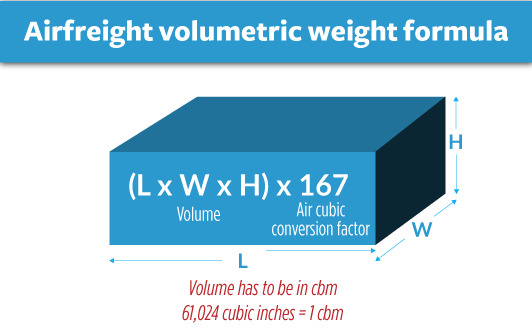
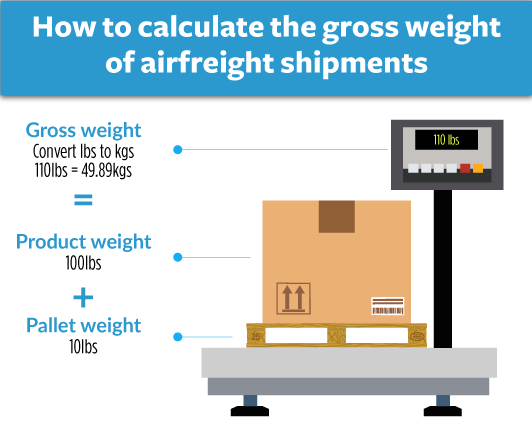
What is the difference between volumetric and gross weight?
*To make a quote based on your good’s specifications, we try two calculations for getting the chargeable weight.
Please immerse yourself in the example below to better understand. We will select the highest weight in order to work on your quotation. The two images below give you a better understanding of the two methods:
Should I choose a Classic Air freight from Vietnam to Japan ?
Which airlines company should you ship with ?
- ANA, short for All Nippon Airways, is an air transport company that was founded in 1952 as the Japan Helicopter and Airplane Transport Corporation. The company is a direct result of World War II with the Japanese government’s obligation to recreate an air transport network in the country. The international service center is based at Narita International Airport; the Japanese service center is based at Tokyo-Haneda International Airport. It has been rated 5-star Skytrax1 since March 29, along with Cathay Pacific, Singapore Airlines, Malaysia Airlines, Asiana Airlines, Qatar Airways and Hainan Airlines. The ANA Group has two subsidiaries: ANA Wings and Air Japan
- Vietnam Airlines (in Vietnamese Hãng hàng không Quốc gia Việt Nam) is the national airline of Vietnam. It operates domestic and international flights from its two main hubs at Tan International Airport Sơn Nhất in Ho Chi Minh City and Nội Bài International Airport in Hanoi.
Transit time Door to Door from Vietnam to Japan by air freight ?
For a door to door operation, you must count for sure less than a week.
How much does it cost to ship a parcel from Vietnam to Japan ?
Please contact us now and start a personalized exchange with one of our advisers. We will guide you and advise you on the best solution according to the characteristics of your operation.
Should I choose an Express Air freight from Vietnam to Japan ?
Express service – Perfect solution for small package
If your shipment is about 100kgs or less this is an interesting solution. For important volume, this service would be too expensive. Therefore, we will advise and book for you what is necessary.
How long does it take for a package to be shipped from Vietnam to Japan ?
We will go through the express companies we know well, which will guarantee the best price and service for you. The customs clearance process being automated in this case, the operation should take 1-2 days.
How much does an Express service cost from Vietnam to Japan ?
*For quoting express, an other method is applied. For express freight, note that 1 CBM = 200 kgs.
Please reach us with the information needed (dimensions, weight, address…) so that we can explain you the next move. We will assist you from A to Z.
Docshipper Note:
Please, click on our dedicated express air freight article. You can become an expert in 10 minutes !
Main international airports in Vietnam
Tan Son Nhat International Airport
Cargo Volume: Vietnam’s largest cargo airport, handling over 600,000 metric tons of cargo annually.
Key Trading Partners: Japan, South Korea, the US, and ASEAN countries.
Strategic Importance: Located in Ho Chi Minh City, Vietnam’s main commercial hub, with strong connections to southern industrial zones in Binh Duong, Dong Nai, and Long An.
For Your Business: If your suppliers are based in southern Vietnam and your cargo needs to reach Japan quickly, Tan Son Nhat offers the most frequent and competitive air freight options on this corridor.
Noi Bai International Airport
Cargo Volume: Approximately 400,000 metric tons of cargo annually.
Key Trading Partners: Japan, China, South Korea, and key European markets.
Strategic Importance: Located in Hanoi, Noi Bai serves the industrial zones of northern Vietnam including Bac Ninh, Hai Duong, and Vinh Phuc, many of which house Japanese-owned manufacturing facilities.
For Your Business: For companies sourcing from northern Vietnamese factories — particularly in electronics, components, or precision manufacturing — Noi Bai provides direct air freight access to Japan with multiple weekly frequencies.
Da Nang International Airport
Cargo Volume: Up to 200,000 metric tons annually.
Key Trading Partners: Japan, ASEAN countries, and China.
Strategic Importance: Serves central Vietnam’s growing industrial zones and is a secondary departure point for time-sensitive cargo from the region.
For Your Business: If your production or sourcing is based in central Vietnam, Da Nang offers a viable air freight alternative, particularly for lighter, high-value goods.
Major airports to ship in Japan
Tokyo Haneda International Airport
Tokyo Haneda International Airport or simply Haneda Airport is located in the Haneda district, 30 km southwest of Tokyo, in the district of Ōta, Japan. It is one of the two main airports of Greater Tokyo, the other being Narita International Airport located about 60 km east of Tokyo.
Tokyo-Haneda International Airport is the main connecting hub for domestic flights of Japan Airlines and All Nippon Airways as well as several Japanese low-cost airlines, Hokkaido International Airlines, Skymark Airlines, Skynet Asia Airways and StarFlyer. It also receives a few international flights, mainly from Asia.
Tokyo-Haneda International Airport was the 5th largest airport in the world in 2019 with 72,263,025 passengers, far ahead of Tokyo-Narita International Airport.
Narita International Airport
Narita International Airport is an international airport located in Narita, Chiba Prefecture, Japan. It is one of the two main airports in Greater Tokyo, the other being Tokyo Haneda International Airport. It receives most international flights unlike Haneda International Airport located much closer to Tokyo which receives domestic flights. It is located about 60 kilometres east of the capital and until 2004 it was known as the New Tokyo International Airport. Narita International Airport is the main international hub for Japan Airlines and All Nippon Airways and a secondary hub for Delta Air Lines.
In 2019, it was the twenty-fourth largest airport in the world in terms of total traffic volume with more than 35 million passengers transiting through it and the eighth largest airport in the world for international traffic with more than 32 million passengers on international flights in 2019.
Chūbu International Airport
Chūbu International Airport is the main airport for Nagoya City and the Chūbu region in Japan. It is located in the territory of the city of Tokoname, 35 km south of Nagoya. The airport is managed by Central Japan International Airport Co., Ltd. It is the fourth Japanese airport built on water, after Tokyo-Haneda, Nagasaki and Kansai near Osaka. Like the latter, it is built on an artificial island attached to the municipality of Tokoname.
The airport operates 24 hours a day and can be reached from central Nagoya in 28 minutes by train or 40 minutes by road. In 2018, 15.8 million passengers transited through the airport.
Volumetric vs gross weight
Gross weight is the actual physical weight of your shipment in kilograms, including the goods and all packaging.
Volumetric weight reflects the space your shipment occupies. It is calculated by multiplying the length × width × height of your package in centimetres, then dividing by 6,000 for standard air cargo, or by 5,000 for express courier services.
Here’s a practical example: you’re shipping a box measuring 60 cm × 50 cm × 40 cm with an actual gross weight of 15 kg.
- Volumetric weight (air cargo): (60 × 50 × 40) / 6,000 = 20 kg
- Volumetric weight (express): (60 × 50 × 40) / 5,000 = 24 kg
Since both volumetric weights exceed the gross weight of 15 kg, the airline charges based on 20 kg (or 24 kg for express). Air freight is always billed on whichever is higher — gross or volumetric weight. Understanding this upfront helps you optimise packaging dimensions and avoid unexpected costs.
Door-to-door transfer from Vietnam to Japan
Door-to-door method overview
Operate by the means most appreciated by our customers around the world : door-to-door. In fact, we take care of all the phases of the operation so that you are at peace and have no fear or reluctance.
Therefore, be aware that we are responsible of every phase of the transfer.
How door-to-door services are helpful?
From A to Z our employees in Vietnam and Japan will work together to ensure the best possible service.
This cooperation is unique and makes the risks associated with this type of operation almost nil.
This is very much appreciated by our customers because we manage everything, especially what they are generally afraid of: customs. Everything is under our control.
Why should I use a Door-to-Door service between Vietnam and Japan?
Door-to-door shipping is consistently one of the most requested services on the Vietnam–Japan corridor, and for good reason. Here are five concrete reasons why it simplifies your operation:
1. Single point of accountability: One team coordinates supplier pickup, export clearance in Vietnam, international freight, import customs in Japan, and final delivery. You don’t chase multiple agents across two countries.
2. Customs handled by specialists: Japanese customs can be strict. Documentation errors, missing certificates, or incorrect HS code declarations can hold your cargo for days. Our team prepares and verifies documents on both sides before your goods move.
3. Fewer surprises on costs: With door-to-door, you get a comprehensive quote covering all legs of the journey upfront — including destination charges in Japan that are often hidden in port-to-port quotes.
4. Adapted to your urgency: Whether your cargo moves by sea for cost efficiency or by air for speed, the door-to-door service covers both modes. We choose based on your timeline and product value, not convenience.
5. Efficient for regular importers: If you ship repeatedly from Vietnam to Japan, a structured door-to-door arrangement creates operational routines. You spend less time on logistics coordination and more time on your business.
Docshipper Note:
This is your lucky day, we have a dedicated door-to-door article, or reach one of our Docshipper experts for more info.
Customs clearance in Japan for goods imported from Vietnam
Customs clearance process in Japan
Customs process
In principle, it is the importer who arranges the declaration. But Docshipper is there to take care of the declaration and the import procedure. As a general rule, the clearance of goods through Japanese customs takes place without any noticeable incidents.
Articles 68 to 70 of the Customs Code describe the documents that must be presented at customs clearance. These are the commercial invoice, packing list, consignment note (bill of lading or air waybill), cargo manifest, entry declaration for ships or aircraft (an announcement at the time of entry into the port), import declaration (electronic), customs value declaration, certificate of origin (if the goods are eligible for a preferential tariff), insurance certificate, the import authorisation (where applicable) and the written request for reduction or exemption from customs and/or excise duties (if applicable).
How much will I pay ?
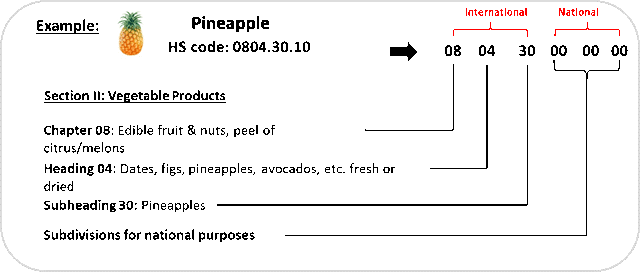
You must get an estimation of freight and customs clearance. As each member of the World Trade Organisation the HS code is used (composed of 6 numbers). the Harmonized Commodity Description and Coding System. This numbers defines the nature of your good (by ID).
Here is the composition of an HS Code
How to find the right HS Code for my goods ?
You have few options but you should start with asking your supplier. He must be able to probide it, if not he has no experience …
However, go on this website : HTS – HS code finder
It’s very simple to use ! Let’s continue this example with ” pineapple ” :
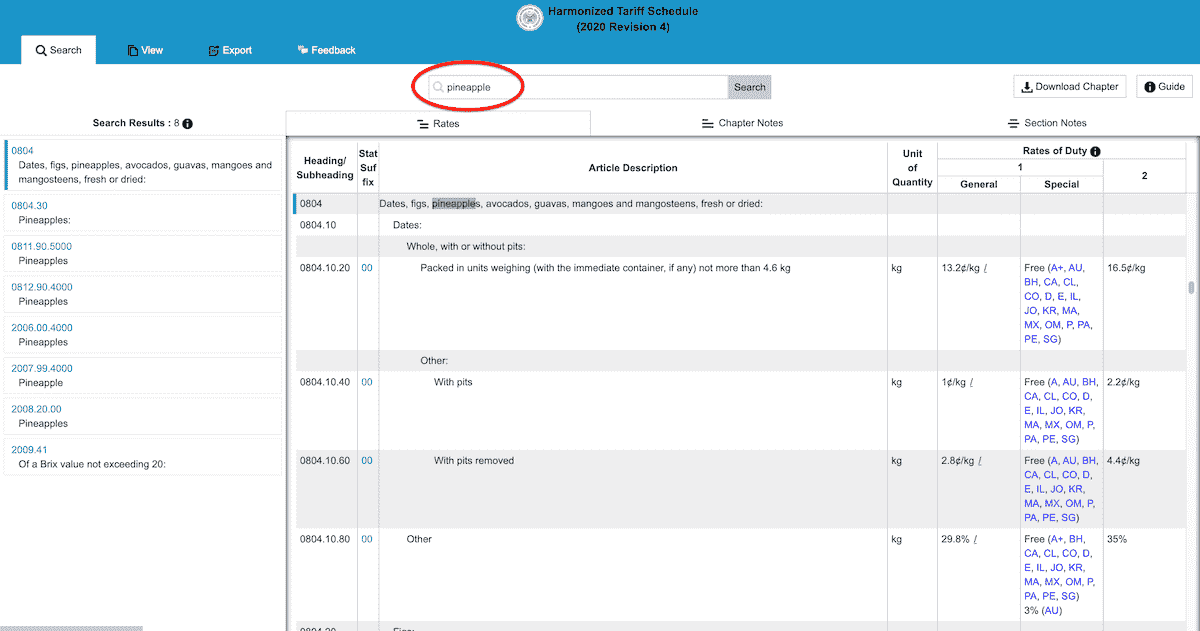
Calculate applicable tariff with the HS code
You found your HS Code ? It’s now time to check how many taxes you will have to pay on your shipment. You just need to do the following steps :
Go on the Free Trade Agreement Portal
Go on this link, you should reach a page who looks like this :
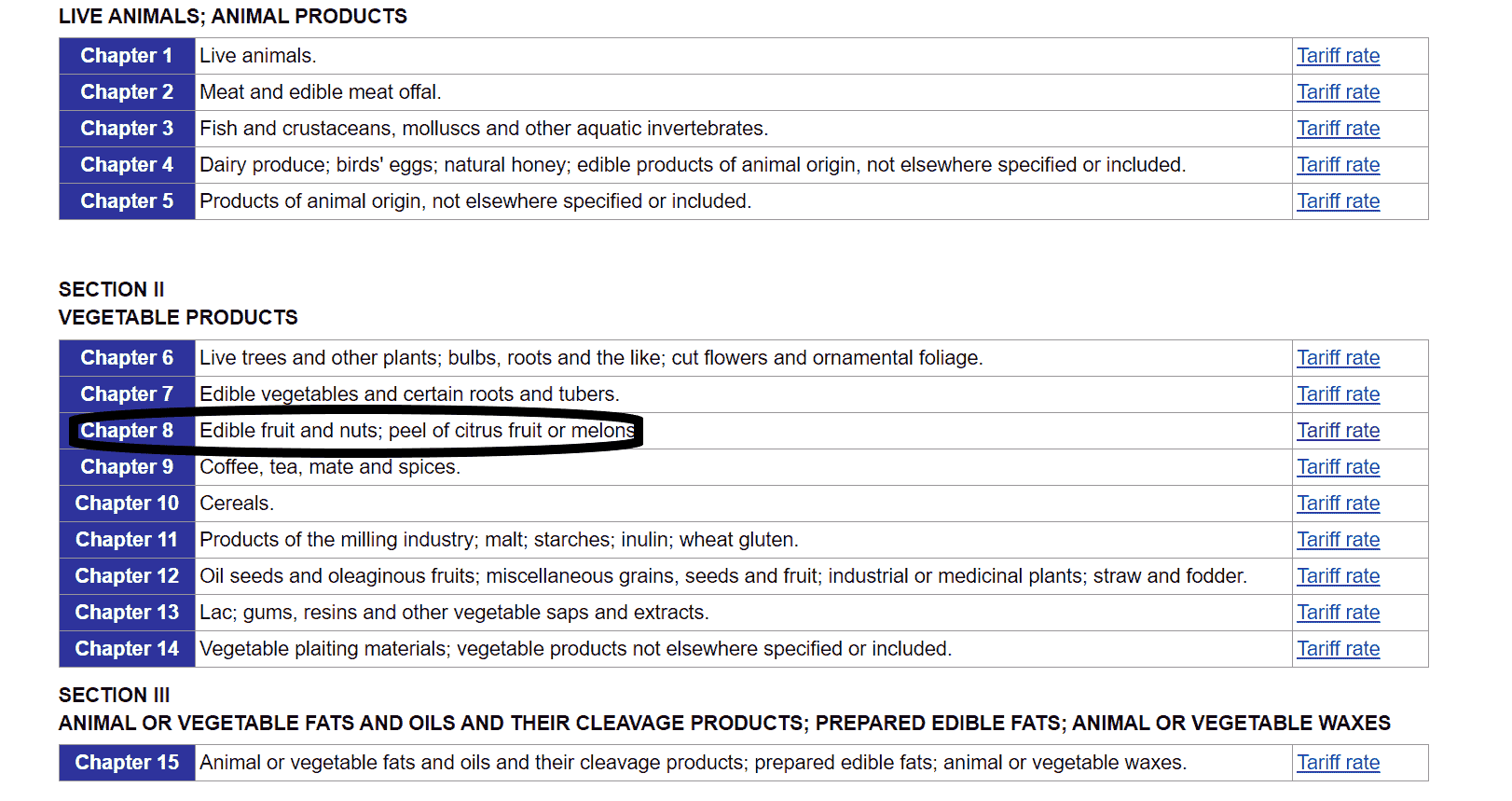
As our example on the screenshot :
- Choose the chapter corresponding (8 here)
Select the correct product and check the duties and taxes applied on your product
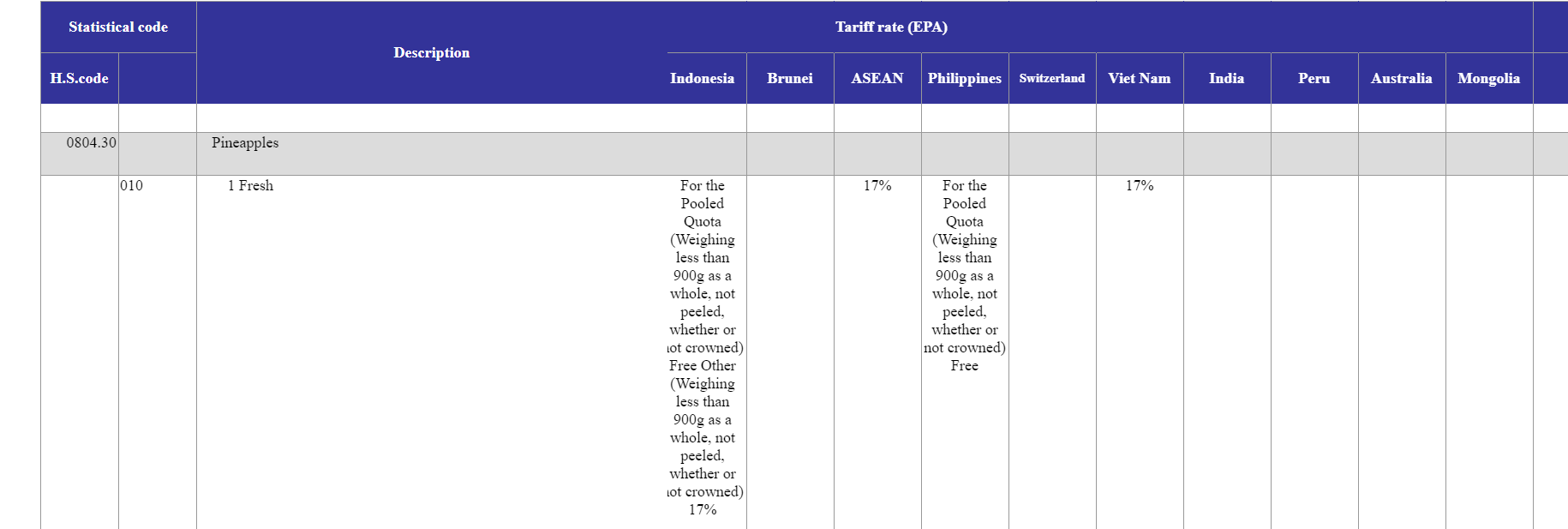
As you can see, for fresh pineapple imported from Vietnam, the rate applicable is 17%.
DocShipper advice : You need more information about the tariff classification ? You should click here. Be aware of these information will avoid some potential issues.
Different taxes existing for your goods
TVA
Import VAT is due on the customs value plus the duty paid value. This is fixed at 5% (including the local taxes).
Due to the large public debt and the relatively low general VAT rate, the Japanese government decided on December 30, 2011 to increase the rate to 8% in 2014 and 10% in 2015. This decision is highly controversial and its approval by the parliament is not certain.
The excise tax in Japan
Japan applies excise duties on a number of products (Law No 37 on the collection of excise duties on imports, 1955). These are the tobacco products, fuel and alcohol.
Under the Liquor Tax Act (No. 6, 1953), the following tariffs are in force:
- For beer with an alcohol content of less than 20%: JPY 220,000/kl ;For wine: JPY 80,000/kl;
- For whisky, cognac and other alcoholic beverages with an alcohol content of less than 37%: JPY 370,000/kl;
- For whisky, cognac and other alcoholic beverages with an alcohol content of 37% or more: JPY 370,000/kl + JPY 10,000/kl for each percent above 37%;
- For liquor with an alcohol content of less than 13%: JPY 120,000/kl.
How to get a taxes exemption?
You have a way to get a partial or total exemption in GSP countries (including Vietnam). For the rest, it will depend on the nature of what you import and the country of importation.
GSP
The Generalized System of Preferences (GSP) is a program of trade preferences for goods from developing countries, established by several developed countries within the framework of the World Trade Organization. Without negotiation or reciprocity, it does not apply to the customs duties of poor countries, but only to their exports; It is a system of aid for developing countries to support them in their trade. Therefore, a lot of Vietnamese products are included.
Products too competitive (textile for example) won’t beneficiate from GSP.
Get a Certificate of Origin to give it to Japanese customs and be able to benefit from GSP.
Customs contact
Vietnam Customs
![]()
Official Name: General Department of Vietnam Customs
Official Website:
What are the Licenses required ?
Import license ?
Most goods are exempt from presentation of an import authorization. However, Article 7 of the Customs Code provides that for certain goods, an import authorization must be presented in advance, without which Japanese customs will not be able to clear the goods concerned through customs.
This point is further elaborated by Art. 52 of the Foreign Trade and Commerce Act and Art. 3 of the Decree on the Control of Import Trade. These include perishable goods, goods from specific countries for which marketing restrictions have been established, whale products from countries that are not members of the International Convention for the Regulation of Whaling, etc. The import trade is regulated by article 52 of the Foreign Trade and Commerce Act and article 3 of the Decree on the Control of Import Trade. For the import of goods for which a quantitative import quota system exists, it must also be possible to present an authorisation. These include explosives, raw silk, certain species of fish, substances affecting the ozone layer, medicines, products of animal species or of endangered plants (falling under the CITES Convention) and military equipment and weapons. The latter are also subject to export authorisation.
It goes without saying that the import of goods that may present a risk to the environment is subject to an export licence for safety or health (nuclear material, medical devices, foodstuffs, insecticides, veterinary products, cosmetics, toiletries, etc.) is also subject to provisions involving technical checks and the presentation of certificates (analysis, free sales, etc.) and supporting documents. Opium may only be imported by a specialised agency of the Ministry of Health.The import and sale of milk and milk products is controlled by agricultural professionals. Rice, wheat and barley are even more heavily regulated given their importance in the Japanese food chain.
Necessary documents
The bill of lading is the most frequently used shipping document. Today, it has a triple evidentiary role : proof of the terms of the contract of carriage, proof of receipt of the goods by the carrier and proof of the condition of the goods at the time of shipment. The essential characteristic of the bill of lading is its function as a representative title to the goods, which determines its negotiability. It is required on arrival for the withdrawal of the goods.
Please note below details about the Bill of Lading:
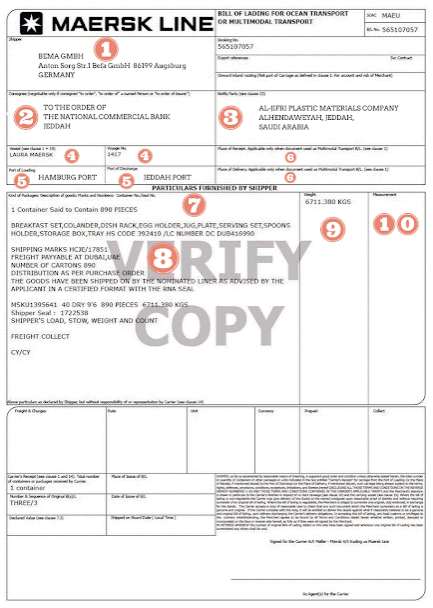
- 1 = Shipper
- 2 = Consignee
- 3 = Notify party
- 4 = Vessel No.
- 5 = Port of loading / discharge
- 6 = Place of receipt / delivery
- 7 = Container No.
- 8 = Goods description
- 9 = Net weight
- 10 = Dimensions / volume
The original invoice
It allows the Japan customs to see if it matches with the goods received.
Commercial Invoice
The commercial invoice is one of the most critical documents in any Japan-bound shipment. Japanese customs uses it to verify the nature, value, and origin of your goods.
A properly completed commercial invoice must include: the full name and address of the exporter and importer, a precise description of the goods (avoid vague terms like “merchandise” or “samples”), the HS code, the unit price and total value, the currency, the Incoterm agreed, and the country of origin.
Errors on the commercial invoice are one of the most common causes of customs holds in Japan. Even minor discrepancies between the invoice value and the actual transaction can trigger additional scrutiny. Make sure all values align perfectly with your packing list and bill of lading before shipment departs Vietnam.
The packing list
The packing list is listing every items included in your shipment.
Certificate of Origin
This document is very important if you’re wishing that your goods can be treated under the GSP. Customs will use it as a legal proof that your goods were made in Vietnam. This a higly important document for a shipping operation.
We have an exemple for you (for China here):
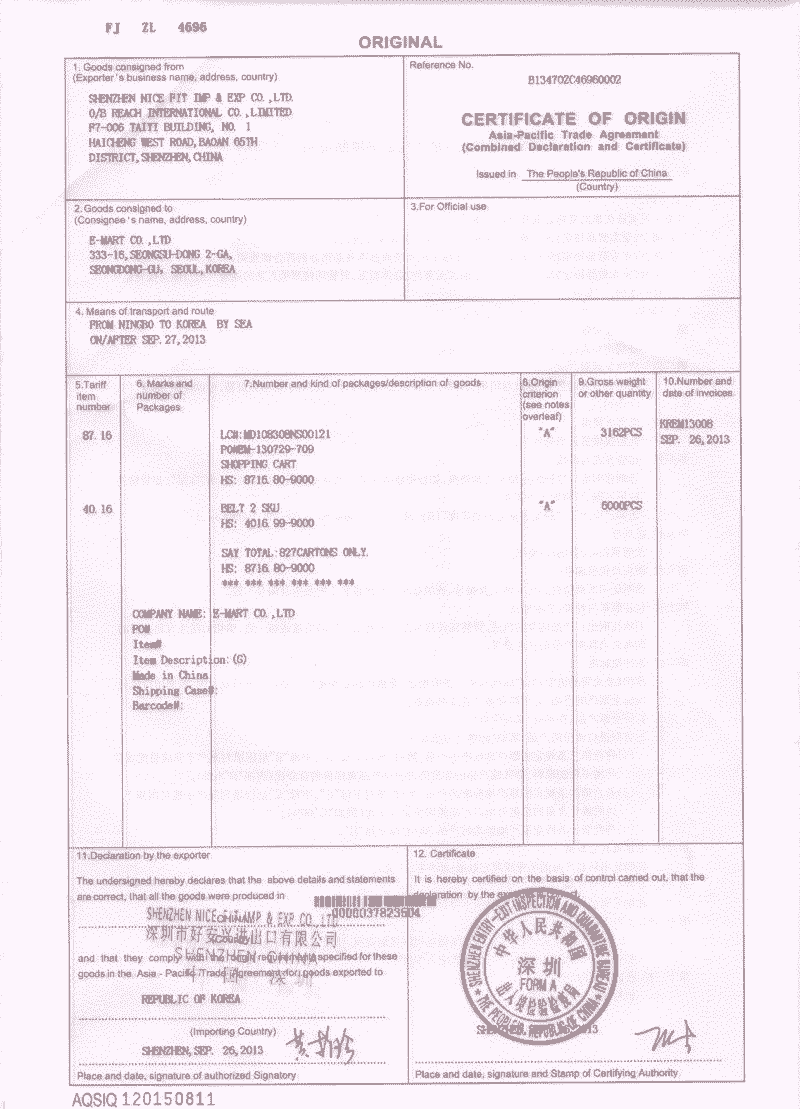
We can understand that it afraids you. If this is a case, just send us an email or call us !
Prohibited & restricted items
As in most countries, Japan has a list of products prohibited for import, including for reasons of public order.
The list includes :
- narcotics, stimulants;
- marijuana, etc;
- the import of firearms: pistols, revolvers, etc.; and the import of firearms.
- articles infringing intellectual property rights and films and images depicting child pornography.
Trade agreement
Japan and Vietnam concluded a broad Economic Partnership Agreement in 2008 that provides for a bilateral expansion of trade, with reductions in customs duties on nine-tenths of the products and services concerned. Japanese Foreign Minister Hirofumi Nakasone and Vietnamese Industry and Trade Minister Vu Huy Hoang initialled the document on Thursday. However, it has yet to receive the assent of the Japanese Parliament.
“This approval will enable our two countries to strengthen their economic ties, which will be mutually beneficial, by promoting the flow of goods, services and capital,” the two nations stressed in a joint communiqué. Various agricultural and marine products imported from Vietnam will no longer be subject to customs duties upon arrival in Japan. Conversely, Japanese industrialists will be able to export auto parts, electronic components and other intermediate goods to assembly plants in Vietnam without being taxed on arrival.
Trade relationship
Prime Minister Nguyên Xuân Phuc received on 12 January in Hôi An in the central province of Quang Nam the Secretary General of the Japan Liberal Democratic Party and Chairman of the Japan-Vietnam Alliance of Friendship Parliamentarians, Nikai Toshihiro, at the head of a Japanese delegation currently visiting Vietnam.
Nguyên Xuân Phuc said that the Vietnamese government and localities held in high esteem the economic and cultural exchange activities between the two countries, which exemplified the successful development of the deep strategic partnership between Vietnam and Japan. He stressed that Vietnam considers Japan as a reliable, long-term and first-class partner in their relations of the deep strategic partnership for peace and prosperity in Asia established since 2014. He highly appreciated the valuable contributions of Nikai Toshihiro, Secretary General of the Japan Liberal Democratic Party and Chairman of the Japan-Vietnam Alliance of Friendship Parliamentarians, to the development of bilateral relations.
Vietnam – Japan trade and economic relationship
The trade relationship between Vietnam and Japan is one of the most significant bilateral partnerships in Southeast Asia. Japan has been one of Vietnam’s top trading partners and largest investors for decades, with ties strengthened by the Vietnam–Japan Economic Partnership Agreement (VJEPA) signed in 2008.
By 2024, total bilateral trade between Vietnam and Japan reached approximately USD 42–45 billion, encompassing electronics, machinery, textiles, seafood, and agricultural products. Japan remains one of the largest sources of foreign direct investment in Vietnam, particularly in manufacturing, automotive, and electronics sectors — which directly drives logistics volumes on this corridor.
For importers, the VJEPA provides preferential tariff rates on a wide range of product categories. Ensuring your goods carry the correct Certificate of Origin (Form VJ) allows you to take full advantage of these reductions at Japanese customs.
Additional services
Our warehousing services
The first obvious advantage is the proximity of the ports: HCMC (Saigon), Haiphong and Quy Nhon. We will receive your goods and we have the capacity to store them as much as you want and then send them.
During storage, security will be supervised by our exceptional services (camera, guards).
Docshipper advice :
You need more information about this service ? Check our dedicated page on the following link : warehousing services
Storage service in Japan
Our relationship with Japanese network allows us to store your goods . Docshipper and collaborators ensure a safety and very good price for you.
Our packing/unpacking services
Overview
Docshipper has been handling all types of packaging for years. Indeed we will offer you the best alternative according to your goods and their characteristics but also according to your budget.
We know the crucial importance of a good packing, that’s why our experts will use their experience for a perfect packing.
Packing material
Carton box
We provide a good quality of cartons box, it will be thick and unfolded to ensure the best safety.
Palletization
The pallet is a handling platform intended to receive goods and to constitute a package (palletized load). The use of pallets in logistics activities is widespread in transport, warehouses and stores.
Due to the variability of palletizable goods, we supply many pallet variants that have been created to adapt this platform to the characteristics of the goods and transport.
Wooden boxes
If you are shipping many heavy and bulky products, wooden export crates are ideal. These are solid crates that can be assembled in the blink of an eye and are securely closed with a lid. There are wooden crates and wooden boxes. The crate will be preferable if you need to have it placed in a certain direction. If this is not the case, you might as well use the box.
Others: bubble wrap, tape, wrapping paper…
We aim to protect your goods by softening their contact with the wooden crate for example.
Why packing is important for the insurance ?
Our experience allows us to provide an impeccable packing service.
However, the insurance in case of unforeseen events, will do everything to make you pay. By choosing our professional packing you limit the risk of having to pay.
Freight insurance
How much does a freight insurance cost ?
Please kindly note this calculation : (freight value + product value) * 2-3%. – estimation
This rate is variable depending on the nature/category of your goods.
Supplier management in Vietnam
Control quality in Vietnam
Our experience translates into thousands of client files and we have observed some problems with the process. In particular, sometimes the supplier fails to meet these obligations.
That’s why, with the help of our multilingual teams, we will contact the supplier in advance to ensure that the packing and condition of your goods are OK. There is no way we will start the process if it is not.
You can count on us !
3PL Services in Vietnam
Order fulfillment/Packing & labelling in Vietnam
We will manage your orders (inventories, stock, delivery, customer relations) in order to facilitate your supply chain.
Last mile delivery
Thanks to our collaborator in every country we can guarantee you a delivery at your residence with a professional service.
Shipping personal effects from Vietnam
Excess baggage
What if you come back from your trip busier than expected? Your excess baggage won’t be allowed by airline. Let us take care of it !
We will book for you an express air freight in order to quickly receive your cargo at home in Japan (1 or 2 days !!)
Moving service from Vietnam to Japan
Do you want to go further on the Moving services ?
We will manage the whole process for you: pick up, packing, transport, customs, unpacking and unloading… Be free-stress !
Free regulation advisor
Our experienced staff know everyting about administrative (or other matters). Within 24h, get an efficient answer from our seller !
What are you waiting for? Please contact us and ask anything !
More than 10 years of expertise in Asia, enables us to deliver tailor-made freight solutions at hyper competitive prices. Do not hesitate to contact our dedicated staff for more information about your transfer, we’re always happy to serve and spread knowledge! Contact us
Additional logistics services
Discover DocShipper's holistic approach to supply chain management, covering not just shipping and customs, but a full suite of additional logistics services tailored to streamline your global operations effectively.
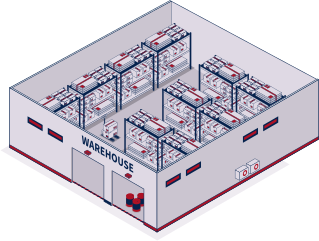
Warehousing and storage
Securing a reliable warehouse in a foreign land could be a mountain to climb. Your goods, especially temperature-sensitive ones, need perfect conditions to stay market-ready. Imagine the peace of mind that a well-managed, temperature-controlled storage would bring! Your quest for such reliable warehousing ends here. More info on our dedicated page: Warehousing.
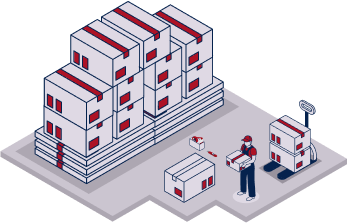
Packaging and repackaging
Protecting your products for the journey from China to Thailand requires expert packing and repackaging. Looking for items that defy the odds? Our network of trustworthy agents can handle everything from electronics to fragile ceramics. They ensure safe transport, perfect for businesses shipping diverse goods. Want to dive deeper? Find more at our dedicated page: Freight Packaging
Cargo insurance
Cargo insurance acts as your safety net during your shipping journey. Ever considered a scenario where your shipment gets damaged by incidents other than fire? This is where cargo insurance comes into play, covering physical losses or damages from external causes. Think of a heavy storm tossing your ocean freight; cargo insurance has your back! Our customized coverage mitigates such risks. Need more insights? Visit our dedicated page: Cargo Insurance.
Supplier Management (Sourcing)
Looking to manufacture in Asia or East Europe? The supplier management service from DocShipper seamlessly handles it all - right from finding reliable suppliers to overseeing the entire procurement process. Forget language limitations or complex sourcing steps - DocShipper guides you through it all. For instance, if you strive to create a new toy line in China, we connect you with the best manufacturers and handle all purchasing details. More info on our dedicated page: Sourcing services
Personal effects shipping
Moving special items from China to Thailand? Your precious or oversized belongings deserve safe and efficient shipping. That's where we come in, with expertise in handling fragile and bulky cargo with utmost care. Consider the time we secured a customer's antique Chinese vase; it arrived in Bangkok unscathed! Craving more insights? More info on our dedicated page: Shipping Personal Belongings.
Quality Control
Ensuring the excellence of your products is our priority. Our Quality Control service eliminates your worries over manufacturing errors in your China-to-Thailand shipping. Imagine unboxing your Thai order only to find unsuitable items - a nightmare avoided with our pre-shipment inspection. Don't gamble with your business reputation; let us protect it. More info on our dedicated page: Quality Inspection

Product compliance services
Ensuring your merchandise arrives safely is essential, but have you considered if it meets local compliance standards? Our Product Compliance Services handle this crucial aspect, conducting rigorous laboratory tests for certification and verifying that your goods abide by the destination's regulations. Suppose true peace of mind in international shipping means no surprises at customs. In that case, our specialized expertise might be invaluable to you. More info on our dedicated page: Product compliance services
FAQ - Shipping from Vietnam to Japan
Yes, and this route is more common than most people think. We regularly manage relocations from Ho Chi Minh City and Hanoi to Tokyo, Osaka, and Nagoya.
Shipping personal effects to Japan is not just about transport. Japanese customs can request a detailed packing list in English or Japanese, proof of residence status, and in some cases a visa copy. If documents are incomplete, clearance delays happen fast.
We handle:
- Professional packing in Vietnam
- Export customs clearance
- Sea freight or air freight depending on urgency
- Import customs coordination in Japan
- Final delivery to residence
If you are relocating, timing matters. Sea freight is more economical but takes a few weeks port to port. Air freight is faster but significantly more expensive. We help you choose based on your move-in date so you do not end up sleeping on the floor waiting for your container.
We manage the shipment end to end, not just the freight booking.
On this route, the real issues usually happen before departure or during customs clearance in Japan. Suppliers miss export documents. HS codes are incorrect. Importers underestimate Japanese compliance requirements.
Here is how we operate:
- Pre-shipment check of supplier documents
- Verification of HS code and Japanese import requirements
- Booking with the most reliable carrier, not just the cheapest
- Export customs clearance in Vietnam
- Arrival coordination and customs clearance in Japan
- Delivery to final warehouse or store
You deal with one team. We coordinate the rest. That is how you avoid last-minute surprises at Yokohama or Osaka.
The cheapest option depends entirely on your cargo size and urgency.
For regular commercial shipments, sea freight is usually the most cost-effective solution between Vietnam and Japan. The transit is short compared to Europe or the US, so ocean freight remains very competitive.
- Less than 1 CBM and urgent, express or air freight may make sense
- 1 to 8 CBM, LCL sea freight is often the best balance
- Full container volumes, FCL gives you the lowest unit cost
What most importers overlook is destination charges in Japan. Even if freight looks cheap, terminal handling and customs brokerage can impact your final landed cost. We always calculate total landed cost, not just freight, before recommending an option.
This decision directly impacts your control and your risk.
If your supplier in Vietnam is reliable and experienced in export procedures, FOB is usually the safest balance. They handle export clearance, and you control the international freight.
With EXW, you take full responsibility from the factory gate. This gives you maximum control but also means you must manage export formalities properly. Many first-time importers underestimate this.
CIF may look convenient, but you lose control over freight costs and carrier selection. In Japan, we often see higher-than-expected local charges under CIF shipments.
We can operate under any Incoterm, but if your goal is transparency and cost control on the Vietnam to Japan route, FOB is often the most practical option.
We do not estimate blindly. To give you an accurate quotation, we need operational details.
- Pickup address in Vietnam and delivery address in Japan
- Type of goods and HS code if available
- Total weight and dimensions or volume
- Number of cartons or pallets
- Preferred Incoterm
- Target delivery deadline
If the cargo is regulated in Japan, such as food, cosmetics, electronics, or chemicals, tell us upfront. Import procedures can differ significantly.
Once we receive complete information, we usually respond within 24 hours with a structured breakdown so you understand where every cost comes from.
Yes, and this is very common for buyers sourcing from different factories in Ho Chi Minh City, Binh Duong, or Hai Phong.
We collect goods from each supplier, store them in our warehouse, inspect packaging if needed, and consolidate everything into one LCL shipment or full container.
This reduces:
- Multiple export declarations
- Repeated destination charges in Japan
- Coordination stress with several suppliers
It also gives you better control over shipment timing. Instead of receiving goods in Japan in separate waves, you receive one structured delivery.
It is possible, but timing is critical.
If the cargo has not yet departed Vietnam, changes are usually simple. Once the container is on board and documents are issued, modifications may generate amendment fees and delays.
In Japan, delivery address changes after customs clearance can also impact trucking costs, especially for bonded or port-area deliveries.
The earlier you inform us, the more flexibility we have. Last-minute changes are manageable, but they are rarely free.
This is a short regional route, so transit times are relatively fast compared to Europe or North America.
- Sea freight: typically around 5 to 10 days port to port
- Air freight: usually 1 to 3 days airport to airport
- Door to door: add customs clearance and local delivery time
For example, Ho Chi Minh City to Yokohama is often under one week at sea, but total door-to-door timing depends on export clearance, vessel schedule, and Japanese customs processing.
If your cargo is time-sensitive, we recommend planning backwards from your required delivery date rather than relying only on carrier transit time.
Costs depend on volume, mode of transport, season, and final destination in Japan.
On this route, sea freight is generally affordable due to the short distance. However, total cost includes:
- Origin charges in Vietnam
- Ocean or air freight
- Destination terminal handling charges in Japan
- Customs clearance fees
- Import duties and consumption tax if applicable
- Final delivery
Many importers focus only on freight rates and forget Japanese port charges and customs brokerage. We always calculate the full landed cost so you know your real margin before confirming your order.
Your choice of port affects delivery time and domestic trucking cost.
The main container ports used for shipments from Vietnam are:
- Tokyo
- Yokohama
- Osaka
- Kobe
- Nagoya
For the Kanto region, Yokohama and Tokyo are common. For Kansai, Osaka and Kobe are preferred. Nagoya is strategic for central Japan and automotive-related cargo.
We choose the port based on your final delivery address, not just vessel availability. A slightly longer sea transit can sometimes reduce inland trucking cost significantly.
Sea freight from Hai Phong to Tokyo or Yokohama generally takes about one week port to port under normal schedules.
However, total timing depends on:
- Feeder or direct service availability
- Carrier schedule reliability
- Port congestion
- Customs clearance speed in Japan
If you are working with tight production deadlines, we check the exact vessel schedule before confirming booking. One missed weekly departure can add several days to your planning.
Importing into Japan is structured but strict. Preparation makes the difference.
The basic process includes:
- Confirm HS code classification
- Check if your product requires special permits or inspections
- Prepare commercial invoice and packing list correctly
- Arrange freight from Vietnam
- Submit import declaration to Japanese customs
- Pay applicable duties and consumption tax
- Release and delivery
Japan applies consumption tax on most imported goods, and some products such as food, cosmetics, and electronics may require additional compliance steps.
If this is your first import, we strongly recommend validating regulatory requirements before production starts. Fixing compliance issues after arrival in Japan is expensive and sometimes impossible.