

Freight Shipping between Vietnam and Tunisia | Rates – Transit times – Duties and Taxes

You quickly realize that freight Vietnam Tunisia is not just about booking space on a vessel, it is about aligning transit times, customs clearance, and the right Incoterm from day one, because one wrong assumption can add weeks to your schedule or unexpected costs to your budget. You might be comparing sea freight from Hai Phong to Rades, checking air options via Noi Bai Airport, or estimating duties and taxes before confirming your purchase order, and what you really need is clarity on how this corridor actually works in practice. In this destination guide, we will cover transport modes, route logic, documentation steps, customs risks, and the cost drivers you need to control your shipment from Vietnam to Tunisia.

Which are the different modes of transportation between Vietnam and Tunisia?

You choose between sea and air based on one simple logic, cost versus urgency. You use sea freight from Hai Phong or Cat Lai to Rades when you ship larger volumes and can plan around longer transit times, and you switch to air freight via Noi Bai Airport when your cargo is urgent, high value, or time sensitive.

You also need to factor in container availability, airline capacity, and the local cut-off at origin, because missing it can trigger costly rollovers or storage fees. If you are unsure which option fits your cargo profile, we can advise you using real-time data on rates, space availability, and market conditions, and we will break down each mode in more detail below.

How can FNM Vietnam help?

At FNM Vietnam, we smooth the way for your goods to travel from Vietnam to Tunisia. From handling customs clearance to administrative duties, we’ve got you covered. Want an easy, efficient shipping experience? Let us handle the details. Get your free estimate in less than 24 hours or call our consultants for free advice. Your international shipment is just a call away.

Sea freight between Vietnam and Tunisia

If you’re considering sea freight from Vietnam to Tunisia, the first thing we always tell you is simple. It makes sense when you ship heavy, bulky, or non-urgent cargo and when you care more about cost control than speed. On this international shipping route Southeast Asia to North Africa, ocean transport is usually the most economical option for machinery, textiles, furniture, industrial components, and consolidated shipments.

You should not choose ocean freight Vietnam Tunisia if your cargo is urgent, seasonal, or tied to a tight commercial launch. The average ocean shipping lead time can stretch beyond 30 days, and that’s port to port only. Add inland trucking, export formalities, and import customs clearance Tunisia, and you quickly add extra days. The mistake we see most often is assuming the port-to-port transit time equals total delivery time. It does not.

Another common issue comes from poorly chosen Incoterms. If you buy under EXW supplier terms Vietnam without understanding export procedures, you may face delays at export customs clearance Vietnam. On the Tunisian side, underestimating congestion at port of discharge in Tunisia such as Rades can expose you to demurrage charges. Sea freight works very well on this corridor, but only if you structure it correctly from day one.

Main ports to know in Vietnam and Tunisia

When you organize container shipping Vietnam to Tunisia, your choice of port of loading in Vietnam and discharge port in Tunisia directly affects transit time, inland costs, and service reliability. Here are the ports that actually matter operationally on this corridor.

Vietnam

  • Ho Chi Minh City, Cat Lai: Handles the majority of southern exports and offers the widest range of container vessel service to Tunisia via transshipment hubs. If your supplier is in the south, this is usually your most reliable option.
  • Hai Phong: Main gateway for northern factories around Hanoi. Good connectivity, but you should check feeder schedules carefully because many services require transshipment in Singapore or the Middle East.
  • Da Nang: Useful for central Vietnam, but fewer direct options. You often add days due to feeder connections.

Tunisia

  • Rades: Primary container hub and the most common port of discharge in Tunisia. Best choice for general cargo, but you should anticipate potential congestion during peak periods.
  • La Goulette: Handles mixed cargo and some container flows, sometimes used depending on shipping line routing.
  • Sfax: More focused on bulk and industrial cargo. Not always ideal for standard containerized imports.

Your port decision affects more than vessel arrival. It determines inland trucking distance, container handling charges, and how quickly you can start customs clearance fee at destination port procedures. Choosing the wrong port can quietly increase your landed cost.

Before confirming your booking, you should also verify how often your carrier serves the route and whether your shipment moves direct or via transshipment. On this corridor, most container shipping Vietnam to Tunisia moves through hubs such as Singapore or Mediterranean gateways. That means your cargo is reloaded, which adds handling and sometimes risk of delay. The key decision point is the transshipment dependency.

If you assume a weekly direct sailing but your cargo actually waits for a feeder, you may lose a full week. During high season, typically before major European demand peaks, you can also face rollover risk where containers are bumped to the next vessel. We always recommend confirming vessel routing and cut-off times before finalizing your purchase schedule.


Should I choose FCL or LCL when shipping between Vietnam and Tunisia?


Choosing between Full Container Load (FCL) and Less than Container Load (LCL, also known as consolidation) is a strategic decision when shipping goods from Vietnam to Tunisia. This choice can make a significant difference in cost, delivery timelines, and ultimately, successful freight forwarding. In the upcoming section, you’ll learn about these two sea freight options. We’ll clear the fog of confusion, outlining the advantages and trade-offs of each, so you can better align your shipping strategy with your business objectives. Let’s dive in and make sea freight an asset rather than an obstacle.


Full container load (FCL)

Definition: FCL, or Full Container Load, refers to a standard form of shipping freight that involves renting an entire container, whether a 20ft or 40ft.
When to Use: FCL shipping becomes a viable option when your cargo volume exceeds 13 to 15 cubic meters. Its uniformity and safety make FCL shipping appealing, as the container remains sealed from point of origin to destination, reducing the potential for damage.
Example: Suppose a Vietnamese furniture manufacturer has a 16 CBM shipment of dining tables and chairs for a Tunisian retailer. Given the volume, FCL shipping, utilizing either a 20’ft container or a 40'ft container, would be the most economical and secure means of transportation.
Cost Implications: Since FCL shipping entails renting the complete container, the cost per unit generally decreases the larger your shipment, making it cost-effective for mass shipments. It's worth requesting an FCL shipping quote early to budget accordingly. However, FCL container rental charges, loading costs, and the fees for the shipping line need to be factored into the total cost.

Less container load (LCL)

Definition:
LCL, or Less than Container Load, refers to a method of shipping that consolidates goods from multiple parties into a single container. This option is utilized when freight doesn't require a full container.
When to Use:
Transitioning to LCL shipping is sensible when your cargo volume falls short of filling up a complete container, often less than 13/14/15 CBM. This strategy brings heightened flexibility and cost-effectiveness for low volume shipments.
Example:
Imagine you're a Vietnamese furniture manufacturer shipping 10 CBM of chairs to a client in Tunisia. Instead of paying for an underutilized full container, you'd share a container with other shippers, thereby leveraging LCL freight, ensuring your shipment doesn't rack up unnecessary costs.
Cost Implications:
Going the LCL route often provides a more economical lcl shipping quote, particularly for smaller businesses, by only charging for the space your shipment occupies. However, note that while the overall cost might be cheaper, the price per unit space in the container could be higher compared to full container load (FCL) shipping. This means that LCL shipment could escalate in cost quicker as volume increases.

Hassle-free shipping

Conquer the complexities of shipping with FNM Vietnam - your trusted, professional freight forwarder. Our top-notch ocean freight experts aid in making the best choice between consolidation and full container options. They consider your specific needs, such as cargo type, shipment size, speed, and cost-efficiency. Give your business the hassle-free shipping experience it deserves. Kickstart your successful journey between Vietnam and Tunisia today. Connect with us now for your free estimation. Let us make shipping easier.

Transit times: how long does it take to ship from Vietnam to Tunisia?

The average sea transit time Vietnam to Tunisia usually ranges between 30 and 50 days port to port. The variation depends on your port pair, carrier routing, and whether your shipment moves under FCL shipping Vietnam to Tunisia or LCL shipping Vietnam to Tunisia.

Port of loadingPort of dischargeEstimated port-to-port transit time
Hai PhongLa Goulette30 to 40 days
Ho Chi Minh CityRades33 to 45 days
Cai LanSousse35 to 45 days
Da NangBizerte38 to 50 days

You should treat these numbers as planning ranges, not guarantees. If your cargo moves via transshipment, each connection adds risk. Port congestion in Rades or delays at Asian hubs can extend delivery. The real question is not only transit time, but your total ocean shipping lead time including export clearance, vessel cut-off, and Tunisian import procedures.

Shipping rates: how much does a sea freight shipment cost from Vietnam to Tunisia?

ModeIndicative price rangeNotes
LCL40 to 100 USD per CBMBased on volume, includes basic ocean freight only
FCL 20ftMarket dependentFull container load service, price fluctuates monthly
FCL 40ftMarket dependentLower cost per CBM compared to 20ft when optimized

Your sea freight rates Vietnam to Tunisia depend on container size, routing, season, and carrier space availability. Fuel costs such as bunker adjustment factor, temporary peak season surcharge, and port conditions all influence your final number. Most importantly, ocean freight alone is rarely your total expense. Your real focus should be the landed cost for sea freight shipment, including inland trucking, documentation, and Tunisian import charges.

Special sea freight solutions

Standard containers are not your only option. Depending on your cargo type, weight, and dimensions, you may need a tailored maritime setup on this corridor.

Out of Gauge and project cargo

If your machinery exceeds container dimensions, you will require out of gauge cargo by sea or flat rack solutions. This is common for industrial equipment and project cargo Vietnam to Tunisia. You must check port handling capacity in advance because special lifting equipment is not available everywhere.

Break bulk and Ro-Ro

For oversized or rolling equipment, break bulk or Roll-on/Roll-off vessels may be suitable. These options avoid container limitations but require precise loading coordination and documentation.

Reefer container shipping

If you move food or temperature-sensitive goods, reefer container shipping ensures controlled conditions from Vietnam to Tunisia. You must confirm power availability at transshipment hubs and verify temperature settings on the Bill of Lading (B/L) to avoid disputes.

Each solution changes your pricing structure, documentation such as sea waybill or telex release bill of lading, and insurance exposure. If you want clarity before committing, we can provide a detailed ocean freight quote Vietnam Tunisia and walk you step by step through the sea freight process step by step, from booking to final delivery.

Air freight between Vietnam and Tunisia

If you are considering air freight Vietnam to Tunisia, you are usually trying to solve one of three things: time pressure, high cargo value, or supply chain disruption. On this corridor, you rarely get a true direct flight cargo service, so your shipment often moves via Europe or the Middle East under a transshipment air cargo setup. It is fast, but it is also technical, with strict security screening air cargo and tight airline cut-off times.

You have probably heard that air freight always takes three days, is always too expensive, or that you are charged only on real weight. None of that is reliably true. Your final invoice depends on the chargeable weight calculation, not just kilos on a scale, and poor packaging requirements for air cargo can trigger a reweigh surcharge or even cargo refusal. The first thing we tell clients is simple: control your dimensions, confirm your Incoterm, and never assume airport-to-airport means door delivery.

Air Cargo vs Express Air Freight: How should I ship?

Cracking the code of freight forwarding between Vietnam and Tunisia, aren’t we? Let’s compare two key options: air cargo, which books our goods a comfy seat in a commercial airline just like a passengers flight, versus express air freight, which is more like chartering your own private jet for your goods. Choosing the right one comes down to your business needs and the urgency of your shipment. Let’s explore these options further.

Should I choose Air Cargo between Vietnam and Tunisia?

You should look at classic air cargo Vietnam Tunisia once your shipment exceeds about 1 CBM or 100/150 kg (220/330 lbs). At that point, a standard air cargo service with possible air freight consolidation service usually gives you better control over routing, costs, and documentation. This is especially true if you ship B2B, on a recurring basis, or handle high-value cargo by air or temperature-controlled air cargo.

Before requesting an air cargo quote Vietnam Tunisia, you need your exact dimensions, gross weight, HS code, Incoterm such as FOB or CIF, origin airport, ready date, and cargo type including any dangerous goods by air (DGR) or restricted items air freight. If you miss one of these, your booking can be blocked at export handling at origin airport. Many shippers also confuse airport-to-airport air cargo with door-to-door air freight Vietnam to Tunisia, which leads to unexpected destination charges and delays during customs clearance for air freight Tunisia.

Extracted Image

Should I choose Express Air Freight between Vietnam and Tunisia?

Express air freight Vietnam Tunisia makes sense when you ship small parcels, urgent samples, or an urgent shipment Vietnam to Tunisia and you do not want to manage multiple stakeholders. If your cargo is under 1 CBM or below 100/150 kg, the express courier vs air cargo difference becomes clear, you gain speed and simplicity, often with integrated customs and last-mile delivery after air freight.

The trade-off is control. With express, you accept the courier’s pricing logic, including strict volumetric weight formula air freight rules and automatic remeasurements. Many shippers underestimate the box size and face a dimensional weight adjustment after pickup. You also need to check what your Incoterm really covers, because assuming everything is included can lead to billing surprises at destination. Express is a good choice if speed and simplicity matter more than fine cost optimization, but it becomes risky if your margins are tight or your packaging is inconsistent.

Extracted Image

Main airports to know in Vietnam and Tunisia

When you plan air freight Vietnam to Tunisia, airport selection directly affects air shipping lead time, trucking cost, and available airline cargo capacity Vietnam to Tunisia. Here are the main international airports in Vietnam and main international airports in Tunisia that you should realistically consider:

  • Tan Son Nhat International Airport (SGN), Ho Chi Minh City, the primary southern hub with strong international connections and frequent wide-body capacity. If your supplier is in the south, using SGN reduces inland trucking and avoids missed flight cut-offs.
  • Noi Bai International Airport (HAN), Hanoi, the key northern gateway with solid cargo infrastructure. Ideal if your production is in the north and you want to limit domestic transfers before export handling at origin airport.
  • Da Nang International Airport (DAD), useful for central Vietnam, but with fewer long-haul options. You may rely more on transshipment air cargo here.
  • Tunis Carthage International Airport (TUN), the main cargo gateway for Tunisia, close to the capital and most customs brokers. This is where most customs clearance for air freight Tunisia takes place.
  • Monastir (MIR) and Djerba (DJE), secondary airports with more limited cargo capacity. You should confirm handling capability before routing valuable or time-sensitive goods.

The airport you choose impacts not only flight time but also import handling at destination airport, local trucking, and how fast you can move cargo after release.

From experience, most shipments between Vietnam and Tunisia ultimately clear through Tunis Carthage (TUN), even if they land elsewhere first. If you plan inland delivery to industrial zones around Tunis, Sfax, or Sousse, you should factor in last-mile delivery after air freight and local warehousing availability.

Before confirming your booking, you should verify handling capacity for your cargo type, especially for temperature-controlled air cargo or dangerous goods by air (DGR). Not every airport supports every commodity. Overlooking this can result in a cargo offload at transit hub, which directly extends your air transit time Vietnam to Tunisia.

Transit times: how long does air freight take from Vietnam to Tunisia?

Service typeEstimated transit timeNotes
Standard air cargoApproximately 5 to 10 daysUsually includes one transshipment in Europe or the Middle East
Express air freightApproximately 3 to 6 daysCourier network with integrated customs handling

Your real air transit time Vietnam to Tunisia depends on origin airport such as SGN or HAN, the chosen service, and how early your cargo is ready before airline cut-off. The biggest drivers are pre-flight security screening air cargo, possible transshipment delays, and seasonal capacity constraints. During peak seasons, limited airline cargo capacity Vietnam to Tunisia can extend your timeline. If your supplier delivers late to the airport, you can easily lose a full flight cycle, which is often the hidden reason behind a two-day delay in what looked like a simple booking.

Shipping rates: how much does air freight cost from Vietnam to Tunisia?

Service typeIndicative rangeCharging basis
Standard air cargoSubject to quotationBased on chargeable weight and route
Express air freightSubject to quotationBased on courier tariff and volumetric weight

Your air freight rates Vietnam to Tunisia are primarily driven by the chargeable weight calculation, not just gross kilos. The second driver is your dimensions and packaging density, which directly affect the volumetric weight formula air freight. Then come urgency, season, and available capacity, followed by origin airport choice and any pre-carriage or last-mile delivery after air freight. If you underestimate size or declare incomplete cargo details, you risk a post-departure surcharge. The safest move is to request a detailed air cargo quote Vietnam Tunisia with confirmed dimensions and Incoterm before production is finalized.

What is the difference between volumetric and gross weight?

When you ship by air, airlines compare two figures, gross weight vs volumetric weight, and charge you on the higher one. Gross weight is what your cargo actually weighs on a scale. Volumetric weight reflects how much space your cargo occupies in the aircraft. In air freight, space is often more limited than weight capacity, which is why the chargeable weight calculation follows strict IATA cargo regulations terminology.

  • Gross weight, the real weight including packaging.
  • Volumetric weight, the dimensional weight based on volume.
  • Chargeable weight, the higher of gross or volumetric weight.
  • Air Waybill (AWB), the transport document, whether house AWB and master AWB, where the chargeable weight is stated.

For standard air cargo, the usual formula is: Length x Width x Height (cm) / 6000. For express services, it is generally: Length x Width x Height (cm) / 5000. Example, if you ship 100 x 50 x 40 cm, you get 33.3 kg using 6000, and 40 kg using 5000. That difference directly changes your invoice.

The most common mistake is focusing only on scale weight and ignoring box size. If you use oversized cartons filled with light products, you will trigger a higher chargeable weight even if the goods feel light. Optimizing packaging early is one of the simplest ways to control your total air freight cost.


Door to door between Vietnam and Tunisia


Navigating the lofty waves of international shipment, Door to Door shipping is your trusted lighthouse between Vietnam and Tunisia. It’s a complete, hassle-free package of dispatching goods from one exact location to another, saving you time and effort. Considering your route, the convenience and cost-effectiveness simply shine. Fancy a closer look? Let’s dive in!


Overview – Door to Door


Relieving your logistics headaches, door-to-door shipping between Vietnam and Tunisia is our most popular client request at FNM Vietnam. This stress-free service swiftly handles complex customs, cuts out intermediaries, and ensures your cargo moves seamlessly from origin to final destination. However, convenience comes with a premium cost and potential delays due to all-inclusive nature of the service. Yet, despite these trade-offs, it’s the perfect antidote to shipping complexities.


Why should I use a Door to Door service between Vietnam and Tunisia?


Ever wished shipping could be as easy as ordering pizza? Well, with Door to Door service from Vietnam to Tunisia, it’s pretty darn close! Here are five compelling reasons why this might be just the slice you need.


1. Stress-free logistics: Say goodbye to complicated schedules and fretting over transport plans. Door to Door service takes charge of the whole flow for you.

2. Timely delivery: The punctuality of your shipment is our business. Urgent delivery needs? No sweat. We’re on it like white on rice!

3. Specialized care for complex cargo: Got something unusual to ship? We handle it with kid gloves, from the trickiest medical equipment to the largest machinery.

4. End-to-End convenience: The true luxury of this service? Not lifting a finger. We handle everything, from pickup in Vietnam to delivery in Tunisia. Sit back and sip that coffee!

5. Trucking to Final Destination: From customs clearance to navigating Tunisian roads, we’re behind the wheel so you can stay in your comfort zone.


So, if you’re seeking a simpler, more streamlined shipping solution, Door to Door service is a strong contender. After all, who doesn’t love pizza at their door?


FNM Vietnam – Door to Door specialist between Vietnam and Tunisia


Experience seamless, hassle-free ‘door-to-door’ shipping between Vietnam and Tunisia with FNM Vietnam. Rely on us for comprehensive shipping solutions as we expertly navigate through all stages of freight forwarding – packing, transportation, customs clearance across any ship method. Rest easy, knowing a dedicated Account Executive is at your service, ensuring smooth handling of your shipment. For a no-obligation, free estimate within 24 hours, reach out to us. Alternatively, you can connect with our friendly consultants at your convenience. Let us transform your shipping process into a worry-free experience.


Customs clearance in Tunisia for goods imported from Vietnam

When you handle customs clearance in Tunisia for goods from Vietnam, you are deciding your final landed cost, your release timing, and who acts as Importer of Record. On this route, a small mistake in your commercial invoice for customs or your HS code classification for imported goods can delay release and increase storage. We coordinate the import customs process Tunisia end to end, including working with a licensed customs broker in Tunisia when required.

You will notice fast that most delays come from tariff classification Vietnam to Tunisia errors, missing certificate of origin Vietnam, or incomplete documentation checklist for importing from Vietnam to Tunisia. Add port congestion and you risk demurrage and storage during customs hold. Below, you will see exactly how to calculate duties and how clearance really works in practice.

How to calculate duties & taxes when importing from Vietnam to Tunisia?

To calculate your duties, you need five inputs: the country of origin determination, the HS code, the customs value calculation method, the applicable import duties Tunisia, and any additional import taxes and fees. Your estimate often differs from the final customs assessment because customs may adjust your CIF value for customs purposes or challenge your classification.

The first thing we always tell you is this: never rely on a freight quote that ignores the real tax base. If your supplier gives you a low FOB value for customs without clear freight and insurance, you risk a customs value uplift at clearance. Let us break it down step by step so you can calculate your numbers properly.

Step 0 – Quick checks before you calculate

  • Importer of Record: Confirm who is legally responsible for customs compliance for importers in Tunisia, and whether you have the local tax registration, often referred to as the EORI equivalent registration Tunisia.
  • Incoterm: Check if you are buying under FOB, CIF, or DDP, because this decides who controls the import customs process Tunisia and who pays duties.
  • Low-value or special regime: Verify whether your shipment qualifies for a simplified path, temporary import procedure, inward processing regime, or storage in a customs bonded warehouse Tunisia.

Step 1 – Identify the Country of Origin

You must clearly document the country of origin determination, which is not the same as the shipping country. If your goods are manufactured in Vietnam, your certificate of origin Vietnam can influence the preferential tariff outcome and documentary requirements.

If origin is unclear or inconsistent with your commercial invoice for customs, customs can question eligibility or apply stricter controls, including origin dispute risk. Many importers confuse origin with export port, and that is where problems start.

Step 2 – Find the HS Code of your product

Your HS code classification for imported goods drives your duty rate, VAT base, and whether your product appears on a restricted and prohibited goods list. In Tunisia, the wrong code does not just change the rate, it can trigger an inspection under the customs inspection process.

You can start by asking your supplier, then cross-check using an official lookup tool such as the Harmonized Tariff Schedule. Match your product description, materials, and function to the correct heading and subheading, then confirm the tariff classification Vietnam to Tunisia with your broker.

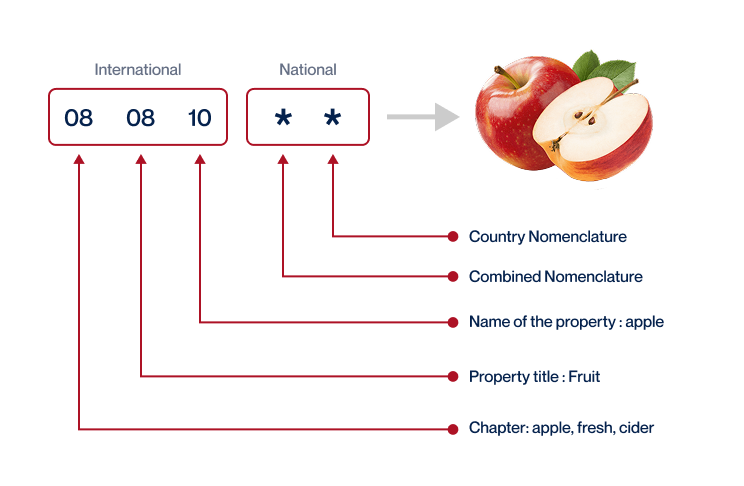
If you misclassify, you risk retroactive duty claims, fines, or being routed to the red channel instead of green channel customs clearance. Here’s an infographic showing you how to read an HS code.

Step 3 – Calculate the Customs Value

In Tunisia, duties are generally calculated on the CIF value for customs purposes, not just your invoice price. That means your goods value plus international freight and insurance, even if you bought under FOB. This is the core of the customs value calculation method.

For example, if your goods cost 10,000 USD, freight is 1,500 USD, and insurance is 200 USD, your customs value becomes 11,700 USD. If you forget to declare freight under a FOB value for customs, customs can re-add it and apply penalties for undervaluation.

You also need to include assists, special packaging, commissions, or royalties when applicable. If it increases the transaction value, it may increase your taxable base.

Step 4 – Figure out the applicable Import Tariff in Tunisia

An import tariff is the percentage applied to your customs value to determine your import duties Tunisia. Your rate depends mainly on your HS code and confirmed origin.

To find it, you should follow three steps within the tariff consultation process. First, open the official Tunisian customs database. Second, enter your full HS code. Third, read the duty rate and any additional notes attached to that code.

  • Duty rate: Ad valorem percentage or specific duty.
  • Preferential treatment: Whether origin documents are required.
  • Trade defense measures: Any anti-dumping or special duties.
  • License requirement: Possible import license requirements Tunisia.

If your customs value is 11,700 USD and your duty rate is 10%, your duty would be 1,170 USD. On this route, product categories like electronics or machinery often face documentary checks, so confirm before shipment. If you want, we can validate the rate with your local customs broker in Tunisia before departure.

Step 5 – Consider other Import Duties and Taxes in Tunisia

After customs duty, you calculate VAT on imports Tunisia, usually applied to the customs value plus duty. This is where many landed cost calculations go wrong when estimating how to calculate landed cost Vietnam to Tunisia.

If your customs value is 11,700 USD and duty is 1,170 USD, VAT applies to 12,870 USD. If the VAT rate is 19%, the VAT would be 2,445.3 USD. If you forget that VAT applies on duty included, you will underbudget and face unexpected cash flow pressure.

You must also check for additional import taxes and fees, such as excise or anti-dumping duties, depending on your product. Some goods may require prior authorization under the restricted and prohibited goods list.

  • Confirm VAT rate for your HS code.
  • Check special taxes linked to your product category.
  • Validate licensing before shipment departure.
  • Align documents including packing list for customs clearance.

Step 6 – Calculate the Customs Duties

Your formula is straightforward. Duty = Customs Value × Duty Rate. Then VAT = (Customs Value + Duty) × VAT Rate. This sequence defines your real import cost.

Using the earlier example, 11,700 USD × 10% gives 1,170 USD duty. Then VAT on 12,870 USD at 19% gives 2,445.3 USD. Add any other approved taxes to reach your total payable amount.

Once assessed, duties are paid by the Importer of Record before or at release, depending on your broker setup. Customs will issue a customs release note after validation of your customs declaration form Tunisia, often based on the single administrative document. If documents are inconsistent, you risk post-clearance audit customs or delayed release.

Step-by-step: how customs clearance usually works on this route

When you ship from Vietnam to Tunisia, the operational flow depends on the port or airport of entry, your Incoterm, and whether you move by sea or air. The sequence looks similar on paper, but the timing and control points vary in practice. Here is how we typically coordinate the import customs process Tunisia with your freight forwarder and local broker.

  1. You confirm shipment details, HS code, and documentation including commercial invoice for customs and packing list for customs clearance.
  2. We review origin documents such as the certificate of origin Vietnam and check any import license requirements Tunisia before departure.
  3. Your carrier submits cargo data, and where applicable we prepare pre-arrival customs filing to reduce port time.
  4. Upon arrival, the broker files the customs declaration form Tunisia through the official system using the single administrative document.
  5. Customs assigns a control channel, ideally green channel customs clearance, but sometimes customs red channel inspection if documents or values raise questions.
  6. If inspection is required, goods are physically checked, and this is the moment where classification or value errors can trigger delays and extra storage costs.
  7. Once duties and VAT on imports Tunisia are paid, customs issues the customs release note.
  8. You arrange final delivery from port or airport, and we monitor any risk of demurrage or terminal storage.

You should also understand the difference between freight forwarder vs customs broker roles. Your forwarder manages transport, while your broker ensures regulatory compliance. When both coordinate early, you reduce surprises and move from Vietnam to Tunisia with fewer disruptions.


Contact Details for Customs Authorities


Vietnam Customs

Vietnam customs

Official name: General Department of Vietnam Customs

Official website: https://www.customs.gov.vn/

Tunisia Customs

customs tunisia

Official name: Tunisian Customs Administration Official website: http://www.douane.gov.tn/

Required documents for customs clearance in Tunisia

When you ship from Vietnam to Tunisia, customs clearance usually slows down because documents do not match, not because your cargo is stuck at the port. The first thing we always tell you is simple, every document must show the same shipper, consignee, values, and product descriptions. Tunisian customs focus on consistency and traceability. If one figure or HS code differs, you risk customs hold for clarification instead of a quick release.

Bill of Lading or Air Waybill

The Bill of Lading for sea freight or Air Waybill for air freight is the transport contract issued by the carrier. Tunisian customs and your broker use it to confirm ownership, routing, and arrival details at ports like Rades or airports such as Tunis-Carthage. Transport document consistency is critical for cargo release.

Example: 1x 40HC container from Ho Chi Minh City to Rades, consignee listed exactly as on the commercial invoice.

Common mistake, using a different company name spelling than on the invoice, which can trigger release delays and amendment fees.

Commercial Invoice

The Commercial Invoice states the transaction value, currency, Incoterm such as FOB or CIF, and the correct HS code. Tunisian customs calculate duties and VAT based on this document, so valuation accuracy directly affects your landed cost.

Example: FOB Ho Chi Minh City, total value USD 48,000, HS code aligned with ceramic product category.

Common mistake, under-declaring value or using the wrong HS code, which can lead to reassessment of duties and financial penalties.

Certificate of Origin

The Certificate of Origin confirms that your goods were manufactured in Vietnam. Tunisian authorities may require it to determine the applicable customs duty rate and verify origin compliance.

Example: Textile products manufactured in Binh Duong, origin declared as Vietnam and stamped by the relevant chamber.

Common mistake, inconsistencies between the origin declared on the invoice and the certificate, causing verification requests and clearance delays.

Get Started with FNM Vietnam

Overwhelmed by the complexity of customs clearance between Vietnam and Tunisia? Let FNM Vietnam lighten your load. We’re experts at navigating these intricate procedures, ensuring everything runs smoothly while you focus on your core business. Reach out to us today for a free, no-obligation quote and experience stress-free international shipping. We promise a response in less than 24 hours!

Import Declaration and Customs Entry

The Import Declaration is filed electronically in Tunisia by your appointed customs broker. It consolidates all shipment data and formally requests clearance under the correct customs regime.

Example: Home appliances declared under the appropriate tariff line with duties and VAT calculated before release.

Common mistake, submitting incomplete data to your broker, which leads to corrections after submission and wasted time at port.

Product-Specific Licenses or Technical Certificates

Certain goods require prior authorization or conformity proof before customs release. This applies to categories like electronics, cosmetics, or food products entering the Tunisian market.

Example: Electrical appliances supported by compliance documents matching Tunisian technical standards.

Common mistake, shipping controlled goods without checking local approval requirements first, which can result in cargo blocked pending authorization.

Prohibited and restricted items when importing into Tunisia

Before you ship from Vietnam to Tunisia, you need to distinguish between restricted and prohibited goods. Restricted means your cargo is allowed but subject to licenses, quotas, or technical checks. Prohibited means the goods should not enter Tunisia at all, and you risk seizure or forced re-export. From experience, most issues come from assuming a product is “standard” when it actually falls under import control regime.

Restricted products

  • Food products, health certificates and sanitary approval required.
  • Cosmetics, ingredient compliance and local registration checks.
  • Electrical appliances, technical conformity to Tunisian standards.
  • Pharmaceuticals, prior authorization and strict documentation.
  • Used machinery, condition verification and possible inspection.
  • Agricultural inputs, phytosanitary controls and permits.

Prohibited products

  • Narcotics and psychotropic substances, strictly banned.
  • Counterfeit goods, seizure and legal action risk.
  • Weapons and ammunition, prohibited without special state authorization.
  • Hazardous waste, import not permitted.

If you are unsure whether your HS code falls into a controlled category, you should confirm with your broker before shipment. Shipping first and asking later can lead to confiscation or forced re-export, which is far more expensive than a pre-check.

Your Next Step with FNM Vietnam

Breaking into the Vietnam-Tunisia trade route? It can be overwhelming handling the unique customs processes, shipping methods, and regulatory requirements. Let FNM Vietnam smoothly sail you through these complexities. With our unrivaled expertise, we turn shipping hassles into effortless transactions. Ready for a hassle-free trade journey? Contact us. Your first successful shipment awaits.
More than shipping

Additional logistics services

1 Warehousing
1

Warehousing

Longing for reliable warehousing in Vietnam or Tunisia? Temperature-controlled storage for sensitive goods like chocolates or electronics? Your quest ends here, as we understand storage isn't just about space. It’s having peace of mind that your products are in safe and capable hands. Craving more savvy warehousing solutions? Discover more on our dedicated page: Warehousing.
img
2 Packing
2

Packing

When shipping goods between Vietnam and Tunisia, proper packaging is vital. Whether you're sending handicrafts or hi-tech hardware, getting your items repackaged by a reliable agent ensures they arrive safely and securely. Imagine you're shipping delicate ceramics, sturdy repackaging keeps your precious cargo intact, avoiding damage. At the same time, industrial equipment benefits from specialized packaging, preventing corrosion during ocean transit. More info on our dedicated page: Freight packaging

img
3 Transport Insurance
3

Transport Insurance

Cargo insurance, unlike fire insurance, defends your goods against the unpredictability of global shipping – mishandling, rough seas, or even theft. An example? If your goods catch a severe case of 'container rain' onboard, insurance will have you covered. Prevention is key, and it empowers you to mitigate these oceanic vagaries. Dive deeper into the ins and outs on our dedicated page: Cargo Insurance.
img
4 Household goods shipping
4

Household goods shipping

Moving your most prized possessions from Vietnam to Tunisia? With our Personal Effects Shipping, we handle delicate or oversized items with utmost professionalism, just as carefully as if you were moving a family heirloom. For example, that bulky grand piano or irreplaceable vase will be in safe hands. For further details, dive into Shipping Personal Belongings.
img
5 Procurement in Thailand
5

Procurement in Thailand

Looking to simplify your procurement process? We're here to help! At FNM Vietnam, we assist businesses in finding top-notch suppliers in Asia, East Europe, and beyond. We handle everything - from pinpointing reliable sources to masterfully maneuvering through language barriers and procurement procedures. Just think of us as your personal guide through the bewildering maze of global sourcing. Get all the details - visit our dedicated page: Sourcing services.

img
6 Quality Control
6

Quality Control

Ensuring your goods are up to the mark before shipping from Vietnam to Tunisia can save enormous costs and hassles. Imagine your batch of ceramic dinnerware has uneven glazes; it's better to spot those now than upon arrival in Tunisia, right? Our Quality Control service tightly inspects product standards at the manufacturing stage, catching any lapses early. It's like having your own guard dog, but for your products. More info on our dedicated page: Quality Inspection.

img
7 Conformité des produits aux normes
7

Conformité des produits aux normes


Shipping goods across borders? It's crucial that your product passes all regulatory checks to avoid hiccups. That's where our Product Compliance Services come into play. We handle laboratory tests to ensure your goods meet every standard waiting at your final port. Think of it like a ticket that grants your product smooth, trouble-free admission. It’s the difference between an impounded shipment and timely delivery.
img