

Freight Vietnam – Europe | Rates – Transit Times – Duties & Taxes
Sheipping Vietnam Europe is rarely just about booking a container, it is about aligning production in Ho Chi Minh City or Hanoi with port schedules in Rotterdam, Hamburg or Antwerp, and avoiding small documentation errors that create weeks of delay.
If you are planning freight from Vietnam to Europe, you need clear numbers on transit times, duties, and realistic routing options, not generic theory. This guide gives you the operational logic we use every day so you can structure your shipment the right way from the start.
FNM Advice:
If you are looking at this route, you should know that coordination is what makes or breaks it. We act as your single point of contact in Vietnam and Europe, handling packing, transport booking, customs clearance, and all administrative formalities, whether you choose air freight, sea freight, road or rail. You stay focused on your supplier and your client, we make sure the cargo actually moves as planned. Contact us and you will receive a free quote within 24 hours, with clear assumptions and no grey areas.
What is the best method to ship your goods from Vietnam to Europe ?
The short answer is simple, choose sea freight if your priority is cost efficiency and you can plan around longer transit via ports like Cat Lai or Hai Phong to Rotterdam or Hamburg, and choose air freight from Tan Son Nhat or Noi Bai if speed, high value cargo, or tight deadlines matter more than price.
If your goods are bulky, stable, and forecastable, ocean freight usually wins on budget, but if you are dealing with urgent replenishment, samples, or sensitive products, air keeps your supply chain flexible. We monitor real-time capacity, rates, and congestion on this corridor every week, so you can always ask us which option makes sense right now, and we will break down the details further in the sections below.
Docshipper Note:
Need assistance with your shipment? Dont hesitate to contact us even for a simple question. Choose the option that suits you
Live chat with an expert Chat us on WhatsApp Fill the form
Sea freight from Vietnam to Europe
Overview – Ocean cargo from Vietnam to Europe
Europe remains the world’s most active importing region for Vietnamese goods. The route connecting Vietnamese ports to Northern Europe — primarily via the Strait of Malacca, the Indian Ocean, and the Suez Canal — is one of the busiest container trade lanes globally.
As of 2026, this corridor faces a structural disruption: ongoing security concerns in the Red Sea have pushed many carriers to divert vessels around the Cape of Good Hope, adding approximately 10 to 14 days to standard transit times and increasing fuel surcharges on most Europe-bound services. This is a critical planning factor when budgeting delivery windows.
Within the European Union, Rotterdam and Antwerp remain the dominant gateways, together handling well over 25 million TEUs annually and serving as the entry points for the bulk of Vietnam’s containerised exports to the continent. Hamburg is the primary gateway for Central and Eastern European distribution, while Mediterranean hubs — including Valencia, Algeciras, Genoa, and Piraeus — have grown significantly in importance as distribution points for Southern Europe.
The EU–Vietnam Free Trade Agreement (EVFTA), fully in force since August 2020, has materially changed the cost of importing Vietnamese goods into Europe. Tariff elimination is progressive, with the majority of Vietnamese industrial goods already benefiting from significantly reduced or zero duty rates. Understanding EVFTA eligibility before booking your shipment can generate substantial cost savings.
Worldwide, trade by sea is predominant. But what about in Europe? Bathed by the Mediterranean Sea, the Atlantic Ocean and the North Sea, the Old Continent is not to be outdone.
1.77 billion euros on the waves :
The European Commission’s Directorate-General for Community Statistical Information, Eurostat recently revealed that trade by sea between the European Union (EU) and third countries amounted to €1.77 billion. This represents more than half of the EU’s trade in goods.
In addition, over the last 10 years there has been an increase in the use of sea transport for the transport of goods. Indeed, in 2006, 47% of European merchandise trade with third countries chose the sea.
Rotterdam and Antwerp in the lead :
Within the European Union, Rotterdam and Antwerp are the two most active port areas. In 2014, 421.6 and 180.4 million tonnes of goods were handled in Rotterdam and Antwerp respectively.
In France, the leading port is Marseille. However, “only” 74.4 million tonnes of goods were handled in Marseille. Le Havre follows with 61.4 million tonnes.
Shipping company offering services from Vietnam to Europe ports
Here are few examples :
Main shipping ports in Vietnam
Location and Volume: Situated in Northern Vietnam near Hanoi, Hai Phong is Vietnam’s principal northern gateway for international sea freight. With the commissioning of the Lach Huyen deep-water terminal, the port complex now handles well over 7 million TEUs annually and continues to grow rapidly as the preferred export hub for northern industrial zones.
Key Trading Partners and Strategic Importance: Hai Phong has direct and feeder connections to major European ports via transshipment hubs in Singapore, Port Klang, and Tanjung Pelepas. It serves the electronics, garments, footwear, and industrial goods manufacturing clusters of Bac Ninh, Hai Duong, and Vinh Phuc — home to Samsung, Canon, and many key European-facing supply chains.
Context for Businesses: If your Vietnamese suppliers are based in Hanoi or the northern industrial belt, Hai Phong is your natural origin port for Europe-bound cargo. Container services connect to Rotterdam, Antwerp, and Hamburg with weekly or near-weekly frequency, typically via one transshipment call.
Location and Volume: Located in central Vietnam along the eastern coastline, Da Nang handles approximately 2.5 million tons of cargo annually and functions as the main transshipment gateway for central Vietnamese provinces.
Key Trading Partners and Strategic Importance: Da Nang trades primarily with Asia-Pacific markets but increasingly routes Europe-bound cargo through regional hubs. The port is strategically important for Vietnam’s seafood, processed food, and agricultural exports, as well as for manufactured goods from the Da Nang and Quang Nam industrial zones.
Context for Businesses: If your production or sourcing is concentrated in central Vietnam and you want to avoid routing cargo north to Hai Phong or south to Ho Chi Minh City, Da Nang provides a viable departure point. For Europe-bound LCL or FCL cargo from central Vietnam, it reduces inland trucking distance significantly.
Location and Volume: Vietnam’s largest and busiest port complex, Ho Chi Minh City handles over 7 million TEUs annually across its two main terminals: Cat Lai, the dominant intra-Asia and LCL hub, and Cai Mep, the deep-water terminal purpose-built for direct calls by large ocean-going vessels including ultra-large container ships (ULCS) on Europe services.
Key Trading Partners and Strategic Importance: Ho Chi Minh City is the dominant departure point for Vietnam–Europe container traffic. Cai Mep in particular offers direct weekly services to Rotterdam, Antwerp, and Hamburg without transshipment — a significant transit time advantage compared to northern Vietnamese ports. It handles the bulk of Vietnam’s electronics, furniture, garments, footwear, and consumer goods exports to Europe.
Context for Businesses: For most importers based in Europe sourcing from southern Vietnamese suppliers — in Ho Chi Minh City, Binh Duong, Dong Nai, or Long An — Cai Mep is the optimal departure port. Direct Europe services reduce transit time by 4 to 7 days compared to feeder-based routing from Hai Phong, and offer better cargo security with fewer handling steps.
Main Europe ports
Port of Hamburg
Location and Volume: Germany’s largest commercial port and the third largest in Europe, Hamburg handles approximately 8 to 9 million TEUs annually. Situated at the end of the Elbe estuary, 144 km from the North Sea, it is the primary container gateway for Central and Eastern Europe.
Key Trading Partners and Strategic Importance: Hamburg is the dominant European entry point for goods destined for Germany, Poland, Czech Republic, Austria, and the broader Central European manufacturing corridor. It maintains strong trade flows with Asia, including Vietnam, and is the preferred port for high-value industrial goods, machinery, chemicals, and electronics.
Context for Businesses: If your final delivery is in Germany, Austria, Switzerland, or Central/Eastern Europe, Hamburg often provides the best combination of port-to-door transit time and competitive inland trucking costs. It is also a key hub for re-export to Scandinavian markets.
Port of Amsterdam
Location and Volume: The second largest port in the Netherlands and fourth largest in Europe (by total tonnage), Amsterdam handles approximately 80 to 90 million tonnes of cargo annually, with a particular focus on dry and liquid bulk, petroleum products, and agribulk. Container volumes are more limited than Rotterdam.
Key Trading Partners and Strategic Importance: Amsterdam’s primary trading relationships are with Germany, Belgium, the UK, and Baltic states. The port plays an important role in fuel, cocoa, and agri-commodity trade, and supports multimodal connections to inland European waterways via the Rhine network.
Context for Businesses: For standard Vietnamese container cargo destined for the Netherlands or Northwest Europe, Rotterdam remains the primary choice. Amsterdam is most relevant for bulk commodity shippers or businesses seeking a less congested alternative for specific cargo types.
Port of Valencia
Location and Volume: Spain’s busiest container port and the largest in the Mediterranean by volume, Valencia handles approximately 6 million TEUs annually.
Key Trading Partners and Strategic Importance: Valencia is the primary Mediterranean gateway for goods destined for Spain, Portugal, and Southern France. It connects to a dense network of feeder services covering the entire western Mediterranean basin and is one of the fastest-growing European ports for Asia traffic.
Context for Businesses: If your final delivery is in Spain, Portugal, or Southern France, routing your Vietnam shipment through Valencia can significantly reduce inland trucking costs compared to discharging in Rotterdam and trucking south. Transit times from Vietnam to Valencia are comparable to North European ports on many services.
Port of Piraeus
Location and Volume: The largest port in Greece and one of the largest in the Mediterranean, Piraeus handles approximately 5 million TEUs annually, largely driven by COSCO’s investment and development of the terminal since 2016.
Key Trading Partners and Strategic Importance: Piraeus has emerged as a major transshipment hub connecting Asia — including Vietnam — to the Eastern Mediterranean, the Balkans, Black Sea ports, and Central Europe via rail through the Balkan rail corridor.
Context for Businesses: If you are serving markets in Southeast Europe — Greece, Bulgaria, Romania, Serbia, or Turkey — Piraeus can offer a competitive total landed cost compared to routing through Northern European ports and trucking south. It is particularly relevant for importers distributing across multiple Balkan markets.
Should I ship by consolidation or full container from Vietnam to Europe ?
Choosing between Full Container Load (FCL) and Less than Container Load (LCL) on the Vietnam–Europe route is one of the first decisions that directly affects your cost per unit, risk exposure, and delivery timeline. Here is how to think through it practically.
Practical note for this route: Given the length of the Vietnam–Europe corridor and the typical cargo profiles (furniture, garments, electronics, consumer goods), FCL is the most common choice for volumes above 10 CBM, because the transit time difference between FCL and LCL becomes negligible over a 30+ day ocean voyage, while the handling risk difference is significant.
LCL: Less than Container Load
Grouping several shippers into one and same container is called LCL or “by consolidation”. This is a way to offer you a good price although your volume is not enough for a full container (FCL).
Definition: FCL means booking an entire container — typically a 20-foot (33 CBM) or 40-foot (67 CBM) unit — exclusively for your goods. The container is sealed at origin in Vietnam and opened only at final destination in Europe.
When to use: FCL becomes cost-effective once your shipment exceeds approximately 13 to 15 CBM. At that volume, the flat container rate per CBM drops below what LCL charges for the equivalent space.
Example: A Vietnamese furniture manufacturer ships 22 CBM of wooden furniture to a wholesaler in Hamburg. Booking a 20-foot FCL seals the goods at the factory in Binh Duong, loads onto a vessel at Cai Mep, and delivers directly to the Hamburg warehouse without any intermediate handling. Given both the volume and the fragile nature of the cargo, FCL is both cheaper per CBM and safer than LCL.
Cost implications: FCL is a flat rate per container regardless of fill. This means the more you pack, the lower your unit cost. On a route this long — 30 to 42 days — FCL also minimises the risk of cargo damage from repeated handling at consolidation and deconsolidation stations.
FCL: Full Container Load
FCL is an ISO international standard that relates to a (full) container load (20″ feet or 40″) containing a shipment for a consignee (which is an importer). FCL sea freight is the cheapest mode of transport for imports from Vietnam.
FCL is in fact very cost-effective if it involves a very large quantity of goods (often above 15 CBM).
Definition: LCL, also known as consolidation, groups your cargo with other shippers’ goods inside a shared container. You pay only for the cubic metres your shipment occupies.
When to use: LCL is the right choice when your shipment falls below 13 to 15 CBM and does not justify the cost of a full container.
Example: A Vietnamese cosmetics brand ships 5 CBM of skincare products to a distributor in Amsterdam. LCL consolidation allows them to ship this small volume regularly without waiting to accumulate full container quantities, maintaining consistent supply to their European partner.
Cost implications: LCL has lower upfront cost, but the cost per CBM is higher than FCL. You also need to factor in consolidation handling at the origin freight station (CFS) in Vietnam and deconsolidation at the European destination CFS — typically adding 3 to 5 days to overall transit time versus direct FCL. On a 35+ day voyage, this difference matters less than on shorter routes.
Advantages of shipping by LCL
Operating by LCL allows you to end up with a rather moderate cost. In addition, it will make it less expensive to package and inspect shipments.
However, to benefit from these advantages, the volume of your goods must be too high for air freight but less than 13, 14 or 15 CBM (FCL volume).
Disadvantages of shipping by LCL
Packing, loading and unloading will soon become too expensive for volumes corresponding to one FCL (above 13 CBMs).
In our experience, FCL often proves to be a more viable option from Vietnam (from Asia in general).
Advantages of FCL sea freight
Price less than one cubic metre in relation to an equivalent volume or weight of goods shipped by LCL by air or sea.
More convenient for optimizing quantity and packaging for export to maximize the use of space in a container from 20″ or 40″.
Higher level of security and less risk of damage due to less handling (loading, temporary storage, unloading) of your cargo.
Disadvantages of FCL shipping
Do not consider this option unless your volume is large enough.
But what does “large enough” mean ?
Starting at 13,14,15 to 20 CBM (it equals to 40 to 70% of a 20″ container).
How long does it take to ship from Vietnam to Europe by sea freight ?
| Rotterdam | Antwerp | Hamburg | Amsterdam | Fremantle | Algeciras | |
| Da Nang | 30 days | 29 days | 30 days | 30 days | 35 days | 35 days |
| Saigon | 28 days | 27 days | 30 days | 30 days | 33 days | 35 days |
| Ba Ngoi | 30 days | 32 days | 34 days | 34 days | 35 days | 35 days |
| Cam Pha Port | 34 days | 34 days | 33 days | 34 days | 35 days | 35 days |
Please take into consideration that the transit time only considers the freight (The pick up / delivery and any other optional operation will increase the transit time).
How much does it cost to ship a container between Vietnam and Europe?
Ocean freight rates on the Vietnam–Europe corridor are among the most dynamic in global shipping. They shift with fuel costs, seasonal demand surges, and structural factors such as Red Sea diversions that increase voyage distances and carrier operating costs.
As of 2026, indicative market rates for a 40-foot container from Vietnam to North European ports generally range from approximately USD 2,500 to USD 4,000 for the ocean freight portion under current conditions. Mediterranean port services can fluctuate at different levels. These numbers can move significantly during peak season (July–October) and in response to geopolitical events affecting key shipping corridors.
The ocean freight rate is only one component of your total cost. For a complete picture of what it actually costs to land your goods in Europe, you need to factor in: origin handling charges and export formalities in Vietnam, the main freight rate, destination terminal handling charges (THC) at the European port, customs clearance, any applicable import duties (including EVFTA-preferential rates), VAT, and inland trucking to your warehouse.
Our team provides detailed landed cost breakdowns, not just headline freight rates. Contact us with your cargo details and we will return a comprehensive quote within 24 hours.
Anyway if you want to send more than 1 CBM or 100 kg, air freight will not be profitable. Going by rail is far too complicated.
So the general solution applies here (Vietnam to Europe) : Sea freight is more profitable than the rest.
FNM Advice :
We are experts in freight forwarding. Do you need to ship your goods from Vietnam to another country by sea? We are here and are able to take care of everything for you to help you save time and money! Contact us for more information about sea freight and a free quote!
Special sea freight services
Reefer container from Vietnam to Europe
A refrigerated container or reefer container,”thermally insulated” is a container capable of maintaining a certain temperature regardless of external conditions. Its control is ensured by transmitting its parameters to the gateway. The principle of the reefer container is based on a cold production system supplied with power from the ship’s reefer sockets. It is mainly used for food or chemical products.
Docshipper can advise you about the type of container you may need. If necessary, we will reserve it for you.
Roro/Bulk/OOG from Vietnam to Europe
RORO:
ROROs are vessels equipped with a mobile access ramp allowing loading/unloading of cargo by towing between the shore and the dock. They are fast and offer reduced loading/unloading times. Trucks with trailers, semi-trailers, containers (dry / reefer), exceptional loads are therefore easily unloaded.
The use of RORO vessels allows a safer, simpler and faster transport to preserve an optimal quality of goods.
Dry Bulk
Definition: Dry bulk shipping transports loose, unpackaged homogeneous commodities directly into the vessel’s hold without containerisation or intermediate packaging.
Suitable for: High-volume commodity shipments where individual packaging is not feasible.
Examples: Rice, coffee, animal feed, cassava chips, fertiliser, coal, mineral ores, grains.
Why it might be the best choice for you: Vietnam is one of the world’s largest exporters of rice, coffee, and agricultural commodities, all of which move primarily by dry bulk. If you are an agricultural commodity importer in Europe, dry bulk is not a choice — it is the industry standard. We work with bulk operators serving major European grain and commodity terminal ports including Rotterdam’s bulk terminals and Hamburg’s agricultural import facilities.
Break Bulk
Definition: Break bulk refers to cargo loaded individually onto the vessel — on pallets, in crates, or as loose pieces — rather than inside a container.
Suitable for: Cargo that is too large, too heavy, or too irregularly shaped for any container type, and goods shipped in volumes that make containerisation impractical.
Examples: Bagged fertiliser, steel coils, timber bundles, large cable reels, structural steel sections, stone slabs.
Why it might be the best choice for you: If you are shipping raw materials or commodities from Vietnam to Europe in quantities that make container booking inefficient — either too large for containers or needing vessel-hold loading — break bulk gives you the operational flexibility your cargo type requires. We coordinate with break bulk operators and specialised stevedores on both ends to ensure proper handling.
Out of Gauge (OOG) Container
Definition: OOG containers are designed for cargo that exceeds the internal dimensions of a standard container in height, width, or length. They are shipped on flat rack or open-top containers, with special stowage and lashing arrangements.
Suitable for: Industrial machinery, power generation equipment, construction vehicles, wind turbine components, large manufacturing plant sections.
Examples: Excavators, turbines, industrial presses, large printing machinery, oversized structural steel components.
Why it might be the best choice for you: If your goods cannot fit within a standard container’s 2.35m width or 2.39m internal height, OOG is not optional — it is the correct and legally required mode. This is common for European importers of Vietnamese-manufactured industrial or processing equipment. We handle the pre-shipment dimension survey, carrier notification, and special stowage planning to ensure your cargo arrives safely and on schedule.
Air freight from Vietnam to Europe
Air freight between Vietnam and Europe is a strategic tool, not a default. The cost premium over sea freight is significant — typically five to eight times higher per kilogram — but for the right cargo profile, it pays for itself through avoided stockouts, tighter product launch windows, and protection of high product margins.
The core decision logic is straightforward: if your cargo is high-value, time-critical, or needs to reach Europe within a week rather than a month, air freight is justified. If volume and budget are your primary constraints and you can plan 5 to 7 weeks ahead, sea freight almost always wins on total cost.
What many importers underestimate is the operational advantage of air freight for partial replenishment. Many experienced importers on the Vietnam–Europe lane run a hybrid model: sea freight for their main bulk orders, and air freight for emergency restocking, promotional stock, or new product launches where missing a sales window costs more than the freight premium.
Both Tan Son Nhat in Ho Chi Minh City and Noi Bai in Hanoi maintain direct or one-stop air cargo services to major European hubs including Amsterdam Schiphol, Frankfurt, Paris CDG, and London Heathrow.
Overview – Classic vs Express air freight
Should I choose Classic Air Cargo from Vietnam to Europe?
Classic air cargo on scheduled airline belly-hold or freighter services is the right choice when your shipment weighs between 100 and 150 kg or more. Below this threshold, express courier services are usually faster, simpler, and often comparable in total cost once standard air cargo handling fees are added.
Airlines operating cargo services between Vietnam and Europe include Vietnam Airlines (with connections via intermediate hubs), Lufthansa Cargo (via Frankfurt), Air France Cargo (via Paris CDG), Korean Air Cargo (via Seoul), and several freight-only operators. Choice of airline affects both transit time and rate, and we select based on current capacity and your specific departure/arrival airport pair.
Should I choose Express Air Freight from Vietnam to Europe?
Express air freight — operated by integrators such as DHL Express, FedEx, and UPS — is the optimal choice when your shipment weighs under 90 to 100 kg or occupies less than 1 CBM, and when door-to-door speed is the primary requirement.
Express services provide a fully managed door-to-door solution with online tracking, guaranteed transit time, and streamlined customs clearance at European entry. For urgent samples, replacement parts, prototype batches, or high-value parcels, express is both faster and operationally simpler than coordinating classic air freight independently.
Note: express carriers apply a volumetric weight divisor of 1 CBM = 200 kg, which is different from the classic air cargo standard. Always verify chargeable weight before accepting an express quote on light but bulky cargo.
What is the difference between volumetric and gross weight?
* To take into account the density of your shipment, two methods are used to determine the invoiced weight of your goods.
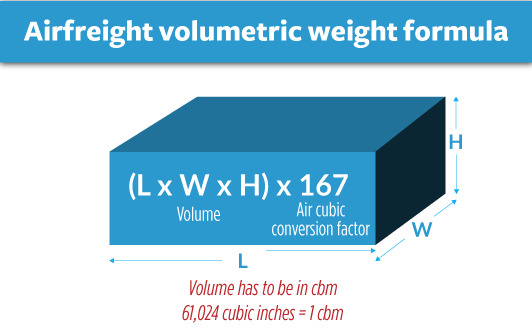
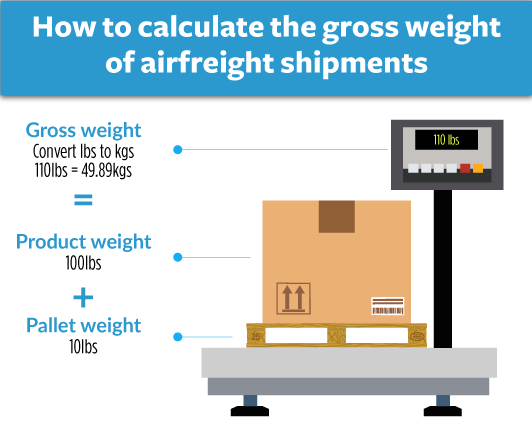
The calculations presented here will allow you to better understand the difference between gross weight and volumetric weight. It is the greater of the two that we will use to give you an interesting quotation:
Gross weight is the actual physical weight of your shipment in kilograms, including the goods and all packaging.
Volumetric weight reflects the space your shipment takes up in the aircraft. For standard air cargo, it is calculated as: length (cm) × width (cm) × height (cm) ÷ 6,000. For express courier services, the divisor changes to 5,000.
Here is a practical example: you are shipping a carton measuring 40 cm × 40 cm × 50 cm with a gross weight of 25 kg.
- Volumetric weight (air cargo): (40 × 40 × 50) ÷ 6,000 = 13.33 kg
- Volumetric weight (express): (40 × 40 × 50) ÷ 5,000 = 16 kg
In this case, the gross weight of 25 kg is higher than both volumetric weights, so you are charged on 25 kg. The airline always charges on whichever is greater — gross or volumetric weight.
Now change the scenario: the same carton weighs only 5 kg. The volumetric weight (13.33 kg) now exceeds the gross weight, so you are billed for 13.33 kg despite the cargo physically weighing only 5 kg. This is why understanding volumetric weight before you pack is essential — it directly affects the rate you are quoted and the actual invoice you receive.
Should I choose a Classic Air freight from Vietnam to Europe ?
Which airlines company should you ship with ?
Vietnam Airlines This national airline allows flights both inside and outside Vietnam. The airports of Saigon (Tan Sơn Nhất) and Hanoi (Bài) are obviously strategic places of the country and consequently for the airline company. This is why it operates there a lot.
Air France is the French national airline, founded on October 7, 1933. Its main activities are the transport of passengers and freight as well as the maintenance and servicing of aircraft. It serves the main French airports as well as many foreign airports. Its main hub is located at Paris-Charles de Gaulle airport, with which it has a number of operating agreements. Paris-Orly airport is the company’s second hub, which it uses mainly for flights to the overseas territories and for regional flights.
Lufthansa is the private German airline as well as the leading European airline in terms of number of passengers carried ahead of Ryanair and Air France-KLM. It is the co-founder and European pillar of the Star Alliance. Lufthansa owns Lufthansa Cargo and since 2005 Swiss International Air Lines. Its subsidiary Lufthansa Regional controls Lufthansa CityLine and Air Dolomiti.
Transit time Door to Door from Vietnam to Europe by air freight ?
For a door to door operation, you should count at about 5 to 8 days.
How much does it cost to ship a parcel from Vietnam to Europe ?
Once again, we operate with the goal of offering you individualized services. Therefore, we need the many characteristics related to this operation (dimensions, weight, addresses and desired services). We will get back to you within 24 hours in order to make progress on your file.
Should I choose an Express Air freight from Vietnam to Europe ?
Express service – Perfect solution for small package
Your shipping weigh less than 90 kg ( 200 pounds) ? In this case, opt for an express service. Otherwise it won’t be a cost-effective service (especially if you don’t have a large budget).
How long does it take for a package to be shipped from Vietnam to Europe ?
We have been working with these companies for years. This allows us to offer you the best services through these brands. Please note that for accelerated air freight, customs clearance is also very fast. Therefore, between 3 and 5 days will be sufficient.
How much does an Express service cost from Vietnam to Europe ?
*To quote your express shipment, a different method than gross and volumetric weight is applied. For express freight, you must consider that 1 CBM = 200 kgs.
Please, by contacting us, you will be able to give us more specific details about this operation. Then, we will discuss about it in order to give you the best rate.
FNM Note:
As a freight forwarder, we are also providing air freight services to handle your shipment when you are in a rush and need the operation to be completed quickly. Don’t hesitate to contact us for more information about air freight and a free quote!
Main airports in Vietnam
Tan Son Nhat International Airport (SGN) — Ho Chi Minh City
Cargo Volume: Vietnam’s largest cargo airport, handling over 600,000 metric tons annually. The dominant air cargo hub for southern Vietnam and the most important departure point for air freight on the Vietnam–Europe corridor.
Key Trading Partners: Europe, the United States, Japan, South Korea, China, and ASEAN. Multiple weekly freighter and belly-hold services connect directly or via one hub to Amsterdam, Frankfurt, Paris, and London.
Strategic Importance: Located in Vietnam’s commercial capital, Tan Son Nhat serves the manufacturing zones of Binh Duong, Dong Nai, Long An, and Ho Chi Minh City itself. It is the natural departure airport for air freight sourced from southern Vietnam.
Notable Features: A 115,000 sqm cargo terminal with dedicated handling for express parcels, perishables, pharmaceuticals, and general air cargo. Major express integrators — DHL, FedEx, UPS — all operate hub facilities here.
For Your Business: If your suppliers are in southern Vietnam and you need goods to reach Europe in under a week, Tan Son Nhat is your primary departure point. Frequencies are high, competition among carriers keeps rates competitive, and the airport’s scale ensures capacity availability on most trade lanes.
Noi Bai International Airport (HAN) — Hanoi
Cargo Volume: Approximately 400,000 metric tons of cargo annually, serving as Vietnam’s primary northern air cargo gateway.
Key Trading Partners: Europe, China, South Korea, Japan, and the United States. Several airlines offer freighter or belly-hold cargo capacity from Hanoi to European hubs, often with one connection.
Strategic Importance: Noi Bai serves northern Vietnam’s industrial zones including Bac Ninh, Bac Giang, Hai Duong, and Vinh Phuc — home to Samsung’s flagship smartphone and electronics manufacturing facilities and many European-owned industrial supply chains.
Notable Features: A 35,000 sqm cargo terminal equipped for electronics, garments, and high-value manufactured goods. Significant capacity expansion has accompanied rapid growth in FDI-driven manufacturing in northern Vietnam.
For Your Business: If you are sourcing electronics, precision components, or manufactured goods from northern Vietnamese factories, Noi Bai provides competitive air freight access to Europe. Avoid the cost and time of trucking goods south to Ho Chi Minh City when Hanoi services can reach the same European hubs in comparable transit times.
Da Nang International Airport (DAD)
Cargo Volume: Up to 200,000 metric tons annually.
Key Trading Partners: ASEAN countries, Japan, China, and increasingly European markets via hub connections.
Strategic Importance: Serves central Vietnam’s growing industrial zones. For time-sensitive cargo originating in Quang Nam, Quang Ngai, or central Vietnamese production facilities, Da Nang provides a viable air freight departure point without routing goods north or south first.
For Your Business: A secondary but increasingly relevant option for businesses with central Vietnam sourcing. Useful for samples, urgent shipments, or top-up orders from the central region when routing through Ho Chi Minh City or Hanoi would add unnecessary handling time.
Cam Ranh International Airport (CXR)
Cargo Volume: Emerging cargo hub with growing facilities.
Key Trading Partners: ASEAN countries, China, and European connections via hubs.
Strategic Importance: Located at the southeastern tip of Vietnam, Cam Ranh provides access to the Khanh Hoa and Ninh Thuan provinces and is a secondary option for airfreight from south-central Vietnam.
For Your Business: Most relevant for businesses with specific south-central Vietnam sourcing who need air freight access without routing through Ho Chi Minh City. Capacity is more limited than the main hubs, so booking lead time matters.
Cat Bi International Airport (HPH) — Hai Phong
Cargo Volume: Growing alongside Hai Phong’s development as a major export hub.
Key Trading Partners: China, South Korea, Japan, and regional Asian connections.
Strategic Importance: Located in Hai Phong, Vietnam’s key northern seaport city, Cat Bi serves as an air freight complement to sea freight operations in the north. For urgent or high-value goods from the Hai Phong industrial cluster that cannot wait for the next vessel sailing, Cat Bi provides a local departure option.
For Your Business: Most useful in combination with sea freight operations from Hai Phong. For time-sensitive component replenishments from northern Vietnamese electronics factories, Cat Bi reduces trucking time to the airport versus routing through Noi Bai.
Major airports to ship in Europe
London Heathrow Airport
Cargo Volume: Europe’s largest cargo airport by international freight volume, handling approximately 1.5 million metric tons annually.
Key Trading Partners: USA, China, Middle East, India, and Southeast Asia including Vietnam. Multiple carrier services connect Vietnamese airports to Heathrow via hub connections.
Strategic Importance: For UK-destined cargo, Heathrow is the dominant air freight gateway. Note that since Brexit, goods entering the UK from Vietnam require a separate UK customs declaration under UK Global Tariff rules, not EU customs procedures.
For Your Business: If your final delivery is in the United Kingdom, Heathrow is your primary airport. Ensure your UK EORI number is valid and that your goods are classified under the UK Global Tariff schedule — rates may differ from EU TARIC rates for Vietnamese-origin goods.
Paris Charles de Gaulle Airport
Cargo Volume: Europe’s second busiest cargo airport, handling over 2 million metric tons annually.
Key Trading Partners: USA, Asia (including Vietnam), Africa, and intra-European connections.
Strategic Importance: CDG is the primary gateway for France and serves as a transshipment hub for francophone African markets. Air France Cargo and multiple freight carriers operate regular Vietnam-Paris services with one connection.
For Your Business: If your delivery is in France, Belgium, or Switzerland, CDG offers competitive cargo handling and reliable connections. For businesses using Paris as a distribution point for French-speaking markets in Europe or Africa, CDG provides efficient multimodal onward connections.
Amsterdam Schiphol Airport
Cargo Volume: Europe’s third largest cargo airport, handling approximately 1.7 million metric tons annually.
Key Trading Partners: China, USA, Russia, and key Asian markets including Vietnam. KLM Cargo operates dedicated Vietnam services with good frequency.
Strategic Importance: Schiphol is the main European cargo hub for KLM/Air France group and provides connections to virtually every European destination. It handles a disproportionate share of perishable goods, pharmaceuticals, and cut flowers due to specialised facilities.
For Your Business: For Netherlands-destined cargo or goods transiting to Benelux, Germany, or Scandinavia, Schiphol offers excellent connectivity and competitive handling rates. Its specialised perishable and pharmaceutical facilities make it the top choice for temperature-controlled shipments from Vietnam.
Frankfurt Airport
Cargo Volume: Europe’s second largest cargo airport overall and the continent’s main freighter hub, handling approximately 2.3 million metric tons annually.
Key Trading Partners: USA, Asia, Middle East, and all major global routes. Lufthansa Cargo, which has its main hub here, operates significant Vietnam cargo capacity.
Strategic Importance: Frankfurt is Germany’s dominant air freight gateway and serves as the main transshipment hub for Central Europe. Its location at the heart of the European road network makes it optimal for onward distribution to Germany, Austria, Switzerland, Czech Republic, and Poland.
For Your Business: If your final delivery is in Germany, Austria, Switzerland, or Central Europe, Frankfurt minimises inland trucking time and cost. Lufthansa Cargo’s strong presence on Asia routes, including Vietnam, ensures competitive rates and reliable frequency on this lane.
How long does air freight take between Vietnam and Europe?
Classic air freight from Vietnam to Europe typically takes 6 to 8 days airport to airport for standard services via one hub connection. Direct or semi-direct services on high-frequency lanes (e.g. Ho Chi Minh City to Amsterdam or Frankfurt) can reach 5 to 7 days.
Door-to-door transit time — including export handling in Vietnam, air transit, EU customs clearance, and inland delivery — typically runs 7 to 12 business days depending on destination country, port of entry, and delivery location.
Express courier services (DHL, FedEx, UPS) typically deliver within 3 to 5 business days door to door under normal conditions.
How much does it cost to ship a parcel between Vietnam and Europe with air freight?
Air freight rates from Vietnam to Europe broadly range from $3 to $15 per chargeable kilogram, depending on the specific trade lane, airline, cargo type, and market conditions. Express courier rates follow a different pricing structure and are quoted per shipment based on dimensions and weight.
The lower end of this range applies to high-volume cargo on competitive lanes such as Ho Chi Minh City to Amsterdam or Frankfurt. The upper range applies to lower-volume shipments, niche trade lanes, or cargo with special handling requirements such as temperature-sensitive pharmaceuticals or dangerous goods.
As with sea freight, the headline rate is only part of the total cost. Airport handling charges, fuel and security surcharges, customs clearance fees, and last-mile delivery must all be factored in for an accurate landed cost comparison. Contact us and we will provide a comprehensive quote within 24 hours.
Door-to-door transfer from Vietnam to Europe
Why should I use a Door-to-Door service between Vietnam and Europe?
Door-to-door shipping from Vietnam to Europe removes the most common source of cost overruns and delays on this route: coordination failure between multiple independent agents who do not speak the same language, work in the same time zone, or share the same objective.
Here are five concrete reasons why door-to-door is the right structure for most businesses on this corridor:
1. Absolute Convenience: You coordinate with one team. We manage supplier pickup in Vietnam, export paperwork, freight booking, EU customs clearance, and final delivery to your European warehouse. You do not chase a Vietnamese customs broker, a Singaporean transshipment agent, a European customs declarant, and a local trucker separately. One call, one file, one invoice.
2. Stress-Free Customs on Both Sides: Vietnam export procedures and EU import customs are both document-intensive. An error on the export declaration in Vietnam can cause your container to miss its vessel. An incorrect HS code at EU entry can hold your goods for weeks and generate unexpected duty assessments. Our team verifies documentation on both sides before the cargo moves.
3. EVFTA Benefit Secured from Day One: If your goods qualify for preferential duty rates under the EU–Vietnam Free Trade Agreement, the Certificate of Origin must be prepared correctly in Vietnam before the shipment departs. Under a door-to-door service, we handle this at origin — so you never miss the preferential rate because of a documentation error caught only after arrival.
4. Specialist Handling for Any Cargo Type: Whether you are shipping fragile ceramics, temperature-controlled seafood, high-value electronics, or oversized machinery, the door-to-door service is adapted to your cargo. We select the right container type, packing specification, and carrier based on your product’s specific requirements — not a one-size-fits-all solution.
5. End-to-End Accountability: A single party is accountable from origin to destination. If there is a delay, a customs query, or a delivery problem, you do not spend days establishing which party in a chain of independent agents is responsible. We are. That accountability changes how problems are resolved — fast.
FNM Vietnam — Door-to-Door Specialist between Vietnam and Europe
With more than 10 years of operational experience on the Vietnam–Europe corridor, our team handles every step of your shipment so you can focus on your business rather than your logistics. We provide dedicated account management, proactive documentation review, and real-time visibility on your cargo status. Contact us for a no-obligation estimate within 24 hours.
FNM Note:
Because we want to provide the most valuable and comfortable service to our customers, we propose door-to-door shipping, so you don’t have to worry about your shipment from the beginning to its arrival in the recipient’s office. Contact us for more information and a free quote!
Customs clearance in Europe / European Union for goods imported from Vietnam
How much will I pay ?
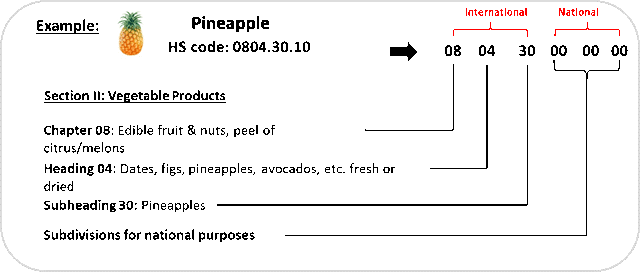
The HS code is an international recognition code. It is mainly used in the establishment of the national customs nomenclature and the collection of world trade statistics. The HS code is composed of 6 digits and reflects the nature of the goods. Some countries require it to be mentioned for the shipment of goods.
It will allow you to know precisely the amounts of customs clearance and freight.
Here is the composition of an HS Code
How to find the right HS Code for my goods ?
There are few options available to you. Your supplier must be able to provide you with this size accuracy. However, if he does not have the necessary knowledge, you have other options.
Going to this site is, in my opinion, a very good solution : HTS – HS code finder
It’s very simple to use ! Simply enter your keyword in the search bar and get results. Let’s show you ” pineapple ” example.
Calculate applicable tariff with the HS code
You found your HS Code ? It’s now time to check how many taxes you will have to pay on your shipment. You just need to do the following steps :
Go on the Free Trade Agreement Portal
Go on this link (Free Trade Agreement Portal European Union), you should reach a page who looks like this :
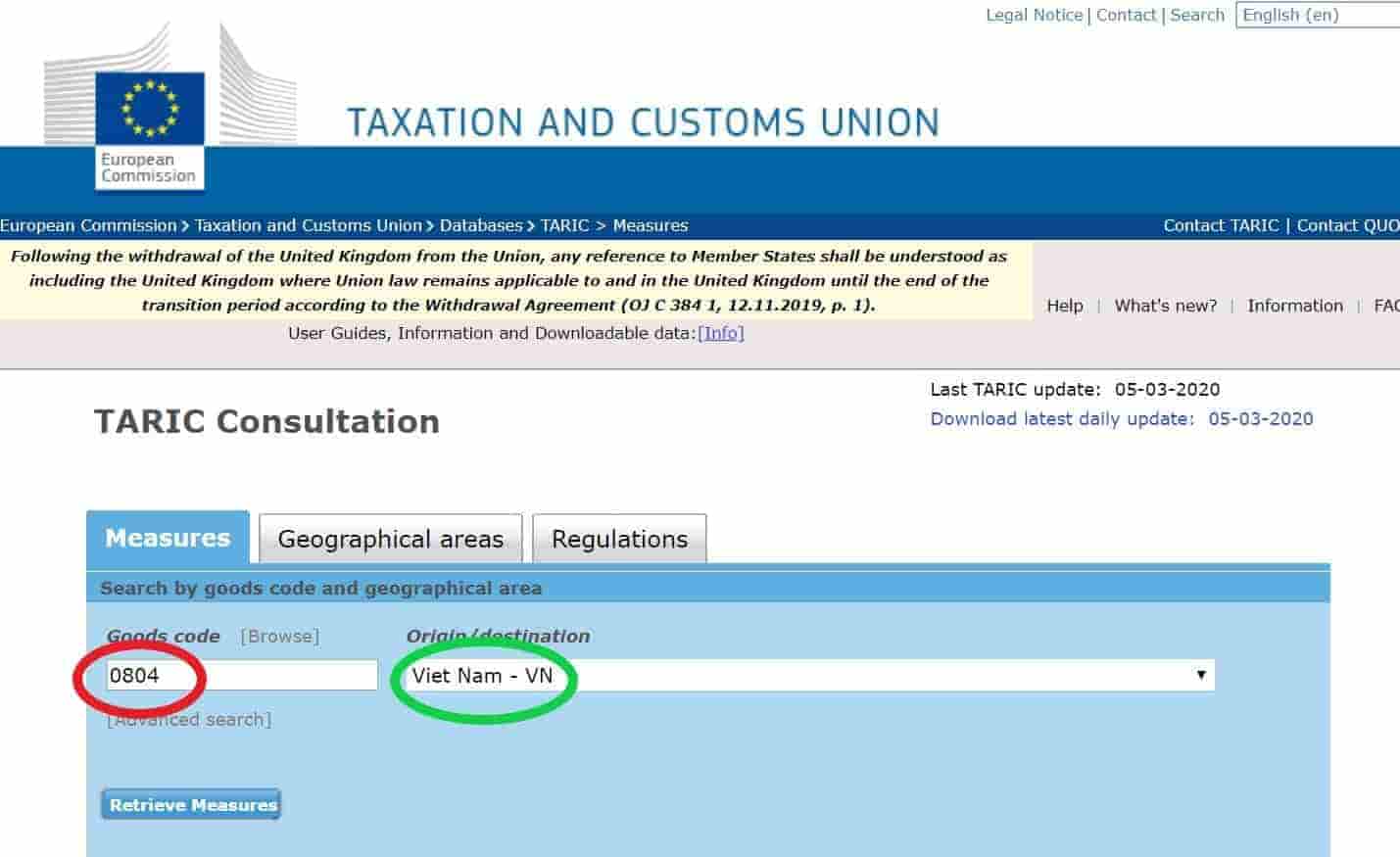
As our example on the screenshot, fill 2 requested informations :
- Your HS Code
- Origin of goods
Check the duties and taxes applied on your product
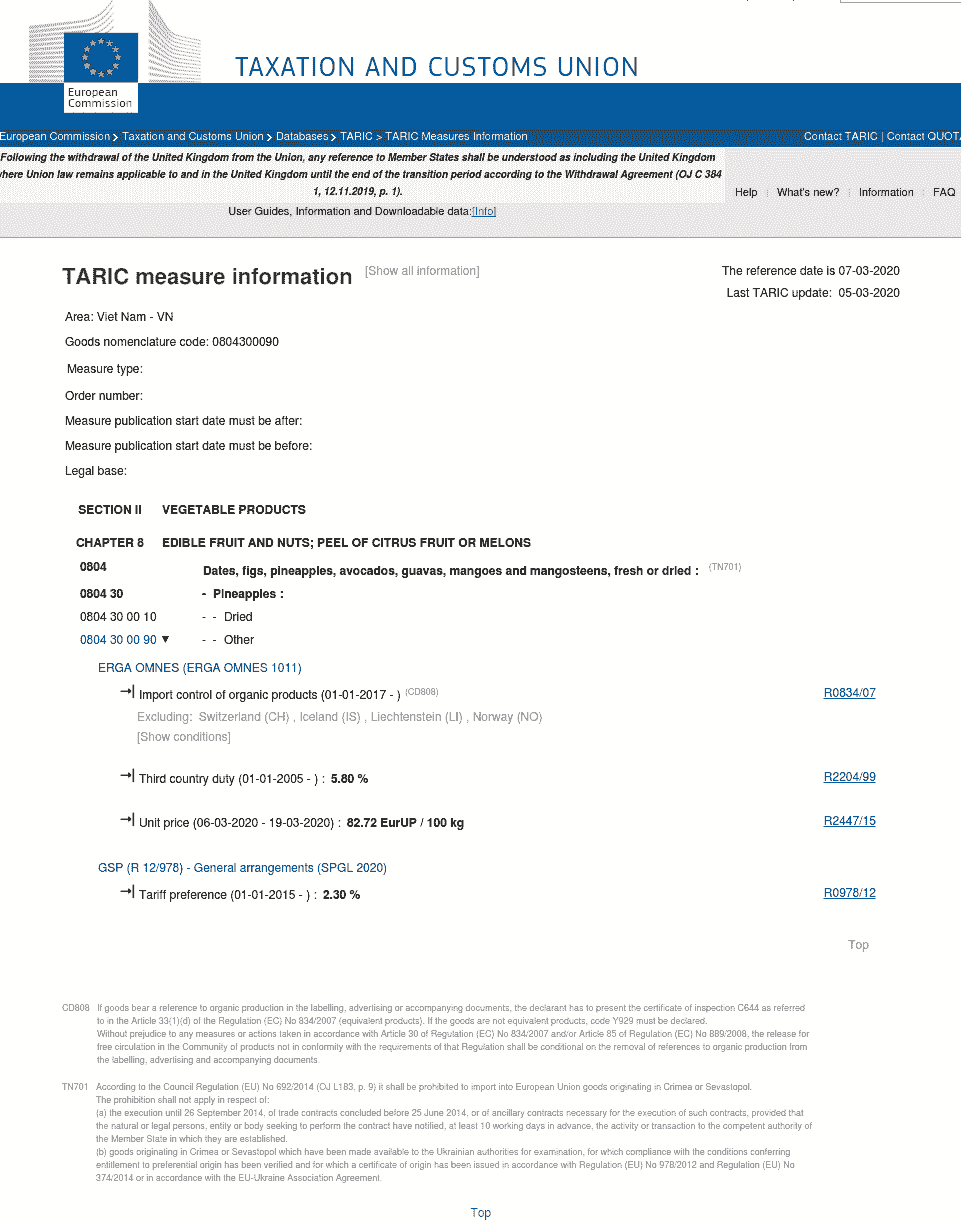
Different taxes existing for your goods
The VAT
The tax must be paid by the person designated as the actual recipient of the goods on the import declaration. This tax is jointly and severally due by the customs declarant acting under an indirect representation mandate, as defined by the Customs Code of the Union (CDU). Taxable persons must complete and submit to customs the Single Administrative Document
Suspensive arrangements and free zones
Imported goods may be placed under one of the customs procedures listed below. VAT will not be charged until the goods are withdrawn for consumption.
- Goods placed in temporary storage;
- Goods under inward processing arrangements
- Transit procedures.
- Free zones in which goods are not subject to VAT
Tax base
The taxable amount on which VAT must be calculated when goods are imported from outside the EU is the value defined as the customs value of the goods.
If they are not already included in the customs value:
It includes :
- Taxes, duties, levies and other charges that are due outside the EU country of import, as well as those due by reason of the import, with the exception of VAT to be levied;
- Ancillary costs, such as commission, packaging, transport and insurance costs incurred up to the first place of destination of the goods in the EU country of import;
- Incidental costs arising from transport to another place of destination within the EU, if the latter place is known at the time of the chargeable event.
Minimum VAT rates
The standard rate cannot be less than 15% ;
EU countries may also apply one or two reduced rates, which must not be less than 5% and which will only be applied to very specific supplies of goods. The directive allows the application of a reduced rate of at least 12%.
The excise tax in Europe / European Union
Excise duty is a tax which relates to a quantity and not to a value: thus the tax on alcohol consists of levying n euros per hectolitre of alcohol sold. European Union excise rules cover the following products: alcohol, alcoholic beverages, energy products, electricity and tobacco products. Reduced rates and exemptions apply in cases such as duty-free purchases.
How to get a taxes exemption?
Certain goods may be exempt from VAT when they are imported.
These include in particular :
- The re-importation, by the person who exported them, of goods in the state in which they were exported and which benefit from exemption from customs duties, or which would benefit from such exemption if they were subject to customs duties, is exempt from VAT.
- Fishery products imported by sea fishing enterprises.
- Certain goods benefiting from an exemption under the domestic regime may also benefit from an exemption from import VAT. These include in particular :Human organs, blood and milk; Currency, banknotes and coins which are legal means of payment.
- Gold, in all its forms, imported by the issuing institutes.
- Imports of goods dispatched or transported to a place situated within the territory of another Member State of the European Union (EU) and which are the subject of a supply exempted by the importer under Article I of Article 262 ter of the General Tax Code are exempt from VAT.
GSP
The Generalized System of Preferences (GSP) “without reciprocity or discrimination, in favour of developing countries, including special measures in favour of the least developed countries, shall be to promote the development of the least developed countries:
- To increase their export earnings;
- Promote their industrialization; and
- Accelerate the pace of their economic growth
Then, you can guess that a lot of Vietnamese products are included.
Products judged too competitive (textile for example) can’t beneficiate from GSP.
Providing a Certificate of Origin of your goods to the European Union Customs will make you able to benefit of GSP.
Does Docshipper charge duty ?
For the rest, our customs commissioner will definitely not be charged to you. We will revert to you with documents produced by European Customs in order to prove it to you.
Customs clearance process in Europe
EORI number
The EORI (Economic Operator Registration and Identification) number is a unique identification number for customs purposes, which is mandatory in the EU since 1 January 2017. It is required for import and export formalities (outside the European Union). It is mainly used in tele-procedures (electronic declarations) related to the customs clearance of goods1 . Member States have set a mechanism to secure trade entering and leaving the European Union.
A Community database has been set up, making it possible to identify, by means of a unique number, each economic operator having relations with the customs administrations of the European Union (EU), or carrying out activities covered by customs legislation.
Economic operators then use this number in all communications with all customs authorities in the EU that require a European identifier, such as customs declarations.
Entry summary declaration
The entry summary declaration or “advance entry summary declaration” is one of the obligations incumbent on the carrier or his representative, the importer or his representative, or any person who is in a position to present the goods or have them presented and whose purpose is to control the type of goods that are to enter the Community customs territory.
A security check is carried out on the data sent in order to determine whether there is a risk in receiving these goods on European soil. This check is carried out according to the goods transported but also according to the consignors, consignees, etc. Following this risk check, a (exceptional) not to load or arrival checks may follow.
Customs procedures
Once the goods are received by customs, they are temporarily stored (for a maximum of 90 days) before being assigned :
For release for free circulation
This means that the conditions for importing them into the European Union are fully met.
Special regime
For Vietnam-Europe operations, we talk about external transit. The term “external transit” means that non-Community goods can move freely throughout the Union. The goods will not be liable to import duties or other charges (import related charges). Customs clearance formalities are therefore delegated to the customs office of destination.
Customs declaration – SAD (Single Administrative Document)
The Single Administrative Document is primarily used by the customs authorities. It enables them to carry out the customs clearance procedure. For example, the value of the exported/imported goods, their quantities, detailed contents and other details such as delivery terms and transport costs are indicated. Details on the identity of the sender and receiver of the goods are also included.
It will be transmitted to the customs authorities by importer via the Internet or directly at the customs premises. The SAD aims to harmonise data, to bring together all relevant data in one document. It consists of 8 sheets. It is also a means of being transparent with regard to national administrative procedures.
Value for duty
The customs value is the value that will be used, in import-export operations, to calculate the duties and taxes related to the transaction (customs duties, VAT, dock dues, etc.).
This value does not always correspond to the price in the sales contract and may be subject to specific adjustments.
Customs Procedures and Contacts
Vietnam Customs
![]()
Official Name: General Department of Vietnam Customs
Website: Vietnamese Customs
What are the Licenses required (import & export)?
Import license
Agricultural Products
When importing agricultural products, some are subject to an import certificate. It will be used by the EU authorities. They will therefore be able to analyse flows and manage tariff quotas.
Contact the authorities issuing this certificate with a guarantee (the amount varies and can be returned on presentation of the import papers).
Steel products
All these imports are supervised and monitored by the EU a surveillance document is mandatory to be provided when the weight of the imports will be above 2500 kg.
Products originating in Norway, Iceland and Liechtenstein are exempt from the presentation of this document.
Necessary documents
Bill of Lading
Bill of Lading can be compared to a passport / boarding pass. It will be sea or air, depending on your type of cargo of course.
It is a very important document for any international transfer as it will prove its legality and therefore that everything is in order (being issued only after payment has been made).
The following pictures are detailing what information are provided on a Bill of Lading:
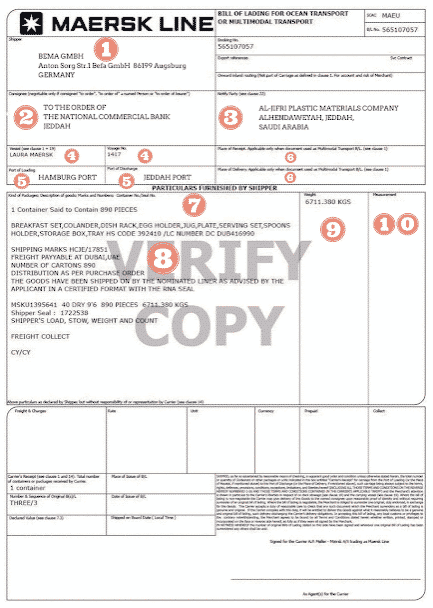
- 1 = Shipper
- 2 = Consignee
- 3 = Notify party
- 4 = Vessel No.
- 5 = Port of loading / discharge
- 6 = Place of receipt / delivery
- 7 = Container No.
- 8 = Goods description
- 9 = Net weight
- 10 = Dimensions / volume
The original invoice
The European Union Customs will see this like a confirmation that the goods received are the same in the declaration.
Commercial Invoice
The commercial invoice is the primary document EU customs uses to assess the nature, value, and origin of your goods. It must be precise, complete, and fully consistent with your other shipping documents.
A correctly completed commercial invoice for the Vietnam–Europe route must include: the full name and registered address of both exporter and importer, a precise and detailed description of the goods (avoid generic terms like “merchandise”, “parts”, or “samples”), the HS code for each line item, the unit price and total value, the currency, the agreed Incoterm, the country of origin (Vietnam), and the total quantity and weight.
For EVFTA preferential duty claims, the invoice value must exactly match the customs value declared. Any discrepancy between the invoice, packing list, and Bill of Lading can trigger a customs examination that delays clearance by days or weeks.
Insider tip: The HS code is the single most consequential field on your commercial invoice for duty calculation. An incorrect HS code can result in overpaying duties, or worse, underpaying duties and facing an assessment and penalty at EU customs. Always verify the correct 8-digit EU HS code for your specific product before the first shipment — do not rely on a 6-digit code or a code your supplier uses for another market.
The packing list
It is made up of your belongings that you are going to have transported. To this list will be attached the MSDS data sheet and the international code in the case of importing certain products (hazardous or chemical products) within the EU.
Certificate of Origin
If you want to link your import to the GSP regime, you will need this certificate. It will attest to the authenticity (Made in Vietnam) of the goods in question. After obtaining the signature of the manufacturer(s), the government agency on site will take care of the rest.
Here is what it looks like (for China here):
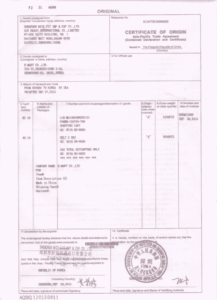
There might be some difficulties for you to handle it entirely. If this is a case, just send us an email or call us !
Certificate of Conformity (CE Standard)
If you are importing goods from Vietnam into the EU that are subject to CE marking requirements, you must ensure your products meet all applicable EU Directives or Regulations before they enter the EU market. The CE mark is a legal requirement, not an optional quality badge.
Product categories requiring CE marking include: electrical and electronic equipment, machinery, personal protective equipment, toys, medical devices, radio equipment, construction products, and pressure equipment, among others.
CE conformity requires the product to meet the relevant EU technical standard, a conformity assessment to be carried out (self-declaration or via a Notified Body depending on the product risk level), and a Declaration of Conformity and technical documentation to be prepared and retained.
For Vietnamese manufacturers, achieving CE compliance typically involves: technical testing by an accredited laboratory (which can be conducted in Vietnam or Europe), preparation of a Technical Construction File, and registration with a Notified Body if required by the applicable Directive.
Attempting to import non-CE-compliant goods into the EU results in seizure at customs and potential destruction of the consignment at the importer’s cost. Do not assume a product is CE compliant because your Vietnamese supplier claims it is — verify with documentation before your first shipment. Our team can connect you with product compliance testing services if needed.
Prohibited & restricted items
Here is a list of the some prohibited items:
- Counterfeits;
- paedophile products: i.e. “objects of any kind containing images or representations of minors of a pornographic nature”;
- asbestos or products containing it, with the exception of those referred to in Article 7 (Decree of 24 December 1996);
- products containing certain dangerous substances (e.g. lead salts, nickel);
- plants, plant products and other products (bark, seeds, soil and growing media) whose introduction is prohibited in all Member States under Annex III of the Order of 24 May 2006;
- animal foodstuffs or foodstuffs of animal origin that are subject to prohibitions under the national or Community health regulations in force;
- polycarbonate baby bottles for infants produced from 2,2-bis (4-hydroxyphenyl) propane, also known as bisphenol A ;
- cat and dog skins or fur and any products containing them.
However, as far as foodstuffs are concerned, this list is not exhaustive and may be updated according to crisis situations that may arise.
Trade agreement
EVFTA and EVIPA are ambitious trade agreements between the EU and a developing country, based on legal regulations, the diplomat said. Under EVFTA, 99% of tariff lines would be removed and many other non-tariff barriers would be reduced on both sides, while EVIPA helps to protect and strengthen European investment in Vietnam, making this South East Asian country a trade and investment hub for EU companies operating in the region.
Currently, the European Union (EU) markets – members of the EU-Vietnam Free Trade Agreement (EVFTA) – are Vietnam’s main import-export markets in Europe.
- Free Trade Agreement opens new era of bilateral cooperation
- VFTA could help strengthen ties between Poland and Vietnam
According to the latest figures from the General Customs Department, at the end of 2019, the import-export turnover between Vietnam and the members of the EU (28 countries) was USD 56.39 billion, or nearly 11% of the country’s import-export value. In particular, Vietnamese exports to the EU reached USD 41.48 billion, down 1% from 2018 but still representing 15.7% of national exports. While imports amounted to USD 14.91 billion, up 7.4%, representing 5.9% of the country’s figure. Thus, Vietnam has a remarkable trade surplus of USD 26.57 billion with the EU.
Data from the General Customs Department show that the markets for Vietnam’s main export products include EU member countries. The largest export product group is “phones and components”, with a turnover of USD 12.36 billion, down 7.1% from 2018, but the EU still accounts for 24% of this figure. The EU is also one of the largest outlets for computers, electronic products and components.
In addition, a number of Vietnam’s flagship export products posted billions of dollars in export turnover to the EU last year, such as textiles-clothing, footwear, agricultural products, machine tools and spare parts . Vietnam also imports a variety of products from EU member countries. In 2019, it imported computers, electronics and components from Iceland worth almost USD 2.3 billion. In addition, machine tools and spare parts, pharmaceuticals, consumer goods, cars, etc. were also imported into Vietnam.
Vietnam – EU Trade and Economic Relationship
The trade relationship between Vietnam and the European Union is one of the most dynamic bilateral economic partnerships in Southeast Asia, and it has been fundamentally reshaped by the EU–Vietnam Free Trade Agreement (EVFTA), which entered into force in August 2020.
By 2024, total two-way trade between Vietnam and the EU reached approximately USD 65 to 70 billion, representing sustained growth from the USD 56 billion recorded in 2019. Vietnam exports primarily electronics, machinery, garments, footwear, furniture, and agricultural products to the EU. Imports from the EU into Vietnam focus on machinery, pharmaceuticals, vehicles, chemicals, and high-technology goods.
Germany remains Vietnam’s largest individual EU trading partner, with bilateral trade exceeding USD 12 billion annually. The Netherlands is a major gateway market, France, Italy, Belgium, and Spain are significant export destinations, and Poland and Czech Republic are growing rapidly as manufacturing-adjacent importers.
The EVFTA has eliminated duties on approximately 71% of Vietnamese exports to the EU at entry into force, with the remaining tariffs being phased out over 7 to 10 years. For European importers, this means that the majority of Vietnamese industrial goods — including electronics, garments, furniture, and many processed food products — now enter the EU at zero or near-zero duty rates, provided the correct Certificate of Origin is presented. This has made Vietnam significantly more competitive as a sourcing destination compared to countries without preferential EU access.
Additional services
Our warehousing services
At Docshipper our mindset guides us to offer the best solutions to our customers and thus facilitate their operations. Our warehouses close to the ports: HCMC (Saigon), Haiphong and Quy Nhon allow us to store your goods as long as you wish before shipping them to Europe. Before that, they will be secured by our cameras and surveillance staff.
Once again the free-stress aspect highly appreciated by our customers!
Storage service in Europe
We have always maintained a good relationship with our local network in Europe (Spain, France, Germany, Portugal …). This ensure a safety, which comes with trust and a competitive price.
Our packing/unpacking services
Overview
To guarantee you a transport without concern passes by a packing service.
Please note:
A package is good, the best package (ours) is better!
Our experience has enabled us to establish packaging conditions adapted to your needs and budget. We will then provide you with the most suitable alternative.
Packing material
Carton box
We guarantee you the best, adapted to your goods and requirements. This includes not only the best know-how but also the best cardboard boxes. In order to guarantee an optimal protection they will be thick and not folded.
Palletization
It’s used to facilitate the process. Transporting your goods inside the container can be complicated. In our warehouses, we manufacture all types of pallets to match your shipments.
Wooden boxes
Wooden transport crates are one of the safest means of transporting goods. Their sturdy structure protects their contents and their format makes them very easy to handle for forklift trucks or pallet trucks. Wooden crates are strong, durable, reusable, and offer an environmentally friendly alternative for packaging and shipping.
Others: bubble wrap, tape, wrapping paper…
It is ideal for fragile goods. Docshipper’s aim is to make the goods in such a (logical) condition. In this way we can protect the goods from the transport material (e.g. wood). Without using bubble wrap or others, your goods can be damaged.
Why packing is important for the insurance ?
Of course you’d be right to worry about your property. Nevertheless, in this article I try to prove to you that we do EVERYTHING to make sure there is no problem. Our experience, our acquired skills make us very good in this field.
From our experience, we can tell for sure that some insurance are very insistant on some details such as packing by professionel, in order to make you pay. We will act in a professional way, which guarantees you a refund if anything happens.
Freight insurance
How much does a freight insurance cost ?
Be aware that the price of your insurance will depend on the value of your goods and also on the value of your freight. The cost of insurance is calculated on the basis of a percentage applied to the total price of your freight and your goods. This price is provided by the insurance company.
The method of calculation is as follows:
(Freight value + commodity value) x 1-3% = cost of your insurance.
The percentage will depend on the type of your cargo.
Supplier management in Vietnam
Control quality in Vietnam
Again in a free-stress perspective for our friendly customers, we will contact your supplier beforehand. We will get to know more specifically the characteristics of the product and go through them with a fine-tooth comb (especially the condition + packaging). Under our supervision, your products will not leave without adequate packaging.
By having contacted Docshipper, the operation will run smoothly from start to finish (regardless of the incoterm). Our staff is fluent in Vietnamese / English / French in order, among other things, to verify the dimensions as well as the HS code of your goods.
3PL Services in Vietnam
Order fulfillment/Packing & labelling in Vietnam
The supply chain is complexe, especially if you are not familiar with it. We will be your right-hand man in Vietnam, taking care of all services (packaging, customer relations, inventory, labelling, fulfilment). These will be our concerns, not yours.
Last mile delivery
The relations with whom we have been working for years allow us to offer and guarantee a delivery in any country (Vietnam or EU in this case) accompanied by a competitive price and an irreproachable service.
Shipping personal effects from Vietnam
Excess baggage
Coming back from a trip busier than you can often happens. In this case, the airlines are not very lenient.
Is there a solution? Yes, and it’s called Docshipper. Our express delivery guarantees you the best service. In 3 to 5 days, the excess goods will be delivered directly to your home.
Moving service from Vietnam to Europe
Moving, especially when it’s your first move, can be a worry. You need to find out about many things at the same time (packing, customs…). Let us relieve you of this stress. Your concerns will become ours! Please take a look on our dedicated page : Moving services.
Free regulation advisor
Docshipper’s been operating for 10 years now. What do all those years mean? A lot of experience, especially in transport between Vietnam and Europe. This experience is at your disposal.
Take advantage of it and let us answer all your questions.
What are you waiting for? Please contact us.
FNM Advice:
More than 10 years of expertise in Asia, enables us to deliver tailor-made freight solutions at hyper-competitive prices. Do not hesitate to contact our dedicated staff for more information about your transfer, we’re always happy to serve and spread the knowledge! Contact us!
Additional logistics services
Discover DocShipper's holistic approach to supply chain management, covering not just shipping and customs, but a full suite of additional logistics services tailored to streamline your global operations effectively.
Warehousing and storage
Securing a reliable warehouse in a foreign land could be a mountain to climb. Your goods, especially temperature-sensitive ones, need perfect conditions to stay market-ready. Imagine the peace of mind that a well-managed, temperature-controlled storage would bring! Your quest for such reliable warehousing ends here. More info on our dedicated page: Warehousing.
Packaging and repackaging
Protecting your products for the journey from China to Thailand requires expert packing and repackaging. Looking for items that defy the odds? Our network of trustworthy agents can handle everything from electronics to fragile ceramics. They ensure safe transport, perfect for businesses shipping diverse goods. Want to dive deeper? Find more at our dedicated page: Freight Packaging
Cargo insurance
Cargo insurance acts as your safety net during your shipping journey. Ever considered a scenario where your shipment gets damaged by incidents other than fire? This is where cargo insurance comes into play, covering physical losses or damages from external causes. Think of a heavy storm tossing your ocean freight; cargo insurance has your back! Our customized coverage mitigates such risks. Need more insights? Visit our dedicated page: Cargo Insurance.
Supplier Management (Sourcing)
Looking to manufacture in Asia or East Europe? The supplier management service from DocShipper seamlessly handles it all - right from finding reliable suppliers to overseeing the entire procurement process. Forget language limitations or complex sourcing steps - DocShipper guides you through it all. For instance, if you strive to create a new toy line in China, we connect you with the best manufacturers and handle all purchasing details. More info on our dedicated page: Sourcing services
Personal effects shipping
Moving special items from China to Thailand? Your precious or oversized belongings deserve safe and efficient shipping. That's where we come in, with expertise in handling fragile and bulky cargo with utmost care. Consider the time we secured a customer's antique Chinese vase; it arrived in Bangkok unscathed! Craving more insights? More info on our dedicated page: Shipping Personal Belongings.
Quality Control
Ensuring the excellence of your products is our priority. Our Quality Control service eliminates your worries over manufacturing errors in your China-to-Thailand shipping. Imagine unboxing your Thai order only to find unsuitable items - a nightmare avoided with our pre-shipment inspection. Don't gamble with your business reputation; let us protect it. More info on our dedicated page: Quality Inspection

Product compliance services
Ensuring your merchandise arrives safely is essential, but have you considered if it meets local compliance standards? Our Product Compliance Services handle this crucial aspect, conducting rigorous laboratory tests for certification and verifying that your goods abide by the destination's regulations. Suppose true peace of mind in international shipping means no surprises at customs. In that case, our specialized expertise might be invaluable to you. More info on our dedicated page: Product compliance services
FAQ | Freight Vietnam - Europe | Rates - Transit Times - Duties & Taxes
Yes, and this route requires real coordination. Vietnam exports mainly through Hai Phong in the North and Cai Mep, Ho Chi Minh area in the South. On the European side, cargo usually lands in Rotterdam, Antwerp, Hamburg, Le Havre, or Mediterranean hubs like Valencia and Piraeus.
We manage the full chain, supplier pickup in Vietnam, export customs clearance, ocean or air freight, European import clearance, and final delivery to your warehouse. If you are buying under EXW, we take control from the factory. Under FOB, we secure the main freight. Under CIF, we protect you from the usual surprise charges at destination.
This route is sensitive to schedule changes due to Red Sea diversions and peak season congestion. We monitor carrier reliability weekly and adjust routing before delays hit your supply chain.
Yes. Door-to-door means you do not coordinate separately with a Vietnamese forwarder, an ocean carrier, a European customs broker, and a local trucker. We centralize everything.
For first-time importers, this avoids the classic mistake of underestimating destination charges in Europe. For experienced importers, it gives cost visibility and a single operational contact.
We confirm before shipment:
- Correct HS code and duty exposure under EU regulations
- Whether your goods benefit from EVFTA preferential duties
- Import VAT handling and EORI validation
- Delivery constraints such as tail lift, time slots, or bonded storage
You stay focused on your business while we control the logistics flow.
On this trade lane, sea freight is almost always the most economical option.
As of May 2026, indicative market levels for a 40ft container from Vietnam to North Europe generally fluctuate around the mid two to low four thousand USD range depending on season and congestion. Mediterranean ports are often higher.
The cheapest method depends on volume:
- Under 1 CBM and urgent, express courier can make sense despite high cost per kilo
- 1 to 10 CBM, LCL sea freight reduces total cost but adds consolidation time
- Full container volumes, FCL gives better control and lower risk of cargo damage
The real mistake is focusing only on the ocean rate. Destination THC, customs clearance, trucking, and VAT cash flow often represent a large share of the landed cost in Europe.
Sea freight from Vietnam to North Europe currently averages around 30 to 42 days port to port, depending on routing and whether vessels are diverted around the Cape of Good Hope.
Air freight typically delivers within 3 to 7 days airport to airport.
Choose sea freight if:
- Your margins cannot absorb high air freight rates
- Your cargo is not time-critical
- You ship heavy or bulky goods
Choose air freight if:
- You are launching a product and cannot miss a sales window
- You need partial replenishment to avoid stockout
- Your cargo value justifies the speed
Many experienced importers mix both, sending a small urgent batch by air and the balance by sea.
Your Incoterm defines risk and cost control.
EXW means you control everything from the factory gate. This gives maximum visibility but requires a strong logistics partner in Vietnam.
FOB is often the safest balance. Your supplier handles export clearance and loading at port, and you control the main freight and destination costs.
CIF looks simple but often hides weak freight contracts and limited transparency. You still pay European charges and you do not control carrier selection.
If you want predictability, we usually recommend FOB combined with a controlled freight contract on your side.
To avoid rate surprises, we need precise operational data.
- Pickup city in Vietnam and delivery city in Europe
- Incoterm agreed with your supplier
- Total volume in CBM and gross weight
- Number of cartons or pallets and packaging type
- HS code and product description
- Whether cargo is dangerous, contains batteries, or is temperature-sensitive
Many delays happen because product details were incomplete. The more precise you are, the more reliable your budget will be.
Yes, and this is common when sourcing textiles, furniture, electronics, or mixed consumer goods.
We collect cargo from different factories, regroup it in our Vietnamese warehouse, check quantities, and load it into one container. This reduces LCL handling risk and gives you better cost efficiency.
Without consolidation control, you risk mismatched documents, split shipments, and customs inconsistencies on arrival in Europe.
It depends on the shipment stage.
Before vessel arrival, we can usually amend the delivery instruction. After customs clearance or once trucking is scheduled, changes may generate storage, demurrage, or re-delivery fees.
On this route, European ports can apply strict free-time limits. A last-minute address change can quickly turn into avoidable port charges. The earlier you inform us, the more options we have to protect you from extra costs.
For ocean freight, expect around 30 to 42 days port to port to North Europe under current 2026 market conditions. Mediterranean ports may vary slightly depending on routing.
Add:
- 3 to 7 days for origin handling and export procedures
- 2 to 5 days for EU customs clearance and port handling
- 1 to 5 days for inland trucking inside Europe
Door-to-door, most shipments move in roughly 35 to 50 days by sea. Air freight door-to-door is typically under 10 days.
As of May 2026, spot market indicators for a 40ft container from Vietnam to North Europe commonly fluctuate between roughly 2,500 and 4,000 USD for the ocean freight portion. Mediterranean routes can reach higher levels, especially during peak periods.
LCL shipments are calculated per CBM and depend heavily on consolidation demand.
Air freight pricing depends on chargeable weight and airline capacity. Rates vary weekly and are significantly higher per kilo than sea freight.
Remember, freight is only one component. European terminal handling charges, customs clearance, duties, VAT, and last-mile delivery define your true landed cost.
For North Europe, the main gateways are:
- Rotterdam
- Antwerp
- Hamburg
- Le Havre
For Southern Europe and Mediterranean distribution:
- Valencia
- Barcelona
- Genoa
- Piraeus
The best port depends on your final delivery point. Choosing a cheaper ocean rate to a distant port can increase inland trucking costs significantly. We calculate total landed cost before confirming routing.
Indicative port-to-port sea transit times in 2026:
- Ho Chi Minh or Cai Mep to Rotterdam, about 30 to 40 days
- Ho Chi Minh to Hamburg, around 32 to 42 days
- Vietnam to Mediterranean ports, typically 28 to 38 days depending on routing
These timings can extend if vessels avoid the Red Sea or during European port congestion. We always check the current carrier schedule before booking.
If you are new to importing from Vietnam, here is the practical sequence:
- Confirm HS code and verify EU duty rate, including EVFTA eligibility
- Obtain your EORI number for EU customs
- Agree on Incoterm with your Vietnamese supplier
- Validate packaging, labeling, and product compliance with EU standards
- Book freight and prepare export documents in Vietnam
- Handle EU customs clearance and VAT payment
- Arrange final delivery to your warehouse
The most common problems are incorrect HS codes, missing origin certificates for preferential duty, and underestimated VAT cash flow. We review these points before shipment departure so you are not blocked at European customs.