

Freight Shipping between Vietnam and Lebanon | Rates – Transit times – Duties and Taxes
Freight between Vietnam and Lebanon looks simple on a map, but once you factor in feeder connections, transshipment hubs, and customs clearance in Beirut Port, you quickly realize that one small assumption can shift your entire budget or timeline. If you are researching freight vietnam lebanon, you are probably comparing transit times, estimating landed costs, or checking duties before you confirm an order, and that is exactly where most costly mistakes start, at the planning stage rather than at customs. The first thing we always tell you is this, the route works well if you choose the right mode, align your Incoterm, and prepare documents correctly from day one. In this Destination guide we will cover transport options, shipping times, customs procedures, duties and taxes, and the practical checkpoints you need to control your shipment from Vietnam to Lebanon.
Which are the different modes of transportation between Vietnam and Lebanon?
You will choose between ocean freight and air freight, since cargo usually departs from ports like Cat Lai Port or airports such as Tan Son Nhat International Airport before heading toward Beirut. You should go by sea when cost per cubic meter matters more than speed and your goods can handle longer transit, and you should choose air when lead time, product value, or tight delivery windows justify the higher rate.
You will notice that sea freight gives you better economics for full containers or larger LCL volumes, while air freight makes sense for urgent, lightweight, or high-margin cargo calculated on chargeable weight. If you are unsure, you can contact our team and we will check real-time capacity, schedules, and pricing to help you decide, and we will break down each option in more detail throughout this guide.
Need help with your shipment?
Need assistance with your shipment? Dont hesitate to contact us even for a simple question. Choose the option that suits you
Live chat with an expert Chat on WhatsApp Free Quote 24hHow can FNM Vietnam help?
Sea freight between Vietnam and Lebanon
If you are planning sea freight from Vietnam to Lebanon, the first thing we always tell you is simple. Choose ocean freight when your cargo is heavy, bulky, or time-flexible. If you are shipping machinery, furniture, raw materials, or consolidated goods above a few cubic meters, container shipping Vietnam to Lebanon will usually give you the lowest cost per unit. If you need urgent delivery under 10 to 12 days, sea freight is not your solution.
On this route, you should expect a long sea shipping lead time Vietnam Lebanon and often a transshipment service rather than a direct vessel. That means more handling points and more sensitivity to delays. The decision is not just about price, it is about how much buffer you have in your supply chain. If your production depends on exact arrival dates, you must plan around the shipping schedule and vessel rotation, not only the sailing time.
Where most importers get caught off guard is paperwork and responsibility split. If you let your supplier control everything under the wrong Incoterms FOB CIF EXW DAP, you can lose visibility between the port of loading POL in Vietnam and the port of discharge POD in Lebanon. A poorly issued bill of lading B/L or misunderstanding between telex release and sea waybill can create avoidable clearance delays at destination. When you structure it properly from the start, ocean freight Vietnam Lebanon becomes predictable and manageable.
Main ports to know in Vietnam and Lebanon
When you organize international sea logistics Vietnam Lebanon, your port choice directly affects inland trucking, vessel frequency, and congestion risk. You should focus on the ports that actually handle regular container flows for this corridor.
- Ho Chi Minh City, Cat Lai and Cai Mep, This is the main gateway in the South and one of the main seaports in Vietnam for export. You will find the highest vessel frequency here, especially for FCL full container load Vietnam Lebanon shipments. Inland access is efficient for factories around Binh Duong and Dong Nai.
- Hai Phong, This is the key northern hub near Hanoi. If your supplier is in Northern Vietnam, shipping from Hai Phong reduces domestic trucking cost and shortens pre-carriage time.
- Da Nang, Useful for central Vietnam factories, but with fewer sailings. You may face more transshipment options rather than direct connections.
On the Lebanese side, container traffic is concentrated in two locations among the main seaports in Lebanon for import:
- Port of Beirut, This is the primary port of discharge POD for container shipping Vietnam to Lebanon. You benefit from better customs infrastructure and broader inland distribution options.
- Port of Tripoli, Sometimes used as an alternative, especially when Beirut faces operational pressure. You should confirm vessel calls in advance because not all services include Tripoli.
Your decision should align with your supplier’s location and your final warehouse in Lebanon. A cheaper ocean rate from the wrong Vietnamese port can quickly turn into higher inland trucking costs and lost time.
Transit times: how long does it take to ship from Vietnam to Lebanon?
The typical transit time Vietnam to Lebanon by sea ranges between 30 and 40 days, depending on your origin port and the transshipment hub used by the carrier. You rarely get a fully direct service, so you should always look at the total transit, not just the main ocean leg.
| Port of loading POL | Port of discharge POD | Estimated transit time |
|---|---|---|
| Ho Chi Minh City | Beirut | 30 to 35 days |
| Hai Phong | Beirut | 32 to 38 days |
| Da Nang | Beirut | 33 to 40 days |
| Ho Chi Minh City | Tripoli | 32 to 38 days |
You should interpret these numbers as port to port only. They do not include export customs clearance Vietnam, container pickup, or import customs clearance Lebanon. During peak months, carriers may adjust the shipping schedule and vessel rotation, which can add several days. If your cargo misses the vessel cut-off, you immediately lose one full week on average. That is where most timelines slip.
Should I choose FCL or LCL when shipping between Vietnam and Lebanon?
Choosing the right sea freight option for your goods between Vietnam and Lebanon can be game-changing. Full Container Load (FCL) or Less than Container Load (LCL), also known as consolidation, can make a real difference in cost, delivery time, and overall success. This section will demystify these concepts, helping you understand their distinct nuances and how they align with your specific needs. Are you ready to dive into the sea of smart shipping decisions? Let’s set sail!
Full container load (FCL)
Definition: FCL stands for Full Container Load, a type of ocean freight where the entire container is for your goods only. This method of shipping, 'fcl shipping', ensures that the container is sealed at origin and unsealed at the destination to ensure the utmost safety of your commodities.
When to Use: FCL is an ideal solution when your shipment volume exceeds 13/14/15 CBM (Cubic Meters). If you're shipping larger volumes, you can utilize this service to its full potential and fetch an 'fcl shipping quote' that may be cheaper than shipping the same volume via LCL (Less than Container Load).
Example: Suppose a Vietnamese furniture manufacturer has a large order to deliver in Lebanon. The order consists of 30 CBM of wooden chairs and tables – too big for an LCL, but perfect for an 'fcl container.' They will likely use a '20'ft container' or possibly a '40'ft container,' depending on the exact volume of their goods.
Cost Implications: Since the entire container is allotted to your shipment, the cost is straightforward and may prove to be less expensive for higher volume orders. Remember, while FCL can be more economical, costs such as the Base Ocean Freight and Local Port Charge are constant regardless of the load size. Consider your shipment size and get an FCL shipping quote to make an informed decision.
Less container load (LCL)
Definition: Less than Container Load (LCL) shipping involves consolidating several shippers' goods into one container for transportation. This method is often chosen due to its cost-effectiveness and flexibility, particularly beneficial when your cargo volume is low (i.e., less than 13/14/15 CBM).
When to Use: LCL shipping is especially useful when your shipment isn't large enough to fill a container on its own. For instance, if you need to ship 10 CBM of handicrafts from Hanoi, Vietnam to Beirut, Lebanon, opting for LCL would let you share container space, reducing costs and environmental impact.
Example: Take John's Fashion Accessories - a small business in Hanoi. During a sales season, they need to send 12 CBM of accessories to a department store in Beirut. Since their shipment volume didn't require a full container, they opted for LCL shipment. This way, they saved on costs and avoided warehouse storage fees, as they could ship inventory directly to the store just in time for the sale.
Cost Implications: With LCL freight, you pay only for the space your goods occupy in the shared container. However, there may be additional consolidation and deconsolidation fees involved. These are costs associated with handling and segregating your goods at the shipping ports in Vietnam and Lebanon.
Hassle-free shipping
Ease the complexities of cargo shipping with FNM Vietnam. As a seasoned freight forwarder, we aim to make your ocean shipping journey hassle-free, selecting between consolidation or full container options based on factors such as volume, time, and cost. Partner with our expert team to understand which is the best fit for you. Ready to explore more about uncomplicated, tailored shipping solutions? Reach out now for a free estimation.
Shipping rates: how much does a sea freight shipment cost from Vietnam to Lebanon?
When you request a freight quote Vietnam Lebanon, you should separate LCL and FCL logic. The ocean freight rates Vietnam to Lebanon fluctuate with fuel prices, capacity, and global demand, so you should treat the figures below as planning ranges.
| Mode | Estimated rate | What it includes |
|---|---|---|
| LCL less than container load Vietnam Lebanon | USD 80 to 150 per CBM | Port to port ocean freight only |
| FCL 20ft | USD 1,800 to 3,000 per container | Ocean freight base rate |
| FCL 40ft | USD 2,800 to 4,500 per container | Ocean freight base rate |
Your final cost per container Vietnam Lebanon depends on season, container type, and negotiation power. A reefer or special equipment unit will cost more than a standard dry container. Most importantly, ocean freight is only one part of your freight cost breakdown ocean shipment. You still need to add origin charges, destination charges, customs clearance, and inland transport. This is why two offers that look similar on paper can end up very different once everything is included.
How to estimate your sea freight cost before requesting a quote
If you want to understand how to estimate sea freight cost Vietnam Lebanon, you need four elements ready, total CBM, total gross weight, chosen Incoterm, and exact port of loading POL and port of discharge POD. For LCL, carriers charge per cubic meter, or per ton, whichever is higher. This is called chargeable weight.
For example, if you ship 8 CBM weighing 5 tons from Ho Chi Minh City to Beirut under FOB, and the rate is USD 100 per CBM, you estimate USD 800 ocean freight. Then you add terminal handling charges THC, documentation fee and origin charges, and destination fees in Lebanon. If your supplier offers EXW instead of FOB, you must also include local trucking and export customs clearance Vietnam. A very low base rate can hide high destination charges, so you should always calculate the total landed cost before confirming.
Special transportation services
Some shipments between Vietnam and Lebanon require more than a standard dry container. Choosing the right equipment protects your cargo and avoids operational problems.
Out of Gauge and project cargo
If your cargo exceeds standard container dimensions, you may need out of gauge OOG cargo or flat rack equipment. This applies to industrial machinery or large structures moved as project cargo by sea. You must confirm port handling capacity in advance because not every terminal accepts oversize units.
Reefer container shipping
For temperature sensitive goods, reefer container shipping Vietnam to Lebanon keeps products within a controlled range. You should define temperature settings clearly in the booking to avoid cargo temperature disputes on arrival.
Consolidation services
If you ship small volumes, consolidation and deconsolidation services under LCL allow you to share container space. This reduces cost, but you should accept slightly longer handling time compared to FCL full container load Vietnam Lebanon.
If you are unsure which configuration fits your cargo, we can analyze your packing list and propose the most reliable option. You can request a detailed quote and breakdown in less than 24 hours.
Step-by-step: how a sea freight shipment usually works on this route
When you book sea freight from Vietnam to Lebanon, you should see the process as a chain where each document and deadline matters. This route requires patience because of transshipment and strict cut-off times. Most delays happen before the vessel even departs. If you prepare properly, the flow becomes predictable.
- We confirm your booking with the carrier based on volume, container type, and agreed Incoterm.
- You send us packing list and commercial invoice so we can prepare cargo booking and shipping instructions.
- Your supplier arranges container stuffing and sealing at factory or warehouse.
- We handle export customs clearance Vietnam and deliver the container before vessel cut-off.
- The carrier issues the bill of lading B/L, either original, telex release, or sea waybill.
- The container sails, usually via transshipment, according to the confirmed schedule.
- Before arrival, we prepare documents for import customs clearance Lebanon.
- You pay destination charges and arrange delivery to your final warehouse.
If one document is inconsistent or late, you risk demurrage and detention at destination. That is why we always double-check paperwork before the vessel sails.
Air freight between Vietnam and Lebanon
When you choose air freight from Vietnam to Lebanon, you are buying speed and predictability. You use it when your cargo is urgent, high value, or time-sensitive, not when you simply want a faster version of sea freight. You should know upfront that air is quick, but it is also strict about cut-off times, screening, and chargeable weight calculation. If your supplier misses the ready date by one day, you can lose the booked flight.
You have probably heard that air freight is always 3 days, always too expensive, and charged only on real weight. None of that is fully true on the Vietnam to Lebanon lane. Transit often depends on direct flight vs transshipment air cargo, costs depend on volumetric weight vs gross weight, and poor packaging can trigger unexpected airport handling charges. If you ignore dimensions, documentation, or security checks, you pay for it later.
Air Cargo vs Express Air Freight: How should I ship?
Making sense of your shipping options between Vietnam and Lebanon, aren’t you? Well, you’ve got two strong contenders. Think of it like this: Air cargo is like grabbing a group taxi ride with others’ goods in an airline, while express air freight is your reserved luxury cab, a dedicated plane, that gets your goods there pronto! Choosing the best fit depends on your business needs such as budget, delivery speed, and volume. Let’s dive right into these two transportation methods and help you make the most informed choice.
Should I choose Air Cargo between Vietnam and Lebanon?
If your shipment is above 100 to 150 kg or close to 1 CBM, standard air cargo Vietnam Lebanon usually makes more sense than express. You benefit from cargo consolidation air freight, better rates per kilo, and more flexibility on palletized or industrial cargo. This is the typical standard air freight service for B2B flows between factories in Vietnam and importers in Lebanon.
Before you request an air cargo quote Vietnam to Lebanon, you should have exact dimensions, gross weight, Incoterm such as FOB or CIF, departure airport, and confirmed ready date. If you confuse airport to airport air cargo with door to door air freight Vietnam Lebanon, you risk missing local trucking and customs clearance for air freight Lebanon. The most common mistakes we see are missed cut-off times and underestimating security surcharge air cargo and handling fees at destination.
Should I choose Express Air Freight between Vietnam and Lebanon?
You should consider express shipping Vietnam to Lebanon if you have small parcels, samples, spare parts, or urgent documents under roughly 100 kg. Express works well if you do not have a logistics team and you want a simple door-to-door flow with one tracking number and fast air freight tracking and shipment visibility. For time-critical cargo, a priority air freight service through integrators can reduce your air shipping lead time Vietnam to Lebanon.
The trade-off is control. With express, you usually accept bundled pricing that includes fuel and security elements, but you can still face reweigh and remeasure charges if your dimensions are wrong. Many shippers underestimate volumetric weight vs gross weight or assume everything is included under DDP. Express is a good option if your cargo is compact and urgent. It becomes risky if your boxes are bulky, poorly packed, or close to the weight threshold where standard air cargo becomes cheaper.
Main airports to know in Vietnam and Lebanon
Vietnam
- Tan Son Nhat International Airport, SGN, Ho Chi Minh City. The main southern gateway and often the first choice for air cargo Vietnam Lebanon. You get strong international connectivity and regular wide-body capacity, but during peak season you can face cargo backlog risk that affects cut-off planning.
- Noi Bai International Airport, HAN, Hanoi. Ideal if your factory is in Northern Vietnam. You reduce inland trucking costs from industrial zones around Hanoi and Bac Ninh, which directly impacts your total landed cost.
- Da Nang International Airport, DAD. Useful for central Vietnam projects or specific industrial shipments, though international cargo options are more limited compared to SGN and HAN.
Lebanon
- Beirut Rafic Hariri International Airport, BEY. The primary and almost exclusive gateway for air freight from Vietnam to Lebanon. Your final cost depends on local handling, storage, and the efficiency of the import release process at destination airport, so you should plan customs documents carefully.
Since BEY is the main entry point, your routing choice in Vietnam, such as SGN versus HAN, mainly affects pre-carriage cost and flight frequency. When you compare options, you should always look at the full chain, including cargo pickup and airport handling in Vietnam and clearance timelines in Lebanon, not just the flight segment itself.
Transit times: how long does air freight take from Vietnam to Lebanon?
| Service | Typical Transit Time | Notes |
|---|---|---|
| Standard air cargo | Approx. 5 to 9 days | Usually with transshipment in a Middle East or European hub |
| Express courier | Approx. 3 to 6 days | Door-to-door, depending on pickup city in Vietnam |
Your real air freight transit time Vietnam Lebanon depends first on whether you book a direct flight vs transshipment air cargo. Most routings involve at least one hub, which adds handling time. Then you have export screening, airline cut-off, and capacity constraints during peak seasons.
You should also factor in export documentation for air cargo accuracy and the speed of customs clearance for air freight Lebanon. A missing invoice detail or wrong HS code can cause clearance delay at BEY. When we plan your shipment, we always calculate door-to-door timing, not just airport-to-airport flying hours.
Shipping rates: how much does air freight cost from Vietnam to Lebanon?
| Service | Indicative Range | Cost Drivers |
|---|---|---|
| Standard air cargo | Commonly between 4 and 9 USD per kg | Chargeable weight, consolidation level, fuel surcharge |
| Express courier | Often higher per kg than standard cargo | Parcel size, urgency, door-to-door service |
Your final air freight rates Vietnam Lebanon are calculated on chargeable weight, not just scale weight. Airlines apply the IATA volumetric formula, and the higher between volumetric and gross weight becomes billable. This is where many budgets go wrong.
After weight, your cost depends on dimensions and packing quality, urgency level, seasonal capacity, and airport choice such as SGN, HAN, or BEY. You also need to consider fuel surcharge air freight, security surcharge air cargo, and airport handling charges. If you ignore these elements, you may face unexpected cost gaps between your estimate and the final invoice.
What is the difference between volumetric and gross weight?
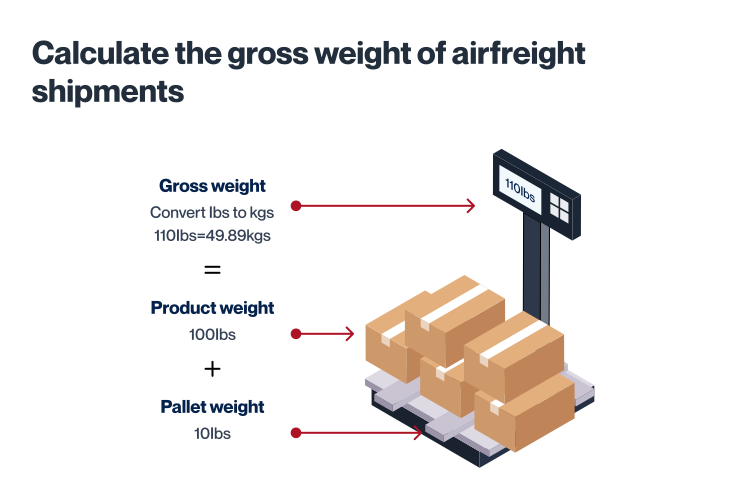
When you book air cargo Vietnam Lebanon, the airline compares two numbers, gross weight and volumetric weight. Gross weight is what your cargo actually weighs on the scale, including packaging. Volumetric weight reflects the space your shipment occupies in the aircraft. The higher of the two becomes your chargeable weight calculation, and that is what drives your freight cost.
- Gross weight, the real weight in kilograms including cartons, pallets, and protective material.
- Volumetric weight, the theoretical weight based on volume.
- Chargeable weight, the higher value between gross and volumetric weight.
- Air waybill AWB, the transport document that confirms these figures, whether under a house air waybill HAWB or master air waybill MAWB.
How to calculate
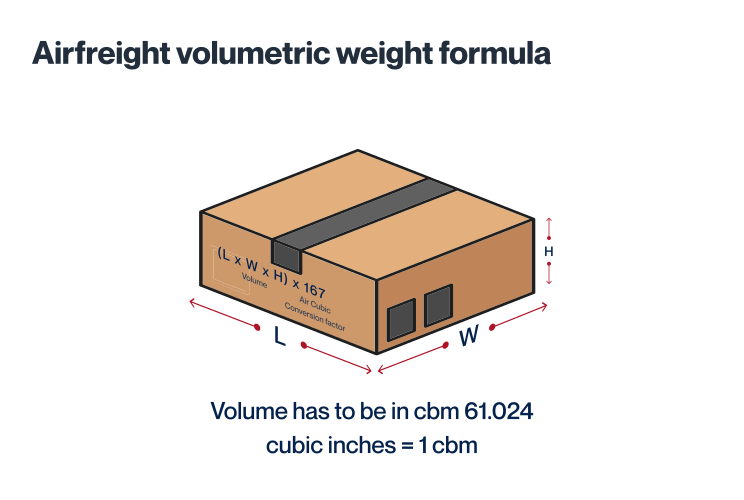
For standard air cargo, you use the IATA volumetric formula, Length x Width x Height in cm divided by 6000. For express, you divide by 5000. Example, if your box measures 60 x 50 x 40 cm, the air cargo volumetric weight is 60 x 50 x 40 / 6000 = 20 kg. If the gross weight is 14 kg, you are billed on 20 kg.
Reference ratios
Air cargo, 1 m3 = 167 kg, divisor 6000 in cm.
Express courier, 1 m3 = 200 kg, divisor 5000 in cm.
Common mistakes include underestimating box size after palletizing or ignoring air freight packaging requirements. If your supplier changes packaging at the last minute, you can face higher chargeable weight than expected. This is why we always validate dimensions before issuing the final booking confirmation.
Door to door between Vietnam and Lebanon
International door-to-door shipping is like a VIP ticket for your freight, managing its journey from Vietnam to Lebanon with unwavering attention. It simplifies the shipping process, offering benefits like time efficiency and lessened paperwork hassle. So, why don’t we roll up our sleeves and delve into the details of door-to-door shipping between these two vibrant countries? Let’s dive in!
Overview – Door to Door
Are you tired of the intricate shipping process between Vietnam and Lebanon? Door to door shipping is the hassle-free solution you’ve been seeking! Unraveling complexities in logistics, it turns transportation into a streamlined task, eliminating middlemen. The big perks? It’s whole comfort, economy of scale, and invaluable peace of mind! For minor drawbacks, the cost might be marginally higher. Yet, clients at FNM Vietnam believe the time and stress saved far outweigh the expense. Many tout it as their go-to shipping method. Undoubtedly, it’s a sought-after service for those craving smooth and seamless logistics. Here’s your ticket to a worry-free shipping experience!
Why should I use a Door to Door service between Vietnam and Lebanon?
Ever wondered how to ship your goods from Vietnam to Lebanon without sweating bullets? Let’s break down why Door to Door service might just be your magic carpet ride.
1. Stress-Free Experience: With Door to Door service, we handle your cargo as if it’s our own child from pick-up to delivery. You don’t need to understand complex shipping jargon or complete layers of documents—just sit back, enjoy your coffee, and let us do the legwork.
2. Rain or Shine, We’re on Time: In the race against the clock, every second counts. With this service, we manage all transport stages to ensure your urgent shipments arrive on time, every time. Just consider us the Usain Bolt of international freight.
3. Complex Cargo, Our Cup of Tea: Got some tricky stuff to transport? Fret not. We’ve got expertise in dealing with complex cargo. Whether it’s fragile or temperature-sensitive, we ensure it is treated with the TLC it deserves all the way.
4. From Ho Chi Minh to Beirut, We’ve Got You Covered: We coordinate trucking until your goods reach the final destination. This means that whether your cargo has to navigate the bustling streets of Beirut or through Lebanon’s spectacular mountain ranges, we’ve got it all under control.
5. Convenience is Key: Door to Door service is like having your personal genie. You don’t need to coordinate between multiple companies or worry about different sections of the transit. From pickup to delivery, your wish is our command—all wrapped into one convenient service.
So, if lack of time, complex cargo, or just the sheer thought of logistics gives you the heebie-jeebies, remember that Door to Door service is here to make everything smooth sailing (or flying, or trucking)!
FNM Vietnam – Door to Door specialist between Vietnam and Lebanon
Let FNM Vietnam sail your worries away! We spearhead door-to-door shipping from Vietnam to Lebanon, minimizing your effort by managing all tasks. From packing to transportation, from navigating customs to choosing the most efficient shipping method, our proficiency ensures a seamless journey for your goods. Partner with us to enjoy the convenience of having a dedicated Account Executive. Reach out for a free, no-obligation estimate in less than 24 hours, or dial our experts for no-cost consultation. Let us steer the way to stress-free shipping!
Customs clearance in Lebanon for goods imported from Vietnam
When you handle customs clearance in Lebanon for goods from Vietnam, you are deciding your real landed cost, your release timing, and who carries the liability as Importer of Record Lebanon. One wrong detail on the commercial invoice requirements or the HS code classification, and your container can sit while storage charges build up. We coordinate with your customs broker in Lebanon to align documents before arrival, so you avoid last minute surprises.
On this route, we regularly see three costly mistakes, mixing up country of origin determination with the shipping country, underestimating the CIF value for customs purposes, and ignoring customs documentation errors to avoid like inconsistent packing lists. You can prevent delays if you prepare correctly before the vessel docks or the flight lands. Let us break down how you should calculate and plan.
How to calculate duties & taxes when importing from Vietnam to Lebanon?
To estimate your customs duties and import taxes Lebanon, you need four inputs, the country of origin determination, the correct HS code classification, the customs value calculation method, and the applicable import tariff Lebanon. You will notice fast that preliminary quotes often exclude adjustments to the CIF value for customs purposes, which changes the final tax base. This is why two forwarders can give you different estimates for the same shipment.
Here is the logic we use in every import procedures Lebanon from Vietnam file. You calculate step by step, then you verify whether special regimes, like temporary import or duty suspension, apply. If you skip one element, you risk unexpected reassessment at clearance, and that is when storage and demurrage start to hurt.
Step 0 – Quick checks before you calculate
Before you touch any tariff table, confirm three operational points.
- Importer of Record, you or your Lebanese partner must be properly registered and ready to sign the customs declaration form or single administrative document SAD.
- Incoterm, under FOB, CIF, or DDP, you need to know who controls the clearance and appoints the customs broker in Lebanon, often via a power of attorney for customs broker.
- Simplified regime, check if your shipment qualifies for low value or pre arrival customs clearance with electronic customs filing.
If you skip these checks, you may face clearance blocked at arrival even if your calculations were correct.
Step 1 – Identify the Country of Origin
Your tariff outcome depends on the real manufacturing origin, not where the goods were shipped from. In this route, you must clearly document country of origin determination and, when applicable, provide a valid certificate of origin Vietnam to support any preferential origin and trade agreements claim.
Customs officers in Lebanon can challenge origin if invoices, labels, or production details do not match. If they suspect inconsistency, you can face origin dispute and duty uplift. The common mistake is confusing Vietnam as the export country with Vietnam as the manufacturing origin. They are not always the same.
Step 2 – Find the HS Code of your product
Your HS code classification drives your import tariff Lebanon, possible restrictions, and whether your goods fall under restricted and prohibited goods Lebanon rules. A small change in wording can shift your rate or trigger an import license requirements Lebanon check.
You can start with a harmonized system code lookup, then compare the description with your technical datasheet and invoice. We always tell you to match material, function, and level of completion before locking the code.
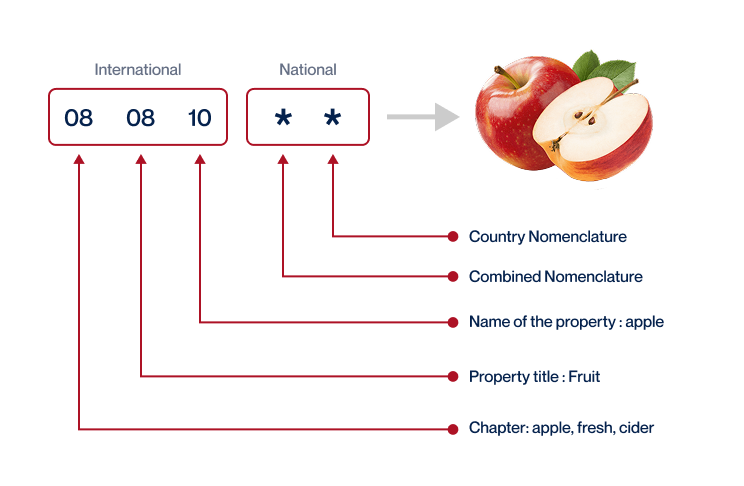
If your HS is wrong, you risk reclassification during customs inspection process, which can mean higher duty, fines, or a post clearance audit. Here’s an infographic showing you how to read an HS code.
Step 3 – Calculate the Customs Value
Lebanese customs generally base duties on the CIF value for customs purposes, meaning cost of goods plus freight plus insurance. Under the standard customs value calculation method, you start from the transaction value, then adjust for elements that were not included in the invoice.
If you buy goods for 10,000 USD under FOB and pay 1,500 USD freight and 200 USD insurance, your customs value becomes 11,700 USD. You also need to add assists, special packaging, commissions, or royalties if they are linked to the sale. If you forget these elements, you expose yourself to value adjustment after clearance during audit.
Step 4 – Figure out the applicable Import Tariff
An import tariff is the percentage applied to your customs value to calculate duty. In practice, you verify the import tariff Lebanon linked to your HS code classification.
Here is the method we use in every step by step customs clearance process Lebanon file. First, open the official tariff database used by your customs broker in Lebanon. Second, enter the full HS code. Third, read the standard duty rate and check if any additional measures apply.
- Standard duty rate, confirm the percentage.
- Additional duties, anti dumping or specific levies.
- Restrictions, links to import license requirements Lebanon.
If your customs value is 11,700 USD and the duty rate is 5 percent, your duty would be 585 USD. Always verify whether your goods are subject to special measures, because ignoring them can trigger customs penalties and fines. If you are unsure, we review the code and rate before you commit to pricing.
Step 5 – Consider other Import Duties and Taxes
After duty, you calculate VAT on imports Lebanon. VAT is generally applied on the customs value plus customs duty. If your customs value is 11,700 USD and duty is 585 USD, VAT is calculated on 12,285 USD. This is where many importers underestimate their cash flow exposure.
Then check other measures such as excise, anti dumping, or product specific controls under restricted and prohibited goods Lebanon. Some goods may require advance authorization or inspection before release.
- Verify VAT base, customs value plus duty.
- Check special regimes, temporary import procedure or duty suspension regime.
- Confirm documents, accurate packing list for customs clearance and invoice.
If you miss one of these checks, you can face clearance delay under risk assessment or reassessment after release.
Step 6 – Calculate the Customs Duties
The core formulas are straightforward. Duty = customs value × duty rate. VAT = tax base × VAT rate, where the tax base usually includes customs value plus duty.
Using the earlier example, 11,700 USD × 5 percent gives 585 USD duty. Then VAT applies to 12,285 USD, according to the applicable rate in Lebanon. If other taxes apply, you add them separately.
What happens next depends on your setup. Your Importer of Record Lebanon or appointed customs broker in Lebanon pays the assessed amounts before release, unless you use a bonded warehouse Lebanon or duty suspension regime. If documents are inconsistent, you may be routed to red line inspection under the customs risk assessment system, which can extend storage and handling costs.
Step-by-step: how customs clearance usually works on this route
When you import from Vietnam, the operational flow matters as much as the calculation. The sequence can differ depending on the port of entry, airport, shipment type, and Incoterm, but the core logic remains the same. Here is how we typically coordinate the file.
- You prepare the commercial set, including commercial invoice requirements, packing list for customs clearance, bill of lading or airway bill, and when needed the certificate of origin Vietnam.
- We appoint or coordinate with your customs broker in Lebanon under a valid power of attorney for customs broker.
- Before arrival, we submit data through electronic customs filing and, when possible, request pre arrival customs clearance.
- Customs runs its customs risk assessment and assigns green line or red line status.
- If green line, duties are assessed and paid, and goods are released quickly.
- If red line, the customs inspection process takes place, this is a key moment of truth where HS, value, and origin are verified.
- After payment of customs duties and import taxes Lebanon, goods are released or transferred to a bonded warehouse Lebanon if required.
- For special cases, you may use temporary import procedure or later a re export procedure.
- Finally, keep your full file ready for potential post clearance audit, because customs can review past declarations months later.
The delays usually happen at document validation and inspection. If you align HS, value, and origin before shipment, you stay in control instead of reacting to problems at the port.
Contact Details for Customs Authorities
Vietnam Customs
Lebanon Customs
Required documents for customs clearance in Lebanon
When you ship from Vietnam to Lebanon, most customs delays do not come from the border itself. They come from documents that do not match. Your shipper name, consignee, values, quantities and HS codes must be identical across every file. One mismatch is enough to trigger a customs hold, storage fees at Port of Beirut, and days of back and forth with your broker. The first thing we always tell you is simple, treat your paperwork as one single file, not six separate documents.
Bill of Lading or Air Waybill
The Bill of Lading for sea freight or the Air Waybill for air freight is the transport contract issued by your carrier. Lebanese customs and your broker use it to confirm who shipped the goods, who receives them, and how they entered the country. If you are shipping by sea to Beirut, you will usually deal with an original B/L or a telex release.
Example: 1x 40’ container from Ho Chi Minh City to Beirut, consignee name exactly matching the commercial invoice.
Common mistake, you change the consignee name at the last minute and forget to update the B/L, which can lead to a clearance suspension until corrected.
Packing List
The Packing List details how your goods are physically packed, cartons, pallets, net weight, gross weight and volume. Lebanese customs officers compare it with your commercial invoice to verify quantities and detect inconsistencies. It is also what inspectors rely on if they open your container.
Example: 500 cartons of coffee, 10 kg net each, total gross weight 5,400 kg, 8 pallets.
Common mistake, you round weights or volumes and they no longer match the manifest, which can trigger a physical inspection and additional port charges.
Commercial Invoice
The Commercial Invoice is the financial document that states the real transaction value of your goods. Lebanese customs calculate duties and taxes based on the declared value and the HS code you provide. If the description is vague, your broker cannot defend your tariff classification.
Example: “Roasted cashew nuts, HS code 0801, FOB Ho Chi Minh City, total value USD XX,XXX” with identical figures on all documents.
Common mistake, under-declaring value or using a generic description like “food products”, which can result in revaluation by customs and penalties.
Certificate of Origin
The Certificate of Origin confirms that your goods were manufactured in Vietnam. Lebanese customs request it to determine the correct duty rate and to verify the country of manufacture. Without it, you may lose access to any applicable preferential tariff treatment.
Example: Certificate issued by the Vietnamese Chamber of Commerce stating “Origin: Vietnam” for a shipment of textiles.
Common mistake, submitting a certificate with a product description that does not exactly match the invoice, which can delay clearance until clarification.
Get Started with FNM Vietnam
Prohibited and Restricted items when importing into Lebanon
Before you ship, you need to understand the difference. Restricted goods can enter Lebanon, but only with prior approvals, permits or specific labeling. Prohibited goods should not enter at all and can be seized or destroyed. If you are unsure, you check before loading in Vietnam, not after arrival at Beirut Port. That is how you avoid expensive surprises.
Restricted products
- Food products, health certificates and Arabic labeling often required.
- Pharmaceuticals and medical devices, prior authorization and product registration.
- Cosmetics, ingredient review and compliance with local standards.
- Telecommunication equipment, technical approval before import.
- Chemicals, safety data sheets and controlled substance checks.
- Used machinery, additional inspection and documentation scrutiny.
Prohibited products
- Narcotics and controlled drugs, strictly banned without exception.
- Counterfeit goods, immediate seizure and legal consequences.
- Weapons and ammunition, prohibited without special government clearance.
- Hazardous waste, entry not permitted.
If you have any doubt about classification, you confirm the HS code assessment with your broker before shipment. Shipping first and asking later can lead to confiscation or forced re-export, and those costs are fully on you.
Trade agreements and preferential duties for imports from Vietnam to Lebanon
As of 2025, there is no bilateral free trade agreement between Vietnam and Lebanon. This means your goods are generally assessed under Lebanon’s standard customs tariff schedule. Your final duty rate depends on the HS code, the declared customs value, and any internal taxes applied at import.
You should also know that Lebanon applies ad valorem duties on many consumer and industrial goods, and customs may review declared values if they appear below market benchmarks. In practice, your Certificate of Origin still matters to confirm Vietnamese origin, even without a specific FTA in place. The key point for you is to verify the exact tariff line before you quote your landed cost, because a small HS code change can significantly affect the total duty and VAT payable at clearance.
If you are importing sensitive categories such as food, electronics or machinery, you should double-check whether any additional internal taxes, technical controls or temporary measures apply at the time of shipment. Regulations can evolve, and assuming a zero or reduced rate without confirmation can result in a budget gap at arrival. We always recommend validating the applicable duty rate and tax base with your broker before cargo departure so your costing reflects the real landed cost structure.
Your Next Step with FNM Vietnam
Additional logistics services
Warehousing
Finding the right warehousing solution in Vietnam can be as daunting as navigating Hanoi's bustling streets. Protecting delicate items, like Vietnam's famous lychee, in temperature-controlled facilities is key to prevent spoilage. For trustworthy warehousing solutions in Vietnam, you need expert knowledge on the ground. Let us help you clear the food market crowd and find your path. More info on our dedicated page: Warehousing.
Packing
When shipping between Vietnam and Lebanon, perfect packaging is key to protect your goods from unexpected damages. Need to repackage? It's common for textiles or machinery to require this service. Partner with a reliable agent like us, confident in handling anything from ceramics to electronic parts. More info on our dedicated page: Freight packaging.

Transport Insurance
Shipping your goods safely is our topmost priority. As compared to fire insurance, transport insurance is preventative by design and mitigates potential risks associated with long-distance transportation. This can range from damage due to bad weather while at sea or unexpected incidents during loading and offloading. For instance, a well-planned cargo insurance can even cover the damage of fragile items that unexpectedly fell during handling. More info on our dedicated page: Cargo Insurance.
Household goods shipping
Sending your cherished personal items from Vietnam to Lebanon? Choose our Personal Effects Shipping for utmost care of your fragile or hefty goods. Picture this: our experts gently packing your vintage mirror or the bulky family couch, ensuring they reach Lebanon intact. Relocation is stressful, we're here to ease the burden. More info on our dedicated page: Shipping Personal Belongings.
Procurement in Thailand
Cracking the code of global procurement? FNM Vietnam has you covered. We specialize in helping businesses source and manufacture in Asia, East Europe, and beyond. Say goodbye to daunting language barriers and hello to a smooth sourcing journey, complete with reliable suppliers. To illustrate, we could help you find the perfect ceramics manufacturer in Hanoi or a reliable textiles factory in Hoi An. Don't sweat the details -- let us handle the procurement process for you. More info on our dedicated page: Sourcing services.

Quality Control
Quality control is your best bet when shipping from Vietnam to Lebanon. It's crucial to ensure your products meet Lebanon's strict standards and avoid costly returns. Imagine shipping customized handicrafts only to find they don't meet your buyer's specifications? By utilizing our quality inspections, you bypass these issues, ensuring your products are perfect before they leave the factory floor. More info on our dedicated page: Quality Inspection

Conformité des produits aux normes
Ensuring your goods meet all required standards is crucial before shipping, sparing you unnecessary hassles later. We step in with Product Compliance Services, conducting detail-oriented laboratory tests to certify alignments with destination regulations. Picture this: A toy manufacturer, saved from a costly recall thanks to due diligence on lead restrictions. Peace of mind, wrapped in our services!