In short ⚡
Importing Cashew Nuts from Vietnam: Suppliers, Grades and Logistics requires choosing the right kernel grade, verifying the processor, defining food-safety requirements, and controlling packaging, inspection, documentation and shipping conditions. Key purchasing and logistics considerations include:| Area | Key information |
|---|---|
| Suppliers | Verify the legal entity, factory address, certifications, export history, bank details and lot-specific laboratory reports. Arrange an independent pre-shipment inspection. |
| Grades | W180 and W240 suit premium snacks; W320 is common for retail and foodservice; W450 and pieces suit value-oriented packs and further processing. |
| Quality | Specify colour, size count, whole and broken percentages, moisture, foreign matter, defect tolerances, aflatoxin and cadmium limits in the contract. |
| Packaging | Use vacuum-, CO2- or nitrogen-flushed packaging, commonly in 10–25 kg formats or 10 kg tins inside cartons. |
| Shipping | A standard container typically holds 700–750 cartons of 25 kg, or approximately 17.5–18.75 tonnes. Confirm the payload, container condition, seal and humidity protection. |
| Documents | Prepare the commercial invoice, packing list, bill of lading, certificate of origin and certificate of analysis, plus destination-specific compliance documents. |
The guide covers Vietnam’s cashew export market, W180–W450 grades and pieces, processor verification, EU and US food-safety rules, contracts and payment protection, packaging, container shipping and the seven steps for placing a first order.
We hope you’ll find this article genuinely useful, but remember, if you ever feel lost at any step, whether it’s finding a supplier, validating quality, managing international shipping or customs, FNM Vietnam can handle it all for you!
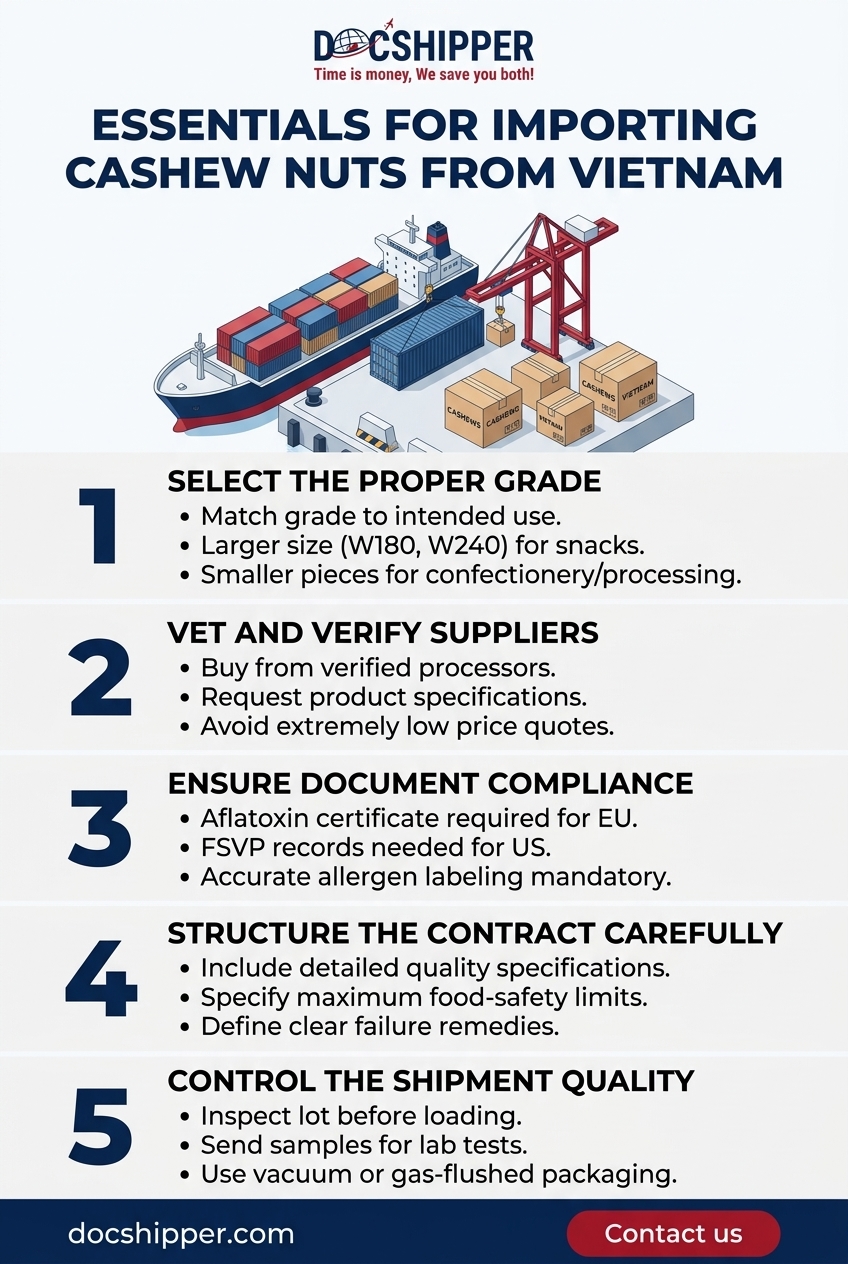
To import cashew nuts from Vietnam successfully, choose the grade against your end use, buy from a verified processor, define food-safety limits in the contract, and inspect the lot before loading. The shipment should then leave in vacuum or gas-flushed packaging with complete customs and compliance documents.
Vietnam is a strong sourcing base for cashew kernels, but a low quotation alone does not guarantee a good purchase. Buyers must control four risks: the grade may not match the sample, contamination may cause rejection, payment documents may be mishandled, and humidity may damage the kernels during transit.
DocShipper Info
Verify raw-nut origin before comparing processor quotations.
Why Vietnam dominates the cashew kernel trade
Vietnam is the world’s leading cashew kernel exporter, with US$5.2 billion in exports and 766,585 tonnes exported in 2025. The country supplied 66% of EU cashew kernel imports in 2024, according to CBI, the Dutch Centre for the Promotion of Imports.
This position comes from processing capacity rather than domestic raw-nut supply alone. Vietnamese processors import substantial volumes of raw cashews, then sort, shell, grade, dry and pack the kernels for international buyers. In 2025, Vietnam imported 2.9 million tonnes of raw cashews worth US$4.5 billion, while domestic raw supply covered only approximately 10% of processing needs.
For an importer, this has two consequences. First, Vietnam offers established grading, processing and export expertise. Second, the origin of the raw nut can affect colour, taste, yield and price, so you should ask whether the kernels were processed from African, Cambodian or other raw-cashew origins.
The market is also changing. China became Vietnam’s largest cashew export market in 2025, ahead of the United States and the Netherlands. Bach Khanh Nhut, Vice Chairman of the Vietnam Cashew Association, attributed the rise in exports to China to “the recovery of the Chinese economy, rising demand for health-oriented agricultural products” in a statement reported by Viet Nam News on 26 January 2026.
| Indicator | What it means for buyers |
| US$5.2 billion and 766,585 tonnes exported in 2025 | Vietnam has large-scale processing and export experience. |
| 2.9 million tonnes of raw cashews imported in 2025 | Ask for raw-nut origin if colour, flavour or traceability matters. |
| 66% of EU kernel imports supplied in 2024 | Many Vietnamese processors already work with European compliance requirements. |
| China became the largest market in 2025 | Market demand is broad, but processors may have competing allocations during busy periods. |
DocShipper Tips
Match the grade to your end use before requesting firm prices.
Cashew grades explained: W180, W240, W320 and pieces
A cashew grade combines a visual description with a size count. “W” means white whole, while the number indicates the approximate number of kernels per pound. Therefore, W240 is larger than W320 because fewer kernels are needed to make one pound.
Trade codes are not the same as every formal quality class. The UNECE standard describes classes such as extra, class I and class II, while commercial codes communicate size, colour and whether the kernel is whole or broken. Put both the commercial grade and measurable quality requirements in your purchase contract.
Use W180 or W240 when the product will be sold as a premium snack or visible topping. W320 is the mainstream choice for retail packs, foodservice and general snacking. W450 and pieces can be more suitable for bakery, confectionery, cashew butter or products where the whole-kernel appearance is less important.
CBI reported indicative Q4 2025 export prices of approximately US$7.60 to US$7.90 per kilogram for W240 and US$7.20 to US$7.50 per kilogram for W320. Using the brief’s 17.5-tonne example, the midpoint difference is approximately US$0.40 per kilogram, or about US$7,000 on 17.5 tonnes. Treat these as dated indications, not a current quotation.
| Grade | Meaning | Typical use |
| W180 | White whole, very large kernels | Premium snacking and gift packs |
| W240 | White whole, large kernels | Premium retail, visible toppings and snack mixes |
| W320 | White whole, mainstream size | General snacking, foodservice and retail packs |
| W450 | White whole, smaller kernels | Value-oriented packs and processing |
| LP, SP, BB and other pieces | Large pieces, small pieces, butts or broken kernels | Bakery, confectionery, sauces and further processing |
When comparing offers, request the size count, colour category, whole-kernel percentage, broken percentage, moisture, foreign matter and defect tolerances. A supplier may quote “W320” while applying different tolerances for scorched kernels, insect damage or broken pieces.
DocShipper Alert
Put measurable tolerances in writing and approve a sealed reference sample.
Finding and vetting cashew processors in Vietnam
Buy from a processor or established exporter that can demonstrate food-safety controls, traceable production and a verifiable export history. Ask for the certification relevant to your market, such as BRCGS, IFS, FSSC 22000 or SQF, and verify that the certificate belongs to the named production site.
Start by separating processors from traders. A processor should be able to explain its production line, raw-nut origin, grading equipment, packing method and laboratory controls. A trader may still be legitimate, but you need to identify the actual factory responsible for the lot and retain the right to inspect it.
Request the business licence, factory address, food-safety certificate, product specification, recent certificate of analysis, export references and a sample of previous shipping documents with sensitive commercial details redacted. You can also check industry contacts through VINACAS, the Vietnam Cashew Association, but association membership is not a substitute for an audit.
Use the same sample protocol for every candidate. Approve a sealed reference sample, specify the laboratory tests, and arrange an independent pre-shipment inspection against that reference. A price far below the market range, pressure for full advance payment, refusal of inspection or inconsistent company and bank details should stop the transaction until independently resolved.
- Confirm the legal name, factory address and bank-account ownership.
- Verify certifications directly with the certification body where possible.
- Ask for lot-specific laboratory reports, not only a generic factory certificate.
- Compare the production sample with the approved commercial sample.
- Inspect the goods before loading and retain sealed counter-samples.
- Check whether the supplier can provide the documents required in your destination market.
DocShipper supports supplier audits and quality-control operations in Vietnam. Our experience includes more than 700 quality-control and conformity projects, but the inspection scope should always be adapted to your grade, destination and contract.
DocShipper Alert
Confirm limits and documents early with your importer or customs broker.
Looking for a Reliable Shipping & Sourcing Partner?


Food-safety and customs requirements by destination
Compliance depends on the destination, not only on the Vietnamese supplier. The EU sets contaminant limits for cashews, the United States places verification duties on the food importer, and every market expects accurate allergen labelling and traceable commercial documents.
European Union and UK
For the EU, Regulation (EU) 2023/915 sets the maximum level for aflatoxin B1 in tree nuts at 5 µg/kg and total aflatoxins at 10 µg/kg. The maximum cadmium level for cashews is 0.20 mg/kg. Confirm the applicable product category and current legal text before shipment because regulations and enforcement conditions can change.
Ask for a lot-specific certificate of analysis covering aflatoxins, moisture, microbiological parameters where relevant, pesticides where required, and heavy metals. Your importer or customs broker should also check whether the shipment is subject to additional controls and monitor the EU’s RASFF alert system for current risks.
For preferential tariff treatment under the EU-Vietnam Free Trade Agreement, confirm the product’s tariff classification and obtain the required proof of origin. Do not assume that a Vietnamese export automatically qualifies for a preferential duty rate.
United States
US buyers must plan for FDA requirements, including facility registration where applicable, prior notice and the Foreign Supplier Verification Program. Under FSVP, the US importer is responsible for evaluating foreign suppliers and verifying that imported food was produced in a manner that provides the level of public-health protection required by US rules.
Define who performs the FSVP activities before the first shipment. Keep the supplier evaluation, hazard analysis, verification procedures, corrective-action records and laboratory evidence in an accessible file. Cashews must also be declared as a tree-nut allergen under applicable US labelling rules.
For 2026, a Honigman client alert reported a 12.5% Section 301 forced-labor tariff on Vietnamese goods from 24 July 2026, stacking with MFN duty and any applicable anti-dumping or countervailing duties, subject to exemptions. Verify the current HTS classification, exclusions and customs treatment with a US customs professional before pricing the order.
Other markets
For the UK, Middle East and Australia, confirm the local contaminant limits, importer registrations, allergen wording, phytosanitary or health-document requirements and tariff treatment. Your supplier should prepare the commercial invoice, packing list, bill of lading, certificate of origin and certificate of analysis in the format your broker accepts.
| Destination | Key controls | Documents and duty logic |
| EU | Aflatoxin B1: 5 µg/kg; total aflatoxins: 10 µg/kg; cadmium: 0.20 mg/kg for cashews | Certificate of analysis, traceability, allergen labelling and proof of origin if claiming EVFTA preference |
| United States | FDA requirements, prior notice and importer FSVP | Facility and importer records, supplier verification, correct HTS classification and applicable tariff review |
| UK | UK food-safety, contaminant and allergen rules | Confirm UK tariff and origin requirements separately from EU treatment |
| Other markets | Local contaminant, labelling and registration requirements | Ask the broker for the destination-specific document checklist before production |
DocShipper Alert
Verify bank details independently before releasing funds or shipping documents.
DocShipper Platform
One platform. Your entire supply chain
Sourcing, freight, customs & documents — all centralised, all visible, 24/7.
Contracts and payment: protect yourself against quality and fraud risks
Your contract should make the shipment measurable. Specify the grade, colour, whole-kernel percentage, broken percentage, moisture, foreign matter, defect tolerances, aflatoxin limits, cadmium limits, packing format, lot identification and the laboratory method used for disputed results.
Link final payment to an independent pre-shipment inspection and the agreed laboratory report. The contract should state who selects the inspector, who pays the cost, what happens if the lot fails, whether the supplier must rework or replace it, and how quickly a dispute must be notified.
Choose payment terms according to the counterparty risk. A letter of credit can provide document-based control, while documentary collection may be appropriate only with a trusted bank and established supplier. Avoid treating a scanned invoice or a supplier’s changed bank details as sufficient confirmation. Verify payment instructions through a known contact using an independent channel.
The 2022 Italy case demonstrates why both documents and counterparties matter. The case involved 100 containers and approximately US$7 million at risk, with 74 containers shipped without payment before recovery efforts. Pham Van Cong, President of VINACAS at the time, stressed that international brokers must be trustworthy and that export documents must be complete, as reported by The Investor.
- Product: grade, size count, colour, whole and broken percentages.
- Safety: aflatoxin, moisture, cadmium, foreign matter and other destination limits.
- Inspection: independent inspector, inspection date, sampling plan and failure remedy.
- Documents: invoice, packing list, bill of lading, certificate of origin and certificate of analysis.
- Payment: deposit, balance trigger, bank verification and document-release conditions.
- Claims: notice period, laboratory method, retention samples and dispute resolution.
Packing and shipping cashews from Vietnam
Cashew kernels generally ship in vacuum or CO2 or nitrogen-flushed flexi bags, commonly in 10 to 25 kg formats, or in 10 kg tins placed inside cartons. The objective is to limit oxygen, moisture and oxidation while protecting the kernels from crushing and contamination.
CBI states that a standard container typically holds 700 to 750 cartons of 25 kg flexi pouches. Using the lower loading figure, 700 cartons multiplied by 25 kg equals 17,500 kg, or 17.5 tonnes per container. Confirm the final payload with the pack dimensions, carrier limits and destination rules.
For a full-container order, ask the forwarder to confirm the container condition, loading plan, seal number, ventilation requirements and humidity-control measures. The cargo should be protected from wet floors, damaged cartons, odours and condensation. Use cargo insurance appropriate to the commodity and contract, since carrier liability may not cover every loss.
Most export flows move from southern Vietnam through ports serving Ho Chi Minh City, including Cat Lai and Cai Mep. For smaller orders, compare consolidation with a dedicated container, but confirm how the consolidator protects food cargo from odours, moisture and incompatible goods. Freight rates and transit times change, so request a current quote rather than relying on a general estimate.
| Decision | Buyer action |
| Packaging | Choose vacuum, CO2 or nitrogen flushing and specify bag, tin, carton and net-weight requirements. |
| Container | Confirm clean, dry equipment, loading plan, seal control and humidity protection. |
| Volume | Use the CBI reference of 700 to 750 cartons of 25 kg, then validate the actual payload. |
| Insurance | Insure the cargo against the risks not covered by the carrier or chosen Incoterm. |
| Partial order | Compare consolidation costs and food-cargo handling conditions with FCL pricing. |
DocShipper Info
Use one detailed RFQ for every verified processor.
Step by step: placing your first cashew order
The safest first order is a controlled comparison rather than a quick purchase. Fix the specification first, compare three to five verified processors, test the samples, and make the contract and inspection conditions binding before production begins.
- Define the requirement. State the destination, end use, grade, colour, whole and broken percentages, moisture limit, contaminant limits, packaging, quantity and whether you need natural, roasted, salted or flavoured kernels.
- Request comparable quotations. Send the same RFQ to three to five processors or exporters. Request the Incoterm, validity period, production lead time, certificates, raw-nut origin, packing details and current laboratory evidence.
- Screen the counterparties. Verify the legal entity, factory, certifications, bank account and export history. Reject suppliers that refuse an audit or independent inspection.
- Test and approve samples. Compare appearance, size, taste, odour and breakage. Send representative samples to an accredited laboratory for the tests required by your destination.
- Sign the contract. Include the complete quality specification, inspection rights, failure remedy, payment milestones, documents, shipment window and claims procedure.
- Inspect before loading. Check quantity, carton marks, packaging integrity, lot numbers and laboratory results. Retain sealed samples and photograph the loading and container seal.
- Clear and receive the shipment. Give the broker the invoice, packing list, bill of lading, origin evidence and certificate of analysis. Inspect the cargo on arrival and record any damage immediately.
Use this RFQ template to keep supplier replies comparable:
Subject: RFQ for Vietnamese cashew kernels, [grade], [destination]
Please quote for [quantity] of [grade and colour], for delivery to [destination]. Confirm the price and Incoterm, packing format, net weight per carton, available shipment window, minimum order quantity, payment terms, certifications, recent certificate of analysis, raw-cashew origin, whole and broken percentages, moisture, foreign matter, aflatoxin and cadmium results, inspection availability, and required export documents. Please also confirm whether the product is natural, roasted, salted or flavoured.
Send us your grade, volume and destination before accepting a quotation. We can verify the processor, arrange pre-shipment inspection and coordinate FCL sea freight and customs handling for cashews from Ho Chi Minh City.
Conclusion
- Vietnam is the leading cashew kernel exporter, with US$5.2 billion in exports in 2025.
- A grade combines colour and size: the number indicates approximate kernels per pound, so W240 is larger than W320.
- EU buyers must control aflatoxin and cadmium limits, while US buyers must plan for FDA requirements and FSVP.
- Put moisture, broken percentage, foreign matter, aflatoxin and inspection rights in the contract.
- Use secure payment and document procedures, especially when working with a new broker or exporter.
- Ship in vacuum or gas-flushed packaging and validate the container loading plan before booking.
Share your target grade, order volume and destination with us. DocShipper can verify Vietnamese cashew processors, inspect the goods before loading and arrange shipping from Ho Chi Minh City with customs coordination.
FAQ | How to Import Cashew Nuts from Vietnam: A Practical Buyer’s Guide
Yes, but these products require a different specification from plain kernels. Ask the processor to declare the complete recipe, additives, salt or flavouring levels, allergen information, shelf life and processing method. Before production, verify the destination market’s labelling, food-registration and tariff requirements, then approve a sample of the finished product rather than only a sample of the raw kernels.
Do not assume that they do—or that they do not. Requirements can differ between raw cashew nuts, shelled kernels, roasted products and the destination country. Processed kernels may follow food-import and health-document rules rather than the same plant-health requirements as untreated agricultural products. Ask your customs broker or plant-health authority for written confirmation before the supplier prepares the export documents.
First, place the affected lot on hold and do not mix it with other stock. Photograph the seals, cartons, labels and visible defects, then notify the supplier and insurer within the contractual claims period. Use the laboratory and sampling method stated in the contract, compare the result with your retained reference sample, and agree whether the supplier must replace, rework or refund the shipment. Keep the lot available until the dispute is formally resolved.
The supplier’s price is only one part of the purchase cost. Build your estimate around the product price, freight, insurance, inspection, laboratory testing, origin and customs documents, import duty, VAT or sales tax, customs brokerage, port charges, inland delivery and any warehousing or demurrage. Compare suppliers using the same Incoterm and destination; otherwise, a cheaper quotation may simply exclude costs that another exporter has already included.
There is no universal best choice, but the Incoterm should match your ability to control freight and customs. FOB can provide clearer control over the international shipment if you have a reliable forwarder, while CIF or CFR may be simpler when the Vietnamese exporter has stronger shipping arrangements. Treat DDP cautiously for food imports: confirm who will be the importer of record, who handles compliance and whether the proposed customs structure is legal in your market.
Yes. A trial order can help you verify the product, packaging, transit performance and supplier communication before committing to a larger volume. However, compare the cost and handling conditions of LCL with a dedicated container, because consolidation can expose food cargo to odours, moisture or incompatible goods. Use the same contract specifications, inspection rights and laboratory requirements for the trial shipment that you plan to use for future orders.
Need Help with Logistics
or Sourcing in Vietnam ?
First, we secure the right products from the right suppliers at the right price by managing the sourcing process from start to finish. Then, we simplify your shipping experience - from pickup to final delivery - ensuring any product, anywhere, is delivered at highly competitive prices.


Fill the Form
Prefer email? Send us your inquiry, and we’ll get back to you as soon as possible.
Contact us