In short ⚡
Importing Electronics from Vietnam: The New Assembly Hub means sourcing products from a major assembly base specializing in phones, computers, PCBA, chargers, cables, accessories and selected sub-assemblies. Vietnam exported US$107.75 billion in computers, electronic products and components in 2025, but relies heavily on imported components and foreign-invested manufacturers. Key topics include Vietnam’s electronics products and supplier types, Vietnamese origin and transshipment, market-specific compliance, tariffs, lithium-battery shipping, factory audits and first-order sourcing steps.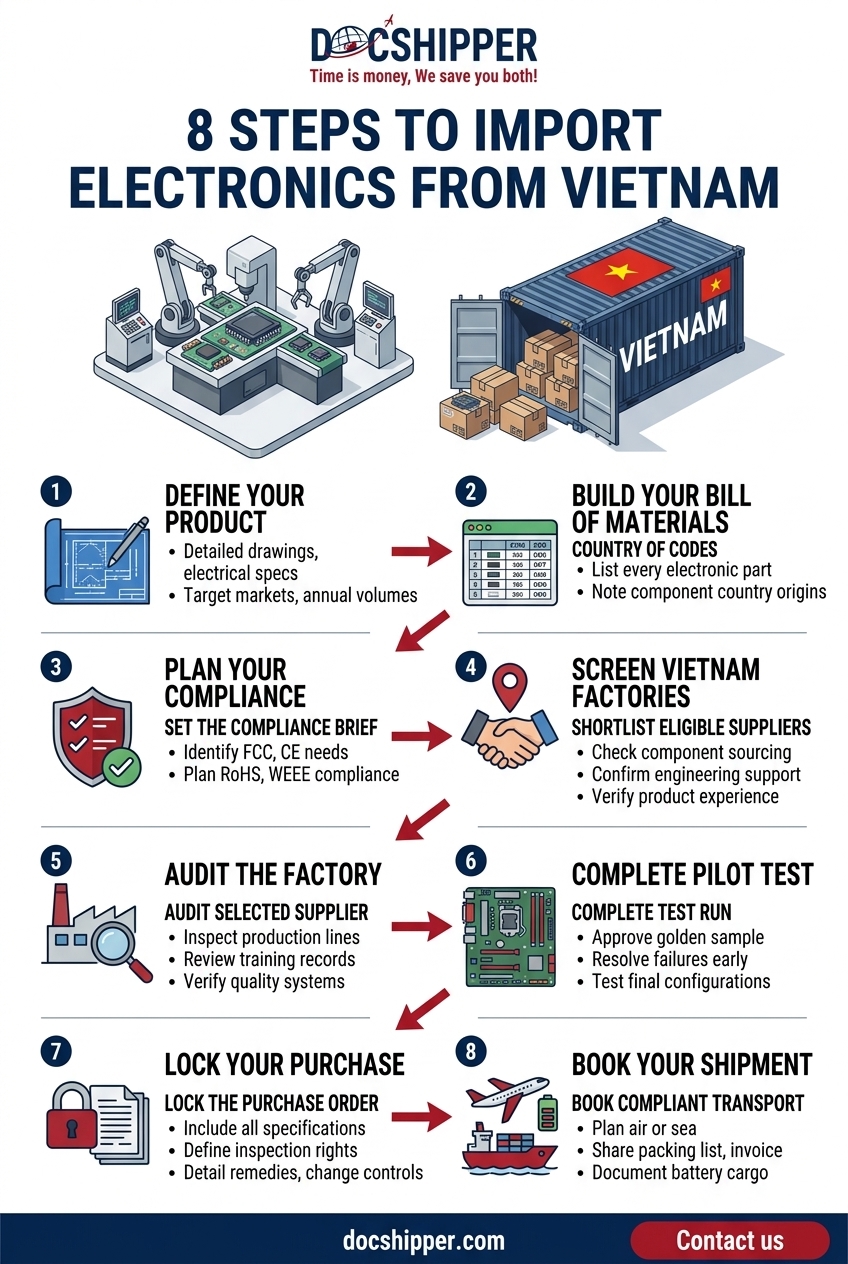
We hope you’ll find this article genuinely useful, but remember, if you ever feel lost at any step, whether it’s finding a supplier, validating quality, managing international shipping or customs, FNM Vietnam can handle it all for you!
Vietnam is a serious electronics manufacturing base, but it is not a simple replacement for China. The country is strong in assembly, consumer electronics, PCBA, cables, chargers and selected sub-assemblies, while much of its component ecosystem remains dependent on imports.
For a brand, distributor or hardware startup, the decision comes down to fit: can a Vietnamese supplier meet your volume, engineering, certification and delivery requirements, while your documentation supports Vietnamese origin at customs? This guide explains what Vietnam makes, which supplier type suits a mid-size buyer, and how to plan compliance, tariffs and shipping.
DocShipper Info
Get expert guidance on compliant sourcing and shipping
What electronics are made in Vietnam today
Vietnam exported US$107.75 billion of computers, electronic products and components in 2025. Its main strengths are large-scale assembly, phones and phone components, computers, displays, consumer accessories, PCBA and selected electrical sub-assemblies, particularly around northern industrial clusters.
The largest programs are generally operated by foreign-invested companies. Samsung, LG Display, Amkor and other Korean, Taiwanese, Japanese and Chinese-linked manufacturers have built significant capacity around Bac Ninh, Thai Nguyen and Hai Phong. Ho Chi Minh City and the southern industrial corridor also support electronics assembly, plastics, metalwork, cables and accessories.
The scale should not be confused with local independence. Vietnam Briefing reports that foreign-invested companies represent approximately 98% of electronics exports, while domestic localization remains around 5% to 10%. Component imports increased to US$136 billion in 2025, which affects lead times, origin analysis and the cost of smaller production runs.
The export momentum continued in 2026. During the first half of the year, computers, electronics and components reached US$71.16 billion, while phones and components reached US$31.69 billion, according to VnEconomy.
| Product category | Vietnamese maturity | Typical supplier type |
| Phones and phone components | Very high for large programs, more limited for SME access | Large foreign-invested manufacturer or approved tier-2 supplier |
| Computers and electronic equipment | High for assembly and contract manufacturing | Foreign-invested EMS, contract manufacturer or specialist assembler |
| PCBA and sub-assemblies | Growing, with strong northern capacity | EMS provider with SMT lines, testing and engineering support |
| Chargers, cables and accessories | Good fit for qualified mid-size buyers | Tier-2 FDI factory or Vietnamese assembler |
| Small appliances and consumer electronics | Moderate to high, depending on product complexity | Assembler supported by plastic, metal and electronics subcontractors |
| Advanced local components | More limited because many components are imported | Specialist supplier or foreign-invested component manufacturer |
Who can manufacture for you: matching supplier type to your volume
Large electronics manufacturers in Vietnam often serve global brands and operate with demanding forecasts, approved vendor lists and high minimum order quantities. A mid-size buyer is more likely to succeed with a tier-2 foreign-invested factory, a specialist EMS provider or a Vietnamese assembler that already manages electronics subcontractors.
Your first question should not be “Can this factory make electronics?” Ask instead whether it can make your product at your expected volume, with your testing requirements and certification responsibility. Request the number and type of SMT lines, in-house engineering capacity, testing equipment, traceability system, production lead time, minimum order quantity and experience with comparable products.
SMT means surface-mount technology, the automated process used to place electronic components directly onto a printed circuit board. For PCBA Vietnam projects, verify whether the supplier only places components or also handles PCB sourcing, programming, functional testing, conformal coating, final assembly and packaging.
A factory audit should compare the supplier’s claims with physical evidence. Review business registration, production areas, equipment serial numbers, calibration records, incoming inspection, non-conformity handling, worker training, subcontracting controls and customer references. Check ISO 9001 where quality management is important, and IATF requirements where the product is intended for the automotive sector.
Vietnam versus China is not a simple unit-price comparison. Vietnam may offer diversification, access to established export factories and a useful production base for selected products, while China can provide deeper component density and broader supplier choice. Compare the complete landed cost, including tooling, testing, imported components, engineering changes, minimum order quantities, freight, duty, quality controls and inventory.
| Buyer situation | Best initial target | What to verify |
| Large recurring program | FDI EMS or approved high-capacity manufacturer | Capacity reservation, forecast requirements, quality systems and component sourcing |
| Mid-size consumer brand | Tier-2 FDI factory or specialist assembler | MOQ, engineering support, certifications and production flexibility |
| Hardware startup | EMS provider with NPI and prototype capability | Prototype process, design-for-manufacturing feedback and test development |
| Accessory or charger brand | Qualified cable, charger or small-appliance supplier | Safety testing, component traceability and battery or power-adapter compliance |
Looking for a Reliable Shipping & Sourcing Partner?


Country of origin and transshipment: making “Made in Vietnam” hold up
Vietnamese origin is not created by a Vietnamese invoice or a final carton label. Customs generally looks for a substantial transformation in Vietnam, while preferential trade agreements apply product-specific rules. Simple relabelling, repacking or minor assembly of Chinese goods can be treated as transshipment or can result in the product retaining another country of origin.
For the United States, the relevant analysis is based on the facts of production and the applicable customs rules. The US Customs and Border Protection approach examines what processing occurred, whether the product became a new article and how the manufacturing operations changed its character. For the EU and UK, preferential treatment under the EVFTA or UKVFTA depends on meeting the agreement’s product-specific rules of origin and holding the required proof.
Vietnam’s import-dependent structure makes this review particularly important. In the first eight months of 2026, electronics exports were reported at US$101 billion compared with electronics imports of US$161 billion. These figures do not prove that a specific product lacks Vietnamese origin, but they explain why you should document the bill of materials and the transformation performed in Vietnam.
Before production, ask the supplier to identify the origin of each major component and describe every Vietnamese operation. Do not accept a vague statement that the goods are “Made in Vietnam” without a manufacturing flow, costed BOM and supporting records.
Origin documentation checklist:
- Final bill of materials showing part numbers, quantities and component suppliers.
- Country of origin for major imported components.
- Production flow from incoming materials to finished goods.
- Description of Vietnamese processing, assembly, programming and testing.
- Purchase invoices and import records for key components.
- Production records, work orders and batch traceability.
- Cost breakdown supporting the applicable origin rule.
- Commercial invoice, packing list and transport documents consistent with the goods.
- Certificate of origin or origin declaration where the destination and trade agreement require it.
Red flags include a supplier that refuses to disclose component origins, offers a certificate before reviewing the product, proposes shipping Chinese-labelled goods through Vietnam, or cannot explain which operations take place in its own factory. Resolve origin questions before paying for tooling or committing to a large production run.
DocShipper Alert
Validate certifications before mass production, including the final product configuration
Certifications and compliance by market
For the United States, electronics may require FCC equipment authorization, depending on the product’s radio and digital functions. In the EU, CE marking may involve the EMC, Low Voltage or Radio Equipment Directive, while RoHS restricts certain hazardous substances and WEEE creates producer responsibility obligations for electrical and electronic waste. In the UK, determine whether CE remains accepted for your product or whether UKCA requirements apply at the time of placing it on the market.
The importer, brand owner or manufacturer placing the product on the market is usually responsible for compliance, even when the Vietnamese factory arranges the laboratory work. Your contract should state who owns the technical file, who approves test reports, who pays for retesting after a design change and who controls the use of marks on the product and packaging.
FCC equipment authorization can involve supplier’s declaration or certification, depending on the equipment. For EU products, the technical file should support the declaration of conformity and identify the standards used. RoHS and WEEE are not interchangeable: RoHS concerns restricted substances, while WEEE concerns collection, recycling and producer obligations.
Test a representative pilot build before mass production. A change to the power supply, wireless module, enclosure, antenna, PCB layout or battery can affect the validity of previous results. Keep the final approved sample, test reports, declarations, labels, user instructions and serial-number or batch-control records together.
| Market | Main rules or marks | Importer duty |
| United States | FCC authorization where applicable; safety requirements may also apply | Confirm the FCC route, retain technical records and ensure the shipped configuration matches the tested product |
| European Union | CE under applicable EMC, LVD or RED rules; RoHS; WEEE | Prepare the technical file, declaration of conformity, marking and producer-responsibility registrations |
| United Kingdom | UKCA or accepted CE route, depending on product and current rules | Verify the current market-access route, technical documentation and importer details |
| Products with lithium batteries | Transport testing and dangerous-goods requirements | Obtain battery test documentation and ensure packaging, labels and transport declarations are correct |
Tariffs on electronics from Vietnam
There is no single tariff for “electronics from Vietnam.” The payable amount depends on the product’s HS classification, customs value, origin, destination, trade preference and any additional measure applying to the product. Confirm the classification and current rate before issuing a purchase order because tariff policy can change.
For the United States, Vietnamese electronics may be subject to the normal HTS duty plus additional measures. According to a 24 July 2026 alert from Honigman, a 12.5% Section 301 forced-labor tariff applies to Vietnamese goods from that date, unless an exemption applies. It can stack with MFN duty and applicable anti-dumping or countervailing duties, while certain Section 232 goods are exempt according to the cited alert.
For the EU and UK, EVFTA and UKVFTA preferences may reduce duty when the product meets the applicable origin rule and the importer holds valid proof. Preference is not automatic merely because a product ships from Vietnam. Your broker should check the exact HS code, rule of origin and documentary requirement for the finished product.
Illustrative duty calculation using the brief’s data:
- FOB value of accessories: US$50,000.
- MFN duty rate: 0%.
- Section 301 rate: 12.5%.
- Section 301 duty: US$50,000 × 12.5% = US$6,250.
- Result: US$6,250 in Section 301 duty, if the goods are covered and not exempt.
This calculation excludes possible customs fees, transport-related charges, other duties and taxes. Treat it as a tariff illustration, not a quotation or a classification ruling.
DocShipper Alert
Confirm your HS code and applicable duties before placing the order
DocShipper Platform
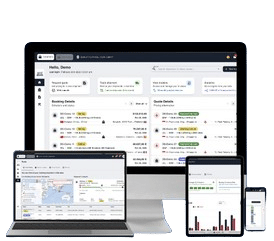
One platform. Your entire supply chain
Sourcing, freight, customs & documents — all centralised, all visible, 24/7.
Shipping electronics from Vietnam: air, sea and lithium batteries
High-value, time-sensitive electronics commonly move by air from Noi Bai near Hanoi or Tan Son Nhat near Ho Chi Minh City. Larger, less urgent shipments generally move by sea from Hai Phong in the north or Cai Mep and other southern gateways. The right choice depends on cargo value, volume, inventory risk, launch date, battery content and the cost of a stockout.
Air freight is attractive for prototypes, replacement units and compact high-value products, but lithium batteries can change the booking process. Sea freight is often more practical for replenishment volumes, yet batteries still require correct declarations, packaging and carrier acceptance. Do not let a supplier hand over battery cargo as ordinary electronics without reviewing the transport classification.
Lithium battery shipments are governed by dangerous-goods requirements, including the IATA Dangerous Goods Regulations for air transport. Request the UN38.3 test summary for the battery or battery-powered product, identify whether batteries are packed with equipment or contained in equipment, and confirm the applicable state-of-charge, packaging, marking and documentation rules with the freight forwarder.
Protect high-value cargo with a documented packing specification, serial-number control, moisture protection where required, tamper-evident procedures and appropriate cargo insurance. The forwarder should receive the commercial invoice, packing list, battery details, UN38.3 documentation, safety data where relevant and the final product description before booking.
| Shipment profile | Likely mode | Documents and controls |
| Prototype or urgent replacement units | Air | Commercial invoice, packing list, battery classification and IATA documentation where applicable |
| High-value compact electronics without batteries | Air or controlled courier service | Accurate product description, insurance and security-sensitive handling |
| Regular replenishment volume | Sea | Commercial documents, origin records, cargo insurance and container packing controls |
| Products containing lithium batteries | Air or sea after dangerous-goods review | UN38.3 test summary, correct packaging, marks, labels and carrier acceptance |
DocShipper Tips
Share UN38.3 records early to avoid booking delays or rejected cargo
Step by step: sourcing your first electronics order in Vietnam
The safest first order is built around a complete specification, a verified factory and a controlled pilot run. Do not begin with a supplier catalogue and a target price alone. Electronics quality, origin and transport compliance are determined by the product configuration and the manufacturing process.
- Define the product. Prepare drawings, electrical specifications, firmware requirements, packaging, target markets, expected annual volume, first-order volume and acceptable defect levels.
- Build the BOM. List every electronic, mechanical and packaging component, including part numbers, approved alternatives, battery information and expected country of origin.
- Set the compliance brief. Identify whether the product needs FCC, CE, UKCA, RoHS, WEEE, battery transport documentation or market-specific safety testing.
- Shortlist suppliers. Screen for product experience, factory ownership, production capacity, MOQ, lead time, engineering support, quality systems and export history. Exclude brokers that cannot identify the manufacturing site.
- Audit the factory. Verify SMT or assembly equipment, testing, calibration, incoming inspection, traceability, subcontracting controls, worker training and corrective-action records.
- Request samples or a pilot build. Approve the BOM, golden sample, firmware version, packaging and inspection criteria before mass production.
- Complete testing. Use an appropriate laboratory and test the final production-intent configuration. Resolve failures before purchasing a full run.
- Confirm origin. Review the BOM, imported components, Vietnamese transformation, production records and certificate-of-origin route with your customs adviser.
- Lock the purchase order. Include specifications, approved sample, change-control procedure, inspection rights, defect remedies, packaging, Incoterm and documentation obligations.
- Inspect before shipment. Use production inspection and, where appropriate, functional testing, battery checks, carton verification and serial-number reconciliation.
- Book compliant transport. Give the forwarder the final invoice, packing list, origin documents, battery documents and product classification before cargo collection.
RFQ template for Vietnam electronics suppliers:
- Product: product name, model, drawings, photos and intended use.
- BOM: component list, approved brands, alternatives and expected component origin.
- Volumes: prototype quantity, first order, monthly forecast and annual forecast.
- Manufacturing: SMT, PCBA, final assembly, programming, testing and subcontracted processes.
- Compliance: destination markets, FCC, CE, UKCA, RoHS, WEEE, safety and battery requirements.
- Quality: inspection standard, functional tests, sampling level, defect limits and traceability.
- Packaging: unit packaging, master cartons, labels, manuals, pallet requirements and drop-test expectations.
- Commercial terms: tooling, unit price, MOQ, lead time, payment terms and quotation validity.
- Shipping: preferred Incoterm, pickup location, battery status, air or sea plan and required export documents.
DocShipper can support supplier search and factory audit, production quality control, and air or sea freight from northern and southern Vietnam. Our experience includes more than 600 sourcing projects and 700 quality-control and conformity projects, with supplier evaluation covering operating history, capacity, MOQ and lead time.
DocShipper Info
Start with a verified supplier shortlist and controlled pilot order
Conclusion: is Vietnam right for your electronics?
Vietnam can be a strong sourcing base when your product fits its assembly and electronics clusters, your volume matches the supplier’s capacity, and your origin and compliance files are prepared before shipment. It is less suitable when you need a deep domestic component ecosystem without importing key parts or when you expect a large factory to accept a small, engineering-intensive order without qualification.
- Vietnam is a major electronics exporter, but the sector is foreign-invested and dependent on imported components.
- Match your volume and engineering needs to an FDI manufacturer, tier-2 supplier, EMS provider or local assembler.
- Support Vietnamese origin with a real production flow, BOM evidence and consistent customs documents.
- Complete FCC, CE, UKCA, RoHS and WEEE checks before mass production, as applicable to your market and product.
- Classify tariffs by HS code and origin, then plan for additional US measures or EU and UK preference rules.
- For battery products, confirm UN38.3 documentation and IATA or sea-freight dangerous-goods requirements before booking.
Share your product, destination markets and expected volumes with us. Our Vietnam team can shortlist and audit factories, inspect production, verify documentation and arrange compliant air or sea freight.
FAQ | How to Import Electronics from Vietnam: Suppliers, Origin, Compliance and Shipping
Yes, but you should target an EMS provider or specialist assembler with an NPI and prototype process rather than a high-volume factory. Ask whether it accepts engineering runs, what prototype MOQ applies, and whether setup, programming, tooling and test-fixture costs are charged separately. Treat the prototype as a paid qualification stage, not simply as a smaller version of a mass-production order.
Do not approve substitutions informally by email. Require the supplier to submit the proposed part number, reason for the change, technical comparison, availability impact and updated compliance documents. Recheck electrical performance, safety, radio behavior, battery characteristics and applicable certifications before authorizing the change. Your purchase contract should state that no component, firmware or process change is allowed without written approval.
Limit the information shared during the quotation stage and disclose detailed drawings, source code and the complete BOM only to shortlisted suppliers. Use a confidentiality and intellectual-property agreement covering designs, firmware, tooling, test fixtures, customer data and subcontractors. Also clarify who owns improvements created during engineering and require the supplier to return or securely destroy confidential files when the project ends.
A DDP price can simplify logistics, but it may hide the identity of the importer, the declared customs value, the applicable origin claim or the party responsible for product compliance. Before accepting it, request a written breakdown of duties, taxes, brokerage, insurance, delivery charges and customs responsibilities. For regulated electronics, confirm that you—not an unknown intermediary—will receive the compliance records and remain able to demonstrate how the goods were imported.
Define measurable acceptance criteria before production starts. The inspection plan should cover appearance, dimensions, power-up behavior, firmware version, connectivity, charging or battery performance, accessories, labels, packaging and serial-number traceability. Keep a signed golden sample and require the factory to record test results by batch. For a first order, combine an in-process inspection with a final inspection rather than relying only on photographs from the supplier.
Preserve evidence before moving or repacking the cargo. Photograph the container or pallets, seals, carton labels, damage, serial numbers and affected products, then compare the findings with the packing list and inspection report. Notify the supplier, freight forwarder, insurer and broker within the contractual or insurance deadlines. Your purchase order should define the remedy—replacement, rework, credit or refund—and specify who pays for return transport, sorting and corrective inspection.
Not automatically. Even a seemingly minor change to a power adapter, wireless module, antenna, PCB layout, battery, enclosure or firmware can affect emissions, safety or performance. Ask your compliance laboratory or technical adviser to perform a change assessment before production. If the tested configuration is no longer representative, arrange partial or complete retesting and update the technical file, declarations, labels and user documentation.
Need Help with Logistics
or Sourcing in Vietnam ?
First, we secure the right products from the right suppliers at the right price by managing the sourcing process from start to finish. Then, we simplify your shipping experience - from pickup to final delivery - ensuring any product, anywhere, is delivered at highly competitive prices.


Fill the Form
Prefer email? Send us your inquiry, and we’ll get back to you as soon as possible.
Contact us