In short ⚡
Importing Rice from Vietnam: Varieties, Suppliers and Shipping requires choosing a measurable rice specification, verifying exporter eligibility, checking destination rules, and comparing complete shipping costs. Vietnam offers ST25, ST24, Jasmine, white long-grain, broken and glutinous rice, with 2025 average exports priced at US$509 per tonne. Key considerations include:| Area | Main options or figures | Essential checks |
|---|---|---|
| Rice varieties | ST25, ST24, Jasmine, white long grain, broken rice and glutinous rice | Broken percentage, moisture, chalky kernels, admixture, grain length, milling degree and crop year |
| Suppliers | Licensed exporters, integrated mills and trading companies using approved facilities | Certificate of eligibility, company records, warehouse and milling capability, traceability and representative samples |
| Destination compliance | EU EVFTA quota of 80,000 tonnes; US FDA and FSVP requirements | Import permits, phytosanitary documents, pesticide-residue limits, quota access, labelling and customs rules |
| Pricing and inspection | 2025 average export price: US$509 per tonne; July 2026 reference: US$511 per tonne | Comparable FOB quotations, detailed contract tolerances, independent inspection and laboratory testing |
| Shipping | 25 kg or 50 kg PP/BOPP bags; ports including Cat Lai, Cai Mep and Hai Phong | Clean container, moisture protection, fumigation, loading plan, insurance and complete shipping documents |
The full guide covers Vietnamese rice varieties and specifications, licensed exporters, destination duties and import rules, pricing and inspection, packaging and sea freight, and the step-by-step process for a first shipment.
We hope you’ll find this article genuinely useful, but remember, if you ever feel lost at any step, whether it’s finding a supplier, validating quality, managing international shipping or customs, FNM Vietnam can handle it all for you!
Why buy rice from Vietnam
Vietnam is one of the world’s leading rice exporters, with a broad offer ranging from fragrant premium varieties such as ST25 and ST24 to white long-grain rice, glutinous rice and broken rice. In 2025, Vietnam exported 8.06 million tonnes at an average price of US$509 per tonne, with much of the production concentrated in the Mekong Delta.
Vietnamese rice suits several buying strategies. A distributor can source fragrant rice for Asian-food retail, white long grain for mainstream wholesale, broken rice for value-focused markets, or glutinous rice for specialist food channels. The right choice depends less on the country of origin than on the exact variety, milling specification, crop year, packaging and destination requirements.
Price positioning changed significantly between 2024 and 2025. Vietnam’s average export price fell from US$627.2 per tonne in 2024 to US$509 per tonne in 2025, a difference of approximately 19%. According to Vietnam Customs data reported by Anti-Dumping.vn, the Philippines represented 40% of export volume in 2025, making Philippine import policy an important market signal.
That dependency creates both opportunity and risk. A Philippine import ban contributed to weaker Vietnamese prices in 2025, while the country’s expected imports of approximately 5 million tonnes in 2026, with Vietnam supplying around 74% of those imports, support stronger demand. Use these figures as market context, not as a quotation for your specific grade.
| Buyer question | Practical implication |
| Do I need premium or standard rice? | Choose fragrant rice for aroma and retail positioning; choose white or broken rice when price and volume matter most. |
| Which market moves Vietnamese prices? | The Philippines is a major demand driver, so import-policy changes can affect available offers. |
| Where is rice mainly produced? | The Mekong Delta is Vietnam’s main rice-producing region and a key sourcing area. |
DocShipper Tips
Specify quality tolerances before requesting quotations, samples or private-label packaging.
Vietnamese rice varieties and specs to put in your contract
Order by variety and measurable specification, not by a commercial name alone. Your contract should state the broken percentage, moisture, chalky kernels, admixture, grain length, milling degree, crop year, packaging and inspection method.
Fragrant rice: ST25, ST24 and Jasmine
ST25 and ST24 are premium fragrant varieties typically selected for aroma, texture and retail differentiation. Jasmine rice is also bought for its fragrance and long-grain appearance, but confirm the precise variety or commercial grade offered by the supplier because “Jasmine” can cover different specifications in international trade.
ST25 has strong branding value. It won the World’s Best Rice award for the third time in 2019, 2023 and 2025. However, an award does not replace a specification sheet or laboratory test. Do Ha Nam, Chairman of the Vietnam Food Association, said that “international awards are the fastest way to introduce a brand to both domestic and overseas markets.” His comment, reported by Tuoi Tre News, supports the branding value of premium rice, not a guarantee that every ST25 offer has identical quality.
White long grain and broken rice
White long-grain rice is usually purchased according to the proportion of broken kernels. A 5% broken specification is positioned differently from 25% broken rice: both can be commercially suitable, but they serve different price points, recipes and markets. Broken rice can be used in value-oriented food channels, processed foods or markets where appearance is less important than cost.
“Broken percentage” means the share of kernels that are shorter than the accepted whole-grain standard. “Moisture” is the water content of the rice; it affects storage stability and may be limited by the buyer’s destination rules. “Admixture” refers to unwanted material or other grains mixed into the lot, while “chalky kernels” are opaque, less translucent grains that can affect appearance and cooking performance.
Looking for a Reliable Shipping & Sourcing Partner?


Glutinous rice
Glutinous rice is a separate buying category and should not be treated as a substitute for fragrant or ordinary white rice. Its sticky cooking texture makes it suitable for specialist retail, Asian foodservice and traditional products, but the contract should identify the variety, crop, milling condition and intended use clearly.
Before requesting offers, prepare a specification sheet containing these points:
- Rice variety and commercial grade, such as ST25, ST24, Jasmine, white long grain or glutinous rice.
- Broken-kernel tolerance, for example 5% or 25% where applicable.
- Maximum moisture, chalky kernels and admixture tolerances.
- Grain length, milling degree, colour and aroma requirements.
- Crop year and whether new-crop or older-crop rice is acceptable.
- Required laboratory tests, pesticide-residue limits and inspection procedure.
- Bag material, net weight, printing, private-label artwork and pallet requirements.
| Variety or grade | Profile | Typical use or market |
| ST25 | Premium fragrant rice with strong origin and award-based branding potential. | Premium retail, private label and Asian-food distribution. |
| ST24 | Fragrant premium rice selected for aroma and eating quality. | Specialist retail and foodservice. |
| Jasmine | Fragrant long-grain category; confirm the exact commercial specification. | Asian-food retail, restaurants and wholesale. |
| White long grain, 5% broken | Mostly whole kernels with a lower broken proportion. | Mainstream retail and foodservice where appearance matters. |
| White long grain, 25% broken | Higher broken proportion and generally more price-oriented positioning. | Wholesale, food processing and value-focused markets. |
| Broken rice | Kernels that do not meet the whole-grain length standard. | Value markets, processed foods and specific regional cuisines. |
| Glutinous rice | Sticky cooking texture and distinct end use. | Specialist retail and traditional food products. |
DocShipper Alert
Request certificates, facility details and representative samples to reduce sourcing risks.
Finding licensed rice exporters in Vietnam
For standard rice, ask for the exporter’s certificate of eligibility before negotiating seriously. Under Decree 365/2026/ND-CP, in force from 1 October 2026, eligible standard-rice exporters must have a dedicated warehouse and milling facility. Organic, parboiled and fortified rice are identified as exemptions in the reported rules, but you should confirm how the exemption applies to your product.
A Vietnam rice exporter may be an integrated mill, a trading company working with approved facilities, or a specialist supplier managing both sourcing and export documentation. Do not assume that a polished website, a marketplace profile or a low quotation proves export eligibility. Request the certificate, company registration details, warehouse address, milling-facility information and recent export documentation.
Then verify the physical operation. A supplier audit should check storage conditions, pest control, moisture management, milling and sorting equipment, traceability between paddy and finished rice, packaging controls and the ability to keep your lot separate. Ask for a representative sample from the same crop and grade that will be shipped, rather than relying only on a catalogue sample.
Use the Vietnam Food Association and the Ministry of Industry and Trade as reference points, while treating each supplier’s documents as the decisive evidence. The certificate of eligibility is a starting control, not a substitute for pre-shipment inspection, laboratory analysis and destination compliance.
| Document or check | What to verify |
| Certificate of eligibility | Exporter is authorised for the relevant standard-rice activity under the applicable rules. |
| Warehouse details | Dedicated storage, hygiene, pest control and capacity for the contracted lot. |
| Milling facility | Ownership or controlled access, sorting capability and traceability. |
| Product sample | Sample matches the variety, crop and measurable specification in the offer. |
| Company and export records | Legal identity, banking details, references and ability to issue required documents. |
DocShipper Alert
Verify permits, MRLs and quota access before signing the contract.
Import rules and duties by destination
Rice import requirements depend on the destination, tariff classification, product type and importer status. Before signing, verify the import permit, phytosanitary requirements, pesticide-residue limits, quota access, labelling rules and customs documents for the exact rice you plan to buy.
For the European Union, the EVFTA provides an annual duty-free quota of 80,000 tonnes: 30,000 tonnes of milled rice, 20,000 tonnes of unmilled rice and 30,000 tonnes of fragrant rice. Broken rice is fully liberalised under the cited guidance. Quota access is not automatic, so confirm allocation, origin documentation and the applicable customs procedure through the EU’s Access2Markets portal.
The EU also applies strict maximum residue levels, known as MRLs. An MRL is the legally permitted maximum concentration of a pesticide residue in food. Check the relevant active substances in the EU Pesticides Database, communicate the limits to the supplier before production and test the shipment through an accredited laboratory.
For the United States, the importer must address FDA food-import requirements, including the Foreign Supplier Verification Program. Review the FDA FSVP requirements, prior-notice obligations, facility registration and applicable tariff treatment. The brief identifies a 12.5% Section 301 tariff unless exempt, but tariff treatment must be checked again at the time of import.
UK buyers should verify the applicable UKVFTA quota and origin procedure rather than assuming that EU quota treatment continues after import into the UK. Buyers in the Philippines, other Asian markets and Africa may need import permits, phytosanitary certificates, inspection certificates and specific labelling or fumigation documents.
| Destination | Key rule | Documents or checks | Duty point |
| European Union | EVFTA quota and strict pesticide MRLs. | Origin proof, quota procedure, phytosanitary and laboratory compliance. | 80,000 tonnes duty-free quota; broken rice liberalised under the cited guidance. |
| United Kingdom | Verify UKVFTA treatment and UK food-import rules. | Origin, import, food-safety and phytosanitary documents. | Confirm current quota and tariff before contracting. |
| United States | FDA food-import compliance and FSVP. | FSVP records, prior notice, facility and supplier documentation. | Check current tariff treatment, including possible exemptions. |
| Philippines and Asia | Destination-specific import policy and permits. | Import permit, phytosanitary certificate, inspection and customs documents. | Confirm current tariff and quota conditions with the importer. |
| Africa and Middle East | National food-safety, inspection and import rules. | Phytosanitary, fumigation, quality, weight and origin documents as required. | Obtain a destination-specific landed-cost calculation. |
DocShipper Tips
Compare equivalent FOB quotations with identical grades, ports, packaging and validity periods.
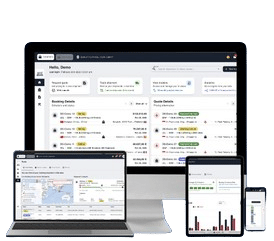
DocShipper Platform
One platform. Your entire supply chain
Sourcing, freight, customs & documents — all centralised, all visible, 24/7.
Prices, contracts and inspection
Vietnamese rice prices move with crop timing, grade and Philippine demand. The average export price was US$509 per tonne in 2025, while the first eight months of 2026 averaged US$481.5 per tonne and July 2026 averaged US$511 per tonne. These are dated market references across exports, not guaranteed prices for ST25, Jasmine or any other individual specification.
Request a current FOB quotation from several Vietnam rice suppliers and ask them to state the quotation date, port, variety, broken percentage, crop, packing and validity period. FOB means the seller delivers the goods on board the vessel at the agreed port, while the buyer normally manages the main sea freight, insurance and destination costs. Compare like with like.
Your sales contract should define the quality tolerance and the remedy if the lot fails. Include the inspection company, sampling method, laboratory, weight basis, moisture limit, broken percentage, chalky-kernel tolerance, admixture, crop year, packaging, fumigation, loading deadline, payment trigger and claims procedure.
Use independent pre-shipment inspection for weight, packaging, visible condition and quality. A company such as SGS or Bureau Veritas may be suitable depending on the destination and contract. Payment against an inspection certificate reduces the risk of discovering a specification mismatch after loading, although it does not replace destination testing.
Illustrative calculation using the brief’s July 2026 average:
- Reference export price: US$511 per tonne.
- Illustrative quantity: 2 containers at approximately 25 tonnes each.
- Total illustrative quantity: approximately 50 tonnes.
- FOB rice value: 50 tonnes × US$511 = approximately US$25,550.
- Not included: ocean freight, insurance, inspection, inland transport, duties, quota costs, port charges and destination taxes.
This calculation is only a planning illustration. Container payload depends on bag size, loading instructions and the confirmed operational plan, so obtain the final payload and freight quotation from your logistics provider.
DocShipper Tips
Confirm loading, moisture control and documents with your forwarder before production.
Packing and shipping rice from Vietnam
Rice is commonly packed in 25 kg or 50 kg PP or BOPP bags, or in smaller retail packs for private-label brands. PP means polypropylene, while BOPP is biaxially oriented polypropylene, a printed and more resistant form often used for branded packaging. Confirm net weight, sewing or sealing method, inner liner, printing, language, barcode and pallet requirements before production.
For container shipping, the forwarder should confirm the suitable container type, loading plan, moisture protection and any liner requirement. The container must be clean, dry, odour-free and free from visible contamination. Fumigation requirements vary by destination and packaging, so specify the treatment, certificate and approved chemical or method in advance.
Vietnamese rice may be shipped from ports serving Ho Chi Minh City, including Cat Lai and Cai Mep, while Hai Phong can be relevant for northern supply chains. The best port depends on the mill location, vessel schedule, destination, inland haulage and available equipment. Do not insert a standard bag count into the contract until the loading plan is confirmed.
Prepare the document set before loading. Depending on the destination, this may include the commercial invoice, packing list, bill of lading, phytosanitary certificate, fumigation certificate, certificate of origin, quality certificate, weight certificate and inspection report. For EU preference claims, check whether a Form EUR.1 or an origin declaration is required for your shipment and exporter status.
| Shipping element | Buyer action |
| Packaging | Approve bag material, size, net weight, artwork, language and private-label details. |
| Container | Require a clean, dry container and confirm the loading plan with the forwarder. |
| Protection | Define fumigation, moisture control and liner requirements for the destination. |
| Port and routing | Compare Cat Lai, Cai Mep or Hai Phong according to mill location and vessel schedule. |
| Documents | Confirm B/L, invoice, packing list, phytosanitary, fumigation, origin, quality and weight documents. |
| Insurance | Arrange cargo insurance according to the Incoterm and the value at risk. |
DocShipper Info
Follow each control step from supplier screening through inspection, loading and customs clearance.
Step by step: your first rice import from Vietnam
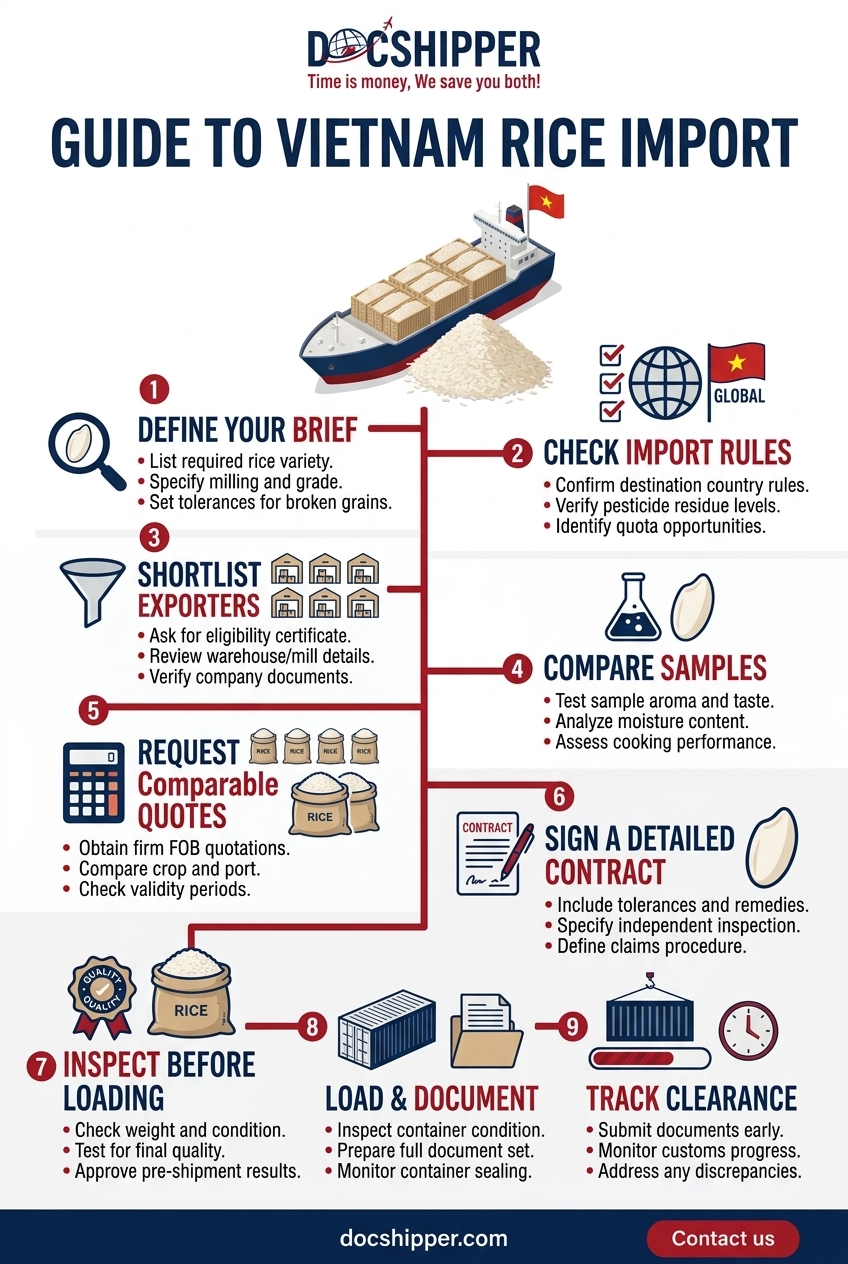
The safest first shipment follows a specification-led process: define the rice, compare licensed exporters, test the product, contract the controls, inspect before loading and verify the destination documents.
- Define the buying brief. State the variety, broken percentage, moisture, chalky kernels, admixture, grain length, crop year, quantity, packing, destination and intended use.
- Check destination compliance. Confirm MRLs, import permits, quota access, labelling, phytosanitary requirements and customs documents before requesting a firm quotation.
- Shortlist three to five exporters. Request the certificate of eligibility where applicable, warehouse and mill details, product specifications, company documents and recent references.
- Compare representative samples. Test aroma, cooking performance, appearance, broken percentage, moisture and relevant pesticide residues. Ensure the sample corresponds to the production lot.
- Request comparable offers. Ask for FOB pricing, quotation validity, port, crop, packing, quantity, production lead time, payment terms and included documents.
- Sign a detailed contract. Include tolerances, sampling, inspection, fumigation, claims, loading deadline, payment trigger and the remedy for non-conformity.
- Inspect and test before loading. Use an independent inspector and laboratory where appropriate. Approve the lot only after the results match the contract.
- Load and document the shipment. Check container condition, packing, seals, fumigation and the complete document set before release.
- Track clearance. Give the importer, customs broker and food-safety representative the documents early enough to resolve discrepancies before arrival.
Use this RFQ template when contacting Vietnam rice exporters:
- Product: variety and commercial grade.
- Quality: broken percentage, moisture, chalky kernels, admixture, grain length and milling degree.
- Crop: required crop year and acceptable substitutions, if any.
- Quantity: trial or regular volume, with the loading plan to be confirmed.
- Packing: 25 kg or 50 kg PP/BOPP bags, retail packs or private label.
- Destination: final country, port and applicable import requirements.
- Commercial terms: FOB port quotation, payment terms and quotation validity.
- Documents: phytosanitary, fumigation, certificate of origin, quality, weight and inspection certificates.
- Compliance: pesticide-residue testing and destination-specific food-safety evidence.
Conclusion
- Vietnam offers rice from premium ST25, ST24 and Jasmine to white long grain, glutinous and broken rice.
- Buy against measurable specifications, not only a variety name.
- Check the exporter’s certificate of eligibility and warehouse and milling capability under Decree 365/2026.
- The EU provides an 80,000-tonne annual EVFTA duty-free quota with strict MRL controls, while US buyers must address FDA and FSVP requirements.
- Inspect, test, fumigate and complete the documents before the container leaves Vietnam.
Tell us the variety, specification, packing and volume you need. We can verify Vietnam rice exporters, arrange pre-shipment inspection and coordinate FCL sea freight from Ho Chi Minh City or another suitable Vietnamese port.
FAQ | How to Import Rice from Vietnam: Varieties, Prices, Exporters and Shipping
Yes, but do not assume that a small shipment is exempt from import rules. Even commercial samples or LCL consignments may require an import permit, phytosanitary documents, labelling compliance and customs declarations. Confirm the minimum order, available packaging and destination requirements with the exporter and customs broker. For food-safety testing, make sure the trial lot comes from the same crop and production line intended for future orders.
Your contract should define the acceptance point, testing method, laboratory, sampling procedure and remedy before shipment. If the cargo fails, preserve the samples, obtain an independent counter-analysis and notify the supplier within the contractual claims period. Depending on the agreement, the remedy could be a price reduction, replacement, destruction or return at the responsible party’s cost. Cargo insurance normally does not cover a quality mismatch, so contractual protection and payment controls remain essential.
New-crop rice is generally selected for fresher aroma, brighter appearance and specific cooking characteristics, while older-crop rice may offer different texture and storage behaviour. Neither is automatically better for every market. State the acceptable crop year in the contract and test a production-representative sample for aroma, moisture, cooking performance and appearance. Do not allow the supplier to substitute the crop without written approval.
These products may fall under specific exemptions from standard-rice export eligibility rules, but an exemption does not remove product-specific compliance obligations. Request the supplier’s legal basis for the exemption, processing details, organic or fortification certificates where applicable, laboratory results and destination documents. Confirm the interpretation with the relevant Vietnamese authority and your importer before signing, because the requirements may differ by product and destination.
FOB can provide better control over the main freight, insurance and routing, but it requires you to manage the forwarder, booking, cargo insurance and destination costs. A supplier-arranged option may be simpler for a first shipment, but compare the freight, insurance coverage, handling fees and delivery responsibilities carefully. Whichever term you choose, write the exact named port and the party responsible for loading, documentation, damage, demurrage and customs clearance into the contract.
Approve the artwork only after checking the destination’s language, nutrition, origin, net-weight, allergen and importer-information rules. Obtain permission to use any supplier name, certification logo, award reference or Vietnamese geographical claim, and verify that your brand is available for registration in the target market. Before mass production, approve a physical packaging proof and specify who pays for incorrect printing, rejected labels or unused bags if the order is cancelled.
Need Help with Logistics
or Sourcing in Vietnam ?
First, we secure the right products from the right suppliers at the right price by managing the sourcing process from start to finish. Then, we simplify your shipping experience - from pickup to final delivery - ensuring any product, anywhere, is delivered at highly competitive prices.


Fill the Form
Prefer email? Send us your inquiry, and we’ll get back to you as soon as possible.
Contact us