In short ⚡
Certificate of Origin Vietnam (EUR.1, Form E, Form D): Which One You Need depends on the destination country and applicable trade agreement. The correct form also requires the goods to satisfy the agreement’s origin rules. Use this destination-based guide:| Destination | Agreement | Required certificate or origin document |
|---|---|---|
| European Union | EVFTA | EUR.1, or an eligible origin statement when EVFTA conditions are met |
| United Kingdom | UKVFTA | EUR.1 UK |
| China | ACFTA | Form E |
| ASEAN countries | ATIGA | Form D |
| Other or non-preferential destinations | No applicable preferential agreement | Form B or another document required by destination customs |
The guidance covers certificate purposes, destination-specific forms, the eCoSys application process, required origin evidence, and common mistakes that can cause preferential duty to be refused.
We hope you’ll find this article genuinely useful, but remember, if you ever feel lost at any step, whether it’s finding a supplier, validating quality, managing international shipping or customs, FNM Vietnam can handle it all for you!
What a certificate of origin from Vietnam is for
A certificate of origin from Vietnam proves where goods originate for customs purposes. A preferential certificate of origin lets the importer claim reduced or zero customs duty under a trade agreement, while a non-preferential certificate, usually Form B, confirms origin without automatically creating a tariff benefit.
The important decision belongs to the destination country and its applicable agreement, not to the supplier alone. Before production or shipment, the importer should tell the Vietnamese exporter which agreement and certificate format its customs authority requires.
A preferential C/O is used when the goods satisfy the agreement’s rules of origin. These rules may require that products be wholly obtained in Vietnam, sufficiently transformed there, or made with materials that meet a specified regional value or tariff-change test. The exporter must therefore support the application with evidence such as a bill of materials, supplier invoices and production information.
A non-preferential C/O has a different function. Form B can be requested when the destination, buyer or customs authority needs proof of Vietnamese origin but no preferential trade agreement applies. It does not, by itself, reduce duty. For a shipment to the United States, for example, the importer must check the current customs requirement because the United States does not appear in the preferential form list supplied for Vietnam in this brief. Depending on the product and transaction, customs may require a C/O, another origin statement or no C/O.
Origin is not the same as the place from which the goods are shipped. Vietnamese export clearance, a Vietnamese port and a Vietnamese seller do not automatically establish Vietnamese preferential origin. Customs may review the manufacturing process and the origin of incorporated materials before accepting the preference.
Vietnam issued 1.8 million preferential C/Os in 2024 in the EVFTA context, according to EuroCham Vietnam. That volume illustrates how frequently the document is used, but it does not remove the need to match the certificate to the exact destination, product and agreement.
| Document type | Purpose | Duty effect |
| Preferential C/O | Shows that goods satisfy a trade agreement’s origin rules | May allow reduced or zero preferential duty |
| Form B | Shows Vietnamese origin on a non-preferential basis | Does not automatically grant preferential duty |
| Origin declaration or self-certification | Exporter or approved origin party makes the required origin statement where the agreement permits it | May support a preference, subject to the agreement’s conditions |
DocShipper Info
Get document support before production.
Which form for which destination
Choose the Vietnamese C/O by destination first: EUR.1 applies to the European Union under the EVFTA, EUR.1 UK to the United Kingdom under the UKVFTA, Form E to China under the ACFTA, and Form D to ASEAN countries under ATIGA. Japan, Korea, CPTPP members and RCEP destinations use other forms or origin procedures, so the importer should confirm the agreement before asking the supplier to apply.
The practical workflow is simple. Identify the importing country, check whether a preferential agreement covers the product, confirm the product’s origin rule and then communicate the required form to the Vietnamese exporter. Asking for “a certificate of origin” without naming the form can lead to the wrong document being prepared.
For the European Union, the relevant preferential document is generally EUR.1 under the EVFTA. The EVFTA can also permit an origin statement for consignments below the applicable value threshold, including the EUR 6,000 threshold referenced in the brief, subject to the agreement’s conditions and the exporter’s status. Check the current European Commission rules before relying on self-certification, and see the dedicated EVFTA guidance for EU-specific details.
Self-certification is not a universal replacement for a Vietnamese-issued C/O. Some agreements provide origin declarations for approved exporters, registered exporters or shipments below a defined value. CPTPP, EVFTA and other agreements may use different conditions, wording and registration systems. The importer should verify the current rule with the destination customs authority and the relevant agreement before shipment.
For current tariff treatment and origin requirements, use the European Commission’s Access2Markets database for EU imports. For a broader overview of Vietnamese forms, the Vietnam Briefing guide identifies the main forms and their associated agreements. Always check the product code because the applicable origin rule can vary by tariff heading.
| Destination | Agreement or route | Vietnam C/O or origin document |
| European Union | EVFTA | EUR.1, or an eligible origin statement where the EVFTA conditions are met |
| United Kingdom | UKVFTA | EUR.1 UK, subject to the applicable UKVFTA procedure |
| China | ACFTA | Form E |
| ASEAN member states | ATIGA | Form D, subject to the applicable ATIGA origin procedure |
| Japan | VJEPA | Form VJ |
| Korea | VKFTA or AKFTA | Form VK or Form AK, depending on the agreement used |
| CPTPP partner | CPTPP | CPTPP certificate or permitted certification of origin, depending on the agreement rules |
| RCEP partner | RCEP | RCEP certificate of origin or permitted declaration, depending on the applicable procedure |
| India | AIFTA | Form AI |
| Australia or New Zealand | AANZFTA | AANZ form |
| Chile | VCFTA | Form VC |
| Eurasian Economic Union | VN-EAEU FTA | Form EAV |
| Other or non-preferential route | No applicable preferential agreement | Form B where proof of origin is required, or another document required by destination customs |
DocShipper Tips
Confirm the agreement and tariff rule before requesting EUR.1, Form E, Form D, or another origin document.
Looking for a Reliable Shipping & Sourcing Partner?


How to get a C/O in Vietnam
The Vietnamese exporter normally applies online through the Ministry of Industry and Trade’s eCoSys system, providing the export declaration, commercial invoice, transport document and evidence supporting Vietnamese origin. Since 5 May 2025, the Ministry of Industry and Trade, or MOIT, is the exclusive issuer of C/Os in Vietnam, including non-preferential documents and relevant REX registration.
This change followed Decision No. 1103/QD-BCT of 21 April 2025, which revoked the previous authority of the Vietnam Chamber of Commerce and Industry. The Ministry’s Import-Export Department is the relevant authority to monitor, while the eCoSys portal is the online application channel identified for C/O applications.
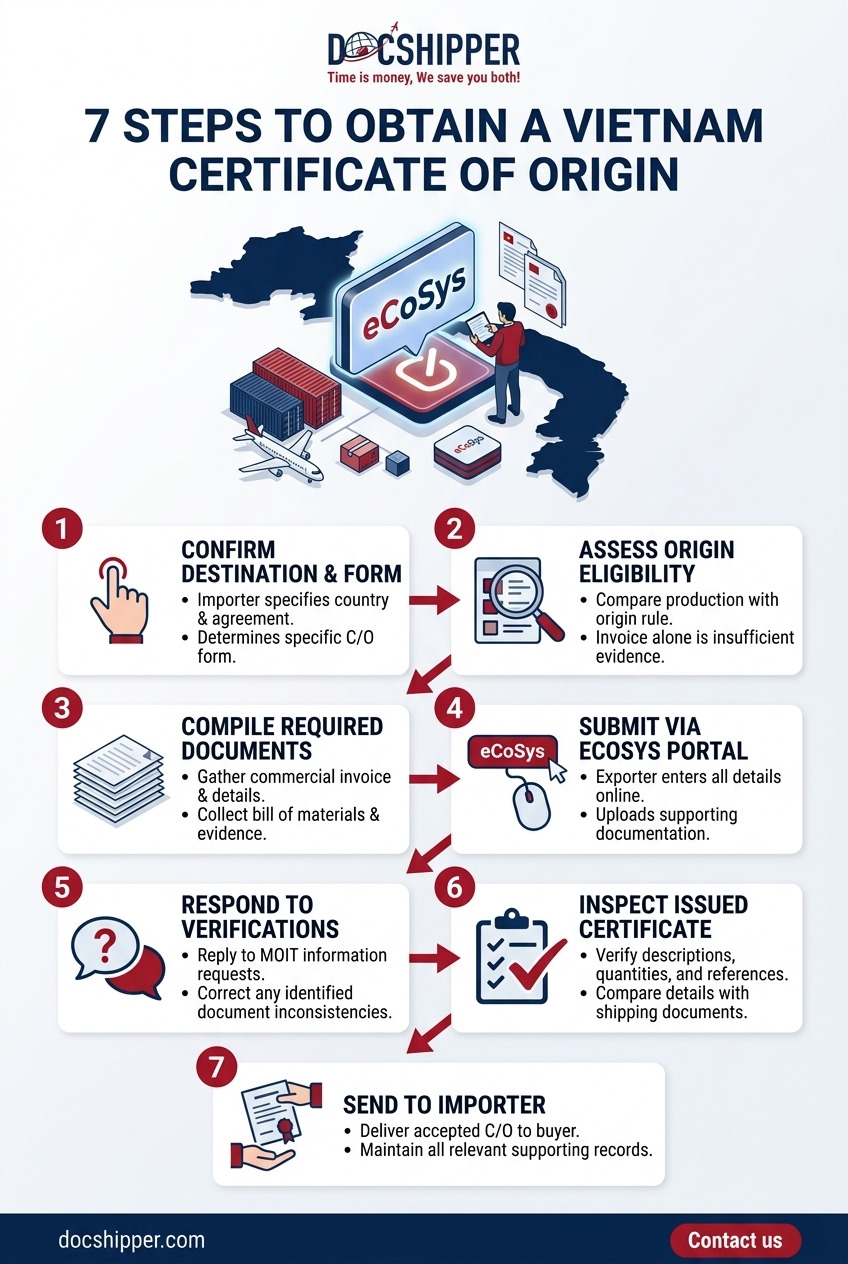
- Step 1: Confirm the destination and form. The importer sends the Vietnamese supplier the importing country, preferential agreement, product classification if available and required form. Do not leave the supplier to select the form based only on the shipping destination.
- Step 2: Check origin eligibility. Compare the product’s manufacturing process and materials with the agreement’s product-specific rule. A Vietnamese invoice is not sufficient evidence if the goods do not meet the agreement’s origin requirements.
- Step 3: Prepare the file. Gather the export declaration, commercial invoice, bill of lading or air waybill, bill of materials, purchase invoices and other production or origin evidence requested for the product.
- Step 4: Submit through eCoSys. The exporter enters the shipment and origin information, uploads or provides the required documents and selects the relevant C/O form. The application should be consistent with the export declaration and invoice.
- Step 5: Respond to verification requests. MOIT may request clarification or additional evidence. The exporter should answer before the shipment file becomes difficult to amend.
- Step 6: Check the issued certificate. Compare the exporter, importer, product description, quantities, invoice reference, transport details, origin criteria and signature or authentication details against the final shipping documents.
- Step 7: Send the document to the importer. The importer uses the C/O or permitted origin statement according to the destination customs procedure and keeps the supporting records in case of verification.
The core document checklist is therefore operational rather than merely administrative. The export declaration establishes the shipment context, the invoice identifies the sale and goods, the B/L or AWB supports transport details, and the bill of materials or purchase invoices support the origin claim.
- Export declaration
- Commercial invoice
- Bill of lading or air waybill
- Bill of materials or manufacturing statement
- Purchase invoices or supplier origin evidence
- Any agreement-specific declaration, registration or supporting record
Do not rely on an assumed processing time. The time required can vary with the form, completeness of the file, product and any request for verification. Submit early enough for the C/O to reach the importer before the customs preference claim is made, and verify the agreement’s rules if a certificate can be issued retrospectively after shipment.
| Stage | Action | Responsible party |
| Before production or shipment | Confirm destination, agreement, tariff classification and required form | Importer with exporter |
| Origin review | Check materials and processing against the agreement’s origin rule | Exporter, with supplier evidence |
| Application | Submit the C/O request and supporting documents through eCoSys | Vietnamese exporter |
| Verification | Answer MOIT requests and correct inconsistencies | Exporter |
| Import clearance | Present the accepted C/O or permitted origin statement to destination customs | Importer |
DocShipper Tips
Early review helps resolve MOIT questions before customs clearance and protects your preference claim.
Common mistakes that cost the preferential duty
The most common failures are choosing the wrong form, submitting a certificate whose descriptions do not match the invoice, lacking evidence for the origin claim and waiting until after shipment to resolve the document. These errors can cause customs to refuse the preference even when the goods were manufactured in Vietnam.
Descriptions should be specific and consistent across the commercial invoice, export declaration, transport document and C/O. Differences in model numbers, quantities, packaging descriptions, invoice references or exporter details can trigger questions. A certificate that says “garments” while the invoice identifies several distinct products may require clarification, even when the underlying goods qualify.
Origin evidence must also follow the selected agreement. A purchase invoice from a Vietnamese vendor may show where materials were bought, but it may not prove that those materials themselves qualify as originating content. Keep the bill of materials, supplier declarations, production records and relevant invoices together so the exporter can explain how the final goods meet the rule.
Late requests create a separate risk. The importer may need the C/O to claim preference at entry, but retroactive issuance and correction rules differ by agreement. If a shipment has already departed, do not assume that a new document will automatically be accepted. Ask the exporter and destination customs authority what procedure applies before filing the preference claim.
| Mistake | Possible consequence | Fix |
| Requesting a generic “Vietnam C/O” | Supplier applies for the wrong form | Name the destination, agreement and form before shipment |
| Using Form B for a preferential claim | Origin may be accepted but preferential duty is refused | Use the form or origin declaration required by the applicable agreement |
| Invoice and C/O descriptions do not match | Customs requests clarification or rejects the preference | Reconcile descriptions, quantities, references and parties before issuance |
| No bill of materials or supplier evidence | Exporter cannot demonstrate that the origin rule is met | Prepare production and sourcing evidence before applying |
| Assuming Vietnamese shipment means Vietnamese origin | Preference is denied after an origin review | Test the product against the agreement’s specific origin rule |
| Applying after shipment without checking the agreement | Late or retrospective document may not be accepted | Verify retrospective rules and request the C/O as early as possible |
| Using self-certification without checking eligibility | Origin statement is invalid for the exporter or shipment | Confirm the value threshold, exporter status and required wording |
For an EU shipment, the EUR.1 choice and EVFTA origin statement rules deserve particular attention because the acceptable procedure can depend on shipment value and exporter status. Review the dedicated EVFTA guidance and the European Commission’s current Access2Markets requirements rather than transferring a procedure from another agreement.
DocShipper Alert
Audit invoice, C/O, quantities and origin evidence before filing, especially for EU shipments and self-certification.
DocShipper Platform
One platform. Your entire supply chain
Sourcing, freight, customs & documents — all centralised, all visible, 24/7.
Conclusion
The right certificate of origin from Vietnam is the one required by the destination country’s agreement and customs procedure, not simply the document a supplier is accustomed to issuing. Request it before shipment and make sure the origin evidence, invoice and certificate tell the same story.
- The C/O form depends on the destination and applicable trade agreement.
- Use EUR.1 for the EU, Form E for China and Form D for ASEAN, subject to each agreement’s current rules.
- MOIT has issued all Vietnamese C/Os since 5 May 2025, with applications made through eCoSys.
- Matching invoice and C/O descriptions helps prevent customs rejection.
- Origin evidence must support the product-specific rule, not just the Vietnamese shipping location.
- Ask the supplier for the required form before shipment and verify any self-certification or retrospective procedure.
Importing from Vietnam? We can check which certificate of origin your goods need and help verify that it is issued correctly before shipping, as part of our customs clearance and document support in Vietnam.
FAQ | Certificate of Origin Vietnam: Which Form Do You Need?
Usually, no. A preferential C/O is generally linked to a specific export shipment, invoice and transport document. If the order is split into several shipments, ask the exporter whether a separate certificate is required for each shipment and ensure that the quantities and invoice references match each document.
A third-country invoice does not automatically prevent a preferential claim, but the applicable agreement may impose specific conditions. The C/O, commercial invoice, packing list and transport documents should clearly identify the Vietnamese exporter, the intermediary and the final importer. Confirm whether third-party invoicing is permitted and whether the intermediary's invoice number must appear on the certificate.
Potentially, but the goods normally must remain under customs control and must not undergo processing in the transit country. The importer may need evidence such as a through bill of lading, a non-manipulation certificate or customs records proving that the goods were not altered. Check the transit requirements under the specific agreement before routing the shipment through a third country.
Do not manually amend the certificate. Ask the Vietnamese exporter to contact the issuing authority for a correction, replacement or officially endorsed amendment. The corrected document should be obtained before the import preference claim whenever possible, because even a minor inconsistency can delay clearance or cause customs to suspend the tariff benefit.
No. A formally valid C/O is important, but it is not the only condition for preferential treatment. Customs may still examine the product's tariff classification, manufacturing records, transport route, supporting supplier evidence and compliance with the agreement's direct-consignment rules. Keep the complete origin file available in case the destination authority requests verification.
Sometimes. Many customs systems allow a post-clearance preference claim or duty refund, but the deadline, evidence and correction procedure depend on the destination country and agreement. Before accepting the standard duty, ask the customs authority or broker whether the C/O can be submitted later and record the applicable filing deadline.
Need Help with Logistics
or Sourcing in Vietnam ?
First, we secure the right products from the right suppliers at the right price by managing the sourcing process from start to finish. Then, we simplify your shipping experience - from pickup to final delivery - ensuring any product, anywhere, is delivered at highly competitive prices.


Fill the Form
Prefer email? Send us your inquiry, and we’ll get back to you as soon as possible.
Contact us