In short ⚡
Vietnam Export Licence and Procedures: What Suppliers Must Provide depends on the product, HS classification, Incoterm and destination. Suppliers should confirm licensing requirements, complete Vietnamese export clearance and provide a consistent document file before loading. Key requirements include:
- Licence assessment: State whether the goods are free to export, conditional, subject to specialised inspection or prohibited, with the applicable legal basis.
- Commercial documents: Provide the commercial invoice and packing list, including accurate descriptions, quantities, weights, values, seller, buyer and Incoterm.
- Export declaration: Submit the electronic declaration through VNACCS/VCIS and provide the declaration reference or customs confirmation.
- Product certificates: Supply phytosanitary, fumigation, quality, conformity or other sector-specific documents where applicable.
- Origin proof: Provide the required certificate or statement of origin when requested by the destination or when preferential duty treatment is claimed.
- Transport document: Provide the bill of lading or air waybill and ensure the shipper, consignee, notify party, routing, marks and cargo description are correct.
Vietnam export clearance responsibilities under FCA, FOB, CIF, DAP and EXW, licence checks, VNACCS risk channels, required supplier documents and measures to prevent export delays are covered in detail.
We hope you’ll find this article genuinely useful, but remember, if you ever feel lost at any step, whether it’s finding a supplier, validating quality, managing international shipping or customs, FNM Vietnam can handle it all for you!
If you buy under FCA, FOB, CIF or DAP, your Vietnamese supplier normally handles export customs clearance, either directly or through a local forwarder. Your role is to confirm the goods’ licensing status early, align the commercial documents and receive the export file before the vessel or aircraft cut-off.
Vietnam export procedures are usually straightforward for ordinary manufactured goods, but missing permits, inconsistent descriptions or an unsuitable Incoterm can stop cargo before loading. This guide explains what your supplier must do and what you should check as an importer.
DocShipper Info
Confirm your Incoterm, legal exporter and local customs representative before production ends.
Who handles export clearance from Vietnam?
Under FCA, FOB, CIF and DAP, the Vietnamese seller is generally responsible for export formalities. Under EXW, the buyer assumes the export responsibility, which is often impractical without a Vietnamese entity or a local customs representative.
Incoterms 2020 define the division of transport tasks, costs and risks between seller and buyer. They do not remove the need to verify who will prepare the Vietnamese export declaration, provide the customs documents and arrange delivery to the port or airport.
With FCA, the seller clears the goods for export and hands them to the carrier or another party nominated by you at the agreed place. FOB adds delivery on board a vessel at the named port, while CIF adds insurance and freight to the destination port. In both cases, the Vietnamese seller normally remains responsible for export clearance.
DAP also leaves export clearance with the seller, while the buyer generally handles import clearance and duties at destination. EXW creates a different risk: the seller makes the goods available, but the buyer is expected to manage export formalities. A foreign company may not be able to complete those formalities efficiently without a local forwarder or customs service provider.
Ask the supplier to identify the legal exporter, the customs declarant and the forwarder before production is finished. Confirm who will transmit the declaration, who will answer customs queries and who will send you the final export documents.
| Incoterm | Who normally clears export | Your action as buyer |
| EXW | Buyer, usually with local support | Appoint a Vietnamese forwarder before placing the order, or negotiate FCA instead |
| FCA | Vietnamese seller or its forwarder | Confirm the named place, carrier handover and document deadline |
| FOB | Vietnamese seller or its forwarder | Check the export declaration and shipping instructions before the port cut-off |
| CIF | Vietnamese seller or its forwarder | Verify export clearance, bill of lading details and destination responsibilities |
| DAP | Vietnamese seller or its forwarder | Separate Vietnamese export clearance from your import clearance at destination |
DocShipper Tips
Confirm who submits the declaration, handles customs queries and delivers the final export file.
Does your product need an export licence or permit?
Most ordinary manufactured goods can be exported without a product-specific export licence. However, conditional goods may require a licence, permit or specialised inspection under the Law on Foreign Trade Management and Decree 69/2018/ND-CP.
Start the check with the exact product, HS classification, composition, intended use and country of origin. Do not rely only on a commercial product name such as “food supplement”, “wood product” or “chemical”. The applicable requirement can depend on the material, species, concentration, processing level or end use.
Decree 69/2018/ND-CP provides the framework for goods subject to export licences and conditions. Ask the supplier to state in writing whether the goods are free to export, conditional, subject to specialised inspection or prohibited, and request the legal or ministerial basis for that answer.
Sector rules require particular attention. Agricultural and food products may need phytosanitary or other specialised certificates issued through the relevant Vietnamese authorities, including the Plant Protection Department where plant health requirements apply. Wood and products made from protected species can raise legality or CITES-related questions, while chemicals may be subject to product-specific management, declarations or permits.
Rice is a current example of a sector-specific rule. Under Decree 365/2026, a rice exporter must hold a certificate of eligibility covering warehouse and milling conditions from 1 October 2026, according to Viet Nam News. This is different from a standard export declaration: the supplier must meet the sector condition before the shipment is presented for export.
For the legal framework, consult Decree 69/2018/ND-CP and ask a Vietnamese customs professional to validate the current rule for your HS code. The legal check should take place when you approve the purchase, not when the container is already at the terminal.
DocShipper Alert
Validate HS classification, permits and specialised inspections before cargo reaches the terminal.
Looking for a Reliable Shipping & Sourcing Partner?


The export customs declaration step by step
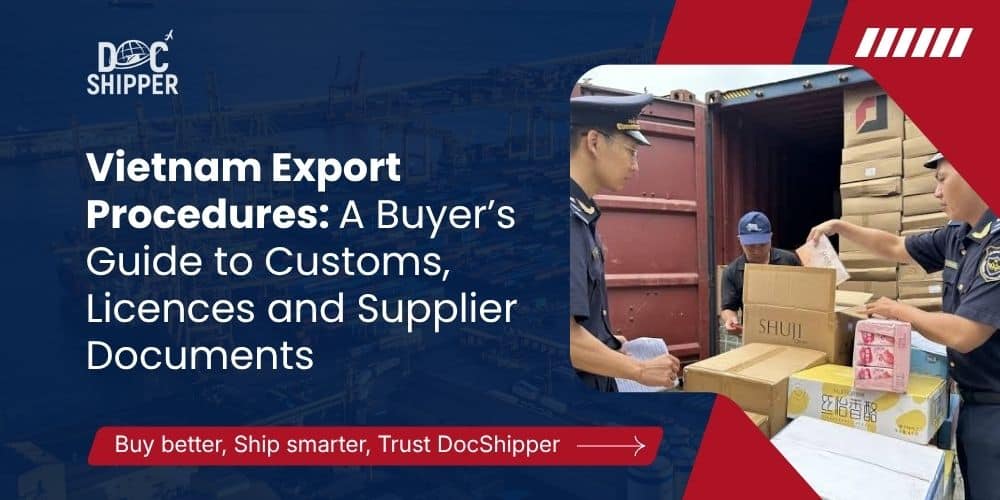
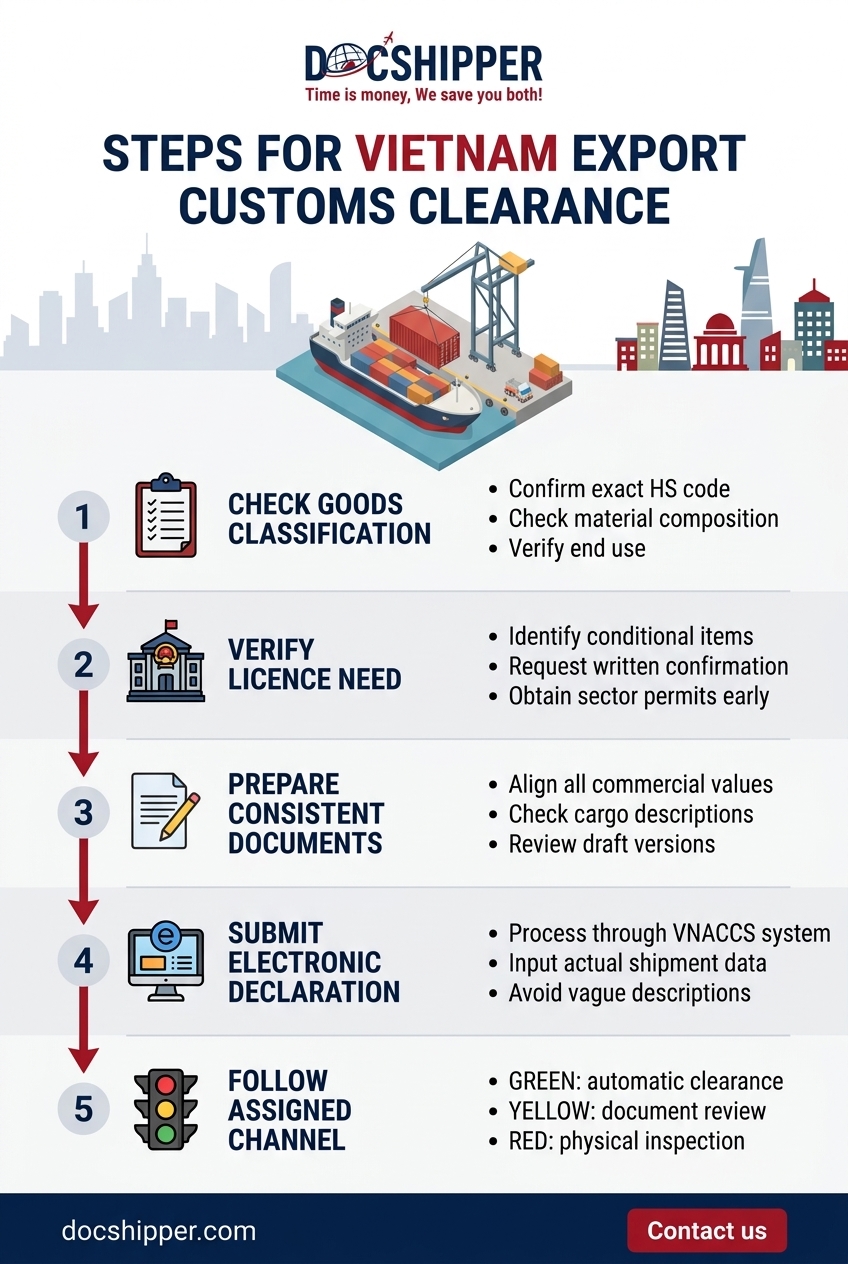
The Vietnamese exporter or its authorised customs agent submits an electronic export declaration through VNACCS, Vietnam’s automated customs clearance system. Customs then assigns a risk channel, any required controls are completed, and the cargo is cleared for loading.
1. Prepare the commercial and regulatory file. The supplier or forwarder collects the invoice, packing list, contract or purchase information where required, transport instructions and any licence or specialised certificate. The HS code, product description, quantity, value, origin and packaging information should match across the file.
2. Submit the VNACCS declaration. The customs declarant enters the shipment data electronically through VNACCS/VCIS. The declaration must reflect the actual goods and transaction. A vague description copied from a quotation can create questions if it does not identify the material, model, function or condition of the product.
3. Follow the assigned channel. A green channel generally allows clearance without the same documentary or physical intervention as the other channels. A yellow channel can involve documentary review, while a red channel can involve documentary and physical inspection. Customs risk management may consider the goods, declaration data, trader profile and inconsistencies in the file.
4. Complete clearance and load the cargo. Once the declaration is accepted and any required review or inspection is complete, the supplier or forwarder coordinates release, terminal delivery and loading. Ask for the declaration reference or export confirmation and check that the final transport document reflects the agreed shipment.
VnEconomy reported that 70% of customs declarations were assigned to the green channel in 2025, with yellow and red channels representing the remaining 30%. This does not guarantee a green result for your shipment, but it shows why a consistent file is a practical delay-prevention measure.
Illustrative breakdown using the reported 2025 distribution: 100 declarations in total; 70 declarations in the green channel; 30 declarations in the yellow or red channels. The figures describe the reported distribution, not a prediction for an individual shipment.
| Channel | What it usually means for the file | Buyer check |
| Green | Clearance with no equivalent documentary or physical intervention | Still verify that the supplier sends the final declaration and shipping documents |
| Yellow | Customs may review documents before release | Keep licences, certificates and consistent product information available |
| Red | Documentary review and possible physical inspection | Ensure the goods, packing and declaration can be matched if inspected |
DocShipper Tips
Reconcile descriptions, quantities, values and weights before your supplier files with customs.
Documents your supplier must provide
Ask your Vietnamese supplier for the commercial invoice, packing list, export declaration, bill of lading or air waybill, origin proof when relevant, and any product-specific certificates. The exact set depends on the goods, destination, Incoterm and whether you are claiming a preferential tariff.
Request the document package in two stages. Before customs filing, ask for draft versions so you can check the description, HS code, quantities, weights, values, seller and buyer names, shipment marks and delivery terms. After loading, request the final signed or issued documents, including the transport document and export declaration confirmation.
A certificate of origin is not automatically required for every shipment. It becomes important when the destination authority or your buyer needs origin proof, particularly when you want to claim preferential treatment under an applicable trade agreement. Confirm which certificate or origin statement is accepted for your destination and product.
Product-specific documents can include phytosanitary certificates for regulated plant products, fumigation certificates where required by the cargo or destination, quality or conformity documents, and licences for conditional goods. Ask the supplier to identify the issuing authority and verify that the certificate covers the shipped product, quantity and relevant shipment date.
Run a consistency check before the vessel cut-off. The invoice total should correspond to the declaration, the packing list should reconcile with the number of cartons and gross weight, and the bill of lading or air waybill should show the agreed shipper, consignee, notify party and cargo description.
- Commercial invoice: check seller, buyer, description, quantity, unit price, total value, currency and Incoterm.
- Packing list: check cartons, packing marks, net weight, gross weight, dimensions and product allocation.
- Export declaration: request the declaration reference or customs confirmation from the supplier or forwarder.
- Bill of lading or air waybill: check shipper, consignee, notify party, port or airport, marks and cargo description.
- Certificate or statement of origin: request it when required by the destination or when claiming preferential duty treatment.
- Product certificates: verify phytosanitary, fumigation, quality, conformity or other sector documents where applicable.
| Document | When to request it | What to verify |
| Draft invoice and packing list | Before customs filing | Commercial data, quantities, weights, values and Incoterm |
| Export declaration confirmation | After filing or clearance | Exporter, goods, HS code and declaration reference |
| Bill of lading or air waybill | After carrier issuance | Parties, routing, marks and cargo description |
| Origin proof | Before destination import filing | Correct form, origin criteria and product coverage |
| Specialised certificates | Before shipment and again in the final file | Issuing authority, product, quantity and validity |
DocShipper Tips
Compare every detail before the carrier issues the final transport document and the shipment reaches cut-off.
DocShipper Platform
One platform. Your entire supply chain
Sourcing, freight, customs & documents — all centralised, all visible, 24/7.
How to avoid export delays
The most effective prevention is to complete the licensing and document check before production is finished. Share your destination requirements with the supplier early, then ask the forwarder to confirm the customs filing plan and document cut-off.
1. Confirm responsibility in the purchase order. Name the Incoterm and place precisely, identify the party responsible for Vietnamese export clearance and require the supplier to notify you immediately if a permit or inspection is needed.
2. Validate the product before booking. Send the product specification, composition, photographs, packaging information and proposed HS code to the supplier and customs specialist. If the goods are agricultural, wooden, chemical or otherwise regulated, request a written permit assessment.
3. Use one controlled document template. Give the supplier the required buyer name, consignee, notify party, cargo description, marks, shipping instructions and Incoterm. Ask for drafts before submission instead of trying to correct the file after the declaration is lodged.
4. Reconcile every version. Compare the invoice, packing list, export declaration and transport document line by line. Correct differences in spelling, weights, carton counts, values or descriptions before the terminal cut-off.
5. Keep the forwarder involved. Confirm the booking, trucking plan, customs declaration timing and document handover with the Vietnamese forwarder. If you selected EXW, arrange local support before the supplier finishes the goods, because the export formalities cannot simply be transferred to an overseas team at the last minute.
Avoid asking the supplier to understate value, change the product description or use an inaccurate HS code to obtain a smoother clearance. A consistent declaration protects both the exporter and the importer, particularly when origin and transshipment scrutiny is increasing on Vietnam-linked shipments.
Conclusion
Vietnam export procedures become manageable when you treat export clearance as a pre-shipment control, not as a task that starts at the port. The supplier should normally clear the goods under FCA, FOB, CIF or DAP, while you verify the licence position, documents and timing.
- The Vietnamese seller normally clears export under FCA, FOB, CIF and DAP.
- EXW can leave you with a difficult export process unless you have local support.
- Check licences, permits and specialised inspections when you approve the order.
- The exporter submits an electronic declaration through VNACCS/VCIS and receives a customs risk channel.
- In 2025, 70% of reported declarations were in the green channel and 30% in the yellow or red channels.
- Request a complete document set and reconcile every description, quantity, weight and value.
Buying from Vietnam? We can check your supplier’s export documents, arrange customs clearance in Vietnam and coordinate sea or air freight so your shipment reaches the loading stage without avoidable surprises.
FAQ | Vietnam Export Procedures: A Buyer’s Guide to Customs, Licences and Supplier Documents
Yes, but this should be agreed before production and documented clearly. A trading company or authorised export service provider may appear as the legal exporter, while your supplier remains the manufacturer. Confirm who will issue the invoice, submit the customs declaration, hold any required licence and answer customs queries. The exporter’s name should be consistent across the commercial and customs documents.
Do not assume that the original declaration can be used without modification. Ask the Vietnamese forwarder to check whether customs will accept an amendment, require a replacement declaration or request an inspection. The final invoice, packing list and transport document must reflect the goods actually loaded. Even a change in carton count or gross weight can create a discrepancy at the terminal or during destination import clearance.
Samples may follow a different commercial process, but they are not automatically exempt from customs requirements. The shipment may still need an accurate description, realistic customs value, packing details and any applicable product permit. Avoid declaring “no commercial value” if the goods have a genuine value. Ask the carrier or Vietnamese customs agent how the sample will be classified before dispatch, especially for food, chemicals, cosmetics, plants or controlled materials.
Not necessarily. The procedure can depend on whether the goods were manufactured in Vietnam, imported into Vietnam and stored under customs control, or merely transshipped. The supplier should confirm the customs status of the goods and identify which company is authorised to export them. Request the relevant warehouse or import records where they are needed to support origin, value or re-export treatment.
Agree in advance how each consignment will be documented and declared. Each shipment should have matching quantities, weights, values and transport details rather than relying on one invoice or packing list for the complete order. Also confirm whether the destination requires separate certificates of origin, phytosanitary documents or other permits for each shipment. Partial shipments can create problems when the purchase order, export declarations and preferential-duty claim do not correspond.
Ask for the supplier’s legal entity details, tax information, export experience and the identity of its customs forwarder. Before paying the balance, request a draft invoice and packing list, then verify that the seller name, bank beneficiary, manufacturer and proposed exporter are properly explained. For regulated goods, obtain a written statement identifying the required permits and the authority responsible for issuing them. A supplier that refuses to disclose the exporter or repeatedly changes the document details is a significant warning sign.
Need Help with Logistics
or Sourcing in Vietnam ?
First, we secure the right products from the right suppliers at the right price by managing the sourcing process from start to finish. Then, we simplify your shipping experience - from pickup to final delivery - ensuring any product, anywhere, is delivered at highly competitive prices.


Fill the Form
Prefer email? Send us your inquiry, and we’ll get back to you as soon as possible.
Contact us