In short ⚡
Rules of Origin: Avoiding Transshipment Penalties on Vietnamese Goods requires proving where goods were wholly obtained or last substantially transformed, rather than relying on a Vietnamese invoice or “Made in Vietnam” label. The applicable US customs test or FTA rule, production evidence, component origins, and shipment records must support the declaration. The main origin scenarios and verification requirements are:| Situation | Typical origin treatment | Evidence or assessment required |
|---|---|---|
| Goods only routed through Vietnam | Origin normally remains the third country. | Review the manufacturing location and shipping route. |
| Relabelling, repackaging, or re-invoicing | Normally does not confer Vietnamese origin. | Check invoices, packaging records, and the actual production process. |
| Minor finishing or simple processing | Usually insufficient without a product-specific basis for substantial transformation. | Assess the operations, tariff classification, and applicable origin rule. |
| Manufacturing with imported inputs | Requires a product-specific analysis of the transformation performed in Vietnam. | Review the bill of materials, cost breakdown, production flow, and regional value-content rules where applicable. |
| Full production in Vietnam | May support Vietnamese origin, subject to the destination’s rule and evidence. | Keep production records, factory evidence, supplier declarations, and shipment documents. |
| FTA preference claim | Requires compliance with the agreement’s product-specific rule. | Verify tariff classification, change-in-tariff requirements, regional value content, or specified manufacturing operations. |
Key topics include country-of-origin tests, illegal transshipment indicators, 2025–2026 enforcement, supplier due diligence, required customs documents, and evidence-pack preparation.
We hope you’ll find this article genuinely useful, but remember, if you ever feel lost at any step, whether it’s finding a supplier, validating quality, managing international shipping or customs, FNM Vietnam can handle it all for you!
If you source from Vietnam for the US, EU, UK or another market, a Vietnamese invoice or “Made in Vietnam” label is not enough to establish origin. The decisive question is where the goods were wholly obtained or last substantially transformed, and whether they satisfy the specific rule that applies to your destination and product.
This guide explains how to distinguish legitimate Vietnamese manufacturing from illegal transshipment, what customs authorities are checking in 2025 and 2026, and which documents you should collect before shipment. It is general compliance guidance, not a legal opinion on a specific product or tariff classification.
DocShipper Info
Match the product, process and destination rule before claiming origin
What “country of origin” means for goods from Vietnam
Country of origin is generally the country where goods are wholly obtained or undergo their last substantial transformation. For preferential trade agreements, however, the product must also meet the agreement’s product-specific rule. A Vietnamese label, invoice or certificate of origin does not automatically make a product Vietnamese for every customs purpose.
Start by separating two concepts. Non-preferential origin is used for ordinary customs treatment, marking, trade remedies and other measures. In the United States, US Customs and Border Protection generally assesses whether the last processing created a new article with a different name, character or use. This is commonly referred to as the substantial transformation test, although the result depends on the facts of the product and the applicable customs analysis.
Preferential origin determines whether goods qualify for a reduced tariff under an agreement such as the EVFTA, CPTPP or UKVFTA. These agreements can require a change in tariff classification, a regional value-content threshold, a specific manufacturing operation, or a combination of tests. A product can therefore have Vietnamese non-preferential origin but fail to qualify for a particular FTA preference.
For example, importing finished parts from China and placing them in Vietnamese packaging normally does not create a new origin. More complex assembly may produce a different result, but the answer requires a product-specific review of the operations, the imported components, the tariff classification and the rule applied by the importing country.
When the destination is the US, review relevant US CBP rulings and guidance rather than relying only on the supplier’s description. When the destination is the EU, UK or a CPTPP market, check the agreement’s origin protocol and product-specific rules before asking the supplier for an origin statement.
| Question | What to verify |
| Where was the product made? | Location of manufacturing, assembly and finishing operations. |
| Where did the components come from? | Bill of materials, supplier declarations and origin of major inputs. |
| Which origin test applies? | US non-preferential substantial transformation or the relevant FTA rule. |
| Is the evidence consistent? | Compare production records, invoices, photographs, shipping data and the origin statement. |
DocShipper Alert
Verify the transformation before relying on a Vietnamese invoice or certificate
What counts as illegal transshipment
Illegal transshipment occurs when goods from a third country are routed through Vietnam and declared as Vietnamese after operations that do not confer origin. Common patterns include relabelling, repackaging, re-invoicing and minor processing. Routing itself is not automatically illegal, but concealing the true origin or using a Vietnamese operation to evade duties is a serious compliance risk.
US authorities and trade enforcement sources have identified several warning patterns. A supplier may remove Chinese marks, replace cartons, issue a new invoice from Vietnam, or perform a light finishing step while the essential product remains unchanged. Other warning signs include a Vietnamese company that has no machinery, no meaningful production workforce, no credible capacity, or a shipment profile that does not match its declared manufacturing activity.
Assembly is a grey area, not a safe harbour. Installing imported components can be substantial when the Vietnamese operation creates a commercially different finished product through significant manufacturing, testing and integration. It may not be sufficient when the operation consists mainly of connecting ready-made parts, applying a label or packing a product for export.
The scale of the issue explains why customs authorities are examining supply chains more closely. A Viet Nam News report dated August 20, 2026 cited US estimates of US$40-303 billion per year of exposure across more than 40 partners considered at elevated risk. The range is an estimate, not a finding against every Vietnamese exporter or every shipment.
Do Ngoc Hung, Trade Counselor at the Vietnam Trade Office in the US, stated that “U.S. authorities need to distinguish legitimate manufacturing in Vietnam from illegal transshipment by examining the actual production process.” His observation, reported by Tuoi Tre News on August 15, 2026, captures the practical issue: customs needs evidence of what happened inside the factory, not only an export document.
| Activity in Vietnam | Illustrative origin outcome |
| Goods only routed through Vietnam | Origin normally remains the third country. |
| Relabelling or replacement of packaging | Normally does not confer Vietnamese origin. |
| Re-invoicing through a Vietnamese trader | Does not change the manufacturing origin. |
| Minor finishing or simple processing | Usually insufficient without a product-specific basis for substantial transformation. |
| Manufacturing using imported inputs | Requires an analysis of the actual operations, components and applicable origin rule. |
| Full production in Vietnam | May support Vietnamese origin, subject to the destination’s rule and evidence. |
DocShipper Info
Build production evidence now to support your origin declaration
Looking for a Reliable Shipping & Sourcing Partner?


Enforcement in 2025-2026: what changed
Enforcement has become more data-driven, while Vietnam has publicly committed to stronger origin controls. Importers should expect customs authorities to compare declarations with trade flows, supplier capacity, component origins, pricing and production evidence. The consequences can include origin reassignment, duty recovery, additional scrutiny and possible exclusion from the market.
In August 2026, Tuoi Tre News reported estimates of approximately US$109 billion in affected trade from the US Commerce Department and approximately US$303 billion from Altana. The same report described planned AI-based “Detective Border” analysis. These figures and tools indicate the direction of enforcement, but they do not replace a product-level customs determination.
Vietnamese exporters are also under pressure to strengthen traceability and prevent false origin declarations. Pham Thu Hang, spokesperson for Vietnam’s Ministry of Foreign Affairs, said that “Việt Nam has been focusing on building institutions and strengthening enforcement capacity… and is determined to prevent origin fraud and illegal transshipment.” The statement was reported by Viet Nam News on August 20, 2026.
Do not rely on a fixed headline penalty when assessing exposure. US tariff and trade measures have changed several times since 2025. For example, the 40% transshipment duty announced in 2025 under IEEPA was invalidated together with the IEEPA tariffs on February 20, 2026, according to a WilmerHale client alert. Verify the regime in force at the time of import with official US sources and qualified customs counsel.
Other measures can also affect the landed cost. A Honigman client alert dated July 24, 2026 reported a US Section 301 forced-labor tariff of 12.5% on Vietnamese goods, stacking with MFN duty and applicable anti-dumping or countervailing duties, with stated exemptions including Section 232 goods. This type of measure is separate from the origin test, so classify the product and review each applicable measure independently.
DocShipper Tips
Request the BOM, process flow and cost breakdown before shipment
Due diligence: how to verify your supplier’s origin
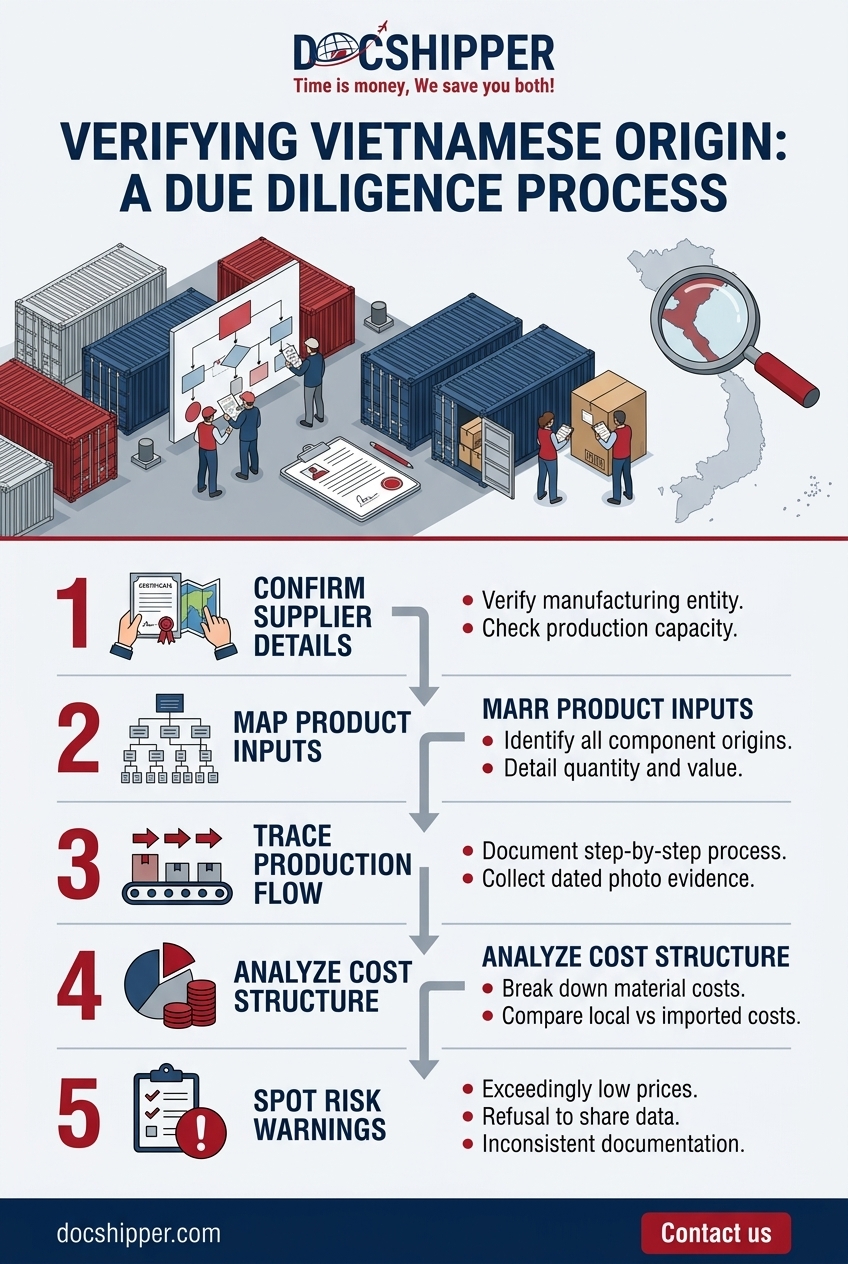
Verify the factory’s real production, map every significant input, and match the process to the rule that applies in the destination market. The safest time to collect evidence is before production and shipment, when the supplier can still provide records and correct gaps.
Use the following process:
- Identify the supplier. Confirm whether you are dealing with the actual factory, a trader, or a trading company representing several factories. Check the legal entity, address, manufacturing licence where relevant, machinery, workforce and production capacity.
- Obtain the bill of materials. Ask for each significant component, its supplier, country of origin, quantity and value. A generic statement such as “mostly made in Vietnam” is not an adequate substitute.
- Map the production flow. Request a step-by-step process from incoming materials to finished goods. Add dated photographs or video showing machinery, workstations, testing and packaging, subject to confidentiality controls.
- Review the cost structure. Ask for a cost breakdown separating imported materials, Vietnamese materials, labour, processing, overhead and other relevant elements. Do not treat a low local-cost percentage as an automatic legal conclusion, but use it to identify questions.
- Compare the rule with the evidence. For the US, assess substantial transformation. For an FTA, review the product-specific rule, tariff classification and any regional value-content calculation.
- Record the result. Keep an origin file linked to the purchase order, production batch and shipment. Escalate unclear cases before the goods leave Vietnam.
Red flags deserve a written response, not an informal assurance. These include a price far below comparable offers, refusal to disclose component origins, a supplier that cannot show production equipment, a factory visit that reveals only storage, inconsistent company names on invoices, and production volumes that exceed the site’s apparent capacity.
For electronics, trade-flow context reinforces the need for traceability without proving wrongdoing by itself. Asia News Network reported Vietnamese electronics exports of US$101 billion versus imports of US$161 billion during the first eight months of 2026. The figures show why imported inputs are common and why a supplier must explain the transformation performed in Vietnam rather than simply claim that the finished goods are Vietnamese.
Put the supplier’s obligations in the contract. Include an origin warranty, a duty to disclose material changes in sourcing, access to supporting records, cooperation with customs verification, and responsibility for losses caused by inaccurate origin information where legally enforceable. A factory audit can test whether the documented process matches what is actually happening on site.
DocShipper Info
Organise one evidence file per shipment for faster customs responses
DocShipper Platform
One platform. Your entire supply chain
Sourcing, freight, customs & documents — all centralised, all visible, 24/7.
Documents to keep in case of a customs verification
Keep a complete evidence pack for each shipment, including commercial documents, production records and proof of component origin. Organise the file so that a reviewer can move from the entry declaration to the purchase order, factory, bill of materials, production batch and transport record without relying on the supplier’s memory.
Your core document list should include:
- Commercial invoice, packing list and purchase order.
- Bill of materials identifying the origin of each significant component.
- Supplier declarations and upstream origin statements.
- Manufacturing process flow and product specifications.
- Production records, batch records, work orders and completion records.
- Records of labour, machinery use, testing and quality control where relevant.
- Cost breakdown and supporting purchase invoices for major inputs.
- Factory photographs, audit reports and dated production evidence.
- Certificate of origin or origin statement, where required or available.
- Transport documents, export declarations and records showing the shipping route.
- Contracts containing origin warranties and verification clauses.
- Communications resolving discrepancies in materials, production or origin.
A certificate of origin is useful evidence, but it is not conclusive proof of non-preferential origin for US customs. The certificate confirms what the issuing authority or exporter declared under the relevant procedure. Customs can still examine the underlying manufacturing process, and an inaccurate certificate can create additional risk.
Retention periods vary by importing country, customs procedure, preference claim and product. Follow the period required by the authority that receives the entry, and retain records longer when a claim, audit, investigation or dispute is open. If customs asks questions, do not reconstruct the file from scattered emails. Assign one responsible person, preserve the original records, identify any uncertainty and obtain specialist advice before making a corrective submission.
For a shipment already in doubt, pause the origin claim if operationally possible, separate confirmed facts from assumptions, and ask the supplier for missing evidence in writing. You may need a customs ruling, a voluntary disclosure, a corrected declaration or legal advice, depending on the destination and the nature of the discrepancy.
| Evidence pack | Purpose |
| BOM with component origin | Shows where the main inputs came from. |
| Process flow and production records | Shows what transformation occurred in Vietnam. |
| Cost breakdown | Helps test the commercial and manufacturing explanation. |
| Factory audit and photographs | Checks that the declared production exists on site. |
| C/O or origin statement | Supports the declaration under the relevant procedure. |
| Transport and commercial records | Connects the evidence to the specific shipment. |
Conclusion
A Vietnamese origin you can defend is built from the production process and the evidence behind it, not from a label or an invoice. Before moving production from China to Vietnam, test the operation against the destination’s origin rule and keep the file ready before customs asks for it.
- Origin depends on substantial transformation or the applicable FTA rule, not the label alone.
- Relabelling, repackaging, re-invoicing and minor processing generally do not confer origin.
- US and Vietnamese authorities increased their focus on origin traceability during 2025 and 2026.
- Audit the supplier and collect the BOM, process flow, cost breakdown and production records before shipment.
- Keep documents organised by shipment and verify the tariff and enforcement regime in force at import.
Moving production to Vietnam? We can audit your supplier’s real manufacturing and help you build the origin file before you ship.
FAQ | Vietnam Rules of Origin and Transshipment: How to Prove Your Goods Are Vietnamese
Not necessarily. A transit country does not automatically change the goods’ origin, but some preferential agreements impose direct-transport or documentary conditions. Keep the bill of lading, transit records, customs documents and evidence that the goods were not processed or released for domestic use in the transit country. Check the specific agreement before claiming preferential treatment.
It may be able to provide commercial or origin information, but it should not present itself as the manufacturer if it only acts as a trader. The origin file should identify the factory that performed the manufacturing, the legal relationship between the parties and the records supporting the declared production. If the applicable procedure requires an exporter, producer or authorised declarant, confirm who is legally permitted to make the statement.
Do not assume that one factory’s evidence covers all shipments. Link each purchase order and shipment to the actual production site, production batch and applicable bill of materials. If the factories use different inputs or processes, assess origin separately and avoid using a single origin statement for goods whose manufacturing history is not consistent.
Usually, no. Repairing, cleaning, replacing a minor part or refurbishing an already finished product generally does not create a new origin unless the operation meets the applicable substantial-transformation or preferential-origin rule. Keep records showing the product’s condition before and after the work, the parts replaced and the exact operations performed.
This category is generally reserved for goods obtained entirely in one country, such as certain agricultural products grown and harvested there, minerals extracted there or products made from qualifying materials. Imported materials normally prevent a finished product from being treated as wholly obtained. When imported inputs are involved, assess the relevant substantial-transformation or preferential rule instead.
Ask for a controlled disclosure rather than accepting a generic origin declaration. The supplier could provide component-level information under a confidentiality agreement, disclose the data to an independent auditor or customs adviser, or provide aggregated information that still identifies the origin and value of significant inputs. If the supplier refuses every verifiable method, treat the origin claim as unsubstantiated and reassess the shipment before export.
Need Help with Logistics
or Sourcing in Vietnam ?
First, we secure the right products from the right suppliers at the right price by managing the sourcing process from start to finish. Then, we simplify your shipping experience - from pickup to final delivery - ensuring any product, anywhere, is delivered at highly competitive prices.


Fill the Form
Prefer email? Send us your inquiry, and we’ll get back to you as soon as possible.
Contact us