In short ⚡
UK Vietnam Free Trade Agreement: Duty Savings for UK Importers depend on the product’s HS code, tariff staging, rules of origin and valid proof of origin. Up to 99% of tariffs are due to be eliminated under UKVFTA, but the saving is not automatic and must be claimed correctly at UK import. The key duty-saving factors are:| Factor | What UK importers should check |
|---|---|
| Tariff treatment | Search the UK commodity code in the UK Integrated Online Tariff and compare the third-country and UKVFTA rates. |
| Eligible products | Footwear, pepper, shelled cashews, apparel, furniture, seafood and other agri-food products may benefit, depending on classification and origin. |
| Rules of origin | Goods must be wholly obtained in Vietnam or sufficiently processed there under the product-specific UKVFTA rule. |
| Proof of origin | Obtain the valid origin statement or certificate required under the current UKVFTA procedure and retain supporting records. |
| Import claim | Instruct the customs representative to claim UKVFTA preference in the UK import declaration. |
| Alternative agreement | Compare UKVFTA with CPTPP for the exact HS code, origin rule, cumulation provisions and available supplier evidence. |
The guide covers UKVFTA’s tariff framework, product-specific savings, rules of origin, import preference claims, required documentation and the comparison with CPTPP.
We hope you’ll find this article genuinely useful, but remember, if you ever feel lost at any step, whether it’s finding a supplier, validating quality, managing international shipping or customs, FNM Vietnam can handle it all for you!
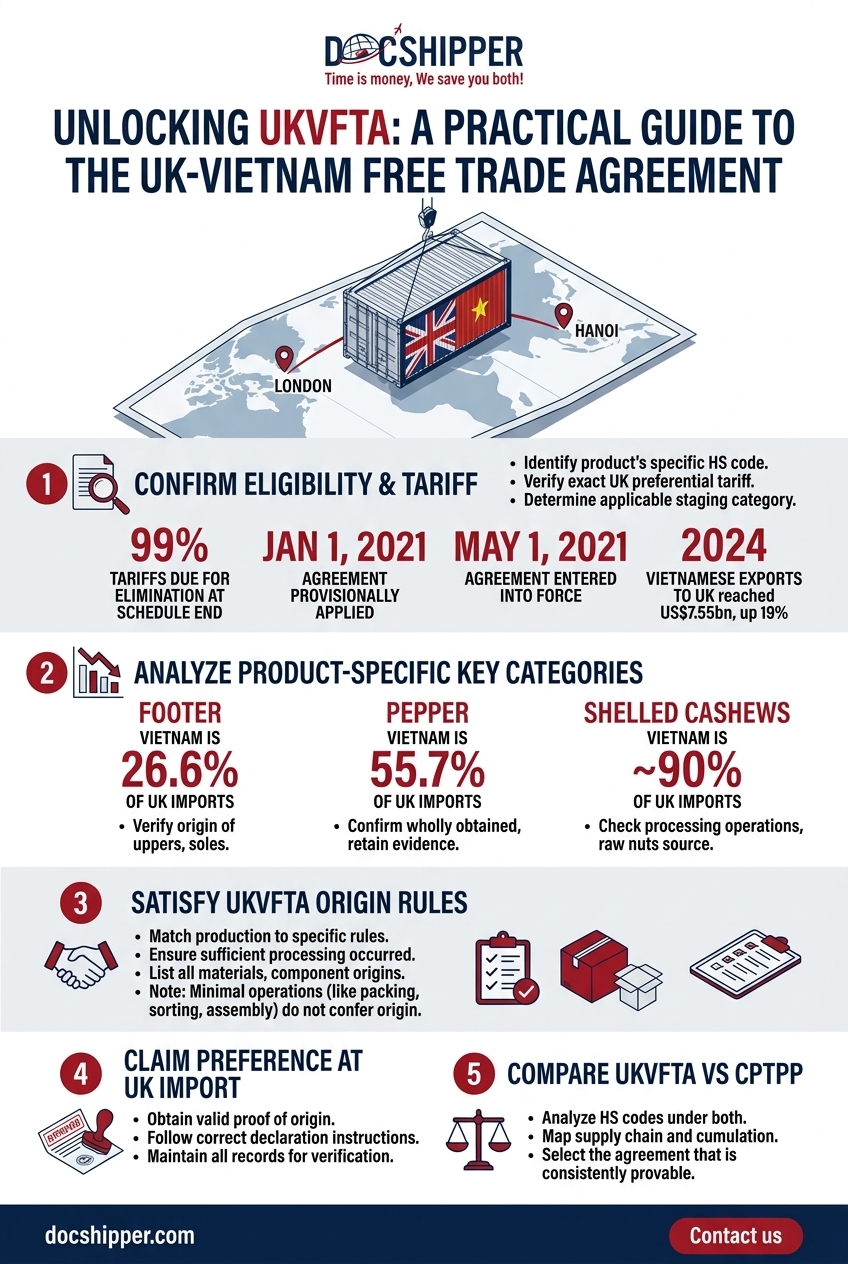
The UK Vietnam Free Trade Agreement, usually called the UKVFTA, can reduce or eliminate import duty on qualifying goods shipped from Vietnam to the UK. The saving is not automatic: your goods must meet the agreement’s rules of origin, and you must make a valid preference claim supported by the right documents.
This guide explains how UKVFTA works, which Vietnamese products may benefit, how to check the applicable tariff, how to claim preference at import, and when the UKVFTA may be worth comparing with the CPTPP.
UKVFTA in brief
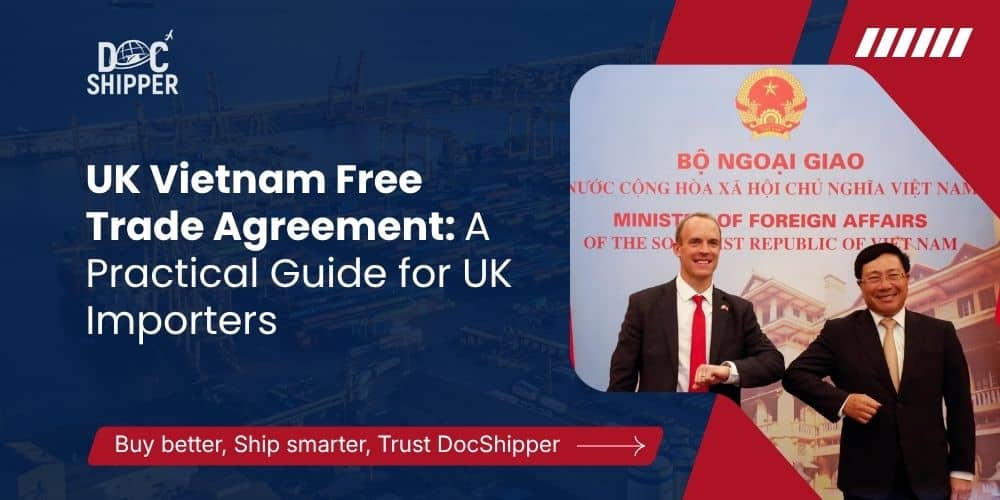
The UK-Vietnam FTA was provisionally applied on 1 January 2021 and entered into force on 1 May 2021. It largely rolled over the EU-Vietnam trade relationship for trade between the UK and Vietnam, giving UK importers a preferential framework for qualifying Vietnamese goods.
At the end of the agreement’s tariff schedule, 99% of tariffs are due to be eliminated. The exact benefit depends on your product’s HS code, the applicable staging category and whether the shipment satisfies the UKVFTA rules of origin.
In practice, the agreement covers more than customs duty. It also sets requirements for origin, customs procedures and trade documentation. HMRC and the UK Department for Business and Trade provide the UK-side guidance, while Vietnam’s Ministry of Industry and Trade is involved in the issuance of origin documents in Vietnam.
Use of the preference remains far from universal. Vietnam’s C/O utilisation rate reportedly increased from 17.2% in 2021 to 36.2% after four years, which suggests that many eligible exports are still entering the UK without the available preference being claimed.
Vietnamese exports to the UK reached US$7.55bn in 2024, up 19% according to Vietnam’s Ministry of Industry and Trade. For a UK retailer, Amazon seller or manufacturer, the commercial question is therefore not simply whether Vietnam has a trade agreement with the UK. It is whether your exact product, supplier and documentation qualify.
| Question | Practical answer |
| When did UKVFTA start? | It was provisionally applied on 1 January 2021 and entered into force on 1 May 2021. |
| What does it do? | It progressively removes customs tariffs on qualifying UK-Vietnam trade. |
| Is every Vietnamese product duty-free? | No. Check the HS code, tariff schedule and origin rule before importing. |
| Who administers the UK side? | HMRC and the UK Department for Business and Trade provide relevant guidance. |
DocShipper Tips
Compare the UKVFTA rate, staging category and origin requirements before committing to a supplier.
Which products save the most under UKVFTA?
Vietnam already has a significant position in UK imports of footwear, pepper and cashews. Vietnam’s share of UK imports is reported at 26.6% for footwear, 55.7% for pepper and approximately 90% for shelled cashews, making these categories particularly relevant for importers reviewing potential UKVFTA savings.
Apparel, furniture, seafood and other agri-food products may also benefit. However, market share does not tell you the duty saving for your shipment. You must identify the correct commodity code and check the UK tariff treatment for goods originating in Vietnam.
Start with the UK Integrated Online Tariff. Search by product description or, preferably, by the HS or commodity code confirmed by your customs broker. Review the third-country tariff, the UKVFTA preferential tariff and any staging note showing whether the duty reduction is immediate or phased.
A tariff that is currently above zero may be moving down gradually rather than becoming duty-free on the date you search. Conversely, a product that looks commercially attractive may have a demanding origin rule, particularly where the supplier imports fabrics, leather, components or other materials from outside the permitted origin area.
Do not calculate a saving from a general product name such as “shoes”, “wooden furniture” or “pepper”. Confirm the full commodity code, customs valuation and preference eligibility first. DocShipper can help coordinate the Vietnam-to-UK shipment, but the tariff decision should be based on the applicable UK tariff entry and the evidence supplied by the manufacturer.
| Product group | Vietnam’s position in UK imports | Origin watch-out |
| Footwear | Vietnam represents 26.6% of UK footwear imports. | Check where the upper, sole and other significant components are made, not only where final assembly takes place. |
| Pepper | Vietnam represents 55.7% of UK pepper imports. | Confirm whether the agricultural product is wholly obtained in Vietnam and retain supplier evidence. |
| Shelled cashews | Vietnam represents approximately 90% of UK imports. | Verify the origin treatment of the raw nuts and the processing performed in Vietnam. |
| Apparel and textiles | Important Vietnamese export categories for UK buyers. | Review the product-specific textile rule and the origin of yarn, fabric and other inputs. |
| Furniture and manufactured goods | Potential beneficiaries, depending on classification and processing. | Simple assembly or packing may not be enough to create Vietnamese origin. |
Looking for a Reliable Shipping & Sourcing Partner?


Rules of origin under UKVFTA
To receive UKVFTA preference, goods must be either wholly obtained in Vietnam or sufficiently processed there according to the product-specific rule. The rule is normally linked to the product’s HS classification and may require a change in tariff classification, a minimum percentage of originating value or a defined manufacturing process.
“Origin” means the economic nationality of the goods for the agreement, not simply the country from which they were shipped. A product bought from a Vietnamese trading company and dispatched from Ho Chi Minh City is not automatically Vietnamese-origin if its qualifying production happened elsewhere.
First, identify all significant inputs and manufacturing stages. Ask the supplier where the raw materials were sourced, where cutting, sewing, milling, roasting or assembly occurred, and which records support the answer. Then compare that production process with the specific rule in the UKVFTA Protocol on rules of origin.
Cumulation may help in some supply chains. Depending on the applicable provision, certain materials originating in the UK or permitted partner countries may be treated favourably when used in Vietnam. Do not assume that any Asian input qualifies: the permitted countries, conditions and evidence must be checked against the current protocol.
Textiles require particular care because the origin result can depend on the origin of yarn, fabric and manufacturing operations. Simple assembly, repacking, labelling or sorting generally does not create origin by itself. If goods are routed through another country, also review the rules on direct transport and transshipment before shipment.
Keep the supplier’s manufacturing declaration, bills of materials, purchase records, production records and origin documents together. If your sourcing model involves several countries, review the chain before placing the order rather than waiting for a customs query after the goods arrive in the UK.
| Origin question | What to verify |
| Where were the goods produced? | Confirm the actual manufacturing location, not only the exporter’s registered address. |
| Where did the inputs come from? | List materials, components and their countries of origin. |
| Was there sufficient processing? | Match the production process to the product-specific UKVFTA rule. |
| Was the product only packed or assembled? | Check carefully because minimal operations may not confer origin. |
| Did the goods transit another country? | Review direct transport, documentary control and transshipment requirements. |
DocShipper Alert
Verify processing, inputs and transit conditions before claiming preference.
How to claim the preference at UK import
To claim UKVFTA preference, confirm the tariff treatment, obtain valid proof of origin, include the preference claim in the UK import declaration and retain the supporting records. A certificate or supplier statement alone is not enough if the goods do not satisfy the origin rule.
- Confirm the commodity code. Identify the complete UK commodity code for the goods and check the UK Integrated Online Tariff for the UKVFTA rate, staging and any conditions.
- Test the origin rule. Ask the Vietnamese supplier for a written explanation of the production process, materials and origin calculations. Compare this information with the relevant UKVFTA product rule.
- Obtain the proof of origin. Depending on the current UKVFTA procedure and the shipment, this may involve an origin statement or a certificate of origin issued through the competent Vietnamese authority. Confirm the permitted proof and wording with HMRC or your customs adviser before dispatch.
- Give the declaration instructions to your customs representative. Tell your broker or freight forwarder that you want to claim UKVFTA preference. Provide the origin proof and the information needed for the import declaration.
- Keep the complete evidence file. Retain the commercial invoice, packing list, transport records, origin proof, supplier declaration, bills of materials and relevant correspondence for the period required by UK customs rules.
- Review the claim after clearance. Check that the declaration used the intended preference treatment and that the customs calculation reflects the claim. Correct errors promptly through the appropriate customs process.
The available proof-of-origin route can depend on the agreement’s current requirements, the exporter’s status and the value or nature of the consignment. For that reason, do not copy a generic “made in Vietnam” statement onto an invoice and assume it is a valid UKVFTA origin statement.
HMRC may verify a claim through the importer, exporter or relevant authorities. Your supplier should therefore be able to substantiate the declaration with production and purchasing records, not simply confirm that the goods were shipped from Vietnam.
Our Vietnam team can verify documents before loading, coordinate with the supplier and align the origin paperwork with the shipping file. This is especially useful when the supplier is a factory for some products but a trader for others, or when a shipment contains multiple product lines with different origin rules.
| Claim checklist | Completed when you have… |
| Classification | Confirmed the UK commodity code and checked the UK Integrated Online Tariff. |
| Origin analysis | Matched the production process and inputs to the UKVFTA product-specific rule. |
| Proof of origin | Obtained the valid document or statement required under the current procedure. |
| Import declaration | Instructed the broker to claim the applicable UKVFTA preference. |
| Records | Filed supplier, production, commercial and transport evidence for verification. |
DocShipper Tips
Check the preference code, supporting evidence and duty calculation, then correct errors promptly.
DocShipper Platform
One platform. Your entire supply chain
Sourcing, freight, customs & documents — all centralised, all visible, 24/7.
UKVFTA or CPTPP: which one should you use?
Compare UKVFTA and CPTPP for the exact HS code, origin rule and supplier evidence before choosing an agreement. The best option is the agreement that provides the better tariff treatment and that your supplier can prove consistently.
The UK is a member of the CPTPP, so Vietnamese goods may need to be assessed under both frameworks where the product and supply chain qualify. The comparison is not simply about selecting the agreement with the lowest headline rate. A more favourable rate is unusable if the product fails the relevant origin rule or the required proof cannot be produced.
- Check both tariff schedules. Search the product’s UK commodity code under the UKVFTA and CPTPP arrangements using the current UK tariff database.
- Compare the origin rules. Review the required manufacturing process, regional value content, tariff shift and any textile or sector-specific conditions.
- Map the supply chain. Identify where each material is sourced and whether the agreement recognises the relevant cumulation rules.
- Test the documentation. Ask the supplier which proof of origin it can issue and whether its records support that proof.
- Choose and document the decision. Record why the selected agreement applies to the product and retain the tariff and origin analysis with the import file.
CPTPP may be worth testing where its cumulation rules fit your supply chain better, or where the product-specific rule is easier for the supplier to satisfy. UKVFTA may remain the cleaner route where the goods are clearly Vietnamese-origin and the supplier already has an established UKVFTA documentation process.
Do not use both preferences for the same customs claim. Compare them before shipment, communicate the selected agreement to the exporter and customs broker, and make sure the commercial documents support the same origin position.
Although the UK’s wider CPTPP membership is evolving, including Costa Rica’s concluded accession process with entry expected in the second half of 2027, the relevant question for a Vietnam-to-UK shipment is the rule and tariff available for your goods at the time of import. Recheck the official tariff and agreement guidance when your order is ready to ship.
| Situation | Agreement to test first | Why |
| Goods are clearly made in Vietnam and the supplier has UKVFTA evidence. | UKVFTA | The supply chain and documentation may already align with the bilateral agreement. |
| Imported materials are sourced across several CPTPP-linked countries. | UKVFTA and CPTPP | Compare the cumulation provisions and permitted input origins. |
| The supplier cannot support the required origin calculation. | Neither until verified | A preference claim should not be made without reliable evidence. |
| The two agreements show different tariff treatment. | The agreement with the qualifying lower rate | Confirm that the product and proof satisfy that agreement before claiming it. |
DocShipper Info
The better tariff only matters when your supplier can prove origin and provide compliant documentation.
Conclusion
UKVFTA can lower the cost of importing qualifying Vietnamese goods into the UK, but the saving depends on preparation. Check the commodity code, test the origin rule, obtain valid proof and give clear instructions to the customs representative before the shipment leaves Vietnam.
- UKVFTA was provisionally applied on 1 January 2021 and entered into force on 1 May 2021.
- Up to 99% of tariffs are due to be eliminated at the end of the agreement’s schedule.
- Vietnam already has a strong UK import position in footwear, pepper and shelled cashews.
- A shipment must satisfy the relevant rules of origin before it can receive preference.
- Keep origin statements, certificates, supplier records and production evidence for customs verification.
- Compare UKVFTA with CPTPP for the exact HS code and supply chain before choosing the preference.
Importing from Vietnam to the UK? We can check your supplier’s origin documents, coordinate your Vietnam-to-UK shipment and help ensure the customs paperwork supports the preference you intend to claim. See our Vietnam to UK shipping service or contact DocShipper Vietnam before your order is dispatched.
FAQ | UK Vietnam Free Trade Agreement: A Practical Guide for UK Importers
No. UKVFTA preference generally affects the customs duty charged on qualifying goods. Import VAT, excise duty and certain customs-related charges may still apply. Calculate the full landed cost using the preferential duty rate, the customs value and the taxes applicable to your product.
In some cases, you may be able to request a repayment or correction if the goods qualified but preference was not claimed at import. You will need the relevant proof of origin and evidence that the goods met the origin rule at the time of importation. Check the current HMRC procedure and deadline before submitting the request.
Preference can generally be applied only to the qualifying products or product lines. Do not claim the preference for the entire shipment simply because all goods were shipped from Vietnam. Ask the supplier to identify the origin status of each item and ensure that your customs declaration and supporting documents distinguish qualifying and non-qualifying goods.
Transit through a third country does not automatically disqualify the goods, but they must remain under the required customs control and must not undergo processing that changes their status. Keep transport documents, warehouse records and evidence of any customs supervision. If the goods are repacked, processed or split into new consignments, confirm the direct-transport conditions before claiming preference.
A reduced UKVFTA rate may be available only within a tariff-rate quota for certain products. Once the quota is exhausted, imports may face a different rate even if the goods meet the origin rule. Check the current UK Integrated Online Tariff for quota volumes, allocation conditions, licences and any “first come, first served” requirements before finalising your shipment cost.
A trading company may provide the commercial documents, but it must obtain reliable origin information from the actual manufacturer. A Vietnamese invoice or shipping address is not sufficient evidence by itself. Before ordering, request the factory’s production details, bills of materials and supporting origin records, and confirm that the exporter can issue the proof required under the current UKVFTA procedure.
Need Help with Logistics
or Sourcing in Vietnam ?
First, we secure the right products from the right suppliers at the right price by managing the sourcing process from start to finish. Then, we simplify your shipping experience - from pickup to final delivery - ensuring any product, anywhere, is delivered at highly competitive prices.


Fill the Form
Prefer email? Send us your inquiry, and we’ll get back to you as soon as possible.
Contact us