In short ⚡
Importing Motorcycle Parts from Vietnam requires separating safety-regulated components from lower-risk parts, verifying suppliers, confirming destination-market compliance, and preparing accurate customs and origin documents before ordering.
Key steps include:
- Build a detailed part list with vehicle application, reference number, drawings, materials, finishes, quantities and destination country.
- Separate regulated parts such as brake hoses, lamps, tyres and helmets from lower-risk body panels, mechanical spares and accessories.
- Shortlist and audit Vietnamese manufacturers by checking their legal identity, production site, tooling, quality systems and subcontracting controls.
- Verify IP rights and avoid unauthorised branded parts; approve unbranded or private-label specifications and retain a golden sample.
- Inspect dimensions, materials, finish, function, markings and packaging before shipment using an agreed quality-control plan.
- Confirm HS or HTS classification, duties, origin evidence, destination-market approvals, shipping method and required customs documents.
The guide covers Vietnam’s motorcycle-parts supply base, part risk levels, US and EU compliance, counterfeit prevention, supplier vetting, quality control, packaging, duties, origin rules, shipping and the first-order process.
We hope you’ll find this article genuinely useful, but remember, if you ever feel lost at any step, whether it’s finding a supplier, validating quality, managing international shipping or customs, FNM Vietnam can handle it all for you!
To import motorcycle parts from Vietnam successfully, separate safety-regulated components from lower-risk parts, verify the supplier’s right to sell the goods, and confirm classification, origin and destination-market compliance before placing an order. The objective is simple: parts that fit, comply and clear customs.
Vietnam is already a major sourcing base for scooters, underbone motorcycles and small-displacement vehicles. This guide covers supplier selection, counterfeit risk, US and EU requirements, quality control, packing, duties and the first-order process.
DocShipper Info
Verify the factory’s real production scope before requesting samples or prices.
Why source motorcycle parts in Vietnam
Vietnam sold about 3.4 million motorcycles in 2025, up 14.9% year on year, according to Power Systems Research. The country also hosts large manufacturing operations connected to Honda, Yamaha, Suzuki, Piaggio and SYM, creating a broad base of component and aftermarket suppliers.
This installed market supports production of scooter body panels, rubber parts, plastic injection components, castings, fasteners, exhaust components and mechanical replacement parts. Local demand also gives factories practical experience with fitment for popular scooters and underbone motorcycles.
The supply base is not uniform. A tier supplier serving an assembly plant may offer strong process control but refuse small aftermarket orders, while a workshop may accept lower volumes but rely on manual production and have limited traceability.
Vietnam is therefore usually more attractive for scooter and small-motorcycle parts than for highly specialised components for large-displacement bikes. Ask for the supplier’s actual production scope, not only a catalogue, and confirm whether the factory makes the part, outsources it or trades it.
For context, the market data can be read line by line:
- Motorcycles sold in Vietnam in 2025: about 3.4 million.
- Year-on-year change: plus 14.9%.
- Regional position: second-largest Southeast Asian market behind Indonesia, at 6.55 million units.
- Source: Power Systems Research, 21 February 2026.
DocShipper Tips
Build a complete fitment file before comparing suppliers or approving parts.
Which parts to buy: families and risk levels
Mechanical spares, body panels and accessories are generally lower-risk from a vehicle-safety perspective, while lighting, brake hoses, tyres and helmets can be regulated in the United States and European Union. The correct sourcing decision depends on both the part and the destination market.
Start with a fitment file containing the vehicle make, model, model year, engine version, dimensions, technical drawing, reference number and acceptable tolerance. A supplier’s statement that a part “fits Honda” or “fits Yamaha” is not enough without a comparison against your target application.
For regulated components, ask for the applicable approval or certification evidence before discussing price. For free parts, focus on material specifications, dimensional consistency, surface finish, packaging and whether the supplier can reproduce an approved golden sample.
| Part family | US position | EU position | Ask the supplier for |
| Brake hoses | FMVSS 106 may apply | Check the applicable approval and vehicle rules | Certification, marking, material specification and pressure-test records |
| Lamps and reflective devices | FMVSS 108 may apply | Relevant UNECE approval and E-mark may apply | Approval number, photometric data and marking photographs |
| Tyres | FMVSS 119 may apply | Approval and E-mark requirements may apply | Size, load and speed rating, approval evidence and production date coding |
| Motorcycle helmets | FMVSS 218 may apply | Check the relevant helmet approval requirements | Test documentation, permanent marking and traceability |
| Body panels and trim | Usually focus on fitment and materials | Check vehicle-specific rules where relevant | Drawing, material grade, colour standard and golden sample |
| Mechanical spares and accessories | Often lower regulatory risk, but verify the part | Verify whether the item affects vehicle approval or safety | Dimensions, function test, material and own-brand labelling options |
Genuine, OEM-equivalent or counterfeit: avoid the IP trap
Parts advertised as “genuine Honda” or “genuine Yamaha” outside an authorised channel may be counterfeit, diverted or unauthorised for export. The safest commercial model is to buy unbranded OEM-equivalent parts or components made under your own brand, unless you hold the necessary trademark and distribution rights.
OEM-equivalent means a part designed to match the original part’s function and fitment without being sold under the vehicle manufacturer’s trademark. It does not automatically prove equal quality, so you still need drawings, samples, material evidence and functional testing.
Ask the supplier to declare the brand owner, manufacturing entity, export authorisation and packaging origin. Search the proposed packaging, labels and part markings for unauthorised logos, copied mould marks and claims such as “original factory” that the supplier cannot document.
Do not assume that a factory supplying a vehicle manufacturer may export that manufacturer’s branded replacement parts. A factory can produce an OEM component while having no right to sell the trademarked item independently.
The practical rule is to put the IP position into the purchase contract. Prohibit unauthorised trademarks, require approval of artwork before production, and make the supplier responsible for goods that differ from the approved unbranded or private-label specification.
DocShipper Alert
Choose authorised, unbranded or private-label parts and document trademark rights contractually.
DocShipper Tips
Audit the actual production site and confirm traceability before approving samples.
Looking for a Reliable Shipping & Sourcing Partner?


Finding and vetting parts manufacturers
Shortlist manufacturers around Vietnam’s main industrial clusters in the Hanoi area and the Ho Chi Minh City area, then verify the factory, production process and ownership before approving samples. Factory location names should be checked against Vietnam’s current administrative structure because the provincial merger changed the official province and city framework from 63 to 34 units on 1 July 2025.
Separate suppliers into three categories. OEM tier suppliers may have better tooling and process discipline, aftermarket factories may offer more flexible private-label production, and traders may provide a wider catalogue but less control over the actual production site.
Request a company registration profile, factory address, product list, customer references where disclosable, quality certificates and photos of production equipment. ISO 9001 or IATF 16949 can support your assessment, but a certificate does not replace an audit of tooling, incoming materials, process controls and final inspection.
Send an RFQ that includes one line per part number. Specify application, drawing or reference number, material, finish, packaging, target market, regulatory documents, branding, quantity, delivery term and required sample approval.
- Supplier identity: legal name, address, ownership and manufacturing or trading status.
- Technical file: drawing, tolerance, material, finish, colour and fitment reference.
- Compliance file: approval mark, test report, declaration and manufacturer certification where applicable.
- Quality file: inspection plan, test equipment, calibration records and corrective-action process.
- Commercial file: MOQ, tooling ownership, lead time, payment terms, Incoterm and replacement policy.
- Sample process: labelled samples, golden sample approval and change-control procedure.
DocShipper Alert
Confirm the applicable approval before production, not after the shipment is ready.
Compliance by destination market
In the United States, equipment covered by an FMVSS must be certified by its original manufacturer, and non-compliant equipment may not be imported. In the European Union, replacement parts for L-category vehicles must be checked part by part against Regulation (EU) 168/2013 and the relevant UNECE requirements.
For the US, confirm whether the component falls under FMVSS 106 for brake hoses, FMVSS 108 for lamps and reflective devices, FMVSS 119 for tyres or FMVSS 218 for motorcycle helmets. Ask for the manufacturer’s certification and verify that markings, packaging and product identity correspond to the certified item.
For the EU, an E-mark is not a universal approval for every motorcycle component. Confirm the applicable UNECE regulation, approval number, marking location and documentation for lighting, mirrors, tyres, exhausts or other parts before production.
Other markets, including the UK, Australia, the Philippines and African destinations, may use different national rules or accept selected international approvals. Your RFQ should therefore name the final country of sale, not merely the port of importation.
| Market | Main check | Proof to request |
| United States | Applicable FMVSS and manufacturer certification | Certification, required marking, test evidence and product traceability |
| European Union | Regulation (EU) 168/2013 and relevant UNECE approval | E-mark details, approval number, technical file and conformity evidence |
| United Kingdom | Applicable UK vehicle and product requirements | Market-specific conformity and marking documents |
| Other destinations | National rules and accepted international approvals | Importer’s regulatory checklist and supplier test evidence |
Use the NHTSA importation and certification FAQs for the US and consult the European Commission text of Regulation (EU) 168/2013 for the EU framework.
Quality control and packing
Inspect dimensions, material, finish, function and markings before shipment, using an agreed sampling plan such as AQL. AQL, or Acceptable Quality Limit, is a statistical inspection method that defines the sample size and acceptable defect thresholds for a lot.
For mechanical parts, measure critical dimensions against the drawing and check threads, mounting points, hardness, weight and moving clearances. For lighting, brake and other safety-related parts, add the applicable functional test and confirm that the tested sample is the same specification as the production batch.
Use a golden sample as the physical reference approved by both parties. The inspection report should record the purchase order, lot, sample size, defects by severity, photographs, measurements, failed tests and corrective action.
Packaging must prevent corrosion, impact, deformation and part-number confusion. Use VCI packaging where suitable for metal components, separate finished surfaces, protect fragile lenses, and label each carton with the SKU, quantity, batch and destination-market marking.
- Dimensions: compare critical points with the approved drawing.
- Material: verify grade, hardness, thickness or composition where specified.
- Finish: inspect colour, coating, scratches, burrs, mould marks and corrosion.
- Function: test fitment, movement, sealing, illumination or pressure as applicable.
- Marking: check part number, batch, approval mark and private-label artwork.
- Packing: verify inner protection, carton strength, moisture control and carton labels.
DocShipper Alert
Validate the HS or HTS code, origin proof and current tariffs before quoting customers.
DocShipper Platform
One platform. Your entire supply chain
Sourcing, freight, customs & documents — all centralised, all visible, 24/7.
Duties, origin and shipping
Classify each part correctly before quoting the landed cost. HS code 8714 is commonly associated with motorcycle parts and accessories, but lamps, tyres, engines and other components may fall under different headings, so do not apply 8714 automatically.
For EU imports, verify the TARIC classification and the applicable EVFTA preference before production. Preferential treatment depends on the product-specific origin rule and valid proof of Vietnamese origin, such as the required certificate or statement arrangement for the shipment.
For the US, verify the HTS classification, MFN duty and any additional tariff in force on the quotation date. The brief’s secondary tariff source reports a 12.5% Section 301 base tariff on Vietnamese goods from 24 July 2026, stacking with MFN duty, but this must be checked against current USTR and CBP information before you commit to a price.
For transport, compare LCL and FCL after packing dimensions are confirmed. LCL can suit a first consolidated order, while FCL may simplify handling when multiple cartons, pallets or suppliers are consolidated through Hai Phong or Cat Lai.
A complete US tariff example using the available data is:
- Origin: Vietnam.
- Reported additional tariff: 12.5% Section 301 base tariff.
- Effective date reported in the brief: 24 July 2026.
- Stacking rule: additional tariff on top of MFN duty.
- Action before quotation: verify the HTS code and current CBP or USTR treatment.
DocShipper Tips
Start with a controlled sample and inspection process before scaling volumes or consolidating shipments.
Step by step: your first parts order from Vietnam
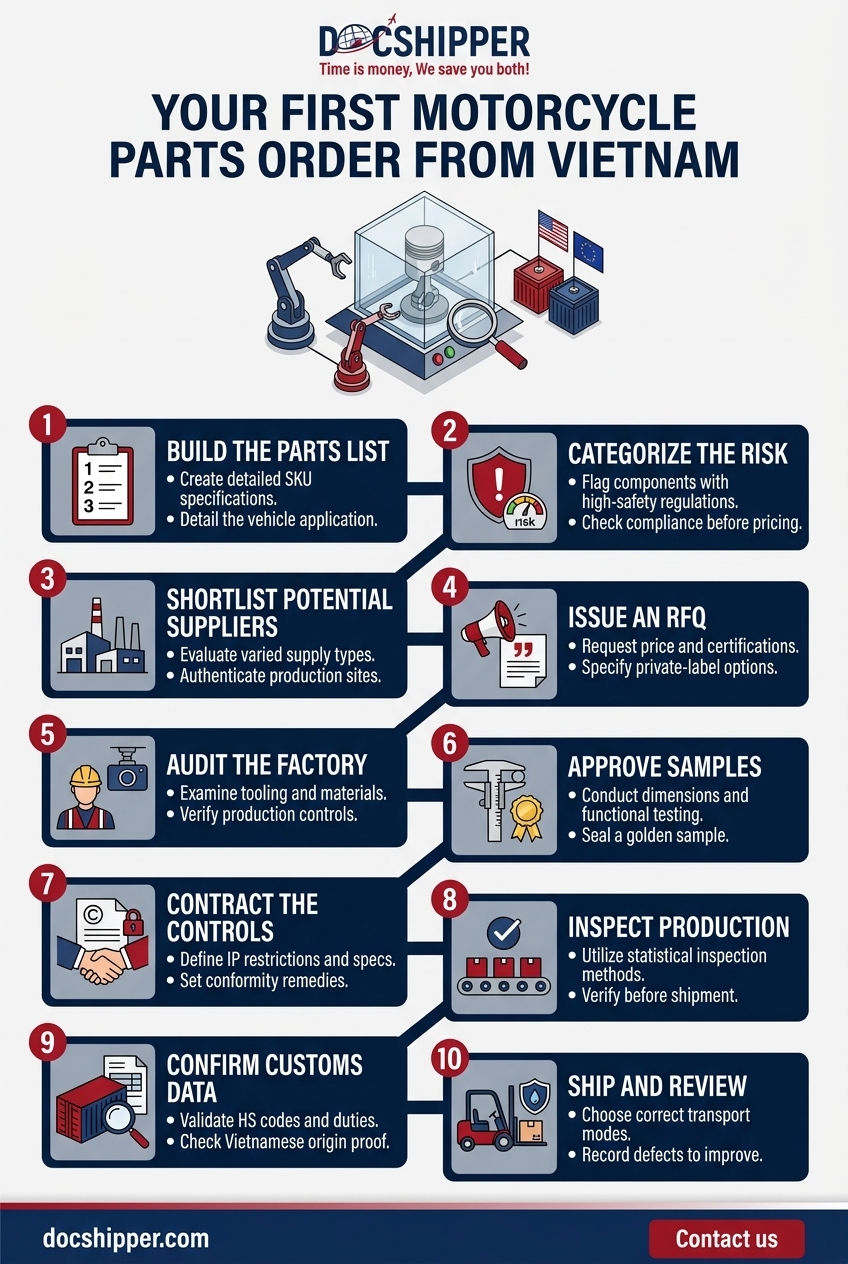
The safest first order begins with a structured part list and ends only after inspection and document review. Do not let a low unit price substitute for fitment evidence, regulatory proof or a clear origin strategy.
- Build the part list. Record the vehicle application, reference number, drawing, material, finish, quantity and target country for every SKU.
- Separate the risk groups. Mark lighting, brake hoses, tyres, helmets and other potentially regulated parts for compliance review before price comparison.
- Shortlist suppliers. Compare OEM tier suppliers, aftermarket manufacturers and traders, then verify the legal entity and actual production site.
- Issue the RFQ. Request price, MOQ, tooling, lead time, Incoterm, private-label options, test documents and origin evidence on one consistent template.
- Audit the factory. Check tooling, raw materials, production flow, inspection equipment, traceability, storage and subcontracting controls.
- Approve samples. Test dimensions, fitment, finish and function, then sign and retain a golden sample for production comparison.
- Contract the controls. Include IP restrictions, approved specifications, change notification, inspection rights, packaging rules and remedies for non-conformity.
- Inspect production. Use pre-production, during-production or pre-shipment inspection according to the product risk and order structure.
- Confirm customs data. Validate HS classification, duties, origin proof, commercial invoice, packing list and any destination-market certificates.
- Ship and review. Select LCL or FCL, protect parts against moisture and impact, then record delivery defects to improve the next order.
Conclusion
Vietnam offers a deep motorcycle and scooter parts base, but successful importing depends on separating commercial opportunity from regulatory and IP exposure. The most reliable process combines supplier vetting, sample approval, destination-specific compliance, documented QC and correct customs preparation.
- Vietnam’s motorcycle market supports a substantial local parts supply base.
- Separate safety-regulated parts from body, mechanical and accessory categories.
- Never buy or ship branded parts without the necessary trademark and distribution rights.
- Check US FMVSS requirements or EU approval marks for each relevant part.
- Confirm HS classification, origin evidence and additional tariffs before quoting.
Sourcing motorcycle or scooter parts in Vietnam? We can find and audit the right factories, inspect your parts and ship them with the correct origin documents.
FAQ | How to Import Motorcycle Parts from Vietnam: A Practical Buyer’s Guide
Avoid paying 100% upfront, especially when the supplier has not completed a factory audit or sample approval. A common structure is a deposit to start production and the balance only after an independent pre-shipment inspection confirms quantity, specifications and packaging. For a larger order, consider a letter of credit or another payment method that gives you documentary control. The purchase contract should also define what happens if the supplier misses the specification or shipment deadline.
Treat the refusal as a supplier-risk signal, particularly if the company claims to be a manufacturer. Ask for a live video walkthrough, the legal entity’s production address, details of subcontractors and evidence showing who actually makes the parts. If the supplier still avoids verification, do not send a large deposit or approve branded or safety-critical products. You can continue with a small, independently inspected trial order, but only if the commercial and compliance risks are acceptable.
Yes, but appoint one freight forwarder or consolidation partner before production begins. Each supplier should use standard carton labels showing the SKU, quantity, purchase order and destination. Keep separate commercial invoices and packing lists unless your customs broker confirms that a consolidated document is appropriate. Confirm in advance who will collect the goods, check carton counts and handle missing or incorrectly labelled cartons.
Stop shipment and compare the goods against the signed golden sample, drawing and purchase-order specifications. Record the differences with photographs, measurements and batch information, then request a written corrective-action plan. Do not accept an unapproved material, mould, finish or packaging change simply because the part still appears functional. Your contract should require written approval before any change and specify replacement, rework or refund remedies.
Often, yes. Used tyres, batteries, engines, airbags where applicable and contaminated mechanical components may trigger additional environmental, safety or quarantine requirements depending on the destination country. Ask the supplier to state the part’s condition, refurbishment process, remaining service life and cleaning method. Before buying, have your customs broker and destination-market regulator confirm whether the product can be imported and what declarations or inspections are required.
Separate the defective units from saleable stock and preserve the packaging, batch labels and inspection records. Document the issue with photos, measurements, vehicle-fitment results and the affected quantities, then notify the supplier within the contract’s claim period. Compare the defect with the agreed acceptance criteria rather than relying only on a general warranty. For recurring or safety-related failures, suspend further orders until the supplier provides root-cause analysis and verifies the corrective action.
Need Help with Logistics
or Sourcing in Vietnam ?
First, we secure the right products from the right suppliers at the right price by managing the sourcing process from start to finish. Then, we simplify your shipping experience - from pickup to final delivery - ensuring any product, anywhere, is delivered at highly competitive prices.


Fill the Form
Prefer email? Send us your inquiry, and we’ll get back to you as soon as possible.
Contact us