In short ⚡
CPTPP and Vietnam: Tariff advantages for Canada, Japan and Australia depend on the exact HS code, product-specific origin rule and valid certification; CPTPP does not automatically remove customs duty. Compare the main market-specific considerations below.| Market | CPTPP advantage | Key comparison | Where to check |
|---|---|---|---|
| Canada | Often the principal preferential route because Canada had no free trade agreement with Vietnam before CPTPP. | Confirm the tariff for the exact import year and applicable origin rule. | Global Affairs Canada and CBSA tariff resources |
| Japan | Provides a preferential option, but CPTPP is not always the cheapest or most-used agreement. | Compare AJCEP, VJEPA and RCEP for the relevant HS code and origin requirements. | Japan Customs and agreement schedules |
| Australia | Provides a preferential option alongside other agreements. | Compare CPTPP with AANZFTA and RCEP based on tariff rate, origin rule and documentation. | DFAT FTA Portal and Australian Border Force |
Key themes include country-specific tariff comparisons, product-specific rules of origin, self-certification and Annex 3-B documents, alternative FTAs, and common preference-claiming mistakes.
We hope you’ll find this article genuinely useful, but remember, if you ever feel lost at any step, whether it’s finding a supplier, validating quality, managing international shipping or customs, FNM Vietnam can handle it all for you!
What CPTPP changes for goods imported from Vietnam
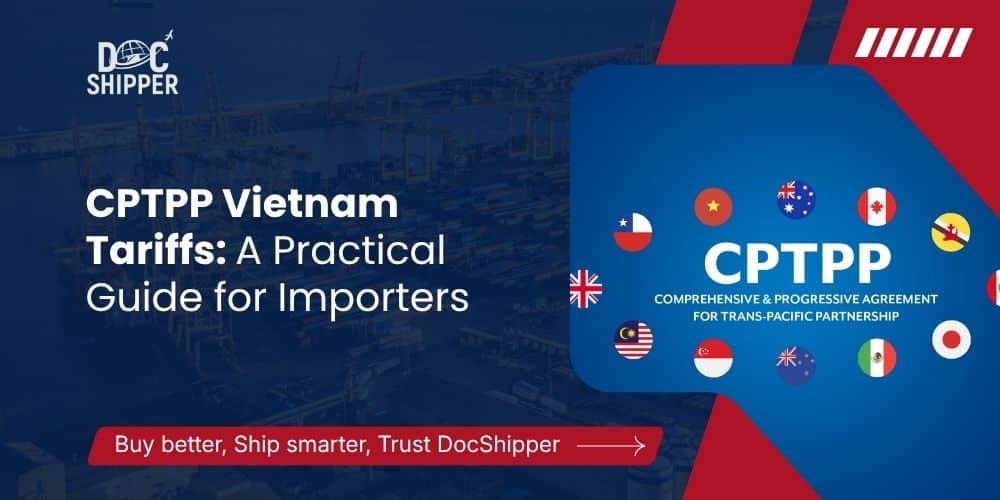
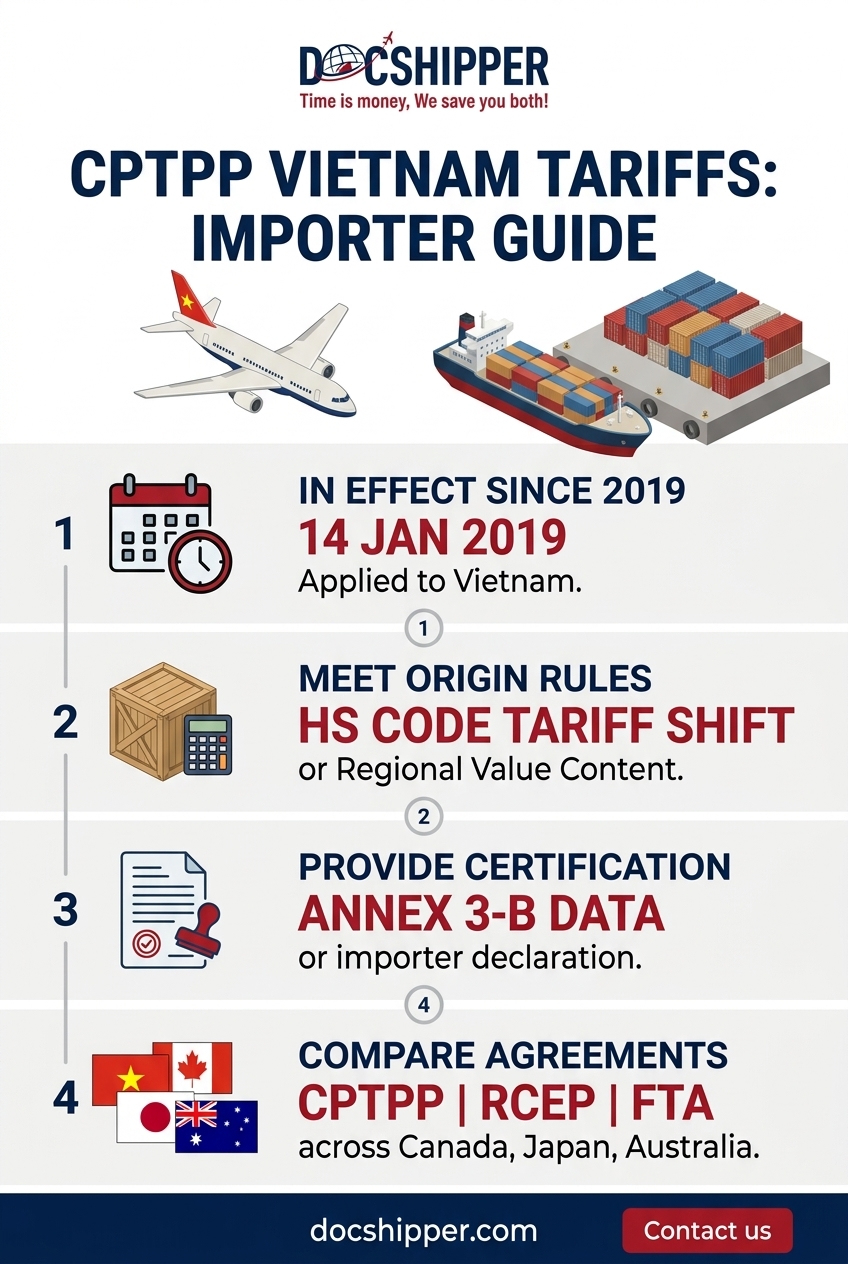
CPTPP, in force for Vietnam since 14 January 2019, can let importers in member countries such as Canada, Japan and Australia pay reduced or zero customs duty on eligible Vietnamese goods. The preference applies only when the product meets its product-specific rule of origin and the importer holds a valid certification containing the required data.
The Comprehensive and Progressive Agreement for Trans-Pacific Partnership links Vietnam with Canada, Japan, Australia, Mexico, the United Kingdom and other Pacific economies. Costa Rica has concluded its accession as the 13th member, with entry expected in the second half of 2027, according to reported accession information.
The agreement matters most where it creates access that did not previously exist. Canada and Mexico are the clearest examples for Vietnamese exporters. By contrast, Japan and Australia already have several agreements with Vietnam, so CPTPP may not be the cheapest or simplest option for every HS code.
Utilisation is increasing, but many exporters still do not claim the preference. Vietnamese exports shipped with a CPTPP certificate of origin rose from US$0.7 billion, approximately 2% of exports to CPTPP markets, in 2019 to US$5 billion, approximately 8.8%, in 2024. Trinh Thi Thu Hien, Deputy Director in Vietnam’s Ministry of Industry and Trade origin and import-export department, said: “These figures indicate a positive growth trend in the utilisation of CPTPP origin preferences, especially in markets that offered tariff preferences for Vietnamese goods for the first time.” Viet Nam News reported the figures.
| Question | Practical answer |
| Does CPTPP automatically remove duty? | No. The HS code, tariff schedule, origin rule and certification all matter. |
| When did CPTPP apply to Vietnam? | 14 January 2019. |
| What should you check first? | Classify the goods, find the CPTPP tariff line and test the product-specific origin rule. |
Canada, Japan and Australia: what to know for each market
Canada had no free trade agreement with Vietnam before CPTPP, so CPTPP is often the first preference route for Vietnamese goods. Japan and Australia also trade with Vietnam under ASEAN, bilateral and regional agreements, which makes a rate-and-origin comparison essential.
Canada
Start with the Canadian HS classification and consult the Global Affairs Canada CPTPP resources and the Canada Border Services Agency tariff information. Confirm the preferential tariff for the exact year of import because CPTPP rates can phase down over time.
At import, your broker or customs team must make the CPTPP claim in the form and manner required by Canadian customs. The certification does not need to be a traditional government-issued form if the applicable CPTPP data requirements are satisfied, but the importer remains responsible for having support for the claim.
Japan
Japan is a comparison market rather than an automatic CPTPP market. Vietnamese exports using the CPTPP form represented only 3% to 5% of exports to Japan, while approximately 50% used some preferential agreement. The alternatives include AJCEP, VJEPA and RCEP, depending on the goods and the available origin rule.
Check the exact tariff line through Japan Customs, then compare the rate and documentation under each agreement. Ta Duc Minh, Vietnamese Trade Counsellor in Japan, attributed 2025 Vietnam-Japan trade growth to “stemmed from parallel gains in both flows,” as reported by VOV. The wider trade context does not, by itself, prove that CPTPP is the best preference for your product.
Looking for a Reliable Shipping & Sourcing Partner?


Australia
Australia offers CPTPP alongside AANZFTA and RCEP, among other possible arrangements. Use the Australian Department of Foreign Affairs and Trade FTA Portal, the Australian Border Force tariff resources and the relevant agreement schedules to compare the HS code, rate and origin test.
A practical country-by-country check should take place before the supplier issues documents. Vietnamese exports to Japan reached US$26.77 billion in 2025, while exports to Canada reached US$5.56 billion in the first nine months of 2025, but these trade totals do not establish an individual product’s eligibility.
| Importing country | CPTPP position | Other agreements to compare | Where to check |
| Canada | In force for Vietnam since 14 January 2019; often the main preference route. | Check the goods-specific tariff options available to your importer. | Global Affairs Canada and CBSA tariff resources. |
| Japan | In force for Vietnam since 14 January 2019; CPTPP is one of several options. | AJCEP, VJEPA and RCEP. | Japan Customs and the relevant agreement schedules. |
| Australia | In force for Vietnam since 14 January 2019; compare before claiming. | AANZFTA and RCEP. | DFAT FTA Portal and Australian Border Force. |
DocShipper Tips
For Japan and Australia, CPTPP may not be the simplest or most economical preference route
Rules of origin: does your product qualify?
Goods qualify under CPTPP when they are wholly obtained in CPTPP countries or satisfy the product-specific rule of origin for their HS code. That rule may require a tariff shift, a regional value content calculation, or a specified manufacturing process.
A tariff shift means that non-originating inputs must change tariff classification after processing. Regional value content measures the required share of value connected to CPTPP production. The applicable test is found in the CPTPP product-specific rules, not in a general statement such as “made in Vietnam.”
CPTPP allows cumulation. In practical terms, qualifying materials from other CPTPP members can support originating status in Vietnam, subject to the agreement’s conditions. Chinese fabric, components or packaging do not automatically qualify merely because Vietnamese workers assemble the finished product.
Textiles and apparel require particular caution because CPTPP uses stricter yarn-forward concepts for many products. A sourcing team should obtain the HS codes and material declarations before production, then map each input to the applicable rule in Chapter 3 and the textile provisions in Chapter 4.
| Origin question | What to verify |
| Where were the materials produced? | Identify Vietnamese, CPTPP-originating and non-originating inputs. |
| What is the product-specific rule? | Check the exact HS code and required tariff shift, value content or process. |
| Was there only simple assembly? | Confirm that the processing is sufficient under the rule; assembly alone may not qualify. |
| Are textiles involved? | Trace yarn, fabric and garment production against the applicable textile rule. |
DocShipper Alert
Verify every input, processing step and textile requirement against the applicable CPTPP origin rule
How to claim the CPTPP preference: certification and documents
A CPTPP certification of origin may be completed by the exporter, producer or, where the importing country permits it, the importer. It can use any format that contains the minimum data elements in Annex 3-B, and the supporting records must be available if customs verifies the claim.
Vietnam moved from the traditional C/O Form CPTPP process to self-certification after its reservation ended on 14 January 2024. Self-certification does not remove the need for evidence. It shifts more responsibility to the party making the certification and to the importer relying on it.
Use this process before shipment:
- Classify the product. Confirm the importing country’s HS code and the CPTPP tariff line.
- Test the origin rule. Collect bills of materials, supplier declarations, production details and value calculations where required.
- Prepare the certification. Include the Annex 3-B minimum data, the certifier’s identity, the goods description and the relevant origin basis.
- Submit the claim. Give the certification and supporting information to the customs broker or importer in the format required by Canada, Japan or Australia.
- Retain the file. Keep invoices, purchase records, production documents, cost data, transport records and supplier evidence for the applicable retention period.
Ask your Vietnamese supplier to provide the product description, HS classification used, manufacturing location, material breakdown, supplier declarations and the person responsible for the certification. If a supplier cannot explain how the product meets the rule, a signed document alone is not a reliable origin assessment.
- Exporter, producer or permitted importer identified.
- Importer and exporter names and addresses recorded.
- Goods described clearly enough to match the commercial invoice.
- HS classification and origin criterion checked.
- Invoice, purchase and production records retained.
- Supplier declarations and regional value content calculations retained where relevant.
- Claim and any post-import correction or refund process checked against the importing country’s rules.
DocShipper Tips
Supplier declarations, production records and Annex 3-B data help support a defensible preference claim
DocShipper Platform
One platform. Your entire supply chain
Sourcing, freight, customs & documents — all centralised, all visible, 24/7.
CPTPP, RCEP or another FTA: choosing the best option
Choose the agreement that gives the lowest applicable rate for your HS code while using an origin rule your supplier can actually meet and document. In Canada, CPTPP is often the first agreement to test; in Japan and Australia, RCEP, AJCEP, VJEPA or AANZFTA may be equal or easier.
Compare agreements in a fixed order. First, confirm the HS code. Second, record the preferential rate and phase-down year. Third, compare the origin rule, including materials and processing. Finally, compare certification responsibilities, evidence requirements and the risk of a customs challenge.
Do not choose an agreement solely because its headline rate is zero. A theoretically better rate can become more expensive if the supplier must redesign sourcing, produce complex calculations or obtain records that are unavailable. Recheck the comparison when the tariff schedule, supplier or bill of materials changes.
| Situation | Agreement to test first | Why |
| Vietnam to Canada | CPTPP | It commonly provides the principal preferential route for Vietnamese goods. |
| Vietnam to Japan | CPTPP, then AJCEP, VJEPA and RCEP | Japan has several overlapping agreements and CPTPP is not always the most-used option. |
| Vietnam to Australia | CPTPP, AANZFTA and RCEP | Compare both the rate and the practical origin rule. |
| Supplier uses non-CPTPP inputs | The agreement with the workable rule | Material sourcing can determine eligibility more than the headline tariff. |
DocShipper Tips
Compare tariff rates, origin rules and documentation requirements before selecting CPTPP
Common mistakes when using CPTPP
The most frequent errors are treating “Made in Vietnam” as proof of origin, using the wrong HS code, missing required certification data and failing to retain evidence. Customs may verify the claim after import, so the preference should be treated as a documented compliance process rather than a supplier promise.
Mistake 1: relying on the label. Fix it by mapping the bill of materials to the product-specific rule. Mistake 2: copying an HS code from an old shipment. Fix it by confirming classification with the importing-country tariff and broker.
Mistake 3: assuming self-certification means no records. Fix it by keeping the Annex 3-B certification and the underlying commercial and production evidence. Mistake 4: selecting CPTPP without comparison. Fix it by checking RCEP, AJCEP, VJEPA or AANZFTA where available.
The importer generally carries the practical risk of an incorrect preference claim at entry, even when the supplier prepared the document. Before loading, have the supplier, origin specialist and customs broker agree on the HS code, origin rule, certification wording and document-retention plan.
| Risk | Preventive action |
| Non-originating inputs overlooked | Request a complete bill of materials and supplier origin declarations. |
| Wrong preferential rate | Check the official tariff schedule for the importing country and import date. |
| Incomplete certification | Review every Annex 3-B data element before shipment. |
| Verification failure | Retain production, invoice, transport and calculation records. |
Conclusion
CPTPP can reduce import duty on eligible Vietnamese goods, but the saving depends on three linked decisions: the correct HS code, a satisfied product-specific rule of origin and a defensible certification.
- CPTPP has applied to Vietnam since 14 January 2019.
- Utilisation is rising, especially in Canada and Mexico: Vietnamese exports using CPTPP C/O reached US$5 billion, approximately 8.8% of exports to CPTPP markets, in 2024.
- Origin depends on the product-specific rule, not simply on a Vietnamese label.
- An exporter, producer or permitted importer can certify origin using the Annex 3-B data requirements.
- In Japan and Australia, compare CPTPP with other available FTAs before claiming a preference.
Importing from Vietnam to Canada, Japan or Australia? We can check your supplier’s origin documents, coordinate customs paperwork and arrange the shipment with the right documentation for your route.
FAQ | CPTPP Vietnam Tariffs: A Practical Guide for Importers
Potentially, yes. Transit through a non-CPTPP country does not automatically remove eligibility, provided the goods remain under customs control and are not substantially processed, altered or released for domestic use there. Keep the through bills of lading, transit records and any customs-control documents to demonstrate that the goods retained their originating status.
Do not assume the preference is permanently lost. Some importing countries allow a post-import refund, correction or preferential claim within a defined deadline, but the procedure and time limit differ. Ask the broker to confirm the local process before entry and retain evidence showing that the goods qualified on the import date.
In appropriate cases, a certification may cover multiple shipments of identical goods during a defined period, rather than being prepared for every shipment separately. This is useful for regular supply arrangements, but the goods, tariff classification and origin rule must remain unchanged. Replace the certification if the bill of materials, production process or supplier changes.
Not always. Transport packaging is generally treated differently from retail packaging or materials included in the product’s tariff classification. Depending on the applicable product-specific rule, retail packaging may affect a tariff-shift analysis or regional value calculation. Identify these materials separately instead of assuming that all packaging is irrelevant.
A low-value shipment may qualify for simplified customs treatment or a certification waiver under the importing country’s rules, but this does not automatically make the goods originating. Duty-free treatment and CPTPP origin are separate questions. Keep enough product and sourcing evidence to support the claim if customs later reviews the shipment.
Pause the preference claim until the change is assessed. A new component can alter the HS classification, tariff-shift result or regional value content, even if the finished product looks identical. Obtain the revised bill of materials and supplier declaration, recalculate the origin result and issue corrected certification or customs information where required.
Yes, the claim may become difficult to defend when the applicable rule requires a regional value content calculation and the supporting figures cannot be verified. The supplier does not necessarily need to disclose commercially sensitive prices to every party, but it should provide a reliable calculation, supporting declaration or verification package. Agree in advance on how confidential evidence will be reviewed and retained.
Need Help with Logistics
or Sourcing in Vietnam ?
First, we secure the right products from the right suppliers at the right price by managing the sourcing process from start to finish. Then, we simplify your shipping experience - from pickup to final delivery - ensuring any product, anywhere, is delivered at highly competitive prices.


Fill the Form
Prefer email? Send us your inquiry, and we’ll get back to you as soon as possible.
Contact us