In short ⚡
Importing Ceramics and Pottery from Vietnam successfully requires matching the product to the right supplier, testing food-contact tableware, approving quality standards, and protecting goods during shipping. Follow these key steps:- Define each product’s specifications, intended use, destination market, quantities, dimensions, finish and packaging requirements.
- Shortlist suppliers in Bat Trang, the former Binh Duong area or Dong Nai according to product fit, capacity and export experience.
- Request production-representative samples, audit the factory and approve a golden sample before mass production.
- Test all food-contact tableware for lead and cadmium migration under the destination market’s requirements.
- Set written quality-control criteria for glaze, cracks, dimensions, functionality, defect classes, AQL sampling and final inspection.
- Use suitable cushioning, dividers, cartons and stable loading; choose LCL or FCL, supervise loading and arrange cargo insurance.
Key topics include Vietnamese supplier clusters, product-specific compliance, lead and cadmium testing, quality control, protective packing, LCL or FCL shipping, and the RFQ requirements for a first order.
We hope you’ll find this article genuinely useful, but remember, if you ever feel lost at any step, whether it’s finding a supplier, validating quality, managing international shipping or customs, FNM Vietnam can handle it all for you!
To import ceramics from Vietnam successfully, choose the supplier by product family, test all food-contact tableware for lead and cadmium migration, and treat packing as a margin-protection decision rather than a final logistics detail. Vietnam is particularly strong in glazed garden pots, decorative ceramics and tableware, with established pottery clusters around Bat Trang, the former Binh Duong area now within Ho Chi Minh City, and Dong Nai.
The right sourcing process connects four decisions: what you are buying, where it is made, which market rules apply, and how the cargo will be protected in transit. This guide covers supplier selection, compliance, quality control, packing, LCL or FCL shipping, and a practical RFQ template for your first order.
DocShipper Info
Match the product, market rules, supplier capability and shipping method before requesting quotes.
DocShipper Tips
Garden pots, tableware and decor need different tolerances, compliance checks and protection standards.
Why source ceramics and pottery from Vietnam
Vietnam offers a broad choice of glazed pots, tableware and decorative pottery, from artisan workshops to more structured manufacturers. Its strongest commercial opportunity depends on the product: garden pots and decorative items require finish, dimensions and packing discipline, while tableware also requires documented food-contact compliance.
The export data supports the importance of this category. In Q1 2024, Vietnam exported US$52.23 million of fine-art ceramics, up 32.4%; the United States represented 38.8% and the European Union 31.8%, while ceramic pots accounted for 71% of the total, according to Vietnam Agriculture.
Bat Trang, near Hanoi, is the best-known pottery cluster for traditional forms, glazed pieces and design-led production. The Hanoi Times reported around 200 enterprises and 1,000 pottery households there in 2024, with approximately 50% of households using e-commerce or social selling. This makes the cluster interesting for both established exporters and buyers looking for smaller, more distinctive collections.
The former Binh Duong ceramics area, now administratively part of Ho Chi Minh City following the 1 July 2025 provincial merger, is relevant when you need manufacturing capacity and export-oriented production. Dong Nai is another southern sourcing option. Always confirm the factory’s current registered address, because older supplier profiles may still describe the location as Binh Duong.
Nguyen Viet Toan, owner of Van Thanh An Co., Ltd. in Bat Trang, said that “Creativity in design, style, and glaze is essential to compete with imported products.” That point matters commercially: a low factory price is not enough if the collection has no distinctive glaze, shape or finish that your customers will recognise.
| Decision | What to assess |
| Product fit | Garden pots, food-contact tableware, decor or lamps |
| Cluster | Bat Trang for artisan and design-led pottery; former Binh Duong and Dong Nai for southern production options |
| Market | US, EU, UK, Australia and any additional destination-specific rules |
| Commercial context | Q1 2024 fine-art ceramics exports: US$52.23 million; pots represented 71% |
Product families: garden pots, tableware and decor
Garden pots should be specified around glaze durability, wall thickness, drainage, dimensions and nesting. Tableware must be specified around food-contact use, glaze consistency, migration testing and repeatability between production batches. Decorative ceramics and lamps need finish control, while wired lamps also require electrical compliance in the destination market.
For garden centres, ask for the exact outer and inner dimensions, weight, drainage-hole position, base stability and stacking or nesting plan. If the products will be used outdoors, request the supplier’s available evidence for the intended climate and define acceptable glaze defects, colour variation and dimensional tolerance in the purchase specification.
For plates, bowls, mugs and serving pieces, identify every surface that may contact food or drink. Do not assume that a piece is safe because it is labelled handmade, glazed or traditional. A decorative item that is genuinely not intended for food use should be labelled and marketed accordingly, but changing the label does not make a food-contact product compliant.
For decor, separate purely ornamental pieces from items that may be used functionally. A ceramic vase, candle holder or sculpture still needs stable glazing and impact-resistant packing. If a ceramic product includes wiring, sockets or other electrical components, add the relevant electrical testing and labelling requirements to the RFQ instead of treating it as ordinary pottery.
If you are combining ceramics with baskets, trays or other home-decor products, keep the product specifications separate. A mixed order can include Vietnamese bamboo or rattan, but each material needs its own supplier qualification, inspection criteria and packing method.
| Product family | Suitable sourcing focus | Compliance focus | Packing focus |
| Glazed garden pots | Bat Trang, former Binh Duong and Dong Nai options | Dimensions, glaze durability, drainage and intended outdoor use | Nesting, separators, reinforced cartons and stable pallet loading |
| Tableware | Manufacturers with controlled glaze recipes and repeatable batches | Lead and cadmium migration testing for the destination market | Individual protection, dividers, carton compression and palletisation |
| Decorative ceramics | Design-led workshops or export-capable factories | Correct use description and finish consistency | Foam, dividers and protection for protruding or fragile parts |
| Ceramic lamps | Supplier able to coordinate ceramic and electrical components | Electrical compliance in addition to ceramic requirements | Protection for the ceramic body, shade and wiring assembly |
DocShipper Tips
Confirm production control, batch consistency, factory capacity and golden-sample approval before committing to volume.
Looking for a Reliable Shipping & Sourcing Partner?


Finding and vetting ceramics manufacturers
The best Vietnamese ceramics supplier is not necessarily the largest factory. Select a workshop or manufacturer that can reproduce your approved shape and glaze, maintain the required capacity during peak periods, document its production process and accept independent quality control before shipment.
Start with a written product brief before contacting suppliers. Include drawings or reference images, dimensions, glaze references, colour tolerance, intended use, target quantity, packaging expectations, destination market and whether the item is for food contact. This lets you compare quotations on the same basis rather than comparing incomplete factory assumptions.
During a factory audit, inspect the kiln capacity, drying and storage areas, glaze preparation, production flow and finished-goods area. Ask how the supplier identifies batches and handles rejected pieces. For tableware, ask whether the glaze formula and firing conditions are controlled between batches, then request recent relevant test reports without accepting a report for a different product as proof of compliance.
Artisan households can offer distinctive designs, but they may have less predictable capacity and documentation. Larger factories may offer better repeatability, packaging control and export processes. The practical test is not the supplier’s presentation: it is whether the supplier can produce a sample, explain the process and meet your written acceptance criteria consistently.
Approve a golden sample before production. The golden sample is the physical reference retained by both parties for shape, colour, glaze, dimensions and finish. Your purchase order should state that mass production must conform to this sample and that changes require written approval.
| Vetting stage | Action |
| Shortlist | Match the supplier to garden pots, tableware, decor or lamps rather than asking one factory to supply every category |
| Document review | Check company identity, production address, export experience, product range and available test reports |
| Factory audit | Review kilns, glaze control, capacity, storage, batch traceability and packing operations |
| Sampling | Order production-representative samples and record all approval criteria |
| Golden sample | Retain the approved reference and attach its requirements to the purchase order |
DocShipper Alert
Food-contact ceramics require destination-specific lead and cadmium migration testing on the finished product.
Compliance: lead and cadmium in ceramic tableware
Tableware must pass lead and cadmium migration testing for the destination market. In the EU, start with Directive 84/500/EEC and Regulation 1935/2004, then check the importing country’s current requirements; the Netherlands tightened its food-contact ceramics limits from 29 May 2026.
Migration testing measures substances that can transfer from the ceramic into a food or drink contact medium under specified test conditions. It is different from simply testing the raw clay or measuring the total amount of a substance in the product, so your laboratory request must specify the product, use and applicable market method.
For the Netherlands, SGS reported Category I limits of lead at no more than 6 µg/dm² and cadmium at no more than 4 µg/dm² under the revised rules from 29 May 2026. The same source notes a transition for products placed on the market before 1 December 2026, so confirm the applicable date and product category with your compliance adviser before shipment.
For the United States, review the applicable US Food and Drug Administration requirements for leachable lead and cadmium. California buyers must also assess Proposition 65 exposure. J.J. Keller reports settlement levels for leachable lead of 0.226 ppm for flatware and 0.100 ppm for other tableware, while the California Department of Public Health tableware resources provide an additional reference point.
Use a competent laboratory, ideally one operating to ISO/IEC 17025, and test the final glaze and finished product rather than relying only on a supplier declaration. Keep the laboratory report, sample identification, production batch and test conditions together. If the glaze, firing process, supplier or product shape changes, assess whether a new test is required.
| Market or rule | What to check |
| EU | Directive 84/500/EEC, Regulation 1935/2004 and the specific importing country’s implementation |
| Netherlands | Revised ceramics rules from 29 May 2026; Category I limits reported as Pb ≤6 µg/dm² and Cd ≤4 µg/dm² |
| United States | FDA requirements for leachable lead and cadmium, based on the product and intended use |
| California | Proposition 65 assessment; reported leachable lead settlement levels are 0.226 ppm for flatware and 0.100 ppm for other tableware |
| Decorative-only products | Do not present them for food use; apply clear, truthful labelling and confirm destination-market requirements |
DocShipper Alert
Clear limits for glaze, cracks, dimensions and stability make AQL results commercially useful.
Quality control for ceramics
Inspect ceramics against a written checklist covering glaze, cracks, crazing, pinholes, colour, dimensions, weight, stability and packing. For pots, add drainage holes, rim condition, base flatness and nesting fit; for tableware, add food-contact surface finish and batch consistency.
Crazing means a network of fine cracks in the glaze surface. Pinholes are small openings or defects in the glaze. Both may affect appearance and, depending on the product and use, cleaning or performance. Your specification should define which defects are unacceptable, which are minor and what maximum quantity is tolerated.
Use AQL sampling when the order is large enough for statistical inspection. AQL, or Acceptable Quality Limit, is a sampling framework used to define how many defects may be found in an inspected sample before the lot is accepted or rejected. It does not replace your defect definitions, laboratory testing or approval of a representative sample.
Carry out a pre-production review when the first production pieces are available, then a final random inspection when the order is complete and packed. Record carton numbers, inspected quantities, defect photos, measurements and the inspector’s decision. Do not allow a supplier to substitute a different glaze or packing material after inspection without written approval.
- Glaze: check colour, coverage, gloss, pinholes, crawling and visible crazing.
- Structure: check cracks, chips, warping, unstable bases and sharp edges.
- Dimensions: measure diameter, height, wall thickness where relevant and weight against the specification.
- Function: check drainage holes, lids, handles, stacking, nesting and flatness.
- Consistency: compare pieces with the golden sample under agreed lighting conditions.
- Packaging: open selected cartons and verify separators, cushioning, carton condition and product movement.
| Defect class | Examples to define in the specification |
| Critical | Food-contact non-compliance, structural failure or a sharp hazardous edge |
| Major | Cracks, unstable pieces, substantial glaze defects or dimensions outside the agreed tolerance |
| Minor | Small cosmetic variation accepted only within the approved standard |
DocShipper Alert
Approve packing samples, stabilise the load and document every stage before shipment.
DocShipper Platform
One platform. Your entire supply chain
Sourcing, freight, customs & documents — all centralised, all visible, 24/7.
Packing and shipping ceramics safely
Safe ceramic shipping starts with product design and ends with supervised container loading. Use double-wall cartons, dividers or foam, nest compatible pots, prevent movement inside each carton, palletise when appropriate, and block or stow the container so cartons cannot shift during handling.
Ask the supplier to show a packing sample before mass production. The sample should demonstrate the internal protection, separation between pieces, edge protection, carton strength, pallet configuration and external carton markings. Large pots may need a different method from plates or mugs, so do not approve one generic packing standard for every SKU.
Choose LCL when the order does not fill a container and FCL when the volume, product mix and delivery plan justify a dedicated container. LCL introduces additional handling and consolidation points; FCL reduces shared-cargo handling but does not remove the need for internal cushioning and stable loading.
Loading supervision is valuable for fragile cargo. Check that heavy cartons are not placed on vulnerable pieces, that pallets or cartons are stable, that voids are blocked and that the final loading condition is photographed. Keep the packing list, carton count, loading photos, inspection report and seal information together for any later claim.
Insurance should be considered before shipment, not after damage occurs. Confirm the policy’s covered risks, exclusions, deductible, required packing standard and claims procedure. In case of breakage, preserve the packaging, photograph the damaged cartons and products, notify the relevant parties promptly and provide the shipping and inspection records.
| Stage | Protection action |
| Product grouping | Separate fragile shapes, nest only compatible pieces and protect rims, handles and protrusions |
| Carton packing | Use double-wall cartons with dividers, foam or equivalent cushioning and minimal internal movement |
| Palletisation | Keep loads stable, protect carton edges and avoid placing excessive weight on vulnerable products |
| Container loading | Block and stow the cargo, supervise loading and photograph the final arrangement |
| Claims protection | Arrange cargo insurance and retain inspection, packing, loading and damage records |
DocShipper Info
Separating product definition, testing, inspection and insured shipping reduces costly surprises on your first import.
Step by step: your first ceramics order from Vietnam
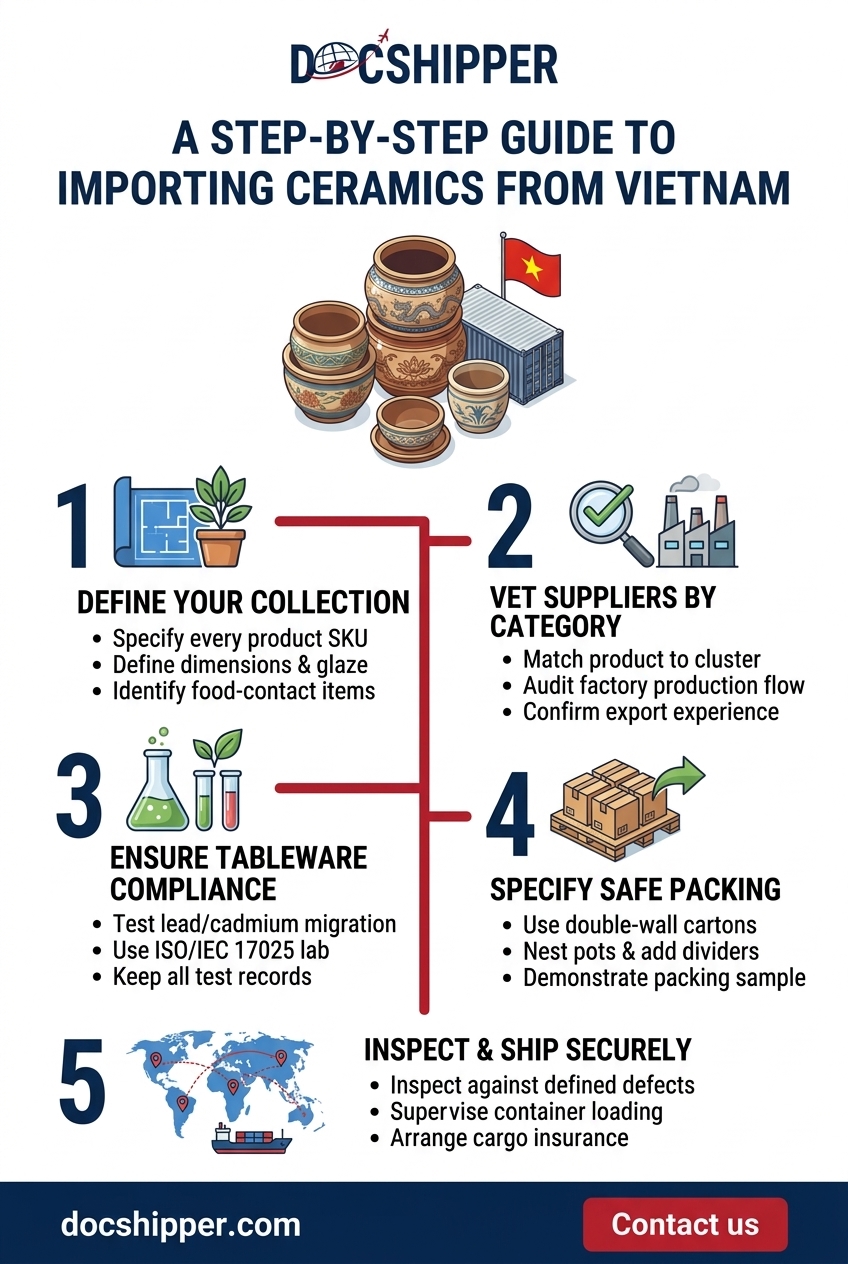
A first order should move from product definition to supplier selection, sample approval, testing, inspection and insured shipping. The sequence below prevents a common mistake: negotiating a price before confirming whether the product can be made, tested and packed to your standard.
- Define the collection. List each SKU, product family, dimensions, finish, colour, intended use, quantity, destination market and target delivery date.
- Separate food-contact products. Mark every plate, bowl, mug or serving item that may contact food or drink. Add lead and cadmium migration testing to its specification.
- Shortlist by cluster. Compare Bat Trang, former Binh Duong and Dong Nai suppliers according to design fit, capacity, export experience and process control.
- Request samples. Ask for production-representative samples and record the agreed glaze, measurements, functional features and acceptable cosmetic variation.
- Audit and verify. Review the factory, kiln capacity, glaze controls, batch handling, available reports and peak-season capacity.
- Approve the golden sample. Keep a signed reference and state that any change requires written approval.
- Test tableware. Use a competent laboratory for the destination-market lead and cadmium migration requirements before mass shipment.
- Contract the controls. Include product specifications, defect classes, AQL sampling, packing requirements, inspection rights, shipping terms and documentation.
- Inspect before shipment. Check finished goods, dimensions, glaze, cracks, colour, drainage, cartons and the actual packing method.
- Pack and ship insured. Choose LCL or FCL, supervise loading, retain photographs and arrange cargo insurance before departure.
Use the following RFQ template so suppliers answer the same questions:
- Product: garden pot, tableware, decor or lamp; include drawings, images and intended use.
- Dimensions: required height, diameter, capacity, wall thickness and acceptable tolerance.
- Finish: glaze type, colour reference, gloss level, handmade variation and defect standard.
- Quantity: quantity per SKU, expected repeat order and peak-season capacity required.
- Compliance: destination market, food-contact status, lead and cadmium migration test requirement, and requested laboratory documentation.
- Sample: sample cost, lead time, courier method and golden-sample approval process.
- QC: inspection timing, AQL plan, defect classes, measurement method and photo-report requirement.
- Packing: inner protection, dividers or foam, carton specification, palletisation, nesting and loading supervision.
- Commercial terms: quotation basis, payment terms, production lead time, shipping port and documents supplied.
- Insurance: cargo value, coverage requested, exclusions and claims documentation.
Conclusion
Vietnam can supply distinctive ceramics, but the sourcing decision should be based on product fit and operational control rather than unit price alone. Pots, tableware and decor require different supplier capabilities, testing plans and packing methods.
- Vietnam is strong in glazed garden pots, decor and tableware, with Bat Trang, the former Binh Duong area and Dong Nai offering different sourcing options.
- Choose the cluster and supplier according to the product family, expected quantity and required consistency.
- Test food-contact tableware for lead and cadmium migration under the destination market’s rules, including EU and Dutch 2026 requirements, FDA expectations and California Proposition 65 where relevant.
- Inspect glaze, crazing, cracks, colour, dimensions and functional features using clear defect classes and an AQL sampling plan.
- Protect the margin with suitable cartons, dividers, cushioning, stable loading and cargo insurance.
Sourcing Vietnamese ceramics? We can help find the right workshop, arrange testing and inspection, specify protective packing, and ship your products with appropriate insurance.
FAQ | How to Import Ceramics from Vietnam: Suppliers, Compliance, QC and Shipping
Do not rely on the word “handmade” as a general tolerance. Define the variations you will accept before ordering, such as slight differences in glaze tone, brush marks, texture or dimensions. Use reference photos and measurable limits, then classify each variation as acceptable, major or unacceptable. This prevents a supplier from treating significant inconsistencies as normal craftsmanship.
Ask the supplier or freight forwarder to confirm the exact requirements for your destination before production. A typical shipment file may include the commercial invoice, packing list, bill of lading or airway bill, certificate of origin where applicable, customs declaration data and any requested test or compliance reports. Make sure the product description, quantities, values, carton count and HS classification are consistent across the documents.
Start with the unit price, then add export packing, inland transport in Vietnam, origin charges, freight, insurance, customs duty, import VAT or sales tax, broker fees, destination handling and delivery to your warehouse. For fragile products, also include an allowance for breakage, replacement pieces and inspection costs. A low factory quotation can become uncompetitive once packaging and destination charges are included.
Treat the change as a new technical decision, even if the finished piece appears similar. Ask the supplier to explain the reason, identify the affected SKUs and provide new samples. For food-contact products, assess whether the change requires renewed migration testing. Do not release mass production until the revised sample and any compliance evidence have been approved in writing.
Discuss capacity before confirming the purchase order, especially if the collection depends on a small artisan workshop. Ask about kiln schedules, material availability, lead times for repeat orders and the supplier’s maximum monthly output. For seasonal products, place orders early and agree on a production slot. You can also hold an approved sample and key specifications with a qualified backup supplier.
Do not assume that all ceramic products use the same HS code. Tableware, garden pots, decorative objects, ceramic lamps and items combined with other materials may fall into different classifications. Give your customs broker precise information about the product’s material, function, composition and electrical components, then confirm the applicable duty rate and import restrictions before finalising the quotation.
Need Help with Logistics
or Sourcing in Vietnam ?
First, we secure the right products from the right suppliers at the right price by managing the sourcing process from start to finish. Then, we simplify your shipping experience - from pickup to final delivery - ensuring any product, anywhere, is delivered at highly competitive prices.


Fill the Form
Prefer email? Send us your inquiry, and we’ll get back to you as soon as possible.
Contact us