In short ⚡
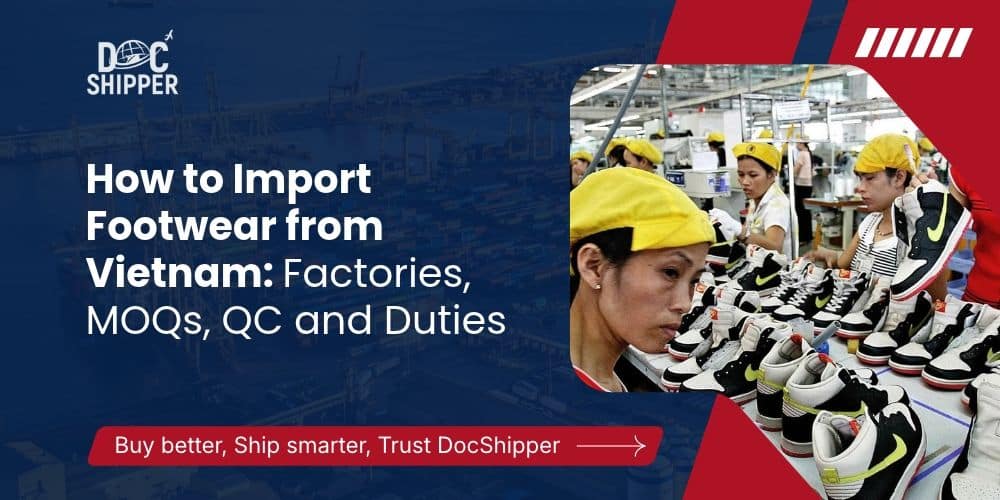
Importing Footwear from Vietnam: Suppliers and Process requires choosing a factory that matches your volume, approving several samples, controlling production quality, verifying origin and HS classification, and coordinating compliant shipping documents.
Follow these key steps:
- Define the footwear category, materials, construction, target price, order volume and destination market.
- Shortlist and verify suitable factories by checking legal details, production capacity, equipment, export history and subcontracted processes.
- Send a complete technical brief, then approve the prototype, fit sample, salesman sample and pre-production sample.
- Confirm MOQ drivers, including materials, colours, sizes, moulds and specialised equipment, before releasing production.
- Inspect materials, construction, dimensions, appearance, function, packaging, labelling and destination-market compliance.
- Calculate duties using the correct HS code, customs value, origin rules and required documents, then align the invoice, packing list, bill of lading and origin proof.
The guide covers Vietnam’s footwear industry, factory tiers, MOQs and sampling, quality control and compliance, EU, US and UK duties, and sea, air and consolidated shipping.
We hope you’ll find this article genuinely useful, but remember, if you ever feel lost at any step, whether it’s finding a supplier, validating quality, managing international shipping or customs, FNM Vietnam can handle it all for you!
To import footwear from Vietnam successfully, you need to match your order volume with the right factory tier, approve several samples, control production against a detailed checklist, and calculate duties from the correct HS classification and origin rules.
Vietnam is a strong option for athletic, casual, leather and private-label footwear, but the market is not a single pool of interchangeable shoe factories. Large foreign-invested manufacturers often serve global brands, while smaller and mid-sized factories may be more suitable for emerging brands and retailers.
DocShipper Info
Match your product, volume and target market with the right factory before requesting quotations.
Why Vietnam for footwear
Vietnam exported nearly USD 29 billion of footwear in 2025 and was the world’s second-largest footwear exporter. Its industry combines export experience, large production capacity and established expertise in athletic, casual and leather shoes.
According to data from Lefaso reported by VnEconomy on 29 January 2026, Vietnam’s footwear exports reached nearly USD 29 billion in 2025, up 5% year on year. The same source reports nearly 3,000 enterprises, approximately 1.5 million workers and annual capacity of 1.3 to 1.4 billion pairs.
The destination breakdown shows why the country is relevant to brands targeting several markets. The United States was the largest destination in the supplied 2025 data, followed by the European Union, China and Japan.
- United States: USD 11.01 billion
- European Union: USD 6.88 billion
- China: USD 1.78 billion
- Japan: USD 1.61 billion
- Total footwear exports: nearly USD 29 billion
The industry also has limits. Foreign-invested companies generated 80% of footwear export value, which indicates that much of the export infrastructure is concentrated among large, internationally connected manufacturers. These factories may offer advanced processes, but their commercial requirements can be unsuitable for a small footwear brand.
Before contacting factories, define your shoe category, construction, target price, expected volume and destination market. Athletic shoes may involve moulds, technical materials and several performance tests, while leather shoes require closer control of hides, colour consistency and chemical compliance.
| Decision factor | What Vietnam can offer | What to verify |
| Product range | Athletic, casual, leather and other footwear categories | Relevant experience with your construction and materials |
| Export capacity | Nearly USD 29 billion in footwear exports in 2025 | Whether the factory has capacity for your order size |
| Factory structure | Large foreign-invested producers and local manufacturers | MOQ, communication, development support and production slot |
| Destination markets | Strong exports to the US, EU, China and Japan | Origin, labelling and product requirements in your market |
DocShipper Tips
Confirm equipment, production ownership, subcontracting and export experience before selecting a supplier.
Finding the right factory tier
Large brand-dedicated factories rarely accept small orders on flexible terms. For a startup or mid-sized retailer, a mid-size Vietnamese factory may be a more realistic target, provided you verify its capacity, materials network, quality system and export history.
Start with a written factory brief rather than a generic request for a catalogue. Include the shoe type, upper and sole materials, construction method, target market, expected order volume, packaging requirements and whether you need private-label development.
Then build a shortlist of Vietnam shoe manufacturers by comparing what each factory actually produces. A factory that makes simple sandals is not automatically suitable for a technical sneaker, and a factory experienced in leather shoes may not have the right equipment for athletic footwear.
Ask for the factory’s legal company details, production address, product categories, equipment, material suppliers and export references. A trading company may present itself as a footwear factory, so confirm whether it owns production equipment, employs production staff and controls the critical operations.
Verification should cover both documents and the physical operation. Review the business identity, visit the site or arrange an independent audit, compare the declared capacity with the machinery and workforce, and confirm which processes are subcontracted.
For a first order, do not select a supplier solely because it offers the lowest quotation. A low price can conceal excluded mould costs, weaker materials, uncertain testing, subcontracting or a production schedule that does not match your launch plan.
| Factory tier | Likely fit | Questions to ask |
| Large brand-focused factory | Established brands with substantial and repeat volumes | Will it accept your volume, development calendar and payment structure? |
| Mid-size local factory | SMEs, private-label brands and retailers needing more flexibility | What products does it make in-house and what is subcontracted? |
| Trading company or sourcing intermediary | Brands needing access to several production options | Who owns the factory, controls QC and issues the commercial documents? |
DocShipper Tips
Approve the pre-production sample in writing before releasing bulk production.
Looking for a Reliable Shipping & Sourcing Partner?


From sample to production: MOQ and timeline
Importing shoes from Vietnam normally requires several sampling rounds before bulk production. The usual sequence is a prototype, fit sample, salesman sample and pre-production sample, although the exact sequence depends on the product and factory.
MOQ means minimum order quantity: the smallest quantity a factory is prepared to produce under its commercial and technical conditions. There is no universal shoe MOQ for Vietnam because the threshold changes with materials, colours, sizes, moulds, components and the factory’s production planning.
Begin by sending a technical package with drawings, measurements, material specifications, logo files, colour references, packaging requirements and tolerances. If the factory must interpret an incomplete brief, the sample may reflect its assumptions rather than your intended product.
Use the first prototype to validate the construction and appearance. The fit sample should then be assessed on sizing, comfort and wearability, while the salesman sample confirms the version that will be shown to buyers or used for commercial approval.
The pre-production sample is the control version for bulk manufacturing. Approve it in writing and retain an identified reference pair, because production quality should be compared with the approved sample rather than with a changing email description.
MOQs increase when the factory must purchase dedicated materials, order a custom sole or mould, set up specialised equipment, or manage many colours and size combinations. Ask the supplier to separate the MOQ for total pairs, colour, material and mould, rather than accepting one unexplained figure.
- Send the product brief and technical files.
- Confirm material availability, development charges, mould requirements and MOQ drivers.
- Review the prototype and issue consolidated technical comments.
- Approve the fit and commercial sample after checking dimensions and construction.
- Approve the pre-production sample as the bulk reference.
- Release production only after the specifications, packaging and inspection criteria are signed off.
| Stage | Purpose | Approval check |
| Prototype | Validate the construction and general appearance | Pattern, components, logo placement and construction method |
| Fit sample | Validate sizing and wearer comfort | Measurements, last, balance and fit comments |
| Salesman sample | Represent the approved commercial product | Colours, materials, finish and presentation |
| Pre-production sample | Set the reference for bulk production | Written approval before the production run |
DocShipper Alert
Set measurable inspection standards for materials, construction, dimensions, appearance and packaging before production begins.
Quality control and compliance
Footwear quality control should check the materials, construction, dimensions, appearance, function and packaging before the shipment leaves Vietnam. A pre-shipment inspection is most useful when the acceptance criteria were agreed before production, not improvised after defects appear.
Start with incoming-material controls. Check leather or synthetic material against the approved reference, inspect colour and grain consistency, verify sole and outsole components, and confirm that labels, boxes and accessories match the approved specification.
During production, focus on the points that are difficult or expensive to correct later: cutting, stitching, bonding, moulding, logo application and size grading. Bonding refers to joining components with adhesive; poor surface preparation, adhesive application or curing can cause sole separation.
At final inspection, use a representative sample of finished pairs and record defects by severity. Inspect pair matching, sizing, symmetry, stitching, loose threads, glue marks, wrinkles, sole attachment, odour, colour, logo position, accessories and carton packing.
Compliance depends on the destination market and the product’s materials. For the EU, REACH is the main chemicals framework to check, including restrictions that may affect leather and other components, such as chromium VI requirements. Confirm the applicable limits and testing method with the laboratory or importer responsible for the product.
Labelling must also be checked before production. Requirements may concern fibre or material composition, size, country of origin, care information, importer details or language, depending on the destination and product category. Do not treat a factory’s existing label as proof that it meets your market’s rules.
- Materials: compare leather, mesh, synthetic upper, lining, insole and outsole with approved references.
- Construction: inspect stitching density, seam alignment, bonding, moulding and sole attachment.
- Dimensions: measure size grading, length, width, opening, heel height and pair symmetry against the specification.
- Appearance: check colour, wrinkles, scratches, glue marks, loose threads and logo placement.
- Function: assess closure systems, flexibility, grip and other product-specific performance points.
- Packaging: verify pair matching, tissue, inserts, labels, carton marks and shipping configuration.
- Compliance: confirm required chemical tests, labelling and technical documentation for the destination market.
| Product type | Priority QC and compliance focus | Evidence to request |
| Athletic shoes | Bonding, moulded components, sizing, flexibility and performance claims | Approved sample, test reports and production inspection record |
| Leather shoes | Leather consistency, colour, stitching, finish and chemical restrictions | Material approvals, applicable laboratory testing and inspection report |
| Sandals | Strap attachment, sole bonding, sharp edges and comfort | Construction specification, approved sample and defect record |
DocShipper Alert
Verify the HS code, origin rule, customs value and required proof for every destination.
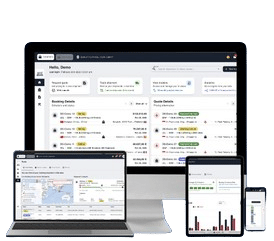
DocShipper Platform
One platform. Your entire supply chain
Sourcing, freight, customs & documents — all centralised, all visible, 24/7.
Duties by market in 2026
The duty on imported footwear depends on the destination, the exact HS classification, the material and construction, the declared customs value and whether preferential origin can be claimed. Do not calculate from the generic phrase “shoes from Vietnam”.
For the EU, the EU-Vietnam Free Trade Agreement removed 71% of duties when it entered into force on 1 August 2020, with the remaining duties scheduled over seven years according to the supplied PwC and French customs data. Footwear is one of the product groups where the difference between a preferential and a normal tariff can be commercially important.
Preferential treatment requires the goods to satisfy the applicable origin rule and the importer to hold the required proof. For consignments above EUR 6,000, the supplied guidance identifies EUR.1 as the relevant proof of origin; verify the current documentation route and product-specific staging in the European Commission’s Access2Markets database.
For the United States, the supplied 2026 source from Kroll reports a Section 301 framework at 12.5% for Vietnam from 24 July 2026, on top of normal duties. Confirm the precise scope, effective date, HTS classification and any current exclusions with USTR and US Customs and Border Protection before committing to a purchase price.
The UK must be checked separately rather than assumed to follow the EU. The applicable tariff depends on the UK tariff classification and the origin preference available under the UK-Vietnam trade arrangements, so obtain a classification and origin review before quoting a landed price.
Build a duty worksheet for every SKU. Record the destination, HS code, material and construction, customs value, normal duty, preferential duty if available, origin document, import VAT or sales tax and any broker or customs charges.
| Market | 2026 duty point | What to verify before ordering |
| European Union | EVFTA preferential treatment may reduce footwear duties when origin requirements and documentation are satisfied | HS code under 6401-6405, staging, origin rule and EUR.1 or applicable proof |
| United States | 12.5% Section 301 framework for Vietnam reported from 24 July 2026, on top of normal duties | HTS classification, exact scope, normal duty, exclusions and CBP requirements |
| United Kingdom | Requires a separate UK tariff and preference review | Commodity code, Vietnam origin, preference conditions, VAT and customs procedure |
DocShipper Tips
Share carton dimensions, volume, weight and ready date with your forwarder to select the right shipping mode.
Shipping footwear from Vietnam
Most commercial footwear shipments move by sea in 40-foot containers from ports serving the main production areas, including Cai Mep in the south and Hai Phong in the north. Air freight is generally used for samples, urgent replenishment or launch-critical pairs when the higher transport cost is justified.
Choose the shipping mode after confirming carton dimensions, pairs per carton, total cartons, gross weight, cubic volume and ready date. Footwear can consume substantial container space because of individual boxes, protective packing and retail presentation requirements.
Ask the supplier to provide a packing list that matches the approved packing configuration. Your freight forwarder can then compare the container requirement, consolidation options and delivery routing without relying on an estimate made before the packaging is final.
Agree the Incoterm before comparing quotations. An Incoterm defines which party arranges transport, insurance, export formalities, import clearance and delivery responsibilities, so two apparently similar factory prices may not include the same logistics costs.
Keep customs documents consistent across the commercial invoice, packing list, bill of lading and origin proof. The product description, quantities, values, carton marks and origin details should align with the goods and with the duty calculation prepared for the destination.
| Transport mode | Best use | Information required |
| Sea freight | Commercial production and full-container shipments | Carton count, cubic volume, gross weight, ready date and port |
| Air freight | Samples, urgent launches and small time-sensitive shipments | Chargeable weight, dimensions, customs value and delivery deadline |
| Consolidated sea freight | Smaller shipments that do not fill a container | Final packing list, cargo volume, destination and consolidation cut-off |
Conclusion: import footwear from Vietnam with a controlled plan
Vietnam can support a footwear brand from sample to shelf, but the result depends on decisions made before production. Choose the factory tier according to your volume, approve the product through several sampling rounds, inspect the critical construction points and calculate duties from verified origin and classification data.
- Vietnam exported nearly USD 29 billion of footwear in 2025.
- Choose a factory tier that matches your MOQ and development requirements.
- Plan for several sampling rounds before bulk production.
- For the EU, EVFTA savings depend on valid origin compliance and documentation such as EUR.1 where applicable.
- For the US, include the reported 12.5% Section 301 framework from 24 July 2026 on top of normal duties, subject to current classification and scope checks.
- Use a footwear-specific QC checklist covering materials, bonding, stitching, sizing, appearance and packing.
Developing footwear in Vietnam? We help you find and verify factories, inspect production and ship to your market with the right origin documents, combining sourcing, quality control, freight and customs coordination in one file.
FAQ | How to Import Footwear from Vietnam: Factories, MOQs, QC and Duties
Register your trademark in Vietnam before sharing production files, especially if the factory will manufacture branded products or custom components. Your manufacturing agreement should also state that the patterns, tech packs, moulds, logos and packaging artwork remain your property. Include confidentiality, non-use and non-disclosure clauses, and specify that the factory may not sell overruns or produce the same design for another buyer. For valuable moulds, record who paid for them, where they are stored and who can authorise their transfer.
Avoid paying the full balance before production is independently checked. A common structure is a deposit to start materials and production, followed by the balance after a passed pre-shipment inspection and receipt of compliant shipping documents. The exact percentage should reflect your negotiating position and order value. Make sure the beneficiary name matches the verified legal entity, and never change bank details solely because of an email request—confirm any change through a known phone number or video call.
Do not rely on a general promise to “maintain quality.” Your purchase contract should define measurable tolerances for dimensions, colour, stitching, bonding, logo placement and acceptable defect levels. If an inspection identifies a serious deviation, place the shipment on hold and request a written corrective-action plan. Depending on the defect, the remedy may be rework, replacement, a price adjustment or production of replacement pairs. Keep the approved reference pair and inspection evidence until the claim is resolved.
A factory’s standard size chart is not automatically suitable for your customers. Test the actual last and size grading with wearers who represent your target market, checking length, width, instep volume, heel slip and comfort after extended use. Approve the conversion between Vietnamese, EU, UK and US sizes in writing, and confirm whether the size label refers to foot length or the internal shoe measurement. For online sales, use the validated measurements in your product size guide to reduce avoidable returns.
Ask the factory to identify which part of the MOQ is fixed and which part can be reduced. A pilot may be possible if you use available materials, limit the number of colours, share an existing sole mould or accept a higher unit price. Put the pilot conditions in writing, including whether its quantities count toward the next bulk order. A small run should test repeatability, packaging, fit and customer response—not merely produce a few attractive samples.
Subcontracting is not automatically unacceptable, but you should know which operations are performed elsewhere. Require the factory to disclose subcontractors involved in cutting, moulding, stitching, bonding, printing or packing, and obtain written approval before any change. The main supplier should remain responsible for specifications, labour compliance, quality control, traceability and delivery. If a critical process is subcontracted, audit or inspect that location as well, rather than treating the primary factory’s audit as sufficient.
Need Help with Logistics
or Sourcing in Vietnam ?
First, we secure the right products from the right suppliers at the right price by managing the sourcing process from start to finish. Then, we simplify your shipping experience - from pickup to final delivery - ensuring any product, anywhere, is delivered at highly competitive prices.


Fill the Form
Prefer email? Send us your inquiry, and we’ll get back to you as soon as possible.
Contact us