Freight Shipping between Vietnam and Croatia | Rates – Transit times – Duties and Taxes
If you treat freight vietnam coatia like a standard Asia–Europe shipment, you’ll quickly run into surprises around port selection, customs clearance, and real transit planning between Southeast Asia and the Adriatic. When you organize freight shipping from Vietnam to Croatia, you’re really managing supplier coordination in Ho Chi Minh City or Hanoi, mainline connections toward Rijeka or inland EU hubs, and EU import formalities that can shift your landed cost more than the ocean rate itself. In this destination guide, we will cover transport options, transit logic, duties and taxes, customs procedures, and the practical checkpoints you should validate before confirming your shipment.
Which are the different modes of transportation between Vietnam and Croatia?
If you ship high-value or urgent cargo, you’ll choose air freight from Tan Son Nhat Airport to a major EU hub with final trucking to Croatia, because you’re buying speed and schedule control. If your priority is cost per cubic meter, you’ll move by sea freight to Port of Rijeka or another Adriatic gateway, where transit is longer but unit economics are stronger.
If your cargo is heavy, oversized, or containerized under FCL, sea freight is usually the logical base option, while LCL works when you don’t fill a container but can accept consolidation timelines. The first thing we always tell you is simple, your decision comes down to budget, deadline, and cargo profile, and if you want clarity, our team can check real-time capacity and rates before you lock anything in, then we’ll break each mode down in detail below.
Need help with your shipment?
Need assistance with your shipment? Dont hesitate to contact us even for a simple question. Choose the option that suits you
Live chat with an expert Chat on WhatsApp Free Quote 24hHow can FNM Vietnam help?
Sea freight from Vietnam to Croatia
If you are planning sea freight from Vietnam to Croatia, the first question is simple. Does your cargo justify the time at sea? On this maritime shipping Vietnam Croatia route, ocean transport makes sense when you ship FCL full container load, heavy machinery, industrial goods, or regular volumes where cost per unit matters more than speed. If you need fast replenishment or urgent samples, sea freight will test your patience.
You should expect a sea shipping lead time Asia to Adriatic that typically runs over a month, often with transshipment in major hubs before arrival at the Port of Rijeka. This is cost-efficient compared to air, but you trade speed for savings. Many first-time importers underestimate inland delivery from port to final address, especially if you require door-to-door sea freight Vietnam Croatia. That is where planning matters.
From experience, the biggest mistakes on container shipping Vietnam to Croatia are poor Incoterm choices, unrealistic timelines, and ignoring destination charges in Croatia. If you assume ocean freight covers everything, you will face unexpected destination costs and time pressure at arrival. When you structure the shipment correctly from the start, sea freight becomes predictable and scalable.
Which Incoterms should you use?
On ocean freight Vietnam to Croatia, choosing between Incoterms FOB CIF CFR DAP DDP changes who controls the shipment and who absorbs the risk. In practice, most shipments move under FOB Ho Chi Minh City or FOB Hai Phong, which gives you control of the main freight while your supplier handles export customs clearance Vietnam. That balance usually protects you better than leaving everything to the supplier.
If you accept CIF or CFR, your supplier selects the carrier and you only discover the routing and local charges once the cargo reaches Croatia. That is often where importers get surprised by non-negotiated destination fees. With DAP or DDP, you gain simplicity, but you must clearly define who acts as Importer of Record in Croatia and who handles import customs clearance Croatia.
The first thing we always tell you is this. The right choice depends on how much visibility and control you want. On this route, choosing the right Incoterm for sea freight is not theory, it is cost control and risk management.
Main ports to know in Vietnam and Croatia
When you plan international sea logistics Vietnam Croatia, port selection shapes your schedule and inland cost. You do not need every port on the map, only the ones that actually connect efficiently to the Adriatic.
- Port of Ho Chi Minh City, Southern Vietnam’s main gateway, best for industrial exports and regular sailings toward Europe.
- Port of Hai Phong, Northern hub close to Hanoi and Chinese supply chains, practical if your factory base is in the north.
In Croatia, container traffic concentrates heavily around one gateway.
- Port of Rijeka, the country’s primary container port and an Adriatic Sea shipping gateway for Central and Eastern Europe. Strong rail and road links toward Hungary, Austria, and Slovakia make it the logical entry point for most containers.
If you select a secondary Croatian port without checking vessel frequency, you risk longer transshipment loops and extra inland trucking. In most cases, routing via Ho Chi Minh City or Hai Phong to Rijeka keeps your plan simple and scalable.
Should I choose FCL or LCL when shipping between Vietnam and Croatia?
Choosing between Consolidation (LCL) or Full Container Load (FCL): your decision could dramatically reshape your Vietnam-Croatia shipping equation. The correct choice often spells the difference between a timely, cost-effective shipment and unnecessary obstacles.
We’ll dive into the nuances of both, offering clarity on advantages and trade-offs. The goal? Equip you with the insights necessary to choose the right sea freight option, enhancing the success of your international trade endeavors.
Let’s embark on this strategic journey, unlocking the potential of effective cargo shipping.
Full container load (FCL)
FCL, or Full Container Load shipping, describes a situation where a single consignee books an entire container for his cargo. Commonly used dimensions include the 20'ft and 40'ft FCL containers.
With FCL shipping, the cost per unit for goods tends to be cheaper for high volumes. Since the entire container is one consignee's, there's added security as it's sealed from origin to destination, reducing the risk of damage or loss.
FCL is an ideal option when shipping larger volumes - typically more than 13, 14, or 15 cubic meters (CBM). Let's say you're a furniture manufacturer shipping a large order from Hanoi to Zagreb. FCL would be cost-effective and ensure the safety of your goods.
Cost implications involve a potentially lower rate per volume for FCL shipping compared to LCL (Less than Container Load). When the cargo volume doesn't justify the cost of an entire container, businesses might consider LCL. For FCL, you’ll typically receive a flat rate for the entire container, making it easier to get an FCL shipping quote and avoid additional fees compared to an LCL shipment. The FCL cost benefits are evident when shipping high volumes and for high-value goods where extra security is paramount.
Less container load (LCL)
Definition: LCL (Less than Container Load) shipment is a transportation method wherein multiple consignors share space in one shipping container. This suits businesses shipping smaller volumes of goods.
When to Use: This option is best when your cargo is less than around 13-15 CBM. LCL provides cost-effectiveness and flexibility for businesses dealing with lower volume shipments, without the need to fill a whole container.
Example: Imagine a Ho Chi Minh City-based handicraft manufacturer needing to deliver 7 CBM of porcelain goods to a retailer in Zagreb. LCL shipping would enable them to share a container with other businesses, thus trimming down costs compared to booking a full container.
Cost Implications: Considerations include the LCL freight rate and additional charges like packing, container freight station fees, and transportation from warehouse to port. It’s generally less expensive than full container shipping for smaller volumes, but the per-CBM cost can be higher. Therefore, getting an accurate LCL shipping quote before committing is crucial. This ensures you’re aware of all potential costs associated with your LCL shipment, helping plan your logistics and budget accurately.
Hassle-free shipping
Ease business shipping between Vietnam and Croatia with FNM Vietnam, your reliable, hassle-free freight forwarding solution. Our ocean freight experts evaluate important factors such as volume, transit time, and cost to help you decide between consolidation or a full container service. Benefit from our deep understanding of international shipping and make an informed decision. Get in touch today for a free, no-obligation shipping estimate. Unleash a smooth shipping experience with FNM Vietnam.
Transit times: How long does it take to ship from Vietnam to Croatia?
| Port of loading | Port of discharge | Estimated port-to-port transit time |
|---|---|---|
| Port of Hai Phong | Port of Rijeka | About 51 days |
| Port of Ho Chi Minh City | Port of Rijeka | About 46 days |
| Port of Da Nang | Port of Rijeka | About 39 days |
| Port of Quy Nhon | Port of Rijeka | About 51 days |
If you ask about transit time Vietnam to Croatia by sea, you should plan roughly 39 to 51 days port-to-port depending on origin. This reflects the typical port-to-port transit time for containers sailing from Southeast Asia to the Adriatic.
You should also read these numbers correctly. Most services are not direct and include at least one transshipment in a major hub, which extends the sea shipping lead time Asia to Adriatic. During peak season or congestion, you may face rolled bookings that push departure to the next vessel. That is why you must add buffer time if your goods feed production or retail deadlines.
Shipping rates: how much does a sea freight shipment cost from Vietnam to Croatia?
| Mode | Indicative pricing structure |
|---|---|
| LCL less than container load | Quoted per CBM, market-dependent rate per cubic meter |
| FCL 20ft container | Freight rate per container, market-dependent |
| FCL 40ft container | Freight rate per container, usually lower cost per CBM than 20ft |
If you are comparing ocean freight rates Vietnam to Croatia, you will see strong fluctuations depending on season and capacity. Your container shipping cost Vietnam Croatia depends on whether you choose FCL full container load or LCL less than container load, the origin port, and carrier space availability. Remember, the ocean leg is only one part of your total landed cost. Terminal handling, documentation, trucking in Croatia, and customs clearance often represent a significant share of the final invoice.
How to estimate your sea freight cost before requesting a quote
Before you request a freight quote Vietnam to Croatia, you should prepare four elements. Total volume in CBM, total gross weight in kg, chosen Incoterm, and exact origin and destination addresses. This is the base of how to estimate sea freight cost correctly.
For example, if you ship 12 CBM and 4,000 kg under FOB Ho Chi Minh City, LCL will usually be charged on volume because sea freight uses cubic meters as the main basis. If the rate is quoted per CBM, you multiply the rate by 12 CBM, then add origin charges, terminal handling charges THC, and destination fees in Rijeka. If your cargo approaches 15 to 18 CBM, you should already compare with a 20ft container, because FCL might become more cost-efficient per unit.
Be careful with offers that look extremely low. Some quotes exclude freight surcharges and additional fees such as bunker adjustment factor BAF, currency adjustment factor CAF, or peak season surcharge PSS. You only discover them later, and that creates budget gaps at arrival. When we prepare your file, we calculate the full picture, including inland delivery and cargo insurance for sea freight, so you understand your real exposure. We provide a free, route-specific quotation in less than 24 hours.
Surcharges and hidden cost drivers to watch for
The first shock most importers feel comes from destination charges in Croatia. Even if you paid the ocean leg, you will still face local handling at the Port of Rijeka, documentation linked to the bill of lading B/L or sea waybill, and customs brokerage for import customs clearance Croatia. This is standard, but often underestimated.
Then come time-related costs. If you do not return the container within the free time, demurrage and detention start to apply daily. If customs inspection or paperwork errors delay clearance, storage may accumulate quickly. This is where small mistakes turn into rapidly escalating port costs.
Finally, market-driven adjustments like BAF, CAF, or temporary congestion surcharges can appear depending on fuel prices and capacity. These are outside your direct control, but you can reduce risk by confirming all applicable surcharges before departure and by planning realistic transit buffers.
Step-by-step: how a sea freight shipment usually works on this route
When you organize sea freight from Vietnam to Croatia, you should see the process as a chain of coordinated steps. This route requires patience because of long sailing times and at least one transshipment. Most surprises happen at documentation stage or at destination when importers underestimate local procedures. Here is how it usually works when we act as your freight forwarder Vietnam to Croatia.
- We confirm volume, weight, Incoterm, and preferred departure port.
- We book space with the carrier and receive the vessel schedule and cut-off dates.
- Your supplier completes export customs clearance Vietnam and delivers the cargo to port or consolidation warehouse.
- The carrier issues the bill of lading B/L or sea waybill once the container is loaded.
- The container sails toward Europe, usually via a transshipment hub before heading to the Adriatic.
- Before arrival, we prepare documents for import customs clearance Croatia to avoid last-minute delays.
- After discharge in Rijeka, we coordinate clearance, pay local charges, and organize trucking for final delivery if you chose door service.
Special sea freight solutions
Standard containers are not your only option on this route. If your cargo does not fit into a dry van, you can choose specific equipment and services adapted to your project.
- Container types dry van reefer open top, for general cargo, temperature-controlled goods, or oversized height.
- Out of gauge OOG cargo, ideal for machinery exceeding standard dimensions.
- Breakbulk shipping Vietnam to Croatia, for pieces loaded individually without a container.
- Project cargo by sea, when you move heavy or industrial equipment in coordinated shipments.
- Multimodal transport sea and road, combining ocean freight to Rijeka with inland trucking across Central Europe.
If you are unsure which format matches your goods, we analyze dimensions, weight, and delivery constraints, then design the most reliable freight vietnam coatia sea shipping solution around your priorities.
Air freight between Vietnam and Croatia
If you are planning air freight from Vietnam to Croatia, you usually do it for one reason, speed. You choose it when your goods are high value, time sensitive, or when production delays in Ho Chi Minh City or Hanoi have already eaten into your schedule. It works extremely well for electronics, samples, urgent spare parts, or any urgent shipment Vietnam to Croatia where waiting for sea freight is simply not an option.
Here is the part most shippers underestimate. Air shipping Vietnam to Croatia is fast, but it is not automatic. You deal with cut-off times, security screening, chargeable weight calculation, and strict air cargo packaging requirements. Many people believe it is always 3 days, always too expensive, or always billed on real weight. That is how you end up paying for volume instead of kilos, missing a flight because the cargo was not ready, or facing unexpected storage fees at destination. If you understand these operational rules from the start, air freight becomes predictable and efficient instead of stressful.
Air Cargo vs Express Air Freight: How should I ship?
Understanding your shipping needs from Vietnam to Croatia? Then you’re at the right place! Let’s break it down: air cargo utilizes regular passenger flights to haul your goods, while express air freight uses specialized cargo planes for speedier delivery.
Choosing the right option boils down to your specific business requirements, such as delivery speed, budget, and cargo size. So strap in, and let’s fly into the details!
Should I choose Air Cargo between Vietnam and Croatia?
You should consider air cargo Vietnam to Croatia when your shipment is above 1 CBM or around 100 to 150 kg. This is where a standard air freight service becomes more cost efficient than courier solutions. It fits B2B flows, regular replenishment, and larger cartons or pallets moving airport to airport or as door-to-door air freight Vietnam Croatia.
Before you book, you need exact dimensions, total weight, the Incoterm such as FOB or EXW, the departure airport, the delivery city in Croatia, the ready date, and the precise nature of the goods. Without that, your quote is only a guess. Many importers confuse airport-to-airport service with full door delivery, forget about handling fees at Zagreb, or miss the airline cut-off. That is when you face rollover to the next flight or surprise destination charges.
Should I choose Express Air Freight between Vietnam and Croatia?
You should look at express air freight Vietnam Croatia if your cargo is under 1 CBM or below roughly 100 kg, and you want simplicity. Couriers manage pickup, customs paperwork, and final delivery under one tracking number. If you do not have a logistics team and you need fast delivery to Zagreb or another Croatian city, this can be the easiest solution.
The trade-off is control. With express, you rely on the courier’s billing rules, including volumetric weight vs gross weight rechecks and automatic surcharges. Many shippers underestimate dimensions, assume all duties are included, or misunderstand the Incoterm. That is how you end up with reweigh and remeasure surcharges or unpaid import VAT at arrival. Express is a good fit if your shipment is small, urgent, and standardized. It becomes risky if your cargo is bulky, irregular, or requires special handling like lithium battery air shipment or dangerous goods by air DGR.
Main international airports in Vietnam
When you plan air cargo Vietnam to Croatia, your choice of departure airport directly impacts inland trucking cost, available capacity, and flight frequency. On this route, you mainly rely on the following hubs.
- Tan Son Nhat International Airport, the main airport in Ho Chi Minh City. This is the largest cargo hub in the south and the most common departure point for exports. You benefit from frequent connections to Europe, but you must watch for peak season congestion and tight cut-offs.
- Noi Bai International Airport, the main airport in Hanoi. This is the key hub for northern Vietnam and industrial zones around Bac Ninh and Hai Phong. If your supplier is in the north, trucking to Ho Chi Minh City adds cost and time, so Hanoi often makes more sense.
- Da Nang International Airport. Useful if your production is in central Vietnam. Capacity is lower than Hanoi or Ho Chi Minh City, so you should confirm space early to avoid last minute capacity shortages.
Main international airports in Croatia
On the Croatian side, air freight volumes are smaller, so airport choice affects onward trucking and clearance speed.
- Zagreb Airport, the main airport in Zagreb. This is the primary cargo gateway and where most import clearance at destination airport takes place. If your final delivery is inland Croatia or nearby EU countries, this is usually the most practical option.
- Split Airport and Dubrovnik Airport. These handle lower cargo volumes and are more seasonal. They can work for specific regional deliveries, but you should verify handling capabilities before booking.
Transit times: how long does air freight take from Vietnam to Croatia?
If you are estimating transit time air freight Vietnam Croatia, you usually look at a global range of 3 to 7 days airport to airport. That said, your real air freight lead time Asia to Europe depends on flight connections and handling steps, not just flight duration.
| Service type | Typical transit time |
|---|---|
| Standard air cargo | Approximately 3 to 7 days airport to airport |
| Express courier | Approximately 2 to 5 days door to door |
You should always confirm the exact departure airport, service type, and cargo readiness date. A shipment leaving from Hanoi with a transshipment in the Middle East will not move the same way as cargo departing from Ho Chi Minh City on a more direct routing. The main variables are pre-flight handling and airline cut-off, security screening especially for batteries or high value goods, and capacity during peak seasons. Most delays happen before takeoff, not in the air, and that is where you can face unexpected rollovers if space is tight.
Shipping rates: how much does air freight cost from Vietnam to Croatia?
If you are budgeting air freight rates Vietnam to Croatia, you will often see indicative ranges around 3 to 6 USD per kg for standard cargo. This is only a market estimate, not a fixed tariff. Your real air cargo cost per kg depends first on your chargeable weight, not just the scale weight.
| Service type | Indicative cost range |
|---|---|
| Standard air cargo | Often around 3 to 6 USD per kg |
| Express courier | Usually higher per kg, depending on size and urgency |
The first cost driver is your chargeable weight, which is based on volume or gross weight, whichever is higher. Then come dimensions, density, and packaging quality. After that, urgency and seasonal capacity influence the rate, especially before major holidays. Finally, your departure airport in Vietnam and final delivery point in Croatia shape pre-carriage and last mile costs. If you ignore dimensions or choose the wrong Incoterm, you can easily trigger unexpected destination charges at arrival.
What is the difference between volumetric and gross weight?
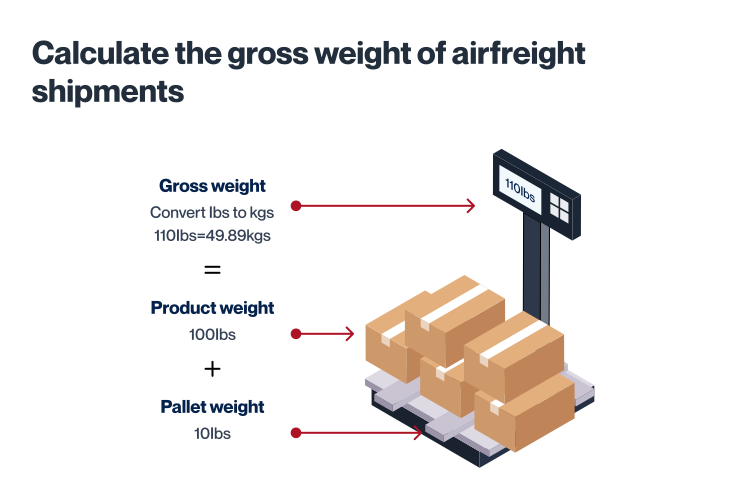
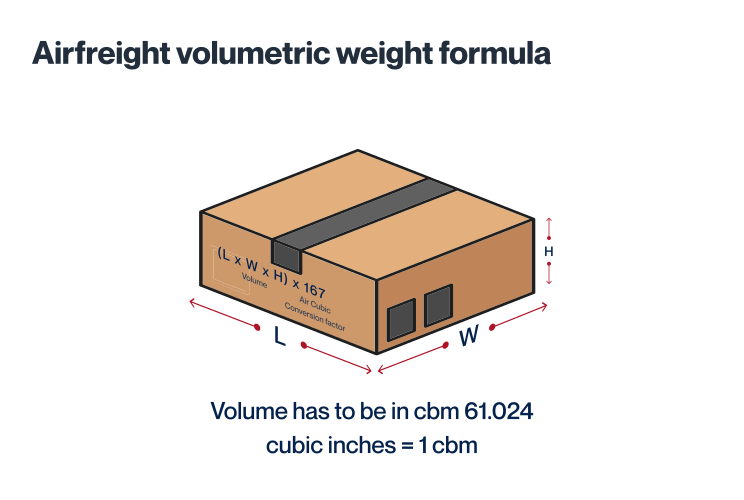
When you book air shipping Vietnam to Croatia, airlines do not charge you only on kilos. They calculate what is called the chargeable weight. This is either the gross weight or the volumetric weight, whichever is higher. If your cargo is light but bulky, you will quickly see why this matters.
- Gross weight, the real weight of your goods including packaging.
- Volumetric weight, the space your cargo occupies in the aircraft hold.
- Chargeable weight, the higher value between gross and volumetric.
To apply the IATA volumetric weight formula, you multiply length × width × height in centimeters and divide by a standard divisor.
- Air cargo: 1 m3 equals 167 kg, divisor 6000.
- Express courier: 1 m3 equals 200 kg, divisor 5000.
For example, if you ship 20 cartons measuring 40 × 30 × 50 cm each, you calculate total volume and divide by 6000 for standard air freight. If the volumetric result is higher than your real weight, that becomes your billing weight. The most common mistake is underestimating carton size or using approximate dimensions. That is how you end up with revised invoices after remeasurement at the airport.
Door to door between Vietnam and Croatia
Venturing into the realm of international Door-to-Door shipping, where convenience champions complexity. In simplest terms, this service transports goods directly from Vietnam to Croatia, eliminating multiple handling procedures. It’s cost-effective, hassle-free, lends control over the entire process and saves valuable time. Intrigued by the promise of shipping ease? Let’s dive in.
Overview – Door to Door
Need a hassle-free shipping solution between Vietnam and Croatia? ‘Door to Door shipping’ is your answer. Many businesses, like FNM Vietnam’s clients, favor this service due to its ease and convenience.
Despite additional costs and occasional scheduling challenges, it’s the antidote to logistics complexities. From pick-up to customs and delivery, all your shipping concerns are handled end-to-end.
Stay stress-free and focus on your core business while we ensure your cargo reaches its destination safely and timely. Discover the charm of worry-free shipping with our door-to-door service.
Why should I use a Door to Door service between Vietnam and Croatia?
Ever wondered if shipping logistics could be as simple as ordering Chinese takeout? Here are five crunchy reasons to consider Door to Door service for shipments between Vietnam and Croatia.
1. Stress-free Logistics: In the frenzied world of freight forwarding, Door to Door service is like your serene Zen garden. It handles everything from goods pickup to delivery, dealing with all the logistics so you don’t have to. That’s one less headache for you!
2. Timeliness: Urgent shipment? No problem! With Door to Door service, punctuality isn’t just expected; it’s the norm. Its well-oiled machinery ensures your goods arrive in the nick of time, as reliably as a Swiss watch.
3. Specialized Care: Moving complex cargo can feel like playing 4D chess. But fear not! Door to Door shines here, providing the specialized attention your goods deserve. It’s like having a personal bodyguard for your cargo!
4. All-Round Convenience: Imagine not having to worry about trucking and final destination delivery. Sounds dreamy, right? Door to Door service smoothly handles these tasks so you can kick back and enjoy a cup of joe.
5. Guaranteed Outcome: The combination of stress-free logistics, timely delivery, focused care, and overall convenience gives an outcome that’s as predictable as the ending of a rom-com. Timely, safe delivery – every single time!
So, whether it’s watches or widgets you’re shipping, Door to Door service between Vietnam and Croatia makes the perfect hassle-free shipping partner. Give it a spin and revolutionize the way you handle your international logistics!
FNM Vietnam – Door to Door specialist between Vietnam and Croatia
Welcome to stress-free shipping with FNM Vietnam – your door-to-door shipping solution from Vietnam to Croatia. Let us take care of all facets of your international shipping needs, from packing and transportation to customs and delivery, across all shipping methods.
Just sit back and relax; our experienced team led by a dedicated account executive ensures a seamless process. Contact us today for a free estimate within 24 hours or feel free to speak with our experts at your convenience. Embrace a worry-free shipping experience!
Customs clearance in Croatia for goods imported from Vietnam
When you handle customs clearance in Croatia for goods from Vietnam, you are deciding three things at once, your total landed cost, your release timeline, and who carries the legal responsibility as Importer of Record. One wrong line on the commercial invoice or a missing EORI registration can freeze your cargo at port or airport. We coordinate the full import customs process Croatia side so you stay focused on sales, not paperwork.
On this Vietnam to Croatia route, you will usually see issues around HS code classification, incomplete country of origin declaration, or underestimating value added tax on imports. That is where costs quietly increase through storage, inspections, or corrections. Let us break down exactly how you calculate duties and how the freight Vietnam Croatia customs procedure really works in practice.
How to calculate duties & taxes when importing from Vietnam to Croatia?
To answer how to calculate import duties and taxes, you need five inputs, the country of origin, the HS code, the customs value, the import tariff Croatia, and the applicable VAT or other measures. You will notice that early estimates often differ from the final assessed amount because customs may adjust your customs value calculation method or challenge your classification. Cheap quotes sometimes ignore VAT, anti dumping, or compliance costs, which creates a gap between forecast and reality. If you structure the calculation properly from the start, you avoid surprises and keep control of your margin.
Step 1 – Identify the Country of Origin
Your country of origin declaration directly affects your customs duty rate lookup result and your eligibility for a preferential tariff. If your goods qualify under specific preferential origin rules, you may reduce duties, but only if you can support it with the right certificate of origin form. Customs can request proof at any time, and during a post clearance audit they will verify that the transformation really occurred in Vietnam.
The common mistake is confusing the shipping country with the origin. If components come from multiple countries, you must confirm where the substantial transformation happened. A weak origin file can trigger a retroactive duty claim and penalties months after release.
Step 2 – Find the HS Code of your product
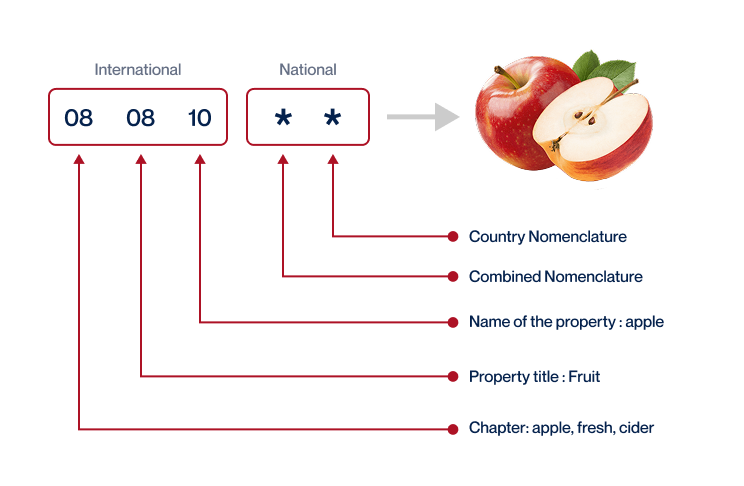
Your HS code classification determines your duty rate, possible import license requirements, and whether your goods fall under restricted and prohibited goods rules. The first thing we always tell you is this, classification is not about product names, it is about technical characteristics, composition, and use. If your supplier cannot give you a defensible code, you can perform a harmonized system code lookup through the EU database such as TARIC and compare headings and explanatory notes.
You should cross check the description on your commercial invoice and packing list details for customs so they match the selected code. If you choose the wrong code, you risk a customs inspection process, reclassification, and back payment of duties. That usually means delays and storage costs at port or airport. Here’s an infographic showing you how to read an HS code.
Step 3 – Calculate the Customs Value
In most standard imports into Croatia, customs use the transaction value method, meaning the price you actually paid, adjusted to reach the CIF value for customs. That usually includes the cost of goods plus international freight and insurance up to the EU border. Your Incoterm matters here, because under FOB you must add freight and insurance, while under CIF they are already included.
You also need to consider assists, packing, commissions, or royalties that relate to the imported goods. For example, if your goods cost 10,000, freight is 1,000 and insurance is 100, your customs base becomes 11,100 under the standard customs value calculation method. If you omit dutiable elements, you expose yourself to a value uplift adjustment during audit.
Step 4 – Figure out the applicable Import Tariff
An import tariff Croatia is the customs duty applied to your product based on its HS code and origin. Croatia applies the EU Common Customs Tariff, so you rely on the official EU tool for your customs duty rate lookup.
Your method is simple. First, open the EU TARIC database. Second, enter your full HS code and select Vietnam as the country of origin. Third, review the duty rate and any additional measures displayed.
When you read the result, check:
• Third country duty rate
• Preferential rate if available
• Additional measures such as anti dumping
• Import conditions or licenses
If your customs value is 11,100 and the duty rate shown is 5 percent, your customs duty equals 11,100 multiplied by 5 percent, which gives 555. This is your base duty before VAT. On this route, tariff treatment can depend on whether your documentation supports preferential origin, so you should confirm eligibility before pricing your product. If you are unsure, we can review your classification and tariff exposure before shipment.
Step 5 – Consider other Import Duties and Taxes
After customs duty, you calculate value added tax on imports. In Croatia, VAT is generally applied on the customs value plus customs duty and certain additional costs. If your customs value is 11,100 and duty is 555, VAT is calculated on 11,655. This is where many importers underestimate their import tax estimation Vietnam to Croatia and face a cash flow shock at release.
You also need to verify whether your goods fall under excise, anti dumping, or special compliance regimes. Certain products may require product compliance documentation or specific import license requirements before clearance. In some cases, you may use a temporary import procedure, inward processing relief, or store goods in a bonded warehouse Croatia to defer payment.
Before shipping, you should:
• Confirm your VAT registration and EORI status
• Validate compliance certificates and labels
• Check for additional measures in TARIC
• Decide who advances duties under your Incoterm
Step 6 – Calculate the Customs Duties
The basic formulas are straightforward. Customs duty equals customs value multiplied by duty rate. VAT equals the taxable base multiplied by the VAT rate. Your taxable base usually includes customs value plus duty and certain charges.
If your customs value is 11,100 and your duty rate is 5 percent, duty equals 555. If VAT applies on 11,655 and the rate is 25 percent, VAT equals 2,913.75. Your total import taxes become duty plus VAT. If customs reclassifies your product or questions your value, you face a release delay and possible amendments to your import declaration submission.
In practice, you or your customs broker in Croatia submits the declaration, often through the Single Administrative Document SAD system. Duties must be secured or paid before release, unless you operate under a deferment account. Extra costs usually come from storage, inspection, or corrections, not from the duty itself.
Does FNM Vietnam charge customs fees?
We act as your customs broker in Croatia and in Vietnam for the export customs procedures Vietnam side, but we do not set or collect government customs duties or VAT. Those amounts are determined by customs authorities and paid to them directly or through a secured account.
What we charge is a service fee for handling your import declaration submission, document checks, coordination with the customs inspection process, and follow up until release. You receive clear breakdowns so you can separate government taxes from operational fees and avoid confusion in your landed cost calculation.
Contact Details for Customs Authorities
Vietnam Customs
Official name: General Department of Vietnam Customs Official Website: https://www.customs.gov.vn/

Croatia Customs
Official name: Customs Administration of the Republic of Croatia Official website: https://carina.gov.hr/en
Required documents for customs clearance in Croatia
When you import from Vietnam into Croatia, your documents must tell the exact same story. The same shipper, consignee, values, product descriptions, and Incoterms must match everywhere. In our experience, most delays do not happen because of “the border” but because of document inconsistencies. A missing detail or mismatch can quickly trigger a customs hold, storage fees, and unnecessary stress.
Bill of Lading or Air Waybill
The Bill of Lading for sea freight or Air Waybill for air freight is the transport contract issued by the carrier. Customs and your broker use it to confirm the route, parties involved, and shipment reference numbers before release. Example, you ship a container from Ho Chi Minh City to Rijeka Port under FOB, and the B/L shows the Vietnamese exporter as shipper and your Croatian company as consignee. A common mistake is listing a different consignee name than on the Commercial Invoice, which can immediately block clearance.
Packing List
The Packing List details what is physically inside each carton, pallet, or container. Croatian customs and your broker rely on it to verify quantities, gross and net weights, and to cross-check the HS code classification. Example, you import 1,200 pairs of shoes packed in 100 cartons, and the document clearly states units per carton, total gross weight, and dimensions. The classic issue is rounding weights differently from the invoice, which can raise suspicion and lead to inspections.
Commercial Invoice
The Commercial Invoice is the financial backbone of your shipment. Customs use it to calculate customs duties, VAT, and to verify the declared transaction value under EU rules. Example, you sell machinery parts worth EUR 48,000 under CIF Rijeka, and the invoice clearly states unit price, total value, currency, and Incoterm. If your product description is vague like “metal parts” instead of a precise description with HS code, you risk a value reassessment or reclassification.
Proof of Origin for EVFTA preference
To benefit from reduced or zero duty under the EU-Vietnam Free Trade Agreement, you need valid proof of origin. Croatian customs check this to grant preferential tariff treatment instead of the standard EU duty rate. Example, your Vietnamese exporter issues an origin statement on the invoice according to EVFTA rules, allowing you to apply for reduced duty on eligible goods. If origin criteria are not properly met or documented, you will pay full duty and may face retroactive claims later.
CE conformity and product compliance documents
For many products entering the EU, especially electronics, machinery, toys, or medical items, you must show CE conformity documentation. Customs may request the Declaration of Conformity and supporting technical file to ensure your goods meet EU safety and environmental standards. Example, you import electrical equipment and provide a signed EU Declaration referencing the applicable EU directives. Shipping without proper compliance can result in a market surveillance block even after customs clearance.
EORI number and Importer of Record details
Your Croatian company must have a valid EORI number to act as Importer of Record within the EU. Customs use this unique identifier to process declarations, assess VAT, and track your import history. Example, your broker files the declaration in Croatia using your HR-prefixed EORI and your company VAT number. If you try to clear goods without a properly registered EORI, your container can sit at port while demurrage starts to accumulate.
Get Started with FNM Vietnam
Prohibited and restricted items when importing into Croatia
When you import into Croatia, you need to distinguish between restricted and prohibited goods. Restricted means you can import them, but only if you meet specific conditions such as licenses, certificates, or inspections. Prohibited means they should not enter at all and may be seized, returned, or destroyed. Understanding this difference is part of your EU import compliance, and ignoring it can lead to seizure or fines.
Restricted products
- Food and agricultural products – sanitary, phytosanitary certificates required.
- Animal-origin goods – veterinary checks at designated EU entry points.
- Cosmetics and chemicals – REACH registration or safety data compliance.
- Electronics – CE marking and technical documentation required.
- Medical devices – EU conformity assessment and proper labeling.
- Textiles and footwear – accurate labeling and origin declaration.
Prohibited products
- Counterfeit goods – intellectual property infringement.
- Illegal drugs and narcotics – strictly banned substances.
- Weapons and certain military items – without special authorization.
- Hazardous waste – non-compliant cross-border shipments.
- Products violating EU sanctions rules – restricted trade regimes.
If you are unsure about your product classification, you should confirm the HS code and check EU restrictions before shipment. The first thing we always tell importers is simple, never load the container until you are certain your goods are admissible under EU rules.
Trade agreements and preferential duties for imports from Vietnam to Croatia
When you ship from Vietnam to Croatia, you are operating under the framework of the EU-Vietnam Free Trade Agreement. Because Croatia is part of the European Union, the agreement applies automatically to your imports if your goods meet origin rules. This is the foundation of your preferential tariff strategy.
Under the EVFTA, many Vietnamese-origin products benefit from reduced or zero customs duties, either immediately or through phased reductions. You only obtain this advantage if your supplier can provide valid proof of origin that complies with EVFTA requirements. If you claim preference without proper documentation, you expose yourself to a retroactive duty recovery after customs audit.
You should also remember that even with zero customs duty, you still pay import VAT in Croatia based on the customs value. From experience, the real savings come when you align origin compliance, correct HS code, and accurate valuation. That is how you turn a trade agreement into a real cost advantage instead of just a line on paper.
Your Next Step with FNM Vietnam
Additional logistics services
Warehousing
Choosing the right warehousing in Vietnam-Croatia routes can be tricky, especially when your goods need special conditions like temperature control. Missteps here can affect the quality of your shipment. Good news – we've got your storage needs covered with reliability and the right conditions. Curious to learn more? Jump over to our dedicated page on Warehousing for deep insights.
Packing
Proper packaging and repackaging is crucial when shipping goods from Vietnam to Croatia. Why? It safeguards your goods from damage during transit, and can even influence customs clearance. Need an experienced hand? Trustworthy agents, like us, know how to prepare different products - from pottery to apparel. Wondering about fragile shipments or special care items? We've got that covered too! More on this craft, on our dedicated page: Freight Packaging.

Transport Insurance
When moving goods, things don't always go as planned. Step in, Cargo Insurance. Unlike fire insurance, this covers you from potential transportation mishaps or accidents that could derail your shipment loaded with valuable items. Remember that time when a storm hit and containers were lost at sea? Cargo Insurance would've been a godsend then. Don't leave it to chance; instead, bank on prevention. Want to learn more about it? Get all the nitty-gritty details on our dedicated page: Cargo Insurance.
Household goods shipping
When relocating your life from Vietnam to Croatia, every sentimental trinket and hefty furniture piece matters. Our Personal Effects Shipping service ensures your belongings reach safely irrespective of their weight or delicacy. Recall the relief you'd feel when grandma's heirloom vase or your designer furniture lands intact. More info on our dedicated page: Shipping Personal Belongings
Procurement in Thailand
Struggling to source goods from East Europe or Asia including Vietnam? FNM Vietnam steps in as your pro navigator, uncovering reliable suppliers and managing the complete procurement process. We crack language barriers and guide you around logistical hurdles – like a local manufacturing hunt turned stress-free spree. Curious for more insights? Visit our dedicated page: Sourcing services.

Quality Control
When shipping from Vietnam to Croatia, quality checks can make or break your shipment. Our team scrutinizes every product right from the manufacturing or customization stage. This rigorous process ensures no unpleasant surprises like faulty goods or customs snags. Remember the case of a client whose 500-unit shipment was saved from potential product recall – all thanks to our inspectors who identified a minor defect during the batch inspection. More info on our dedicated page: Quality Inspection

Conformité des produits aux normes
Ensuring product compliance is indispensable in global trade. Our compliance service helps you meet varying regulations by subjecting your goods to rigorous testing in our laboratory. This way, we ensure your product aligns with the destination's laws and earns the requisite certifications, avoiding costly market entry snags. Consider it as your 'passport' in bringing goods across borders seamlessly and confidently.