LCL consolidation: cut ocean freight costs without filling a full container

  • admin 17 Min
  • Published on September 5, 2022 Updated on May 19, 2026
img

In short ⚡

LCL consolidation is the process of combining multiple shippers’ less-than-container-load shipments into a single container so each pays only for the volume or weight used instead of a full box, enabling lower ocean freight costs while adding CFS handling, strict cutoffs, and specific documentation and labeling requirements for smooth customs clearance and delivery.

In this article, you will find what LCL consolidation means in practice, how it compares with FCL and air freight, the step‑by‑step workflow from warehouse to final delivery, and why it is widely used in Vietnam and other emerging manufacturing hubs to control cost, cash flow, and inventory.

We hope you’ll find this article genuinely useful, but remember, if you ever feel lost at any step, whether it’s finding a supplier, validating quality, managing international shipping or customs,  FNM Vietnam can handle it all for you!

Free shipping quote 24h      I want to talk to a sourcing expert

What LCL consolidation means in ocean freight and warehouse operations
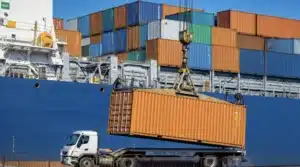
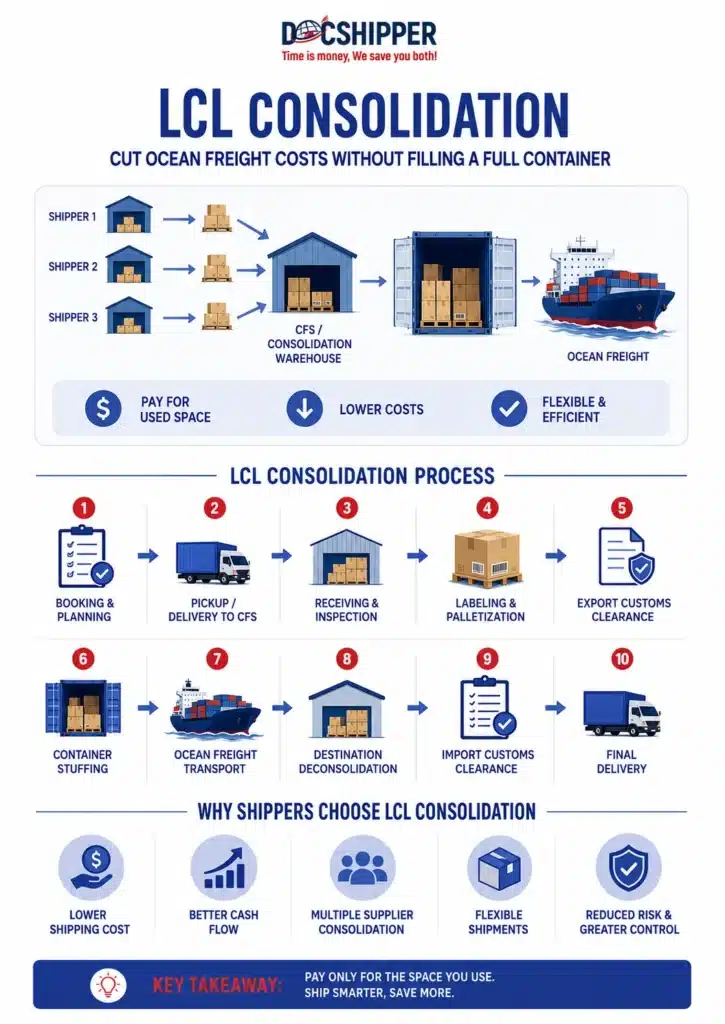
LCL consolidation is the practical answer when you need ocean freight but you do not have enough cargo to justify a full container, so your shipment shares space with others in one box.

In freight forwarding terms, you are buying container capacity by volume or weight, not by the container, and that changes how warehousing, paperwork, and port handling get organized.

Here’s the thing, most frustrations around lcl consolidation come from one gap, you think you’re shipping “a carton,” but the supply chain treats it as a piece inside a consolidated export program with strict cutoffs, labeling rules, and documentation gates.

We see this daily at DocShipper, especially when your supplier is ready, but your consolidation warehouse is waiting on one missing HS code or an incomplete export declaration.

Quick workflow (warehouse to vessel planning)

1) Book space and confirm Incoterms with your consignor and consignee.

2) Deliver cargo to a CFS or consolidation hub, then receive and measure.

3) Build a consolidated container plan, then issue paperwork.

4) Move to port, clear customs, load, and sail.

Checklist, before you send cargo into an LCL program

  • Final Incoterms agreed, and you know who pays origin charges, ocean freight, and destination charges.
  • Accurate HS code and tariff classification, plus product description consistent across invoice and packing list.
  • Carton labels ready, including consignee, marks, carton count, and gross weight.
  • Cargo insurance decision made, especially for fragile or high value goods.
  • Latest cargo cutoff confirmed, including warehouse receiving cutoff and port gate-in cutoff.
Term What it means operationally Why you feel it in cost or lead time
Freight consolidation Multiple shippers’ cargo grouped into one shipment flow at a CFS. Lower freight rate per shipment size, but extra handling and cutoffs.
Load consolidation Optimizing how cargo is built, palletization, stacking, containerization. Reduces damage and dimensional weight surprises, improves space use.
Ocean freight consolidation Consolidation specifically for sea freight, typically via a consolidator and carrier booking. Cheaper than air, slower than FCL if you miss a cutoff.
Bill of lading (B/L) Ocean transport document, often house B/L plus master B/L in LCL. Controls release, delivery order, and customs clearance timing.

Consolidation meaning, LCL vs FCL, and core logistics concepts

Let’s pin down the consolidation meaning in a way you can use, lcl consolidation is the process of grouping compatible shipments so one container moves as a single ocean move, while each shipper keeps their own commercial documents.

You’ll notice fast that LCL vs FCL is not just “shared container” versus “your container,” it changes how customs brokerage, port handling, and delivery order release work for your consignee.

Micro-story from operations

A buyer once negotiated FOB with a supplier, then asked the factory to “just drop the cartons at the port.”

The cargo showed up at the wrong facility, missed the CFS receiving cutoff, and the lcl consolidation rolled a week, the spot rate changed, and the freight invoice was higher than the original freight quotation.

Core concepts you need to keep straight

  • LCL (Less than Container Load): you pay by CBM or chargeable weight, and your cargo passes through a consolidation warehouse.
  • FCL (Full Container Load): you pay the container, you control loading, sealing, and usually reduce handling risk.
  • House B/L vs Master B/L: in LCL, your freight forwarder issues a house bill of lading, while the carrier holds the master bill.
  • CFS and bonded warehouse: where cargo is received, stored, and sometimes held under customs control before export.
  • Trade compliance: accurate HS code, customs inspection readiness, and clean documentation prevent holds.
Decision point LCL consolidation FCL
Cost basis Pay per CBM/ton, plus origin and destination CFS fees. Pay per container, plus drayage and port charges.
Handling More touches, receive, sort, palletization, cross-docking, devanning at destination. Fewer touches, especially if you load at factory and seal.
Control Shared schedules and cutoffs, less control over container build. More control of routing, timing, and loading plan.

For definitions and documentation norms, we align with widely used guidance such as the International Chamber of Commerce (ICC) framework for Incoterms, because who pays what is where many LCL disputes start.

How freight and load consolidation work from warehouse to port

In day-to-day freight consolidation, your cartons leave the supplier, get received at a CFS, then get merged with other cargo into a single export load plan for the carrier.

That load consolidation step is where measurements, palletization, labeling, and routing decisions quietly make or break your lead time.

What actually happens inside the consolidation warehouse

  • Receiving and counting, matching cartons to the packing list, flagging discrepancies.
  • Measuring and weighing to confirm chargeable weight and the freight rate basis.
  • Inventory management by shipment ID, consignee, and destination CFS.
  • Optional re-palletization, stretch wrap, and damage prevention checks.
  • Export documentation prep, commercial invoice checks, export declaration data, and booking confirmation.

Micro-story you will recognize

A supplier once shipped “50 cartons,” but two were unmarked and the warehouse could not tie them to any consignee.

The CFS quarantined them, the export documentation stalled, and customs clearance risk jumped because the carton count on the bill of lading would not match the physical cargo.

Step-by-step workflow (warehouse to port)

1) Cargo arrives at CFS, receiving report issued, discrepancies reported to you and the consignor.

2) Measurement and palletization confirmed, freight quotation updated if dimensions differ.

3) Consolidator builds the container, creates the stuffing plan, then seals for port transfer.

4) Drayage to terminal, port handling, export customs clearance, and vessel loading.

When you work with us for lcl consolidation services, we push hard on pre-receiving checks, clean paperwork, and tracking visibility, because one missing data point can turn a simple intermodal transport move into a week of waiting.


Looking for a Reliable Shipping & Sourcing Partner?

We handle the entire sourcing process, supplier research, negotiation, production, and inspections, so you can focus on what matters most: growing your business.

When you should choose LCL consolidation instead of FCL or air freight

You choose lcl consolidation when your shipment is too small to justify FCL, but too heavy or bulky for air, and you still need predictable customs clearance and delivery planning.

In practice, it is a supply chain tool to protect cash flow and inventory management, especially when you are replenishing often instead of building massive stock.

Checklist, to decide in under 2 minutes

  • Your cargo volume sits below a cost-effective FCL threshold for your lane.
  • You can tolerate ocean lead time, and you have a buffer for consolidation cutoffs.
  • Your products are not overly fragile, or you will pay for proper palletization and cargo insurance.
  • Your documents are clean enough to avoid customs inspection delays.
  • You understand destination charges, including CFS fees and last-mile delivery constraints.
Mode Best for Typical trade-off
LCL consolidation Regular replenishment, mixed SKUs, smaller procurement batches. More handling and destination fees, but strong cost control versus air.
FCL High volume, tight control, higher security, fewer touches. Higher upfront spend, risk of shipping “air” inside your container.
Air freight (AWB) Urgent launches, stockouts, high value, low volume. Higher freight rate, and import duties may rise with higher declared freight.

DocShipper Advice

Not sure if LCL is the right mode for this shipment?
Send us your CBM and deadline, we compare LCL, FCL, and air to protect cash flow and transit reliability.

Shipment profiles that benefit most from LCL consolidation services

The sweet spot for lcl consolidation services is when you ship small to medium volumes, want stable routing, and do not want to gamble on air spot rates.

If your procurement team buys in smaller lots from multiple suppliers, freight consolidation is often the only way to keep your freight invoice sane.

Micro-story from a real planning call

A buyer sourced packaging from two factories and a finished product from a third, all under different Incoterms.

We regrouped everything in one consolidation warehouse, aligned documents by consignee, and the client avoided three separate customs clearance files and three separate last-mile deliveries.

Typical LCL-friendly profiles

  • E-commerce restocks where you want tighter inventory turns and shorter procurement cycles.
  • Multi-supplier sourcing that needs cross-docking into one export shipment.
  • New product launches where demand is uncertain and you cannot risk overstock.
  • Spare parts, components, and accessories with high SKU count but low cube per SKU.
  • Seasonal demand where you ship more often instead of holding dead stock.

To make it work smoothly, we usually ask you for one clean data pack early, invoice, packing list, HS code, and consignee details, then we manage booking, tracking, and customs brokerage coordination end to end.

Trade-offs: cost, transit time, and service level compared with other modes

The trade-off with lcl consolidation is straightforward, you save on ocean freight cost versus paying for an empty FCL, but you accept extra handling and slightly less control over the timeline.

Air looks fast on paper, yet once you add pickup timing, airway bill processing, and customs clearance queues, the gap can shrink more than you expect, while the cost gap rarely does.

Micro-story that happens every peak season

A shipper switched to air to avoid a late LCL sailing, then got hit with capacity limits and a higher spot rate at the last minute.

They still paid for storage waiting for pickup, and the “emergency” plan became a premium freight invoice with no real service-level guarantee.

Where LCL wins, where it bites

  • Cost: strong advantage for small volumes, but watch origin and destination CFS fees and minimum charges.
  • Transit time: longer than air, sometimes longer than FCL if you miss consolidation cutoffs.
  • Reliability: good when you book early, weaker when you push late cargo into a weekly console.
  • Risk: more touches increase damage risk, proper palletization and insurance matter.
  • Control: less control over container build and last-mile delivery scheduling at destination.

Step-by-step decision workflow (mode selection)

1) Estimate CBM and chargeable weight, then request a freight quotation for LCL and a container rate for FCL.

2) Map deadlines backward from your required delivery date, including port handling, customs clearance, and last-mile delivery.

3) Check product sensitivity, fragile goods, compliance risk, and likelihood of customs inspection.

4) Decide the mode, then lock documentation early so your bill of lading or airway bill does not get delayed.

For mode comparisons and sea transport conventions, we follow standards referenced across the industry by bodies like the FIATA, because documentation roles between consolidators and forwarders matter when something goes wrong.

DocShipper Platform

One platform. Your entire supply chain

Sourcing, freight, customs & documents — all centralised, all visible, 24/7.

How LCL consolidation works step by step, from pickup to final delivery

When you choose lcl consolidation, you are not just booking space in a container. You are entering a structured process that synchronizes warehouse operations, customs compliance, and ocean freight execution.

Here is the operational workflow you should expect from pickup to final delivery. Each step directly impacts your cost, transit time, and risk exposure.

  • 1. Booking and cargo planning, you confirm volume, weight, HS codes, Incoterm, and supplier readiness.
  • 2. Cargo pickup or delivery to consolidation warehouse, your goods are transported to the CFS, Container Freight Station.
  • 3. Receiving and warehouse inspection, cartons are counted, measured, weighed, and visually inspected.
  • 4. Cargo labeling and palletization, shipment marks and handling labels are applied to prevent mix-ups.
  • 5. Customs export clearance, documents are filed and validated before container loading.
  • 6. Container stuffing, multiple LCL shipments are strategically loaded into one container.
  • 7. Ocean freight transport, the container moves under a master bill of lading.
  • 8. Destination deconsolidation, cargo is unpacked at destination CFS and sorted per consignee.
  • 9. Import customs clearance, duties and taxes are assessed and paid.
  • 10. Final delivery, goods are transported to your warehouse or distribution center.

You should pay special attention to the consolidation and deconsolidation phases. This is where operational discipline determines whether your cargo arrives intact or damaged.

Stage Key Risk How We Control It
Warehouse receiving Volume discrepancy Cross-check against packing list and supplier declaration
Container stuffing Cargo damage Load planning, weight distribution, protective dunnage
Destination CFS Misrouting Barcode labeling and shipment segregation
Customs clearance Delay or inspection Pre-clearance review and HS code validation

Transit time in LCL is slightly longer than FCL because of CFS handling at both ends. You typically add 3 to 7 days depending on port congestion and consolidation cycles.

If you want to see how we manage this process end to end, you can review our ocean freight solutions at Ocean Freight Services. We coordinate sourcing, inspection, consolidation, and delivery under one operational control tower.

DocShipper Info

Each LCL step adds coordination risk, from pickup to deconsolidation.
We manage the full chain, warehouse, customs, ocean freight, and delivery under one operational control tower.

Why shippers use LCL consolidation in Vietnam and other emerging hubs

You will notice that LCL consolidation is especially popular in Vietnam, India, Indonesia, and other fast-growing manufacturing bases. These markets generate diversified export volumes that rarely fill containers consistently.

In Vietnam for example, export growth has exceeded 8% annually in recent years. Many SMEs ship 2 to 12 CBM per order, making FCL economically inefficient.

  • Lower inventory pressure, you ship smaller batches more frequently.
  • Cash flow optimization, you avoid waiting to accumulate 20 or 40 feet of goods.
  • Supplier diversification, you consolidate cargo from multiple factories into one shipment.
  • Market testing flexibility, you launch new SKUs without committing to container-scale volume.
  • Risk spreading, you reduce exposure linked to single large shipments.

In emerging hubs, factory clusters are geographically dispersed. A structured consolidation program allows you to centralize cargo into a single export CFS efficiently.

Scenario FCL Impact LCL Impact
Multiple small suppliers Multiple containers required Single consolidated container
Seasonal production Idle space or delay Flexible weekly departures
Cash flow sensitivity High upfront freight cost Pay only for used volume

When we manage consolidation in Vietnam, we often combine supplier coordination, pre-shipment inspection, and export compliance under one contract. This reduces your administrative workload and prevents fragmented communication.

You can explore how we support sourcing and logistics in Southeast Asia via Global Sourcing Services. We align procurement strategy with freight execution to protect your margin.

DocShipper Advice

Sourcing from Vietnam or Southeast Asia?
Centralize suppliers into one export CFS to cut admin workload and avoid fragmented communication between factories and forwarders.

Conclusion

If you are not filling a full container consistently, you should seriously evaluate LCL as a structural strategy. It is not just a cost-saving tool, it is a supply chain optimization lever.

  • You pay only for the space you actually use.
  • You reduce inventory buildup and storage pressure.
  • You gain flexibility to source from multiple suppliers.
  • You improve cash flow through smaller shipment cycles.
  • You maintain access to global ocean networks without FCL commitment.
  • You can integrate inspection, consolidation, and freight under one logistics partner.

With a properly managed lcl consolidation strategy, you transform partial loads into a competitive advantage. We design, supervise, and optimize each step so your cargo moves securely and efficiently from factory floor to final delivery.

FAQ | LCL consolidation: cut ocean freight costs without filling a full container

LCL consolidation is when your cargo doesn’t fill a full container, so a consolidator groups your shipment with other shippers’ goods into one ocean container. You still keep your own invoices and bills of lading, but you pay only for the volume or weight you actually use instead of buying the whole container.

Ask us anything!

Need Help with Logistics
or Sourcing in Vietnam ?

First, we secure the right products from the right suppliers at the right price by managing the sourcing process from start to finish. Then, we simplify your shipping experience - from pickup to final delivery - ensuring any product, anywhere, is delivered at highly competitive prices.

Component-15-2.png

Live Chat

Get instant assistance from our team—
just click and start chatting!

Live Chat Now
image

Fill the Form

Prefer email? Send us your inquiry, and we’ll get back to you as soon as possible.

Contact us
image
Component-15-2.png

Call us

Reach out to us on WhatsApp for quick, convenient, and personal support.

Call us
image
Component-15-2.png