


In short ⚡
China vs Vietnam Manufacturing: Costs, Quality and Lead Times Compared. Vietnam often suits labour-intensive products such as garments, footwear and furniture, while China generally remains stronger for complex electronics, machinery and multi-component products. The right choice depends on landed cost, supplier capability, product complexity, destination tariffs and replenishment requirements. The key differences are:| Factor | China | Vietnam |
|---|---|---|
| Costs | Compare supplier labour, materials, productivity, freight, duties and quality costs; deeper supplier networks may reduce total cost for complex products. | Region I minimum wage is approximately USD 210 per month in 2026, but imported inputs, transport and inventory can increase landed cost. |
| Quality and capacity | Broad capabilities, dense component ecosystems, strong engineering support and generally easier access to backup suppliers. | Reliable in established export sectors, with strong capacity for garments, footwear and furniture; audit the exact factory and subcontracting arrangements. |
| Lead times | Often faster for sampling, engineering changes and component substitution, although complexity and capacity determine the result. | Imported components can add replenishment and production time; confirm sailing frequency, capacity and production milestones. |
| Best product fit | Complex electronics, machinery, multi-component products and flexible high-volume production. | Garments, footwear, furniture, home textiles and other labour-intensive finished goods. |
| Destination considerations | US shipments may face China-specific Section 301 duties of 25% to 100% on many goods, in addition to the supplied 12.5% framework rate. | Potential EVFTA and UKVFTA preferences may reduce duties, subject to classification, origin rules and documentation. |
Costs, wage and material assumptions, quality controls, capacity and lead times, destination tariffs, product suitability, and the steps for moving production to Vietnam are examined in detail.
We hope you’ll find this article genuinely useful, but remember, if you ever feel lost at any step, whether it’s finding a supplier, validating quality, managing international shipping or customs, FNM Vietnam can handle it all for you!
China vs Vietnam in 2026: the short answer
Vietnam is usually the better choice for labour-intensive products such as garments, footwear and furniture, especially when the destination market rewards Vietnamese origin. China remains stronger for complex electronics, multi-component products, machinery and very large or flexible production runs. For many brands, the most resilient answer is not China or Vietnam, but a China plus one Vietnam strategy.
The right decision depends on your product architecture, not on a general claim that one country is always cheaper. A sewn product with locally available fabric can benefit from Vietnam’s manufacturing base, while an electronic product that requires dozens of specialised components may become slower and more expensive if those inputs still have to come from China.
Start by comparing the complete supply chain. Request supplier quotations on the same Incoterm, specification, packaging and annual volume, then add tooling, inspection, inland transport, ocean freight, duties, financing and the cost of holding extra inventory. This is your landed cost, meaning the total cost of getting a compliant product to its destination, not simply the factory price.
Then test the operational assumptions. Ask where each material is sourced, how much capacity the factory has available during your peak season, what its minimum order quantity is, and whether it can reproduce your approved sample. A low quotation is not a saving if imported inputs add weeks to the schedule or if quality problems force rework.
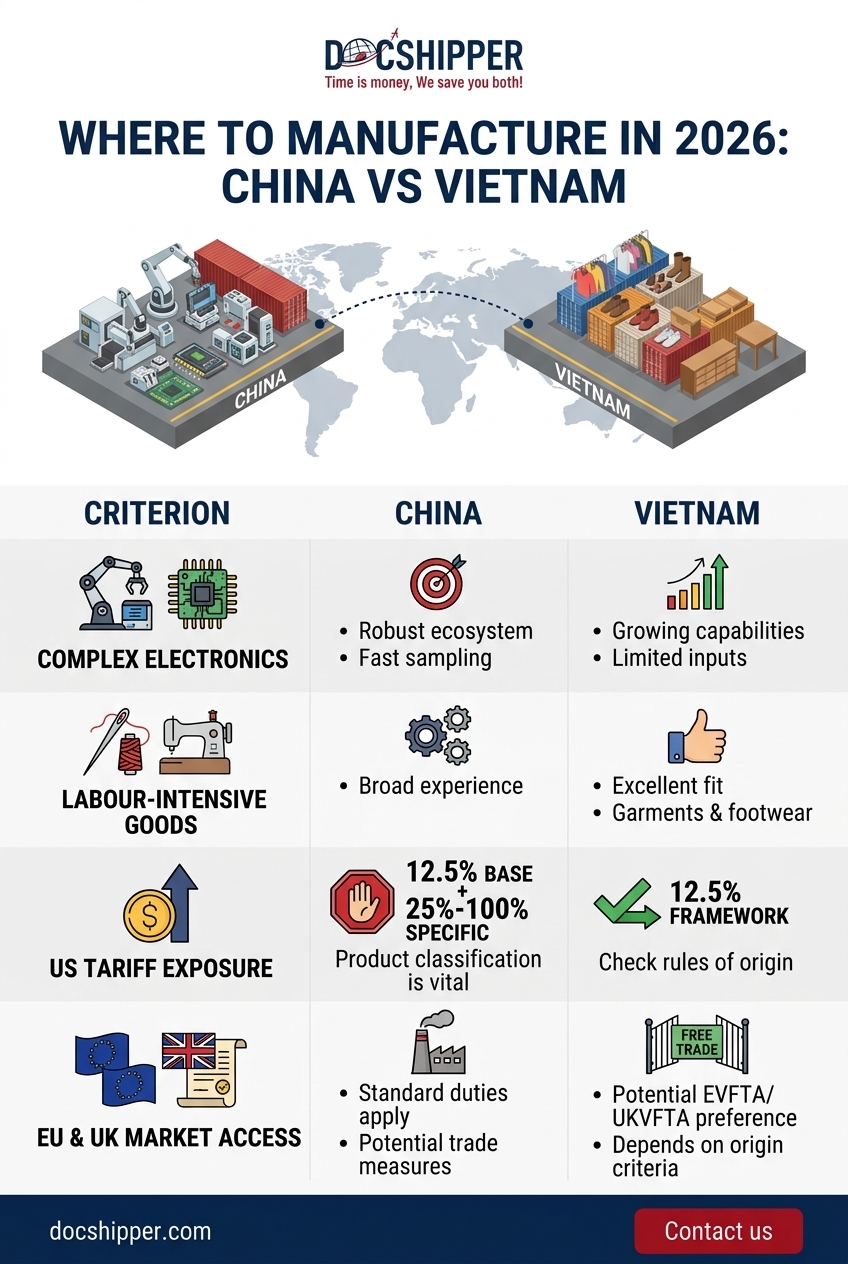
| Criterion | China | Vietnam |
| Labour-intensive products | Strong, with broad industrial experience | Often the better fit for garments, footwear and furniture |
| Complex electronics and assemblies | Usually the stronger ecosystem | Improving, but generally more dependent on imported components |
| Supplier depth | Very deep across components and finished goods | Thinner, with strong clusters in selected sectors |
| US tariff exposure in 2026 | 12.5% framework rate plus China-specific Section 301 duties on many goods | 12.5% framework rate under the information available for 2026 |
| EU and UK access | Standard applicable duties | Potential preferential treatment through EVFTA and UKVFTA, subject to origin rules |
| Best strategic use | Complex products, components and high-volume flexibility | Production diversification and labour-intensive finished goods |
DocShipper Info
Compare suppliers, inputs and landed cost before committing to a single-country strategy.
Costs: wages, materials and the real landed cost
Vietnam’s highest regional minimum wage is about USD 210 per month in 2026, but wages alone do not determine whether Vietnam is cheaper than China. Compare the landed cost per unit after materials, productivity, freight, duties and quality costs have been included.
Vietnam’s regional minimum wages increased by 7.2% from 1 January 2026. The monthly figures are VND 5.31 million in Region I, VND 4.73 million in Region II, VND 4.14 million in Region III and VND 3.7 million in Region IV. The Region I figure is reported as approximately USD 210 per month by Vietnam Government News.
Vietnam Government News reports the 2026 regional wage schedule. These are minimum wages, not a complete factory labour cost. Recruitment difficulty, overtime, social contributions, supervision, productivity and the location of the plant can materially change the cost of a finished unit.
China should be assessed with the same discipline. There is no single national factory wage that gives a fair comparison across all production zones, so request the supplier’s labour, overhead and processing assumptions. Use dated official or local data from the China National Bureau of Statistics or the relevant municipal authority rather than applying an old internet comparison to every Chinese supplier.
Materials can reverse the apparent advantage. A Vietnamese factory may import fabric, hardware, packaging or electronic components from China, then add inland transport, customs handling and extra inventory before production starts. Ask for a bill of materials showing the country of origin for major inputs, the lead time for replenishment and the alternative source available if a Chinese component becomes unavailable.
Build your comparison in a spreadsheet or sourcing platform with one line per cost driver. Keep the factory quotation separate from logistics and tariff assumptions so you can update the model when a classification, freight rate or trade measure changes.
Worked data example from the 2026 wage schedule:
- Region I monthly minimum wage: VND 5.31 million.
- Reported approximate equivalent for Region I: USD 210 per month.
- Region II monthly minimum wage: VND 4.73 million.
- Region III monthly minimum wage: VND 4.14 million.
- Region IV monthly minimum wage: VND 3.7 million.
- Decision implication: use the factory’s actual location and productivity data, rather than applying the Region I figure to every Vietnamese quotation.
A practical landed-cost template is: ex-factory price, plus origin inland transport, export documentation, freight, insurance, destination charges, customs duty, inspection, financing, rework allowance and final delivery. Compare that total at the same order quantity and delivery date. The cheapest labour market is not automatically the cheapest supply chain.
DocShipper Tips
Calculate landed cost with materials, freight, duties, quality and inventory included.
Quality, capacity and lead times
Vietnam offers reliable quality in mature sectors, but its supplier base is thinner and imported inputs can lengthen lead times. China generally offers deeper industrial ecosystems, faster supplier substitution and more options for complex or highly customised products.
Quality is primarily a process question. Before placing an order, define the approved sample, critical dimensions, acceptable quality limits, packaging standard and inspection method. A pre-production inspection checks whether the factory has understood the specification; during-production and pre-shipment inspections then verify whether mass production remains within tolerance.
For Vietnam, examine the factory’s experience with your exact product rather than relying on experience in a neighbouring category. A garment factory may be highly capable with cut-and-sew production but unsuitable for bonded technical fabrics. A furniture supplier may have strong export experience but depend on imported fittings with long replenishment times.
China’s advantage is often the surrounding ecosystem rather than the assembly line alone. Toolmakers, component suppliers, packaging vendors, testing laboratories and backup factories may be located within the same industrial region. This makes sampling and engineering changes easier, particularly for products with many components or frequent revisions.
Vietnam’s capacity is substantial in established export sectors. Vietnam exported nearly USD 29 billion of footwear in 2025, about USD 46 billion of textiles and garments, and USD 9.4 billion of wooden furniture. Vu Duc Giang, Chairman of the Vietnam Textile and Apparel Association, stated: “Export turnover is estimated to reach 46 billion USD, an increase of 5.6% compared to 2024.” This demonstrates sector scale, not a guarantee that every factory can accept your order.
Port capacity also matters when you assess an alternative production base. In 2024, HCMC handled about 9.1 million TEU, Hai Phong about 7.1 million TEU and Cai Mep nearly 7 million TEU, according to VnEconomy. A port’s total throughput does not predict your exact transit time, so confirm the routing, sailing frequency, cut-off date and transshipment plan with your forwarder.
For both countries, request a capacity statement covering current utilisation, monthly output, peak-season constraints, subcontracting and the planned production window. Treat an unverified promise such as “fast delivery” as a sales claim until the supplier provides a production schedule and agrees to measurable milestones.
| Operational factor | China | Vietnam |
| Sampling and engineering changes | Often faster because of dense component and tooling networks | Strong in mature sectors, but may require more coordination for specialised inputs |
| Quality capability | Broad range from basic to highly technical suppliers | Reliable in established export sectors; audit the exact factory |
| Backup suppliers | Generally easier to identify within a mature ecosystem | Available, but the pool can be narrower by product category |
| Lead-time risk | Complexity and capacity determine the result | Imported components can add transport and replenishment time |
| Quality-control action | Use approved samples, production inspections and final inspections | Use the same controls, with additional checks on input origin and subcontracting |
DocShipper Tips
Audit capacity, approve samples and inspect production before scaling volume.
Tariffs by destination in 2026
For the United States, the available 2026 framework places both China and Vietnam at 12.5%, but China also faces China-specific Section 301 duties on many goods. For the EU and UK, Vietnamese goods may benefit from preferential agreements, while Chinese goods generally face the standard applicable tariff.
DocShipper Alert
Verify HS classification and origin rules before pricing your market entry.
Looking for a Reliable Shipping & Sourcing Partner?


United States
The US tariff picture must be checked by product classification and origin on the date of shipment. According to the 2026 information supplied for this comparison, the Section 301 “forced labor” framework has a 12.5% rate for both China and Vietnam since 24 July 2026. China can also face China-specific Section 301 duties ranging from 25% to 100% on many goods.
Do not apply the headline rate without verifying the Harmonized Tariff Schedule classification, substantial transformation, exclusions and any additional measure. A product assembled in Vietnam is not automatically Vietnamese origin if its manufacturing process does not satisfy the applicable origin rules. Confirm the result with a customs broker or trade specialist and retain the supporting documents.
The practical US comparison is therefore not simply 12.5% versus 12.5%. It is Vietnam’s applicable duty versus the Vietnamese supply chain cost, compared with China’s applicable base and China-specific duties, while also considering component origin and compliance risk.
European Union
The EU and Vietnam operate under the EU Vietnam Free Trade Agreement, or EVFTA. It can reduce or eliminate duties for qualifying Vietnamese products, but the benefit depends on the product’s tariff line and whether the shipment satisfies the agreement’s rules of origin and documentation requirements.
China does not receive the same EVFTA preference. Compare the exact EU tariff for the finished product with the Vietnamese preferential rate, then verify whether Chinese inputs are compatible with the required origin calculation. A Vietnamese factory that imports most of its materials from China may not automatically deliver preferential origin.
United Kingdom
The UK uses its own tariff and trade-agreement framework after Brexit. Vietnamese goods may benefit from the UK Vietnam Free Trade Agreement, or UKVFTA, subject to the relevant origin rules. Chinese goods generally enter under the applicable UK standard tariff unless a specific measure says otherwise.
Rates change by classification, origin and trade remedy. Check the current customs database before signing a long-term sourcing decision, and ask the supplier for the documents needed to support origin claims. The following table is a decision screen, not a substitute for a product-specific customs ruling.
| Destination | China | Vietnam |
| United States | 12.5% framework rate in the supplied 2026 data, plus China-specific Section 301 duties of 25% to 100% on many goods | 12.5% framework rate in the supplied 2026 data |
| European Union | Standard applicable tariff, subject to product classification and trade measures | Potential EVFTA preference, subject to tariff line, origin and documentation |
| United Kingdom | Standard applicable tariff, subject to product classification and trade measures | Potential UKVFTA preference, subject to tariff line, origin and documentation |
| Verification action | Check the HS code, China-specific measures and origin | Check the HS code, agreement rules and origin evidence |
DocShipper Platform
One platform. Your entire supply chain
Sourcing, freight, customs & documents — all centralised, all visible, 24/7.
Which products fit Vietnam, which fit China?
Garments, footwear, furniture, home textiles and many labour-intensive consumer goods are strong candidates for Vietnam. Electronics, machinery and products requiring many specialised components usually fit China better. The best answer can also be a split supply chain in which China supplies components and Vietnam completes the finished product.
Vietnam’s export data supports its position in several labour-intensive categories. Its 2025 footwear exports were nearly USD 29 billion, textiles and garments reached about USD 46 billion, and wooden furniture reached USD 9.4 billion. These figures indicate established capabilities and export experience, although they do not remove the need to audit individual suppliers.
China remains attractive when the product depends on a dense local network of moulders, PCB suppliers, motors, batteries, fasteners, packaging vendors or testing facilities. If a design changes frequently, a Chinese cluster may reduce engineering delays even when its unit labour cost is higher.
Use a product-level decision rather than moving an entire catalogue at once. Separate products by bill of materials, manufacturing process, annual volume, compliance requirement and destination market. Then compare the two countries using identical specifications and a pilot order.
| Product category | Better fit | Why |
| Garments and cut-and-sew products | Vietnam | Established export sector and strong labour-intensive manufacturing base |
| Footwear | Vietnam | Nearly USD 29 billion in Vietnamese exports in 2025 indicates significant sector scale |
| Wooden furniture | Vietnam | USD 9.4 billion in 2025 exports and proven export capacity |
| Home textiles | Vietnam, depending on fabric origin | Good fit for labour-intensive production, but imported fabric can affect cost and lead time |
| Consumer products with limited components | Vietnam or both | Vietnam may offer diversification; China may offer more supplier depth |
| Complex electronics | China | Deeper component, engineering and assembly ecosystem |
| Machinery and multi-component assemblies | China | Broader specialised supplier network and easier component substitution |
A China plus one Vietnam strategy does not mean duplicating every supplier immediately. You might keep tooling and complex components in China while qualifying a Vietnamese factory for final assembly, garments, packaging or a separate product line. This reduces concentration risk without forcing a technically unsuitable relocation.
DocShipper Info
Match each product to the strongest ecosystem, then validate suppliers with a pilot.
How to move part of your production to Vietnam
Start with one suitable product line, qualify Vietnamese suppliers, run a controlled pilot with inspection, compare the real landed cost with China, and scale only after the process is stable.
- Select the pilot: choose a product with a clear specification, manageable component dependency and enough margin to absorb a learning curve. Avoid beginning with your most complex product or a launch that cannot tolerate delay.
- Prepare the sourcing pack: provide drawings, bill of materials, target quality limits, packaging requirements, annual volume, forecast, destination and required compliance documents. Ambiguous specifications make country comparisons unreliable.
- Identify and audit suppliers: verify the factory address, ownership, production equipment, workforce, export history, subcontracting policy and available capacity. Request evidence for the exact product category, not only a general company presentation.
- Compare quotations consistently: use the same Incoterm, quantities, packaging, payment assumptions and delivery destination. Ask which materials are imported from China and which can be sourced locally or regionally.
- Approve a sample and production plan: record the approved reference sample, inspection criteria, tolerance limits and corrective-action process. Agree on production milestones before paying a deposit.
- Run the pilot order: use pre-production, during-production or pre-shipment inspection according to the product risk. Check quantity, workmanship, dimensions, function, labelling and packaging before release.
- Recalculate landed cost: replace estimates with actual freight, inspection, rework, duty and delivery data. Compare the result with the equivalent Chinese order, including any tariff difference and inventory impact.
- Scale in stages: increase volume only after the factory has met the quality and delivery requirements across repeated orders. Keep a qualified Chinese supplier during the transition if business continuity matters.
Your transition checklist should also cover intellectual property protection, tooling ownership, payment terms, product testing, insurance, export documents, customs origin evidence and a contingency supplier. Confirm who owns the moulds and technical files before production begins.
The move should be measured with operational indicators: defect rate, on-time shipment, production variance, landed cost, corrective-action response and replenishment time. If Vietnam is cheaper at factory level but slower at replenishment, calculate the additional safety stock required before declaring it the winner.
DocShipper operates sourcing, quality-control and freight services through teams in both China and Vietnam. The DocShipper Group reports a Trustpilot rating of 3.7/5 from 106 reviews as of 1 October 2026, which should be considered alongside your own supplier checks and commercial requirements.
| Transition checkpoint | Evidence to collect |
| Product selection | Bill of materials, complexity assessment and destination tariff classification |
| Supplier qualification | Factory audit, equipment list, capacity statement and subcontracting policy |
| Cost comparison | Comparable quotations, materials origin, freight assumptions and duty verification |
| Quality approval | Approved sample, inspection standard and corrective-action procedure |
| Pilot order | Production records, inspection report, actual shipment data and customs documents |
| Scale decision | Repeated quality, delivery and landed-cost results compared with China |
DocShipper Tips
Start with one suitable product line, measure results, then scale with confidence.
Conclusion
China vs Vietnam manufacturing is a product-by-product decision. Use 2026 tariff data, verified origin rules and landed cost calculations, then validate the result with a controlled pilot before moving significant volume.
- Vietnam is often the stronger fit for labour-intensive goods such as garments, footwear, furniture and home textiles.
- China generally remains stronger for complex electronics, machinery, multi-component products and highly flexible industrial ecosystems.
- Vietnam’s Region I minimum wage is approximately USD 210 per month in 2026, but wages are only one part of total cost.
- For the US, the supplied 2026 framework shows 12.5% for both countries since 24 July 2026, while China also faces China-specific Section 301 duties on many goods.
- For the EU and UK, Vietnam may benefit from EVFTA or UKVFTA, subject to product classification, origin rules and documentation.
- A China plus one Vietnam strategy can reduce concentration risk while keeping technically demanding components in the most suitable ecosystem.
- Pilot one product line, inspect production and compare actual landed cost before scaling.
Weighing China against Vietnam for your products? Our teams in both countries can compare suppliers, landed costs and lead times for you.
FAQ | China vs Vietnam Manufacturing: Where Should You Produce in 2026?
A Vietnamese factory can be a good assembly partner while remaining highly dependent on China for fabric, fittings, packaging or components. Ask for a bill of materials with the origin, lead time and backup source for every critical input. Then calculate whether the extra transport, customs handling and safety stock offset the factory-price advantage. Also confirm whether the production process is sufficient to support Vietnamese origin for your destination market.
A lower unit price in Vietnam may not be attractive if the factory requires a large minimum order that ties up your cash or creates excess inventory. Request the MOQ by product variant, colour, size and production run—not just one global figure. For a first order, negotiate a pilot quantity, shared materials where possible and a clear price ladder for higher volumes. Compare the total cost of the MOQ, including storage and obsolete stock.
Split production when different stages require different strengths. For example, China can produce moulds, electronic modules or precision components, while Vietnam handles final assembly, sewing, packaging or a separate labour-intensive product line. Before proceeding, map the transfer point, documentation, transport time and customs treatment. The strategy only works if the additional cross-border handling does not create more delay and cost than it removes.
Agree in writing who owns the moulds, drawings, software, samples and process documentation before production begins. The contract should cover access, maintenance, permitted use, return or destruction of files, and what happens if the supplier relationship ends. Keep master design files under your control and provide only the technical information required for each production stage. Tooling ownership should never be left to an informal email or verbal promise.
Treat the following signals as reasons to pause the project and investigate further:
- The supplier cannot provide its legal factory address or refuses an independent audit.
- The quoted capacity is much higher than the visible equipment or workforce can support.
- The factory will not disclose subcontracting or the origin of critical materials.
- The sample is approved by sales staff but cannot be linked to a controlled production specification.
- The supplier promises unusually short lead times without a written production schedule.
A low price should not compensate for weak traceability, unclear responsibility or unverified capacity.
The finished product still needs to meet the regulations of its destination market, regardless of the assembly country. Recheck product testing, labelling, restricted substances, packaging rules and supply-chain documentation after changing factories. For US shipments, pay particular attention to forced-labour and origin evidence; for EU or UK shipments, verify that the manufacturing process and inputs satisfy the relevant preferential-origin rules. Obtain and retain supplier declarations, purchase records, production records and shipping documents rather than relying only on the country named on the commercial invoice.
Need Help with Logistics
or Sourcing in Vietnam ?
First, we secure the right products from the right suppliers at the right price by managing the sourcing process from start to finish. Then, we simplify your shipping experience - from pickup to final delivery - ensuring any product, anywhere, is delivered at highly competitive prices.


Fill the Form
Prefer email? Send us your inquiry, and we’ll get back to you as soon as possible.
Contact us

