In short ⚡
Importing Solar Panels from Vietnam: Suppliers and Anti-Dumping Context requires market-specific duty checks, supplier verification, product certification, upstream traceability and shipment controls. US buyers must assess exporter-specific AD/CVD rates, while European, UK, Australian and other buyers should verify origin, conformity and local trade requirements. Key supplier and anti-dumping considerations include:| Area | Key information | Buyer action |
|---|---|---|
| Supplier structure | Chinese-owned factories account for about 75% of Vietnam’s solar-panel exports. | Verify the legal exporter, factory ownership, production line, cell origin, capacity and export history. |
| US anti-dumping duty | The final AD rate was 82.65% for nine mandatory respondents and 271.28% for the Vietnam-wide entity. | Confirm the exporter-specific rate and current Commerce and CBP instructions before ordering. |
| US countervailing duty | CVD rates reached 542.64%, with an all-others rate of 124.57%. | Calculate CVD alongside AD, MFN duty and any applicable Section 301 measure. |
| US additional tariff | A 12.5% Section 301 rate described for covered Vietnamese goods took effect on 24 July 2026. | Check whether it stacks with AD/CVD and ordinary duties for the specific shipment. |
| Product and traceability | Relevant checks include IEC 61215 and IEC 61730 evidence, CE documentation where applicable, and records for polysilicon, wafers and cells. | Request model-specific certificates, supplier declarations, transaction records and chain-of-custody documents. |
| Shipping and inspection | Common gateways include Hai Phong and Cai Mep; modules generally move as palletised full-container cargo. | Confirm packaging, supervise loading, perform EL and visual inspections, retain photographs and arrange cargo insurance. |
In this guide, you will find details on Vietnam’s solar-panel industry, US AD/CVD duties, EU and other-market compliance, supplier vetting, traceability, factory inspection, shipping from Hai Phong or Cai Mep, and the step-by-step ordering process.
We hope you’ll find this article genuinely useful, but remember, if you ever feel lost at any step, whether it’s finding a supplier, validating quality, managing international shipping or customs, FNM Vietnam can handle it all for you!
Importing solar panels from Vietnam can still make sense, but the answer depends almost entirely on your destination market. US buyers must calculate exporter-specific anti-dumping and countervailing duties before treating any quotation as viable, while buyers in Europe, the UK, Australia and other markets should focus on certification, origin and supply-chain traceability.
DocShipper Info
Ownership, factory status and export history can materially change your sourcing decision.
Vietnam’s solar panel industry today
Vietnam became a major solar-panel exporter through foreign direct investment, access to subsidised Chinese inputs and productivity spillovers from multinational manufacturers. Chinese-owned factories account for about 75% of Vietnam’s solar-panel exports, according to researchers from King’s College London, the IFC and the World Bank.
The researchers, Meng Yu Ngov, Pierre-Louis Vézina, Trang Thu Tran and Gaurav Nayyar, describe the country’s growth this way: “Vietnam’s solar boom was built on three key pillars: foreign direct investment (FDI) (mostly from China), access to subsidised Chinese inputs, and productivity spillovers from multinationals to domestic suppliers.” Their VoxDev research, published on 1 December 2025, provides useful context when assessing Vietnamese manufacturers.
This profile matters during supplier selection. A panel marked “Made in Vietnam” may come from a Chinese-owned plant, another foreign-invested company or a Vietnamese manufacturer, and ownership alone does not determine quality. You need to verify the operating entity, production line, cell origin, capacity and export history of the specific factory named in your quotation.
US trade action has changed the industry’s structure. Vietnam lost approximately 10 GW of solar manufacturing capacity, the largest reduction among the four countries targeted in the same trade investigation, according to the Rhodium Group on 25 June 2026. The four countries together represented AD1225″>77% of US solar-panel imports in 2024, according to Viet Nam News citing BloombergNEF.
| Industry fact | What it means for a buyer |
| Chinese FDI companies produce about 75% of Vietnamese solar exports | Check the legal exporter, ownership, cell origin and applicable trade-remedy rate rather than relying on the country label. |
| Vietnam held more than 25% of US solar imports by 2022 | Its previous US scale does not prove that a current quotation remains commercially viable. |
| About 10 GW of capacity was lost after US trade pressure | Confirm that the factory and production line are still operating at the quoted capacity. |
US anti-dumping and countervailing duties on Vietnamese solar
For US imports, the key decision is not simply the panel price per watt. Following the US Department of Commerce’s final determinations on 21 April 2025 and the US International Trade Commission’s affirmative injury vote on 20 May 2025, Vietnamese solar cells and modules can face exporter-specific AD rates, a Vietnam-wide AD rate, CVD and an additional Section 301 tariff.
Anti-dumping duty, or AD, addresses a finding that goods are exported at unfairly low prices. Countervailing duty, or CVD, addresses determined government subsidies. These are separate from ordinary customs duty and must be checked against the current Commerce and CBP instructions for the product classification and exporter.
The final Commerce determination listed an AD rate of 82.65% for nine of the eleven mandatory respondents and a Vietnam-wide entity rate of 271.28%. CVD rates reached 542.64%, with an all-others rate of 124.57%, according to Diaz Trade Law’s summary, dated 28 April 2025.
Since 24 July 2026, the US Section 301 measure described by Honigman as a 12.5% forced-labor tariff on Vietnamese goods may also stack with the applicable MFN duty and AD/CVD. The scope and exemptions must be reviewed for the actual goods, including the stated Section 232 exception, so treat this as a calculation method rather than legal advice.
DocShipper Alert
Confirm MFN, AD/CVD, Section 301 scope and exemptions with your customs broker before ordering.
Looking for a Reliable Shipping & Sourcing Partner?


US duty timeline and calculation method
| Date | Decision | Practical effect |
| 21 April 2025 | Commerce issued final AD/CVD determinations. | Exporter-specific and country-wide rates became the critical variables for quotations. |
| 20 May 2025 | USITC voted unanimously that the investigated imports injured the US industry. | The affirmative injury finding allowed the orders to proceed. |
| Spring 2026 | Preliminary AD/CVD action extended to Indonesia and Laos. | Regional relocation does not automatically remove trade-remedy risk. |
| 24 July 2026 | Section 301 rate of 12.5% took effect for the covered Vietnamese goods described by Honigman. | Check whether it stacks with MFN and AD/CVD for your shipment. |
Illustration only: on a shipment with a declared customs value of US$100,000, an AD rate of 82.65% produces an AD cash deposit of US$82,650. The calculation is US$100,000 × 0.8265 = US$82,650. You would then verify the applicable CVD, Section 301, MFN duty, exclusions and company-specific instructions before deciding whether to import.
Do not accept a supplier’s statement that “Vietnam has no tariff” or that a temporary US moratorium still applies. Ask for the exporter’s legal name, Commerce case information, manufacturer identity and the current CBP entry instructions, then have your customs broker validate the treatment before signing a purchase order.
Importing Vietnamese panels into Europe, the UK and other markets
The US AD/CVD orders do not automatically apply to imports into Europe, the UK or Australia. In those markets, the main checks are product conformity, customs origin, local market access rules and evidence showing where the polysilicon, wafers and cells came from.
For the EU, use the European Commission’s Access2Markets database to check the product code, tariffs, origin rules and any trade-defence measures. Confirm the relevant CE documentation and IEC 61215 and IEC 61730 test evidence for the exact module model, since a certificate for one product family does not necessarily cover every variant.
The EU Forced Labour Regulation, Regulation (EU) 2024/3015, applies from 14 December 2027. Solar-grade polysilicon and solar modules have been identified as high-risk inputs by Fieldfisher, so a buyer should request supply-chain mapping now rather than waiting for an enforcement question at the border.
US buyers must separately consider the Uyghur Forced Labor Prevention Act, or UFLPA. It creates a serious documentation requirement for the origin of materials, particularly polysilicon and upstream inputs. UK and Australian buyers should check their own current customs, product-safety, modern-slavery and electrical requirements instead of assuming that EU or US documentation is sufficient.
| Destination | Trade-remedy exposure | Compliance focus |
| United States | Vietnamese AD/CVD, possible Section 301 and ordinary duties. Rates depend on the goods and exporter. | Commerce and CBP instructions, exporter-specific rate, UFLPA evidence, classification and customs-broker review. |
| European Union | US AD/CVD does not apply merely because the panels are Vietnamese. | Access2Markets, CE requirements, IEC 61215/61730 evidence, origin records and preparation for the EU Forced Labour Regulation from 14 December 2027. |
| United Kingdom | Check current UK tariff and trade-defence treatment separately. | Product conformity, origin, electrical requirements and supply-chain due diligence. |
| Australia and other markets | Confirm the destination’s current tariff and trade-remedy position. | Local certification lists, electrical approvals, customs documents and traceability. |
DocShipper Tips
Request upstream origin records now, especially for polysilicon, wafers and cells.
Vetting a Vietnamese solar manufacturer
Before negotiating price, confirm that the quoted factory is still producing the stated module and that the exporter can document the origin of its polysilicon, wafers and cells. The minimum check is a combination of corporate verification, production evidence, certification review, supply-chain mapping and physical inspection.
- Verify the factory: obtain the registered company name, factory address, ownership, operating status, production lines, annual capacity, current lead time and minimum order quantity. Compare the quotation with the plant that will actually manufacture the modules.
- Verify the product: request the model number, datasheet, bill of materials, cell technology, wattage, dimensions, connector specification, warranty terms and applicable IEC 61215 and IEC 61730 reports.
- Map upstream origin: ask for supplier declarations and transaction records covering polysilicon, wafers and cells. For US shipments, test the evidence against UFLPA expectations. For EU shipments, retain the same records for future forced-labour controls.
- Verify export status: compare the exporting entity with the manufacturer and check whether the entity has the relevant AD/CVD status for the US market. A trading company cannot transfer a manufacturer’s duty rate simply by issuing a new quotation.
A factory audit should examine line activity, incoming-material controls, quality records, calibration, storage, packaging and corrective-action procedures. Because capacity has moved across Asia, a recent audit is more useful than an old brochure or a website showing discontinued models.
Before loading, use electroluminescence, or EL, inspection to identify cell micro-cracks that may not be visible during a normal visual check. Combine EL results with visual inspection, label verification, quantity checks, pallet and carton inspection, and photographs of the sealed container. The inspection specification should be attached to the purchase order.
Use this checklist before approving the supplier:
| Check | Evidence to request |
| Factory status and capacity | Legal records, current production photos, line list, capacity statement and confirmed lead time. |
| Product conformity | Model-specific datasheet, CE documentation where relevant, IEC 61215 and IEC 61730 reports, warranty and serial-number format. |
| Traceability | Polysilicon, wafer and cell supplier declarations, purchase records, batch records and chain-of-custody documents. |
| Quality | Quality plan, EL testing records, visual inspection criteria, non-conformity process and calibration records. |
| Shipment readiness | Packing specification, pallet plan, container-loading method, photographs and pre-shipment inspection report. |
DocShipper Tips
EL testing, packaging checks and documented acceptance criteria can prevent costly disputes after arrival.
DocShipper Platform
One platform. Your entire supply chain
Sourcing, freight, customs & documents — all centralised, all visible, 24/7.
Shipping solar panels from Vietnam
Solar modules should normally move as palletised cargo in full containers, with loading planned around the module dimensions, pallet configuration and destination handling conditions. Common Vietnamese gateways include Hai Phong in the north and Cai Mep near Ho Chi Minh City, but the appropriate port depends on the factory, inland route and available sailing plan.
Ask the supplier for a written packing specification before booking freight. It should define pallet construction, carton orientation, strapping, corner and edge protection, moisture protection, maximum stacking arrangement and the method used to prevent movement inside the container.
At loading, inspect the pallets and cartons, record serial-number ranges where available, photograph each stage and confirm that the container is dry and structurally sound. Loading supervision is particularly valuable when the supplier has changed its packaging or when the order combines different module models.
Arrange cargo insurance for the agreed transport risks and establish the claims procedure before dispatch. Keep the commercial invoice, packing list, bill of lading, inspection report, loading photographs, damage notation and delivery photographs together. If cartons arrive crushed or wet, record the condition immediately and notify the carrier, insurer and relevant parties according to the policy deadlines.
| Stage | Action |
| Before booking | Confirm pallet dimensions, container plan, Incoterm, destination requirements and insurance scope. |
| At the factory | Check carton condition, pallet stability, labels, serial numbers and module quantities. |
| During loading | Supervise stacking and lashing, photograph the container and record the seal number. |
| After departure | Retain transport and inspection documents and prepare a damage-reporting process before arrival. |
DocShipper Tips
Confirm insurance scope, loading records and the claims process before the container leaves Vietnam.
Step by step: deciding and placing a solar order from Vietnam
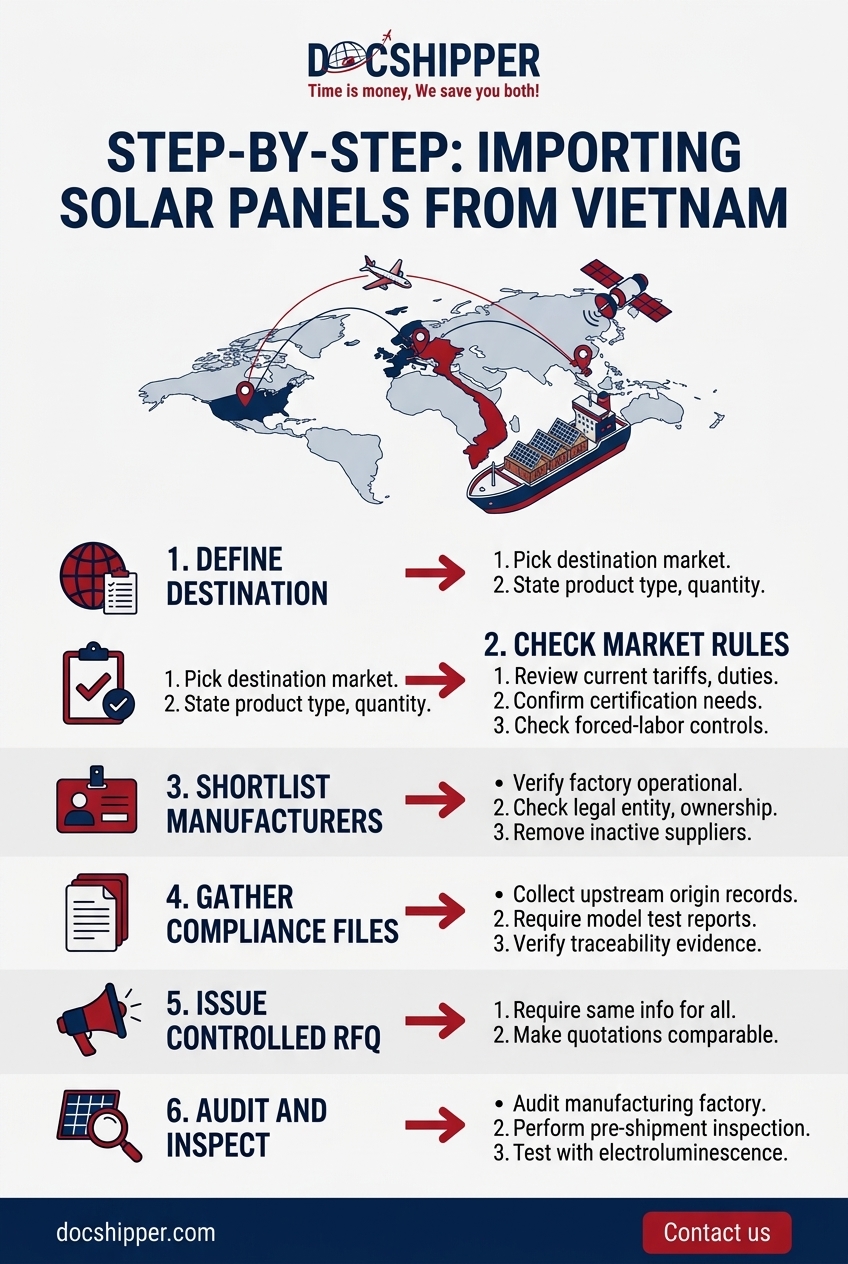
The safest sequence is to test the destination market first, then validate the factory, product, traceability and shipment plan. Do not begin with a low price and try to resolve duties or origin evidence after production has started.
- Define the destination and product. State the importing country, cells or modules, technology, wattage, model, project or distribution use, quantity and required delivery window.
- Check the market rules. Review the current tariff, trade-remedy position, product classification, certification requirements, forced-labour controls and origin rules. US buyers should obtain a current broker and Commerce review before relying on any rate.
- Shortlist active manufacturers. Verify the legal entity, operating factory, ownership, capacity, MOQ, lead time and export history. Remove suppliers that cannot document current production.
- Request traceability and certification files. Obtain upstream origin records for polysilicon, wafers and cells, together with model-specific test reports and conformity documents.
- Issue a controlled RFQ. Require the same technical, commercial and compliance information from every supplier so that quotations are comparable.
- Audit and inspect. Audit the factory where the order is material, then perform pre-shipment inspection including EL testing, visual checks, quantity verification and packing review.
- Book and insure the shipment. Confirm the FCL plan from Hai Phong or Cai Mep, supervise loading, retain photographs and arrange cargo insurance before dispatch.
Your RFQ can use this structure:
- Product: module or cell, model, technology, wattage, dimensions, connector and warranty.
- Compliance: IEC 61215, IEC 61730, CE or destination-specific approvals, test reports and serial-number format.
- Traceability: polysilicon, wafer and cell origins, supplier names, batch records and chain-of-custody documents.
- Quantity: total units, pallet configuration, container requirement and whether the order is for a project or distribution.
- Commercial terms: unit price, currency, MOQ, lead time, payment terms, Incoterm, port, destination and quotation validity.
- Quality and logistics: EL inspection, visual inspection, packing specification, loading supervision, insurance and claims documentation.
Conclusion
Import solar panels from Vietnam only after making a market-specific go or no-go decision. Vietnam remains a sourcing option, but the supplier’s factory status, upstream traceability, certifications and destination-specific duties now matter as much as the panel price.
- Vietnam’s solar exports were built mainly by Chinese-owned and other foreign-invested plants.
- For the US, AD/CVD rates from April 2025, plus the Section 301 measure described as 12.5% from July 2026, can make offers uncompetitive. Check the exporter’s actual rate.
- Outside the US, focus on certification, origin and traceability, especially before the EU Forced Labour Regulation applies on 14 December 2027.
- Verify that the factory is still producing the quoted model and capacity.
- Inspect, pack, load and insure modules carefully to reduce breakage and strengthen any cargo claim.
Tell us your destination market and expected volume. We can help check the manufacturer, arrange inspection before loading and ship your solar modules from Vietnam by FCL with cargo insurance.
FAQ | How to Import Solar Panels from Vietnam: Duties, Due Diligence and Shipping
No. A certificate of origin only supports the declared origin of the goods; it does not remove trade-remedy duties that apply to Vietnamese solar cells or modules. If cells or modules were made in another country and only assembled in Vietnam, customs may also examine whether the processing is sufficient to confer Vietnamese origin. Ask for production records, cell origin evidence and a customs-broker review before relying on any certificate.
Treat the structure as a compliance issue, not just a commercial arrangement. Your purchase contract should identify the actual manufacturer, exporter, seller, invoice issuer and party responsible for warranty claims. Confirm that the exporter’s name matches the applicable customs and trade-remedy documentation. A trading company should not be allowed to describe another factory’s certifications, duty rate or production history as its own.
There is no universally safest Incoterm, but the allocation of customs responsibility must be explicit. Under an arrangement such as FOB, you normally control the main freight and can appoint the forwarder, while under CIF or DDP the seller controls more of the transport chain. Be cautious with DDP if the supplier cannot demonstrate who will act as importer of record, pay duties and handle customs corrections in your country. Put responsibility for damage, insurance, unloading and customs delays in writing.
Link each payment milestone to objective evidence rather than to a promised shipping date. The contract should name the factory, model number, bill of materials, approved cell type, production quantity and permitted substitutions. Require written approval before any change, and make the balance payable only after an independent inspection confirms the agreed specifications. Also verify the supplier’s bank-account details through a separate communication channel before sending funds.
It can be practical for samples or a small trial order, but the handling risk is usually higher because pallets may be moved or consolidated several times. Ask the forwarder whether the cargo will remain palletised, how it will be protected from adjacent freight and who records damage at each transfer. For a commercial order, compare the higher LCL handling risk with the cost of a shared or full container before choosing the cheapest freight option.
Do not rely only on a visual inspection or the supplier’s warranty statement. Preserve the cartons, serial-number records, photographs and inspection report, then arrange testing through an independent laboratory using an agreed measurement standard. Your contract should define the permitted power tolerance, sampling method, test conditions, remedy and deadline for notifying the supplier. Without these terms, proving that an entire shipment is defective can become significantly more difficult.
Need Help with Logistics
or Sourcing in Vietnam ?
First, we secure the right products from the right suppliers at the right price by managing the sourcing process from start to finish. Then, we simplify your shipping experience - from pickup to final delivery - ensuring any product, anywhere, is delivered at highly competitive prices.


Fill the Form
Prefer email? Send us your inquiry, and we’ll get back to you as soon as possible.
Contact us