In short ⚡
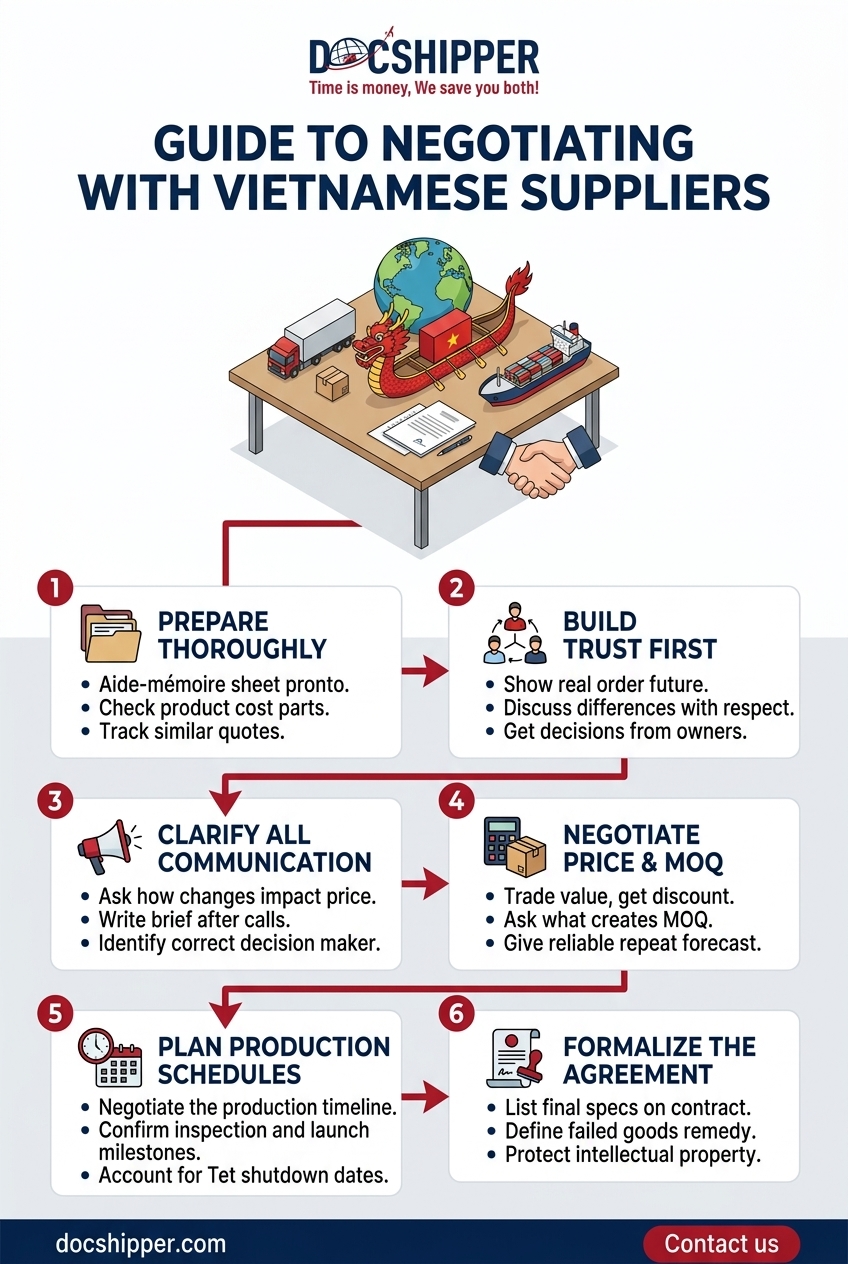
Negotiating with Vietnamese Suppliers: Culture, Pricing and Payment works best when you prepare thoroughly, exchange concessions and document every agreement. Focus on total order value, including price, MOQ, lead time, payment, quality, Incoterms and Tet-related production risks. Key practices include:- Prepare precise specifications, cost drivers, volume forecasts and two or three comparable quotes.
- Build trust through respectful communication, clear English and written recaps after meetings.
- Trade supplier priorities, such as volume visibility or flexible timing, for better price, MOQ or lead-time terms.
- Link payment milestones to defined documents and, where appropriate, a passed pre-shipment inspection.
- Plan for Tet’s practical 20-to-25-day production disruption and possible port congestion.
- Record the specification, quality standards, remedies, payment terms, intellectual property protections and Incoterm in the contract or purchase order.
In this guide, you will find practical advice on preparation, Vietnamese business culture, price and MOQ negotiations, payment protection, Tet planning, and contract requirements.
We hope you’ll find this article genuinely useful, but remember, if you ever feel lost at any step, whether it’s finding a supplier, validating quality, managing international shipping or customs, FNM Vietnam can handle it all for you!
Negotiating with Vietnamese suppliers works best when you negotiate the total value of the order, not only the unit price. Prepare a precise specification, show credible volume visibility, and exchange concessions on price, MOQ, lead time, payment and quality instead of demanding a discount without offering anything in return.
This approach helps you obtain better terms without damaging the relationship or creating quality problems later. It is especially useful for an SME or brand placing a first order with a Vietnamese factory.
DocShipper Tips
Prepare your facts, targets and fallback options to make every concession deliberate.
Prepare before you negotiate
Arrive with a precise specification, a target price based on real cost drivers, a volume forecast and two or three comparable quotes. Vietnamese factories respond better to buyers who demonstrate preparation, commercial potential and a clear understanding of the product.
Start with a product specification sheet covering materials, dimensions, tolerances, colours, packaging, labelling, testing requirements and acceptable quality limits. Define any points that could change the price, such as a different fabric composition, hardware grade, surface finish, printing method or packaging format.
Then separate the supplier’s cost drivers. Labour is only one part of the price. Materials, production complexity, machine time, packaging, rejected units, tooling, energy, internal quality control and order size can all influence the quotation. If a supplier attributes a price increase to labour, ask which part of the unit price it affects rather than disputing the explanation immediately.
Vietnam’s regional minimum wage increased by about 7.2% from 1 January 2026, with Region I set at VND 5.31 million per month under Decree 293/2025/ND-CP. Baker McKenzie reported the change on 10 March 2026 in its Vietnam minimum-wage update. Use this as context, not as proof that the entire quotation should rise by 7.2%.
For example, the Region I monthly minimum wage moves from VND 5.31 million to approximately VND 5.692 million after applying a 7.2% increase: VND 5.31 million × 1.072 = approximately VND 5.692 million. The negotiation question is then: what proportion of your product’s price is actually affected by this labour change, and what other cost movements are included?
Prepare a benchmark file before the call. Record each supplier’s unit price, MOQ, sample cost, tooling, lead time, payment request, Incoterm, packaging assumptions and quotation validity. A lower unit price may become more expensive once you add a larger MOQ, stricter payment terms or higher freight exposure.
| Preparation item | What to prepare | Why it matters |
| Specification | Materials, dimensions, tolerances, packaging and inspection criteria | Prevents price comparisons based on different products |
| Cost drivers | Labour, materials, complexity, packaging and order size | Creates a factual basis for price discussions |
| Benchmark quotes | Two or three comparable offers with terms recorded | Shows the supplier that your target is commercially grounded |
| Volume forecast | First-order quantity and realistic repeat-order outlook | Gives the factory visibility without making an unearned promise |
DocShipper Info
Document every decision so trust supports execution instead of replacing written controls.
Communication and business culture
Build the relationship before pushing hard, keep disagreements respectful, confirm decisions in writing and expect important decisions to involve the owner or director. In Vietnamese business culture, trust and continuity can influence how openly a supplier discusses problems and how much flexibility it offers.
Begin a negotiation by explaining your product, market, expected order sequence and quality priorities. A supplier needs to understand whether you are testing one product, building a repeat programme or looking for a long-term manufacturing partner. Do not present a forecast as a guaranteed purchase unless you are prepared to commit contractually.
When you disagree, avoid publicly cornering the supplier or describing its quotation as unreasonable. Explain the gap and invite a solution: “This price is above our target because of the packaging and MOQ. Which specification or order condition would allow us to reach a more workable level?” This keeps the discussion focused on options rather than blame.
Use clear English and avoid expressions that can be interpreted in several ways. After every call, send a written recap listing the agreed product version, open questions, revised quotation, responsible person and next decision date. Where technical details are important, use photographs, marked-up drawings and a numbered specification rather than relying on a translated sentence.
Meeting etiquette also affects the quality of the discussion. Join on time, allow the supplier to introduce its production capability, ask who has authority to approve commercial terms, and distinguish a factory from a trading company. A trading company may coordinate several factories, while a factory can usually answer more directly about capacity, processes and production constraints.
For a first order, ask the supplier to identify the commercial decision-maker and the operational contact. For repeat orders, use the relationship to discuss forward planning, but continue to document every change. Familiarity should improve execution, not replace written controls.
| Communication objective | Practical action | Risk reduced |
| Build trust | Explain your product and realistic purchasing outlook | The supplier treats you as a serious buyer |
| Disagree constructively | Ask which condition could change the price | Less defensive discussion and fewer hidden compromises |
| Prevent misunderstandings | Send a written recap after each meeting | Different interpretations of the agreement |
| Identify authority | Confirm who approves price, production and quality decisions | Delays caused by negotiating with the wrong contact |
DocShipper Tips
Exchange volume visibility or flexible timing for better price, MOQ or production priority.
Looking for a Reliable Shipping & Sourcing Partner?


Negotiating price, MOQ and lead time
Trade what the factory values, such as volume visibility, simpler packaging or flexible production timing, for what you need, such as a lower price, a smaller MOQ or a priority production slot. Ask for a cost breakdown instead of requesting a flat discount.
Price negotiation should begin with the current quotation and its assumptions. Ask whether the price includes tooling, export packaging, labelling, inspection, inland transport and the agreed Incoterm. The ICC Incoterms rules define responsibilities, costs and risks between buyer and seller, so do not compare two prices that use different delivery terms.
For MOQ negotiation, identify what creates the minimum. It may be a minimum purchase of fabric, a dye lot, a carton quantity, a production batch or a supplier’s internal setup cost. You can then test alternatives: shared raw materials across colours, a reduced number of colourways, standard packaging, a pilot quantity, or a repeat-order commitment based on actual sales.
Lead time should be negotiated as a production plan, not as a single optimistic number. Ask when materials must be approved, when production starts, how long inspection requires, what happens if a component arrives late and which date the supplier considers the shipping-ready date. A shorter lead time may require earlier material approval or a simpler product.
Do not ask for a penalty before defining the operational event that triggers it. A workable clause could distinguish late material approval by the buyer from late production caused by the supplier. It should also state whether the remedy is a price credit, expedited production, priority in the next batch or another agreed solution.
| Lever | What to ask | What to offer in return |
| Price | Which cost elements drive the quotation, and what changes the unit price? | Clearer specifications, standard packaging, better volume visibility or a longer quotation window |
| MOQ | What creates the MOQ: material, colour, packaging or machine setup? | Fewer colours, shared materials, standard components or a realistic repeat-order plan |
| Lead time | What is the production-ready date, and which milestones control it? | Earlier approvals, flexible delivery timing or a confirmed production calendar |
| Packaging | Can the factory use standard cartons and labels? | Accept the supplier’s existing format where it meets your requirements |
| Priority | Can the factory reserve capacity for the order? | Earlier order confirmation, material deposit or a reliable forecast |
DocShipper Alert
Define inspection results, documents and release conditions before transferring the balance.
Payment terms and protection
Common payment structures include a deposit followed by the balance before shipment or against shipping documents, a letter of credit, or documentary collection against payment, often called D/P. The safest structure depends on your relationship, the supplier’s credibility, the order size and your ability to inspect the goods.
Separate the payment discussion into three questions: when money leaves your account, which event releases the balance, and which documents prove that the event occurred. A pre-shipment inspection can be linked to the balance approval, but the inspection scope, sampling method and failure procedure must be agreed before production starts.
For a first order, ask whether the supplier accepts payment of the balance against a copy of the bill of lading or another defined shipping document. A bill of lading is a transport document showing that goods have been received for shipment, but it does not by itself prove that the goods passed your quality inspection. Keep the inspection requirement separate and explicit.
A letter of credit, or L/C, is a bank-supported payment mechanism in which payment depends on compliant documents. D/P means documents against payment: the buyer receives control documents through the banking process after making payment. Both can provide structure, but banks, fees, document discrepancies and timing must be reviewed before you choose one.
Also agree the payment currency, bank-charge allocation, beneficiary name and refund treatment for cancelled tooling or rejected goods. Verify that the contracting entity and bank account belong to the same legitimate business. The Vietnam National Business Registration Portal can help you check the supplier’s registered business information, although registration verification is not a substitute for factory, financial or quality due diligence.
| Payment option | How it works | Protection point to negotiate |
| Deposit and balance | Initial payment funds materials or production, with the remainder paid at an agreed milestone | Define the inspection result and documents required before balance release |
| Balance against shipping documents | Final payment is linked to defined shipping documentation | Specify the exact documents and confirm when ownership or control transfers |
| L/C | Bank payment follows compliant documentary presentation | Review document conditions, bank charges and discrepancy procedures |
| D/P | Shipping documents are released against payment | Confirm the banking route, payment currency and document set |
DocShipper Platform
One platform. Your entire supply chain
Sourcing, freight, customs & documents — all centralised, all visible, 24/7.
Plan around Tet and peak seasons
Tet officially lasts around 7 to 10 days, but the practical production disruption can last 20 to 25 days. Place orders and confirm materials early, protect your shipping window, and avoid assuming that the official holiday dates represent the full factory shutdown and recovery period.
B&Company reported that factories may close for 7 to 14 days, with slower production before the holiday and a gradual ramp-up afterwards. It also noted port congestion during the two weeks before Tet. The company’s holiday-impact comparison provides the basis for this planning range.
For a Tet-sensitive order, ask the supplier for five dates: final material approval, production start, factory closure, production restart and shipping-ready date. Then ask which date is realistic if your approval is delayed. This exposes whether the quoted lead time assumes uninterrupted production.
Tet 2026 was centred on 14 February. Using the brief’s planning ranges, the risk window is not only the official 7 to 10-day holiday. It includes the factory closure period, the slowdown before the holiday, the ramp-up afterwards and possible congestion in the two preceding weeks.
A complete planning example is therefore: holiday reference date, 14 February 2026; official holiday range, 7 to 10 days; possible factory closure range, 7 to 14 days; practical production disruption, 20 to 25 days; additional logistics risk, congestion in the two weeks before Tet. Use these figures to set internal approval and shipping deadlines rather than asking the supplier to “try to be on time.”
If your sales calendar cannot absorb the disruption, negotiate an earlier production slot, earlier material approval, partial shipment or buffer stock. Do not promise an exact arrival date until production, inspection, freight and customs assumptions have been checked together.
| Planning stage | Question for the supplier | Buyer action |
| Before materials | When must the specification and colours be approved? | Freeze the specification before the supplier’s material deadline |
| Before production | What is the last realistic production start before Tet? | Compare the date with your sales and shipping plan |
| Before closure | What will be completed, packed and inspected before the factory closes? | Prioritise urgent or launch-critical quantities |
| After restart | When will normal output and quality-control capacity return? | Allow for ramp-up instead of using the official holiday end date alone |
DocShipper Alert
Build a 20 to 25-day disruption buffer into production and shipping schedules.
DocShipper Info
Lock every commercial and quality term into the contract before approving production.
Put the deal in a contract
Turn every negotiated point into a purchase order or contract covering the specification, price validity, MOQ, lead time, payment milestones, quality process, remedies, intellectual property and Incoterm. A good relationship supports performance, but the written agreement controls what happens when expectations diverge.
Attach the final specification rather than referring to a sample informally. Identify the approved sample version, tolerances, materials, colours, packaging, labels and inspection standard. State whether the supplier may substitute materials or subcontract production, and require written approval for any change.
For price protection, state the currency, unit basis, included charges, quotation validity and conditions for a revision. If the supplier expects material or labour changes to affect future orders, define when a review may occur and what evidence must support it. Do not leave “market increase” as an undefined right to change the price.
For quality, specify the inspection stage, sampling method, defect classification, rework process and remedy for failed goods. The contract should also address late delivery, missing quantities, unauthorised substitutions, tooling ownership, confidentiality, product drawings, intellectual property and any non-negotiable compliance requirements.
Use an NNN agreement for sensitive custom products where appropriate. NNN refers to non-disclosure, non-use and non-circumvention protections. It should be drafted for the relevant Vietnamese contracting entity and product situation, rather than copied from a generic template without local legal review.
Use this checklist before approving the order:
- Legal name, registered address and bank details of the contracting supplier
- Final specification, approved sample and revision number
- Unit price, currency, quotation validity and included charges
- MOQ by product, colour, size or material where applicable
- Production milestones, shipping-ready date and Tet assumptions
- Deposit, balance, inspection trigger and required shipping documents
- Inspection standard, defect limits, rework and rejection procedure
- Remedy for late delivery, short shipment or failed quality inspection
- Rules for material substitution, subcontracting and design changes
- Tooling ownership, confidentiality, IP and NNN protections
- Agreed Incoterm under the current ICC Incoterms rules
- Dispute, governing-law and notice provisions reviewed for the transaction
Your negotiation email should make the give-and-get structure visible:
Subject: Commercial terms for [product and order stage]
Hello [name],
Thank you for the quotation and production discussion. We would like to move forward based on the attached specification, provided we can align the following points:
- Price: please confirm the cost drivers and revise the quotation using the agreed specification and Incoterm.
- MOQ: please propose the lowest workable MOQ and explain whether material, colour or packaging creates the minimum.
- Lead time: please confirm material approval, production start, inspection and shipping-ready dates, including the Tet plan.
- Payment: please confirm the proposed deposit, balance milestone, inspection requirement and shipping documents.
In return, we can provide [realistic forecast, earlier approval, standard packaging or flexible timing]. Please send the revised quotation and the open assumptions in writing so we can approve the purchase order.
Best regards,[Name]
Conclusion
Negotiating with Vietnamese suppliers is more effective when you exchange value instead of pursuing a discount in isolation. A clear specification, respectful communication, realistic timing and written protection give the supplier a workable path to offer better terms.
- Prepare the specification, cost drivers and comparable benchmarks before negotiating.
- Use the 2026 minimum-wage increase as context, but ask how much it actually affects the product cost.
- Respect the relationship, communicate clearly and confirm every decision in writing.
- Trade factory priorities, such as volume visibility and flexible timing, for price, MOQ or production priority.
- Link payment milestones to defined documents and, where appropriate, a passed pre-shipment inspection.
- Plan around Tet’s practical 20 to 25-day disruption rather than only its official holiday dates.
- Lock the specification, quality rules, remedies, payment terms and Incoterm into the contract or purchase order.
Need someone on the ground? Our Vietnam team can negotiate with your suppliers and follow production and QC for you, with sourcing, supplier management and logistics coordinated through one contact.
FAQ | Negotiating with Vietnamese Suppliers: A Practical Playbook for Better Terms
Do not insist on confidential factory margins or demand a full accounting of every expense. Instead, ask the supplier to explain the main cost drivers and model specific changes, such as standard packaging, fewer colours, a different material or a larger production batch. If the supplier cannot explain any assumptions at all, compare the quotation against equivalent offers and treat the lack of transparency as a due-diligence risk.
Agree on the quotation currency and define how long the price remains valid. For repeat orders, avoid giving the supplier an unlimited right to increase prices whenever exchange rates move. A more workable clause identifies a reference exchange rate, a review threshold and supporting evidence, while allowing either party to renegotiate if the change exceeds that threshold.
Treat any change in beneficiary details as a verification event, even if the request appears to come from a familiar contact. Confirm the change through an independent channel, such as a known telephone number or a separate meeting, and check that the beneficiary matches the contracting entity. Do not rely only on an email signature or a PDF bank letter, particularly when the request arrives shortly before the deposit is due.
Define whether the sample is a visual reference, a functional prototype or the exact approved production standard. Record the sample version, measurements, materials, colours, accessories, packaging and any permitted tolerances. You should also agree who pays for revisions, whether the sample cost is credited against the order, and that mass production cannot begin until the correct sample or a signed specification has been approved.
Ask for a description of the tooling, its expected service life, replacement cost and the production quantity required to amortise it. The contract should state who owns the tooling, where it is stored, who may use it and what happens if the relationship ends. If you pay for custom tooling, request identification photographs or records and do not assume that payment alone gives you practical control over it.
First compare the delay with the agreed milestone and check whether it resulted from your late approval, a material change or a supplier-controlled problem. Ask for a written recovery plan showing the revised production, inspection and shipping-ready dates. If the delay affects your launch or logistics booking, apply the agreed remedy—such as priority production, partial shipment or a credit—rather than accepting an informal promise to “try to catch up.”
Ask for evidence that relates to your specific product rather than relying on a general factory presentation. Request photographs or videos of the relevant production process, examples of comparable goods, information about critical subcontractors and an explanation of how quality issues are recorded and corrected. For a high-risk or technically complex order, use an independent factory assessment and a pilot batch before committing to a large production run.
Need Help with Logistics
or Sourcing in Vietnam ?
First, we secure the right products from the right suppliers at the right price by managing the sourcing process from start to finish. Then, we simplify your shipping experience - from pickup to final delivery - ensuring any product, anywhere, is delivered at highly competitive prices.


Fill the Form
Prefer email? Send us your inquiry, and we’ll get back to you as soon as possible.
Contact us