In short ⚡
Cross-Border Trucking from Vietnam to China: Routes via Lang Son and Lao Cai mainly uses Huu Nghi-Youyiguan, Tan Thanh, or Kim Thanh-Hekou, with cargo moved by transloading or licensed through-truck depending on permits, vehicle rules, destination, and cargo type.
The main route options are:
| Route | Border gates | Typical use |
|---|---|---|
| Lang Son–Guangxi | Huu Nghi–Youyiguan | General cargo from northern Vietnam towards Nanning, Guangxi, Guangdong, and beyond |
| Lang Son agricultural corridor | Tan Thanh | Fruit and other agricultural exports; congestion can be highly seasonal |
| Lao Cai–Yunnan | Kim Thanh–Hekou | Cargo bound for Yunnan and shipments where Lao Cai offers a better operational fit |
| Coastal Guangxi | Mong Cai–Dongxing | Potential option for coastal Guangxi, subject to commodity and current operating conditions |
In this article, you will find details on transloading and through-truck operations, border-gate selection, transit times and congestion, customs documents, road-versus-sea-and-rail choices, and the step-by-step booking process.
We hope you’ll find this article genuinely useful, but remember, if you ever feel lost at any step, whether it’s finding a supplier, validating quality, managing international shipping or customs, FNM Vietnam can handle it all for you!
How cross-border trucking between Vietnam and China works
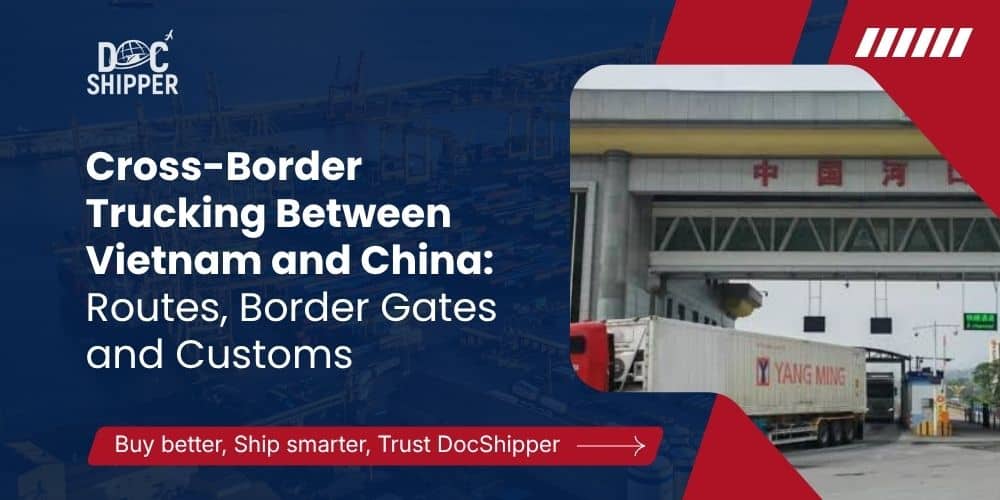
Most Vietnam-China road cargo crosses through Lang Son, using Huu Nghi-Youyiguan or Tan Thanh, or through Lao Cai, using Kim Thanh-Hekou. Depending on the route and permits, cargo is either transferred between Vietnamese and Chinese trucks at the border or carried by a licensed through-truck on an approved cross-border route.
With transloading, a Vietnamese truck delivers the shipment to a border warehouse or interchange area. The cargo is checked, unloaded or transferred, and then loaded onto a Chinese truck for the onward journey. This model is common when vehicle licences, insurance, driver permissions or domestic transport rules prevent one truck from completing the entire route.
A through-truck remains with the cargo across the border. The Greater Mekong Subregion Cross-Border Transport Facilitation Agreement, or CBTA_I-Agreement_0.pdf” target=”_blank” rel=”nofollow noopener” style=”color:#05224d;text-decoration:underline;font-weight:bold”>GMS CBTA, supports this type of operation on approved corridors. A new route opened on 14 May 2025 for trucks travelling from Nanning or Kunming to Hanoi through Youyiguan and Hekou. According to VnEconomy, the route can save approximately one day and up to CNY 1,000 per truck.
For the shipper, the practical choice is also between FTL and LTL. FTL reserves the vehicle for one shipment, while LTL consolidates several shipments in one truck. FTL generally gives better control over loading and delivery windows; LTL can suit smaller lots but adds consolidation and handling steps. Customs declarations are completed in Vietnam for exports and in China for imports, usually with a forwarder coordinating both sides.
| Model | How it works | Best suited to |
| Transloading | Vietnamese truck and Chinese truck exchange cargo at the border | Routes where vehicle or permit rules require a truck change |
| Through-truck | One licensed truck carries the shipment across the border | Eligible corridors and time-sensitive cargo |
| FTL | One customer uses the truck capacity | Full loads, sensitive cargo and fixed delivery windows |
| LTL | Several shipments share truck capacity | Smaller shipments where consolidation time is acceptable |
DocShipper Info
Get a practical cross-border trucking plan today.
Border gates compared
Huu Nghi-Youyiguan is the main choice for general cargo moving from northern Vietnam towards Guangxi and onward to areas such as Guangdong. Tan Thanh is particularly important for agricultural exports, while Kim Thanh-Hekou links Lao Cai with Yunnan. Mong Cai-Dongxing can serve coastal Guangxi, but its suitability should be confirmed for the specific commodity, destination and current operating conditions.
Lang Son can experience substantial two-way traffic. On 19 June 2025, 2,005 trucks passed through Lang Son border gates, including 634 export trucks and 1,371 import trucks. Huu Nghi alone handled 985 trucks that day, according to VnEconomy. This was a recorded day, not a guaranteed daily capacity, so it should not be used as a transit-time promise.
Kim Thanh is the main road option for the Lao Cai-Yunnan corridor. Viet Nam News reported an average of approximately 342 trucks per day at Lao Cai gates in mid-2025, with 120 export trucks and 222 import trucks. The same report recorded two to three freight trains per day, making Lao Cai relevant when road capacity is tight or when rail better matches the shipment.
Gate selection should follow the Chinese destination as well as the Vietnamese origin. For example, a shipment from Hanoi or Bac Ninh to Nanning may favour Lang Son, while cargo bound for Yunnan may be assessed through Lao Cai. Fruit, industrial cargo, dangerous goods and oversized freight may require different checks, equipment or booking arrangements.
| Gate pair | Vietnamese side | Chinese side | Typical use and notes |
| Huu Nghi | Lang Son | Youyiguan, near Pingxiang | General cargo and the main Guangxi corridor; 985 trucks recorded on 19 June 2025 |
| Tan Thanh | Lang Son | China-side agricultural corridor | Important for fruit flows, including durian and lychee; congestion is highly seasonal |
| Kim Thanh | Lao Cai | Hekou, Yunnan | Road link to Yunnan; approximately 342 trucks per day reported in mid-2025 |
| Mong Cai | Quang Ninh | Dongxing | Coastal Guangxi option; confirm current cargo acceptance and operating conditions before booking |
DocShipper Alert
Confirm transit times before booking, and prepare a backup gate where possible.
Transit times and congestion: what to expect
Road is often the fastest surface option between North Vietnam and South China, but border queues can remove that advantage. A reliable door-to-door estimate depends on the origin, destination, gate, customs status, FTL or LTL model, commodity and season. DocShipper should confirm the operational transit estimate before booking rather than relying on a generic number of days.
Fruit seasons create the greatest pressure at Lang Son. Viet Nam News reported more than 214,000 vehicles through Lang Son gates by 4 June 2025, an increase of 23%, while Tan Thanh handled more than 500 tonnes of durian per day. A dedicated lychee lane was reported at up to 200 trucks per day. Industrial shippers should therefore book earlier, avoid the most congested windows where possible, or ask whether Lao Cai is a workable alternative.
Congestion is not caused only by the number of trucks. Missing customs data, incomplete origin documents, inspection requirements, consolidation delays and incompatible truck arrangements can all extend the crossing. LTL shipments need additional planning because the truck may wait for cargo consolidation before the border movement begins.
Infrastructure is also changing. The Huu Nghi smart checkpoint project is planned for a pilot from Q3 2026. The route at markers 1119-1120 is targeted to increase from 800 vehicles per day to 2,000-2,500 by 2027 and 3,000-3,500 by 2030, according to QDND/VNA. These are project targets, not current guaranteed throughput.
For agricultural exporters, Phung Duc Tien, Vietnam’s Deputy Minister of Agriculture and Environment, called for increased inspection capacity and extended working hours at border posts to minimise delays, as reported by Viet Nam News on 10 June 2025.
Looking for a Reliable Shipping & Sourcing Partner?


Documents and customs for Vietnam-China trucking
Prepare the commercial invoice, packing list, export and import declarations, transport details and any required permits before the truck reaches the border. For preferential duty treatment in China, the shipment may need Form E under the ASEAN-China Free Trade Area or an RCEP proof of origin, provided the goods meet the applicable rules of origin.
The invoice and packing list must describe the goods consistently with the HS code, quantities, weights, values and packaging. Customs brokers on both sides use these details to prepare declarations, assess duties and decide whether inspection is required. The General Department of Vietnam Customs and China’s General Administration of Customs, or GACC, apply their respective import and export controls.
Food and agricultural cargo needs additional preparation. Depending on the product, the file may include a phytosanitary certificate, health or food-safety documents, treatment records, packaging compliance and evidence that the relevant exporter or producer is registered where required by GACC rules. Fresh cargo also needs a realistic inspection and temperature-control plan.
Do not wait until loading to check origin eligibility. Ask the customs team to verify the HS code, product origin, Form E or RCEP route, licensing requirements and the Chinese importer’s ability to receive the goods. A certificate of origin supports a preferential claim, but it does not replace the customs declaration or product-specific permits.
| Document | Who prepares or issues it | When needed |
| Commercial invoice | Seller or exporter | For customs valuation and the import/export file |
| Packing list | Seller or warehouse | For quantities, packages, weights and inspection |
| Export and import declarations | Customs broker or authorised declarant | For clearance in Vietnam and China |
| Form E | Competent issuing authority under the ASEAN-China FTA process | When eligible goods claim preferential treatment under the relevant agreement |
| RCEP proof of origin | Authorised exporter, producer or competent authority, depending on the case | When the shipment qualifies under RCEP rules of origin |
| Phytosanitary or food certificates | Relevant Vietnamese authority or competent body | For applicable agricultural, food and plant products |
Road, sea or rail between Vietnam and China?
Choose road when delivery speed, flexible pickup and direct access to South China matter more than the lowest possible freight cost. Sea is usually better for heavy, non-urgent cargo, larger volumes and shipments from South Vietnam. Rail through Lao Cai can suit bulk or containerised flows where a more structured, less road-dependent service is acceptable.
Road is especially practical for North Vietnam origins such as Hanoi, Bac Ninh, Hai Phong or nearby manufacturing areas when the Chinese destination is in Guangxi, Guangdong or Yunnan. However, the best road option may change during fruit-season congestion. Compare Huu Nghi, Tan Thanh and Kim Thanh instead of assuming the nearest gate is the fastest.
Sea freight through Hai Phong may offer a stronger cost position for dense cargo, but it adds port handling and sailing schedules. Rail can reduce dependence on road capacity, although terminal handling and train availability must be checked. For current rates and multimodal alternatives, use a shipment-specific quotation rather than an unsourced market average.
| Situation | Likely mode | Why |
| Time-sensitive cargo from North Vietnam to South China | Road | Flexible pickup and fast surface connection when the border is flowing |
| Heavy, non-urgent cargo or South Vietnam origin | Sea | Better suited to larger volumes and port-based transport planning |
| Bulk or container flow towards Yunnan | Rail | Alternative to road capacity through the Lao Cai corridor |
| Fruit during peak export season | Road with gate comparison | Direct delivery is useful, but queues and inspection capacity must be monitored |
DocShipper Tips
Request a shipment-specific comparison of road, sea and rail options.
DocShipper Platform
One platform. Your entire supply chain
Sourcing, freight, customs & documents — all centralised, all visible, 24/7.
Step by step: booking a cross-border truck
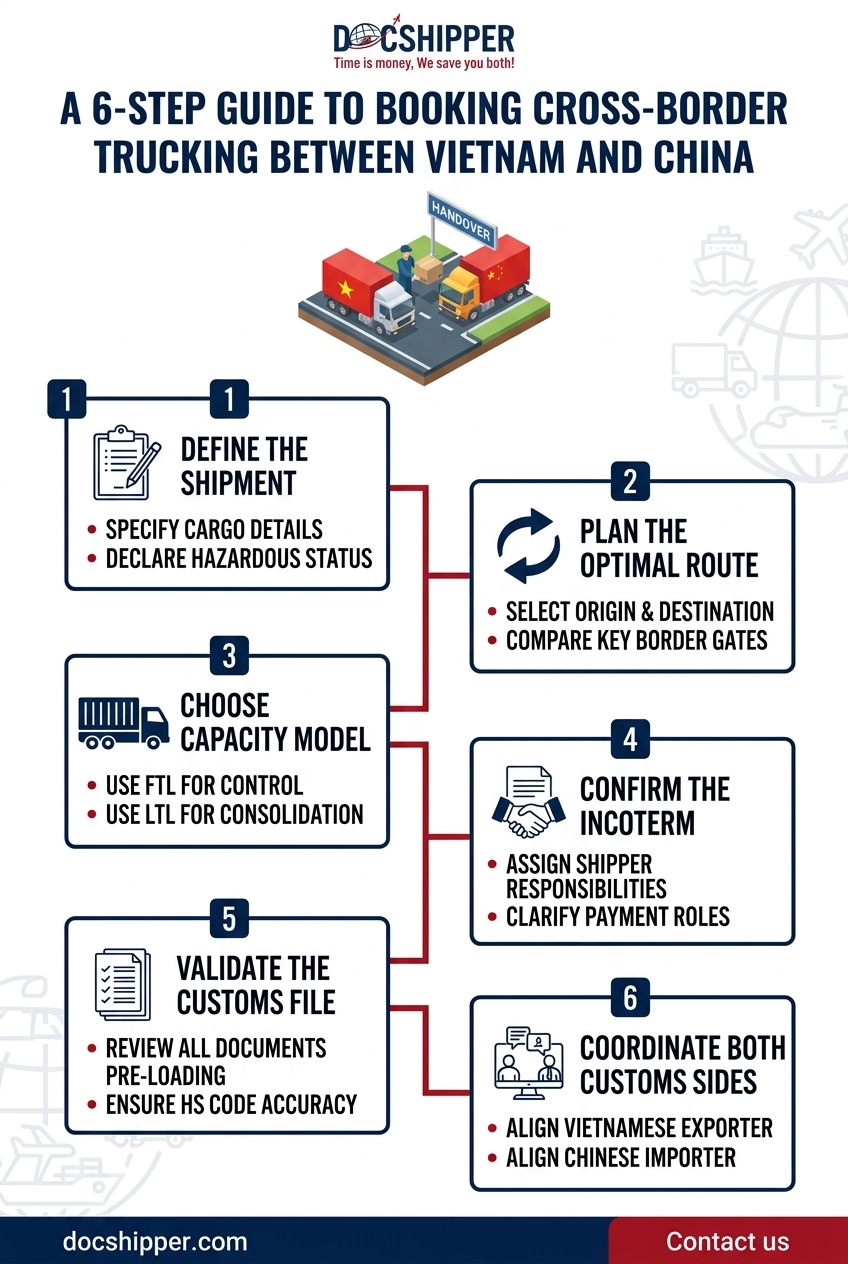
To book Vietnam-China road freight, define the shipment precisely, select the gate and transport model, validate the customs file, and obtain a quote that includes both-side clearance and border handling. The following process reduces the risk of a truck arriving before the documents or receiving party is ready.
- Define the shipment: provide the HS code, product description, number of packages, gross and net weight, dimensions, cargo value, dangerous-goods status and temperature requirements.
- Confirm the route: state the pickup address, Chinese delivery address, requested delivery window and likely corridor. Compare Lang Son, Lao Cai or another suitable gate according to destination and cargo.
- Choose FTL or LTL: use FTL for a dedicated load or fixed schedule, and LTL when the shipment can accept consolidation and additional handling.
- Confirm the Incoterm: identify who pays freight, duties, customs charges, unloading and delivery. The Incoterm should match the actual responsibilities agreed by buyer and seller.
- Prepare the customs file: send the invoice, packing list, declarations, origin information and any Form E, RCEP, phytosanitary or product-specific documents for review before loading.
- Book customs on both sides: confirm the Vietnamese exporter, Chinese importer, brokers, importer registration and the party authorised to respond to customs queries.
- Plan the border movement: confirm whether the load will be transloaded or move by through-truck, where the handover occurs, and how inspections or waiting time are handled.
- Track and manage exceptions: monitor truck arrival, customs release, border entry, handover and final delivery. Escalate document discrepancies before the vehicle reaches the gate.
For a quotation, send the origin, destination, cargo description, HS code, weight, volume, packaging, Incoterm, preferred delivery window and any current documents. We can then assess FTL or LTL, recommend the practical gate and coordinate customs clearance in Vietnam and China.
Conclusion
Cross-border trucking between Vietnam and China is fastest when the gate, truck model and customs file match the cargo. Lang Son and Lao Cai are the key road corridors, but seasonal agricultural traffic can change the practical choice from one week to the next.
- Use Huu Nghi-Youyiguan for much general cargo towards Guangxi and beyond.
- Consider Tan Thanh for agricultural flows, while planning carefully around fruit-season queues.
- Use Kim Thanh-Hekou when the destination is in Yunnan or when Lao Cai offers a better operational fit.
- Choose transloading or a through-truck according to the corridor, permits and service availability.
- Select FTL for control and LTL for smaller loads that can accept consolidation.
- Prepare Form E or RCEP origin evidence early if the goods qualify for preferential duty.
- Use road for speed, and compare sea or rail when cost, bulk or congestion matters more.
Shipping between Vietnam and China by road? Tell us your pickup point, delivery address and cargo details. We will help select the gate, arrange FTL or LTL trucking and coordinate customs on both sides.
FAQ | Cross-Border Trucking Between Vietnam and China: Routes, Border Gates and Customs
The truck may be held until customs completes document, physical or commodity checks. The importer or broker must respond to requests and provide supporting records. Keep the invoice, packing list, product specifications, permits and origin documents consistent, and allow for possible storage, handling and inspection charges.
The answer depends on the agreed Incoterm and the carrier’s quotation. Before booking, confirm whether the price includes border handling, transloading, customs inspection, waiting time, storage, demurrage and delivery attempts. A low base freight rate may exclude these exception costs.
Ask where the handover will take place, which party controls unloading and whether the cargo will be repacked or inspected. Use suitable packaging, photograph the cargo before loading, record package counts at handover and confirm who is responsible for loss or damage. For fragile or high-value goods, FTL or a through-truck may reduce handling points.
Possibly, but these shipments require route and carrier approval before loading. The forwarder may need the safety data sheet, UN number, hazard classification, packaging details, dimensions, axle weights and any transport permits. Do not send dangerous or oversized cargo to the border until the equipment, route and documentation have been accepted on both sides.
Confirm in advance that the importer is registered, authorised to receive the commodity and prepared to answer customs queries. If the consignee cannot clear or receive the shipment, the truck may incur waiting, storage or return costs. Include a reachable consignee contact and an agreed contingency plan in the booking instructions.
Confirm the required temperature range, monitoring method, reefer power supply and maximum time outside controlled conditions before dispatch. The handover location must be able to support the equipment and inspection process. Use temperature records and a written escalation procedure so the parties can act quickly if the cargo leaves its permitted range.
Need Help with Logistics
or Sourcing in Vietnam ?
First, we secure the right products from the right suppliers at the right price by managing the sourcing process from start to finish. Then, we simplify your shipping experience - from pickup to final delivery - ensuring any product, anywhere, is delivered at highly competitive prices.


Fill the Form
Prefer email? Send us your inquiry, and we’ll get back to you as soon as possible.
Contact us