In short ⚡
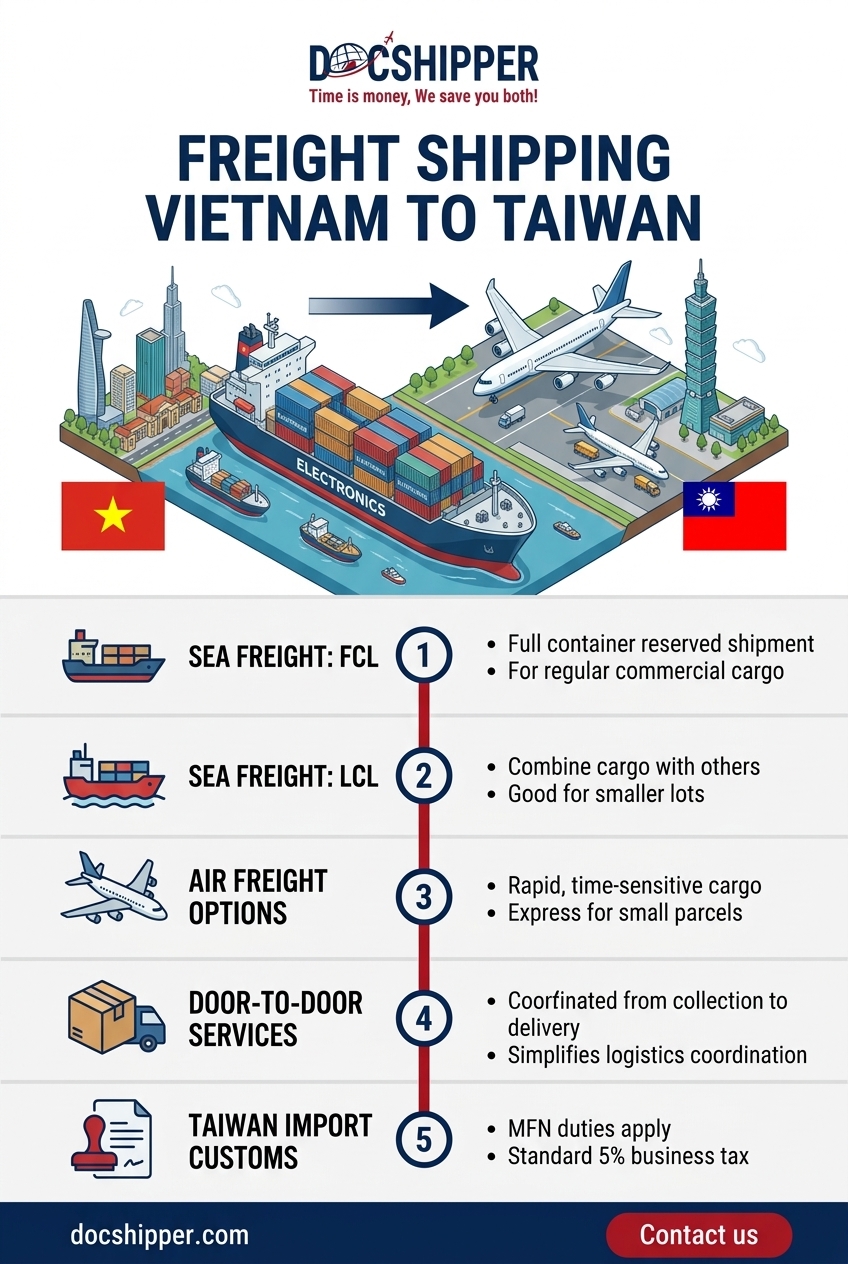
Freight shipping between Vietnam and Taiwan is typically arranged by sea for commercial volumes, by air for urgent or high-value cargo, or door-to-door when pickup, transport, customs clearance and final delivery need to be coordinated under one service.
Compare the main shipping options as follows:
| Shipping mode | Best suited for | Key considerations |
|---|---|---|
| Sea FCL | Full containers and regular commercial cargo | Dedicated container, greater loading control and planned replenishment |
| Sea LCL | Smaller consignments that do not fill a container | Shared container space with consolidation and deconsolidation handling |
| Air freight | Urgent, high-value, lightweight or time-sensitive cargo | Uses chargeable weight; routes commonly connect Hanoi or Ho Chi Minh City with Taoyuan or Kaohsiung |
| Express | Documents, samples, small parcels and urgent shipments | Faster pickup and simplified handling through an express network |
| Door-to-door | Shippers seeking one coordinated logistics plan | Combines pickup, export clearance, main transport, Taiwan import clearance and final delivery |
You will find details on Vietnam and Taiwan ports and airports, FCL versus LCL selection, door-to-door Incoterms, Taiwan MFN duties and 5% business tax, customs documents, BSMI requirements, and additional warehousing, insurance and quality-control services.
We hope you’ll find this article genuinely useful, but remember, if you ever feel lost at any step, whether it’s finding a supplier, validating quality, managing international shipping or customs, FNM Vietnam can handle it all for you!
Freight shipping between Vietnam and Taiwan is usually handled by sea for commercial volumes, by air for urgent or high-value cargo, or through a door-to-door service that combines transport and customs clearance. The right choice depends on your cargo volume, urgency, product classification, destination and required delivery terms.
This guide explains shipping from Vietnam to Taiwan, the main ports and airports, FCL and LCL options, Taiwan import duties and taxes, required documents, and the information needed for a reliable quote. The same logistics corridor can also support shipments from Taiwan to Vietnam, although the import formalities and taxes will change according to the destination country.
DocShipper Info
Request a tailored quote covering transport, customs and delivery.
Ways to ship between Vietnam and Taiwan
Most cargo between Vietnam and Taiwan moves by sea, air is used for urgent or high-value goods, and door-to-door bundles all steps under one logistics plan. For a short intra-Asia route, LCL and air freight can both be competitive when the shipment is small or time-sensitive.
Choose sea FCL when you have enough cargo to use a full container or need exclusive loading control. FCL, or Full Container Load, means that your goods occupy a container reserved for your shipment. It generally offers simpler handling and better control over consolidation risks.
Choose sea LCL when your cargo does not fill a container. LCL, or Less than Container Load, combines your cartons or pallets with other shippers’ cargo. The rate depends on the cargo volume or chargeable weight, the consolidation service, origin and destination handling, and the specific sailing.
Air freight is appropriate for samples, spare parts, electronics, urgent replenishment and high-value goods. Express services add faster pickup and simplified handling for smaller shipments, while standard air cargo is better suited to planned commercial consignments. Transit schedules and rates vary by season and service, so we use DocShipper-confirmed figures before issuing a quotation.
| Mode | Typical use | Transit information |
| Sea FCL | Full containers, regular commercial cargo, planned replenishment | Varies by origin, destination, sailing and season. Request a DocShipper quote. |
| Sea LCL | Smaller consignments that do not fill a container | Varies according to consolidation and handling schedules. Request a quote. |
| Air freight | Urgent, high-value, lightweight or time-sensitive cargo | Varies by flight availability, airport pair and cargo screening. |
| Express | Small parcels, documents, samples and urgent shipments | Depends on the express network, pickup location and service level. |
| Door-to-door | Shippers seeking one coordinated service from pickup to delivery | Combines origin, main transport, customs and final delivery schedules. |
When comparing quotes, do not compare only the main freight line. Check whether pickup, export clearance, terminal handling, documentation, customs clearance, delivery, insurance, duties and taxes are included or billed separately.
DocShipper Tips
Check every surcharge before approving your Vietnam-Taiwan booking.
Sea freight between Vietnam and Taiwan
Containers leave Vietnam through Hai Phong, Cat Lai or Cai Mep and can arrive in Taiwan through Kaohsiung, Keelung or Taichung. This short-sea corridor benefits from frequent intra-Asia services, but the selected port pair, consolidation plan and final delivery location still determine the practical cost and schedule.
Hai Phong is the main northern gateway for cargo from Hanoi and northern manufacturing areas. Cat Lai serves Ho Chi Minh City and nearby industrial zones, while Cai Mep is an important deep-water gateway for southern Vietnam and can be considered when the sailing or container plan suits the shipment.
In Taiwan, Kaohsiung is a major option for southern destinations and containerized freight. Keelung can be relevant for northern Taiwan, while Taichung may suit cargo destined for central Taiwan. The best routing is not always the port with the shortest geographical distance because inland trucking, terminal charges, sailing frequency and customs arrangements also affect the landed cost.
Vietnam’s maritime network is expanding: the country has 34 seaports and 320 berths, while Cai Mep ranked 11th and Hai Phong 13th in the 2025 Container Port Performance Index, according to VietNamNet on July 7, 2026. National container throughput was approximately 18 million TEU in the first half of 2025, showing the scale of the network available to exporters and importers.
Electronics now represent approximately 80% of Vietnam’s exports to Taiwan across five technology product groups, according to VnEconomy on July 14, 2026. That concentration can tighten space on popular sailings, so shippers moving electronics, components or related products should avoid waiting until the last available booking window.
Looking for a Reliable Shipping & Sourcing Partner?


How to choose FCL or LCL
Start with the packing list rather than the product description. Record the number of cartons or pallets, external dimensions, gross weight, stackability, product value, dangerous-goods status and requested delivery address. These details allow the forwarder to compare LCL against a full-container option.
FCL is usually easier to control when the cargo requires dedicated loading, has a high value, must remain sealed, or fills a meaningful part of a container. LCL can be more practical for smaller lots, but it adds consolidation and deconsolidation steps at the origin or destination warehouse.
Sea freight rates are built from several components: the origin pickup, export documentation and clearance, origin terminal handling, ocean freight, destination handling, import clearance, duties and taxes, and final delivery. Fuel, peak-season conditions, container availability, cargo dimensions and the selected Incoterm can change the final amount.
- Confirm the cargo description, HS classification, dimensions, weight, packaging and value.
- Compare FCL and LCL using the same origin address, Taiwan destination and delivery terms.
- Check whether the quotation includes customs clearance, terminal charges, delivery and insurance.
- Confirm the sailing, cut-off date, export documents and Taiwan import requirements before booking.
- Review the landed-cost estimate before the cargo is collected.
| Gateway | Side | Typical routing role |
| Hai Phong | Vietnam | North Vietnam, including Hanoi and surrounding production areas |
| Cat Lai | Vietnam | Ho Chi Minh City and southern industrial zones |
| Cai Mep | Vietnam | Southern deep-water routing and selected container services |
| Kaohsiung | Taiwan | Southern Taiwan and major container flows |
| Keelung | Taiwan | Northern Taiwan and nearby delivery locations |
| Taichung | Taiwan | Central Taiwan and suitable scheduled services |
Seasonality also matters. B&Company reported on February 6, 2026 that Tet can disrupt production for 20 to 25 days and create congestion at Hai Phong and Ho Chi Minh City ports during the two weeks before the holiday. Build schedule flexibility into bookings around this period instead of treating the published sailing date as a guaranteed delivery date.
DocShipper Alert
Book early and confirm space before your cargo reaches the terminal.
Air freight between Vietnam and Taiwan
Air cargo commonly departs from Noi Bai in Hanoi or Tan Son Nhat in Ho Chi Minh City and arrives at Taoyuan International Airport or Kaohsiung International Airport. It is the practical option when the cost of delay is higher than the premium for speed, handling and airport security.
Air cargo pricing uses chargeable weight, which is the greater of the shipment’s actual gross weight and its volumetric weight. Volumetric weight converts the space occupied by a package into a billable weight, so lightweight cartons with large dimensions can cost more than their scale weight suggests.
Before booking, measure each packed carton and provide the number of pieces, dimensions, gross weight, commodity, value and any battery or dangerous-goods information. Incorrect dimensions can lead to a difference between the initial estimate and the airline’s accepted chargeable weight.
Standard air freight is designed for planned commercial cargo, while express is more appropriate for documents, samples or small urgent parcels. A forwarder should also verify whether the shipment needs screening, special packaging, a battery declaration, an import permit or a regulated-product inspection in Taiwan.
- Prepare the packing list with carton count, dimensions and gross weight.
- Identify batteries, chemicals, magnets, liquids or other potentially restricted contents.
- Compare SGN or HAN with TPE or KHH according to the pickup and delivery locations.
- Confirm whether the quote covers airport handling, customs clearance and final delivery.
- Approve the booking only after checking the flight schedule and document cut-off.
For urgent cargo, ask for a door-to-door air quotation rather than comparing an airport-to-airport rate with a complete sea shipment. The relevant comparison is the total delivered cost, including pickup, clearance, destination handling and the financial impact of late delivery.
Door-to-door freight shipping between Vietnam and Taiwan
Door-to-door shipping combines pickup, export clearance, main transport, import clearance and final delivery under one contract and one contact. It is useful when you want a clear landed-cost plan instead of coordinating Vietnamese suppliers, carriers, customs brokers and a Taiwanese delivery provider separately.
The process begins with supplier pickup or collection from your warehouse in Vietnam. The forwarder then checks the commercial documents, arranges the sea or air booking, coordinates export procedures, monitors the shipment and prepares the information required for Taiwan customs clearance.
Incoterms 2020 define which party bears transport costs, risk and responsibilities. Under DAP, the seller or shipping party generally arranges delivery to the named destination, while the buyer handles import clearance and import taxes. Under DDP, the seller or service provider takes broader responsibility, but the feasibility of paying taxes and acting as the importer must be confirmed for the specific Taiwan transaction.
Do not request a DAP or DDP quote without confirming the named place, importer of record, tax responsibility and delivery conditions. A quotation should also state whether duties, business tax, inspection fees, storage, demurrage and special delivery equipment are included.
- Send the pickup address, supplier contact, delivery address and preferred Incoterm.
- Provide the invoice, packing list, cargo description, value, HS code if available and product certificates.
- Choose sea FCL, sea LCL, air cargo or express according to urgency and volume.
- Confirm who will act as importer and who will pay Taiwan duties and taxes.
- Review the complete landed-cost quotation before authorizing pickup.
Door-to-door is particularly useful for SMEs that do not have an established customs broker in Taiwan. It does not remove customs obligations, but it gives you one party to coordinate the operational handover and identify missing information before arrival.
DocShipper Info
Ask for a door-to-door quote with importer, tax and delivery responsibilities clearly stated.
DocShipper Platform
One platform. Your entire supply chain
Sourcing, freight, customs & documents — all centralised, all visible, 24/7.
Customs clearance in Taiwan for goods from Vietnam
Importing goods from Vietnam into Taiwan requires a customs declaration, applicable Most-Favoured-Nation duty because there is no free trade agreement between Vietnam and Taiwan, and Taiwan’s standard 5% business tax, commonly referred to as VAT. Regulated products may also require inspection or approval from the Bureau of Standards, Metrology and Inspection, known as BSMI.
The first customs decision is the correct HS classification. The classification determines the applicable duty rate, possible import restrictions, labeling requirements and whether a permit or inspection applies. A product name such as “electronic parts,” “garments” or “plastic goods” is not precise enough to establish the tariff treatment.
The second step is to establish the customs value. The duty and tax calculation normally uses the CIF value, meaning the value of the goods plus insurance and freight to the Taiwan import point, subject to the applicable customs valuation rules. The exact MFN rate must be checked against the product classification and the current Taiwan tariff information.
The standard calculation method supplied for this route is:
- Duty: CIF value × applicable MFN duty rate.
- Business tax: 5% × (CIF value + duty).
- Total import charges: duty + business tax, excluding any inspection, permit, storage, brokerage or special handling fees.
For example, if the tariff classification produces an MFN rate of D, the duty is the declared CIF value multiplied by D. The business tax is then 5% of the CIF value plus that duty, so a quote must include the real CIF value and confirmed tariff rate rather than an assumed flat duty.
Use the Taiwan Customs Administration, Ministry of Finance, as the primary reference for import procedures and tariff verification. Where the product is regulated, confirm requirements with BSMI before shipping rather than waiting for an inspection hold after arrival.
- Identify the importer in Taiwan and confirm the customs broker or clearance contact.
- Confirm the HS code, product description, origin, customs value and applicable MFN duty rate.
- Check whether BSMI inspection, product registration, labeling or another permit applies.
- Prepare the commercial invoice, packing list, transport document and supporting certificates.
- Submit the customs declaration and settle duty, 5% business tax and any applicable fees.
- Release the cargo and arrange final delivery after customs and any inspection are completed.
| Document or information | Who provides or confirms it |
| Commercial invoice | Exporter or seller, reviewed by the importer and broker |
| Packing list | Exporter or warehouse preparing the cargo |
| Bill of lading or air waybill | Carrier or freight forwarder |
| HS code and product description | Importer, exporter and customs broker |
| Proof of origin or supporting origin data | Exporter, when required for customs review |
| Product permits or inspection documents | Importer and relevant Taiwan authority, including BSMI where applicable |
| Importer information | Taiwan consignee or importer of record |
Documents should describe the cargo consistently across the invoice, packing list and transport document. Differences in quantity, value, product description or consignee information can delay clearance and create additional storage or amendment costs.
DocShipper Alert
Verify the HS code and permits to reduce clearance delays and unexpected charges.
DocShipper Tips
Add only what you need and request transparent line-item pricing.
Additional logistics services for Vietnam-Taiwan shipments
Warehousing, packing, cargo insurance, sourcing and quality control in Vietnam can complete a Vietnam-Taiwan shipping plan. These services are valuable when the shipment involves several suppliers, fragile goods, export-ready packaging requirements or a buyer who needs inspection before dispatch.
Warehousing can consolidate cargo from multiple Vietnamese suppliers before an FCL, LCL or air shipment. Packing and repacking can improve carton consistency, protect sensitive goods and ensure that the final dimensions used for the quotation match the actual shipment.
Cargo insurance protects the shipment according to the policy terms and declared value, rather than relying only on the carrier’s limited liability. Ask for the coverage scope, exclusions, claim documents and insured party before dispatch, especially for electronics, components and high-value goods.
Our Vietnam team also supports sourcing and quality-control workflows where required. FNM/DocShipper reports more than 6,100 clients and 9,200 operations, together with more than 600 sourcing projects and 700 quality-control and conformity projects, as presented on its about-us page.
Additional services should be added to the quote as separate lines so you can see their effect on the landed cost. A complete request should state whether you need supplier collection, consolidation, inspection, export packing, insurance, customs clearance or final delivery.
Conclusion: plan your Vietnam-Taiwan shipment before booking
The best freight shipping option between Vietnam and Taiwan depends on urgency, volume, product requirements and the customs responsibilities agreed between buyer and seller. Planning the Taiwan import file before the cargo leaves Vietnam helps prevent avoidable delays, unexpected tax calculations and document corrections.
- Use short-sea services to Kaohsiung, Keelung or Taichung for planned commercial cargo.
- Compare FCL and LCL according to the packed volume, handling needs and delivery location.
- Use air freight to Taoyuan or Kaohsiung for urgent, high-value or time-sensitive goods.
- Remember that there is no free trade agreement with Vietnam, so MFN duty applies.
- Budget for Taiwan’s standard 5% business tax and verify the product-specific duty rate.
- Check BSMI or other permit requirements before shipping regulated products.
- Book early when shipping electronics or other cargo competing for space on popular sailings.
Shipping between Vietnam and Taiwan? Send us your cargo description, dimensions, weight, origin, destination, Incoterm and preferred mode for a door-to-door quote with customs and delivery requirements reviewed upfront.
FAQ | Freight Shipping Vietnam Taiwan: Sea, Air, Customs and Door-to-Door Options
The same sea, air and door-to-door transport options may be available, but the customs process is not identical. Vietnam’s HS classification, import duties, VAT, product permits and labeling rules apply instead of Taiwan’s requirements. Before booking, confirm the Vietnamese importer of record, the applicable tariff treatment and whether the product requires a specialized inspection or license.
Customs may request technical specifications, catalogs, contracts, payment records or other evidence to verify the classification and customs value. Clearance can be suspended until the information is accepted, which may generate storage, amendment or inspection costs. Ask the broker to review the HS code and valuation basis before shipment, particularly for electronics, machinery, components and products sold between related companies.
Possibly, but acceptance depends on the product, quantity, packaging, transport mode and carrier. Lithium batteries, chemicals, magnets, aerosols and liquids may require a safety data sheet, dangerous-goods declaration, UN-approved packaging, test documentation or airline approval. Provide the exact technical description before receiving a quote; do not describe regulated cargo only as “parts,” “samples” or “accessories.”
The carrier or terminal may hold the cargo while customs documents, permits, tax payment or importer information are completed. This can lead to storage, demurrage, detention or rehandling charges, especially for containers. Confirm the importer’s registration, broker contact and required permits before the vessel or aircraft departs, and agree in writing who pays additional costs caused by a clearance delay.
Photograph the packaging and damage immediately, keep the cartons and packing materials, and notify the carrier and forwarder in writing without delay. Record shortages against the delivery receipt and request an inspection report where necessary. If cargo insurance was purchased, submit the policy, commercial invoice, packing list, transport document, photographs and evidence of loss according to the insurer’s deadline. Carrier liability may be limited and does not always cover the full commercial value.
In most cases, the cargo cannot be fully released until the customs declaration, supporting documents, applicable taxes and any required inspection or permit have been completed. A missing invoice, inconsistent product description or unavailable certificate can therefore delay delivery even when the freight has arrived. Send the final document set to the importer and broker before departure so discrepancies can be corrected while the cargo is still in transit.
Need Help with Logistics
or Sourcing in Vietnam ?
First, we secure the right products from the right suppliers at the right price by managing the sourcing process from start to finish. Then, we simplify your shipping experience - from pickup to final delivery - ensuring any product, anywhere, is delivered at highly competitive prices.


Fill the Form
Prefer email? Send us your inquiry, and we’ll get back to you as soon as possible.
Contact us