In short ⚡
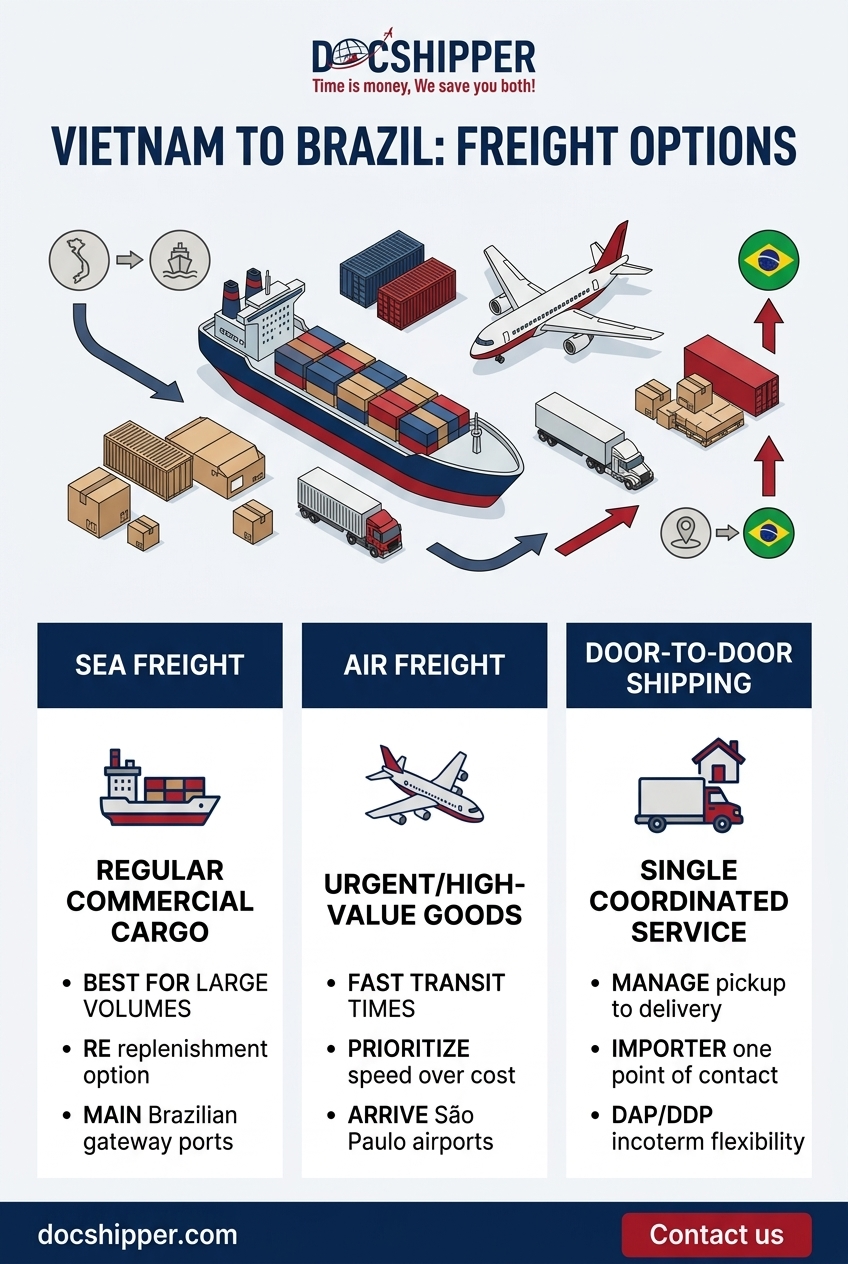
Freight shipping between Vietnam and Brazil typically relies on sea transport for commercial volumes, while air freight serves urgent or high-value cargo. Door-to-door services coordinate pickup, transport, customs clearance and final delivery, but the best option depends on volume, urgency, cargo type, destination and Brazil’s import taxes.
Key shipping options include:
| Shipping mode | Best suited for | Key considerations |
|---|---|---|
| Sea FCL | Large, regular or non-urgent shipments | Dedicated container; routing may involve transshipment and variable schedules. |
| Sea LCL | Smaller commercial shipments that do not fill a container | Charges depend on volume, weight, consolidation, handling and local delivery. |
| Air freight | Urgent, high-value or compact cargo | Priced by chargeable weight and subject to airline routing, capacity and customs handling. |
| Express | Samples, documents and small parcels | Subject to courier limits for size, value, commodity and destination. |
| Door-to-door | Importers seeking one coordinated service | Combines pickup, export clearance, transport, import clearance and final delivery. |
Sea and air freight options, FCL and LCL selection, door-to-door delivery, Brazilian customs requirements, RADAR and Siscomex, import taxes, documentation, insurance and logistics services are covered in detail.
We hope you’ll find this article genuinely useful, but remember, if you ever feel lost at any step, whether it’s finding a supplier, validating quality, managing international shipping or customs, FNM Vietnam can handle it all for you!
Freight shipping between Vietnam and Brazil usually relies on sea transport for commercial volumes, while air freight serves urgent or high-value cargo. The right choice depends on your shipment’s volume, urgency, product type, destination and tolerance for Brazil’s import tax cascade.
For Brazilian importers, the transport booking is only one part of the decision. You also need an enabled importer in Siscomex through RADAR, the correct product classification, complete documents and a landed-cost calculation covering Import Duty, IPI, PIS/COFINS and ICMS.
Vietnam-Brazil trade reached US$7.87bn in 2024, according to Tuoi Tre News. Vietnam’s exports to Brazil include seafood, rubber, textiles, footwear, iron and steel, creating regular demand for container shipping and multimodal logistics.
DocShipper Info
Share your cargo details for a tailored Vietnam-Brazil shipping plan
Ways to ship between Vietnam and Brazil
Most cargo between Vietnam and Brazil moves by sea, air is used for urgent or high-value goods, and door-to-door shipping bundles pickup, export, transport, customs clearance and final delivery. Express shipping can suit samples or small parcels, but it is not automatically the most economical option for commercial imports.
Start by defining the shipment before comparing quotations. You need the cargo description, HS code if available, number of packages, dimensions, gross weight, cargo value, pickup address in Vietnam, Brazilian delivery address and preferred Incoterm.
For regular stock replenishment, compare FCL and LCL sea freight first. FCL means the importer books a full container, while LCL means several shippers share container space and pay according to the space or chargeable volume used.
Air freight becomes more relevant when a production delay, product launch or stockout costs more than the transport premium. Dangerous goods, refrigerated cargo, oversized pieces and controlled products require a separate feasibility check because not every carrier, airport or service accepts them.
| Mode | Typical use | Transit information |
| Sea FCL | Large, regular or non-urgent shipments with enough volume for a container | Varies by port pair, transshipment, carrier and season. Request a DocShipper-confirmed schedule. |
| Sea LCL | Smaller commercial shipments that do not fill a container | Varies by consolidation point, port handling and sailing schedule. Request a quote. |
| Air freight | Urgent, high-value or compact cargo | Varies by airline routing, capacity, airport and customs handling. |
| Express | Samples, documents and small parcels subject to carrier limits | Varies by courier service, destination and customs requirements. |
| Door-to-door | Importers wanting one coordinated service from pickup to delivery | Depends on the selected mode, customs clearance and final-mile location. |
DocShipper Tips
Request an all-in comparison before booking
DocShipper Info
Send exact package dimensions to avoid chargeable-weight surprises
Sea freight between Vietnam and Brazil
Sea freight is the standard starting point for commercial cargo moving from Vietnam to Brazil. Containers commonly depart from Hai Phong, Cat Lai or Cai Mep and arrive through Brazilian gateways such as Santos, Paranaguá or Itajaí/Navegantes.
The exact Vietnam to Brazil transit time cannot be stated responsibly without the origin, destination, service and sailing date. This long route may include transshipment, and schedules change with vessel availability, port congestion, blank sailings, customs conditions and seasonal demand.
Vietnam has an extensive maritime network. A 2026 report from VietNamNet cited 34 seaports and 320 berths, while Cai Mep and Hai Phong ranked 11th and 13th respectively in the 2025 Container Port Performance Index. This gives shippers several origin-routing possibilities, but the nearest port is not always the best option for the final vessel connection.
Choosing FCL or LCL
Choose FCL when your cargo volume, handling sensitivity or replenishment pattern justifies a dedicated container. FCL generally reduces the number of consolidation and deconsolidation points, which can help protect packaged goods and simplify loading control.
Choose LCL when the shipment is too small to fill a container and waiting for a full load would delay your order. LCL pricing depends on chargeable volume, weight, origin consolidation, destination deconsolidation, documentation, terminal handling and local delivery charges.
Do not compare only the ocean freight line in a quotation. Check whether origin handling, export customs, documentation, terminal charges, destination handling, customs clearance, storage, delivery and insurance are included or billed separately.
How sea freight rates are built
A Vietnam-Brazil sea freight quotation usually combines the main ocean freight with origin charges, destination charges and any requested logistics service. The final amount depends on the container type, cargo characteristics, port pair, Incoterm, sailing date, carrier capacity and whether the cargo requires special handling.
For FCL, ask the forwarder to quote the applicable container equipment and clarify whether the offer covers a direct or transshipment routing. For LCL, provide accurate package dimensions and weights because a correction after consolidation can affect the chargeable basis.
Brazilian import taxes and customs costs are not the same as freight charges. Keep the transport quotation separate from the customs simulation so you can see whether a low ocean rate is being offset by destination fees or by a higher landed cost.
Looking for a Reliable Shipping & Sourcing Partner?


Sea freight booking process
Use the following sequence before confirming a container shipment:
- Prepare the cargo profile: describe the goods, packaging, quantity, dimensions, gross weight, value and any dangerous, refrigerated or oversized characteristics.
- Select the routing: compare Hai Phong, Cat Lai and Cai Mep on the Vietnam side with Santos, Paranaguá and Itajaí/Navegantes on the Brazilian side.
- Confirm the commercial term: identify which party pays pickup, export clearance, ocean freight, import clearance, taxes and final delivery under the selected Incoterm.
- Check the sailing: request the current carrier, transshipment points, estimated schedule, cut-off dates and free-time conditions.
- Verify the quotation: separate included charges from exclusions and confirm the currency, validity period and possible surcharges.
- Prepare customs documents: make sure the invoice, packing list, transport document and product information are consistent before cargo handover.
| Port | Side | Routing note |
| Hai Phong | Vietnam | Major northern Vietnam gateway for cargo collected in the north. |
| Cat Lai | Vietnam | Ho Chi Minh City gateway commonly considered for southern Vietnam cargo. |
| Cai Mep | Vietnam | Deep-water gateway in southern Vietnam with international service connectivity. |
| Santos | Brazil | Major Brazilian gateway and a frequent option for cargo destined for the southeast. |
| Paranaguá | Brazil | Alternative Brazilian port for suitable routings and inland destinations. |
| Itajaí/Navegantes | Brazil | Southern Brazil gateway options that may fit the final delivery area. |
Air freight between Vietnam and Brazil
Air cargo normally departs from Noi Bai in Hanoi or Tan Son Nhat in Ho Chi Minh City and arrives through São Paulo-Guarulhos International Airport, also known as GRU, or Viracopos, also known as VCP. It is the practical option when the cost of delay is higher than the transport premium.
Air freight is priced on chargeable weight. The carrier compares the shipment’s gross weight with its volumetric weight, which represents the space occupied by a light but bulky package, and charges according to the greater result.
Give the forwarder the dimensions of every package, not only the total weight. A shipment of lightweight cartons may occupy more aircraft capacity than its scale weight suggests, while dense cargo may be priced closer to its actual gross weight.
Choose cargo air freight for commercial consignments that need structured handling and documentation. Express services are more suitable for samples, documents or small shipments subject to the courier’s size, value, commodity and destination limits.
Air routing can involve an intermediate airport and capacity constraints. Before booking, check the planned airport, airline or consolidator, handling requirements, customs process, delivery scope and whether the quotation includes Brazilian import clearance.
DocShipper Tips
Ask which customs, taxes and delivery charges are included before accepting the quote
Door-to-door shipping between Vietnam and Brazil
Door-to-door shipping combines pickup, export clearance, main transport, import clearance and final delivery under one contract and one contact. It is useful when the Brazilian importer wants a single party to coordinate the route rather than manage several suppliers.
The service begins with a precise scope. Confirm the pickup address, delivery address, cargo description, transport mode, customs responsibility, insurance position, tax payer and treatment of storage or demurrage if clearance takes longer than expected.
Incoterms 2020 define responsibilities between buyer and seller, but they do not replace a customs or tax quotation. DAP generally means the seller arranges delivery to the named place while the buyer handles import clearance and import taxes. DDP places broader delivery responsibility on the seller, but its feasibility depends on the seller’s ability to act correctly for Brazilian import formalities.
For a Brazilian importer, ask specifically whether the door-to-door offer includes RADAR and Siscomex requirements, import declaration support, brokerage, duties and taxes, delivery appointments and any local charges. A quote that says “door-to-door” without defining these items is not sufficiently clear for landed-cost planning.
DocShipper can coordinate sea freight, air freight, customs clearance, cargo insurance and delivery from Vietnam to Brazil. The objective is to give you one operational contact while keeping freight, customs and tax components visible.
DocShipper Alert
Verify RADAR, Siscomex and NCM classification before dispatch
Customs clearance in Brazil for goods from Vietnam
Brazil requires the importer to be enabled in Siscomex through RADAR before the goods arrive. Vietnamese goods do not benefit from a Vietnam-Brazil free trade agreement in this route, so the applicable Most-Favoured-Nation duty treatment must be checked by HS code, while the Brazilian tax cascade can materially increase landed cost.
RADAR is the importer authorization framework used for access to Siscomex, Brazil’s foreign-trade system. Confirm the importer’s status before ordering because an otherwise ready shipment can face delays if the consignee cannot complete the import procedure.
Step 1: Confirm the product classification
Identify the Brazilian NCM classification, which is the local tariff classification used for customs and tax treatment. The NCM determines the applicable Import Duty, possible IPI treatment, licensing requirements and other controls.
Do not rely only on a supplier’s generic product name or an overseas HS code. Check the product composition, function, technical specifications, packaging and intended use, then validate the classification with a qualified customs professional when the product is sensitive or ambiguous.
DocShipper Platform
One platform. Your entire supply chain
Sourcing, freight, customs & documents — all centralised, all visible, 24/7.
Step 2: Check RADAR, licensing and restrictions
Verify that the Brazilian importer is enabled in RADAR and can use Siscomex. Some products may also require an import licence, often referred to as LI, or authorization from a competent Brazilian agency before shipment or customs clearance.
Product controls vary according to the goods. Food, chemicals, medical products, telecom equipment, cosmetics, agricultural products, batteries and other regulated categories may require additional certificates, registrations, labelling or inspections.
Step 3: Build the customs value
Start with the customs value used for the import calculation, normally based on the transaction value and the applicable freight and insurance elements. Confirm the precise treatment with Receita Federal or your Brazilian customs broker because the correct base depends on the transaction and current rules.
The central planning point is that the taxes are not a single percentage applied only to the supplier invoice. Import Duty, IPI, PIS/COFINS and ICMS interact, and ICMS is calculated “por dentro”, meaning the tax forms part of its own calculation base.
Step 4: Apply the tax cascade
Use this method for a preliminary landed-cost model, then verify the current formulas and rates with Receita Federal and a Brazilian tax professional, particularly during the tax reform transition from 2026:
- Customs value: establish the customs value from the transaction and relevant freight and insurance components.
- Import Duty, or II: apply the NCM-specific MFN rate to the customs value.
- IPI: calculate IPI on the customs value plus the Import Duty, using the applicable product rate.
- PIS/COFINS: apply the applicable import contribution rules to the relevant customs base.
- ICMS: calculate the state tax using the applicable “por dentro” method and include the relevant taxes and charges in the legally required base.
- Landed cost: add freight, insurance, customs charges, taxes, clearance fees, storage if applicable and final delivery to understand the real import cost.
Method example, without invented rates: customs value = the verified transaction-based customs value; II = customs value × the applicable MFN rate; IPI base = customs value + II; IPI = IPI base × the applicable IPI rate; PIS/COFINS = the applicable import contribution calculation; ICMS = the applicable state rate calculated “por dentro”; landed cost = cargo value + international freight + insurance + II + IPI + PIS/COFINS + ICMS + clearance and delivery charges.
This line-by-line method is intentionally not a tax quote. Rates, bases, exemptions and formulas depend on the NCM, importer, state, product and rules in force at the time of importation.
Step 5: Prepare the documents
Document consistency is essential. The product description, quantities, values, weights, Incoterm and consignee information should match across the commercial invoice, packing list, transport document and customs entries.
| Document | Usually provided or prepared by |
| Commercial invoice | Vietnamese exporter, with buyer and transaction details. |
| Packing list | Vietnamese exporter, showing packages, contents, dimensions and weights. |
| Bill of lading or air waybill | Carrier or freight forwarder. |
| Import classification and customs data | Brazilian importer and customs broker, based on the product information. |
| Import licence or agency authorization, where required | Brazilian importer, broker or responsible regulated-party process. |
| Insurance certificate, where purchased | Insurer or logistics provider. |
| Product certificates or technical documents, where required | Exporter, manufacturer, importer or competent authority, depending on the product. |
For official guidance, consult Receita Federal and confirm the current Siscomex, RADAR, customs and tax requirements before dispatch. The Brazilian Ministry of Development, Industry, Foreign Trade and Services is also a relevant authority for foreign-trade procedures and policy information.
DocShipper Tips
Build the service package around your biggest exposure
Additional logistics services for Vietnam-Brazil shipments
Warehousing in Vietnam can consolidate purchases from several suppliers before export. This is useful when orders are ready on different dates or when you want one inspection and dispatch process instead of separate shipments.
Packing and cargo preparation should reflect the chosen mode and the long international route. Ask for export-appropriate packaging, accurate carton marks, palletization where suitable and separation of products that require special handling.
Cargo insurance protects against defined transport risks and should be evaluated separately from the carrier’s liability. Confirm the insured value, covered risks, exclusions, claim procedure and whether the policy applies from the supplier’s premises or only from port or airport handover.
Sourcing and quality control in Vietnam can reduce avoidable logistics problems before the cargo moves. Supplier verification, product inspection, quantity checks, conformity review and document matching can identify issues before a container or air shipment reaches Brazil.
These services do not eliminate customs responsibility, but they can make the shipment easier to control. The most useful service package depends on whether your main risk is supplier reliability, product conformity, transport coordination, customs complexity or final delivery.
Conclusion
Freight shipping between Vietnam and Brazil requires a decision based on urgency and volume, followed by a customs plan that reflects Brazil’s tax structure. Sea freight is usually the starting point for commercial cargo, while air freight supports urgent or high-value shipments.
- Use sea freight for regular commercial volumes, with Santos, Paranaguá and Itajaí/Navegantes among the main Brazilian gateway options.
- Compare FCL and LCL according to volume, handling needs, consolidation and total destination charges.
- Use air freight to GRU or VCP when urgency or cargo value justifies the higher transport cost.
- Door-to-door service combines pickup, export clearance, transport, import clearance and delivery under one coordinated process.
- There is no Vietnam-Brazil free trade agreement for this route, so the applicable MFN Import Duty must be checked by NCM classification.
- Brazil’s landed cost includes the tax cascade of II, IPI, PIS/COFINS and ICMS, not just the international freight charge.
- The Brazilian importer must be enabled in RADAR and Siscomex before the goods arrive.
- Accurate invoices, packing lists, transport documents, classifications and licences help prevent customs delays.
Shipping between Vietnam and Brazil? Send us your cargo description, dimensions, weight, value, origin, destination and preferred delivery term for a door-to-door quote with sea, air, customs clearance, insurance and final delivery options.
FAQ | Freight Shipping Vietnam Brazil: Sea, Air, Customs and Door-to-Door Options
Yes, but these shipments require pre-approval before booking. Provide the safety data sheet, UN number, packing details, dimensions, temperature range and product classification. The carrier must confirm that the route, aircraft or vessel, transshipment points and Brazilian destination can accept the cargo. Never describe restricted goods vaguely as “equipment” or “samples,” as inaccurate declarations can lead to refusal, delays or penalties.
The cargo may remain uncleared while storage, demurrage or terminal charges accumulate. A freight forwarder cannot replace the importer’s legal ability to complete the import process. Before dispatch, confirm that the consignee has the required RADAR and Siscomex status, a customs broker and any necessary product authorization. If the importer is not ready, postponing shipment is often safer than sending cargo that cannot be legally released.
No. DDP should only be offered when the seller or its appointed partner can legally and operationally manage Brazilian import formalities. The quotation should identify who acts as importer, who provides the import licence or product authorization, who pays the taxes and who is responsible for customs declarations. If these points are unclear, DAP or another structure may be more appropriate, with the Brazilian buyer handling import clearance and taxes.
Yes. A consolidation warehouse in Vietnam can receive goods from different suppliers, inspect the cargo, reconcile quantities and prepare one export shipment. Ask for a clear cut-off date, warehouse receiving fees, storage limits, inspection scope and treatment of late supplier deliveries. This approach can reduce duplicated export handling, but it may delay the first-ready goods while the remaining orders are completed.
Common issues include different product descriptions between the invoice and packing list, inconsistent quantities or weights, missing Incoterms, incorrect consignee details and values that do not match the commercial transaction. Technical descriptions should identify the product’s material, function and intended use rather than relying on a broad name. Correcting documents before the cargo is handed to the carrier is usually much easier than amending customs information after arrival.
Confirm that the courier accepts the product, value, dimensions and destination before dispatch. A sample may still require a proper invoice, accurate description and customs information, and some products remain subject to licences or agency controls regardless of shipment size. State clearly that it is a non-sale sample only when that is factually correct; describing commercial goods as samples to reduce duties can create customs and compliance problems.
Need Help with Logistics
or Sourcing in Vietnam ?
First, we secure the right products from the right suppliers at the right price by managing the sourcing process from start to finish. Then, we simplify your shipping experience - from pickup to final delivery - ensuring any product, anywhere, is delivered at highly competitive prices.


Fill the Form
Prefer email? Send us your inquiry, and we’ll get back to you as soon as possible.
Contact us