How to find suppliers for your business and build a reliable product pipeline

  • admin 17 Min
  • Published on August 10, 2022 Updated on May 21, 2026
img

In short ⚡

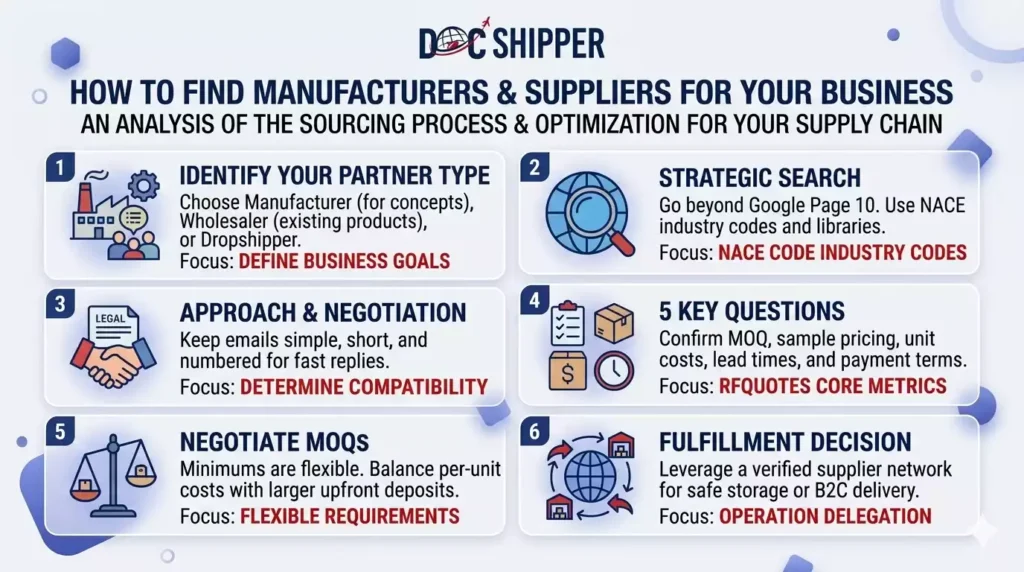
Find suppliers for my business by starting with a clear sourcing strategy, then using the right tools to search, filter, and verify partners before you place any order. Focus on defining product specs and target landed cost, choosing the right supplier type and geography, and then turning online platforms, trade shows, and referrals into a vetted shortlist with samples, inspections, and structured negotiations. Here are the key steps to follow:
  • Define your product spec, target landed cost, and acceptable defect rate.
  • Choose supplier type (manufacturer, wholesaler, distributor, dropshipper) and preferred geography (local or overseas).
  • Search widely via marketplaces, directories, trade shows, and professional networks.
  • Filter and verify using MOQ, lead time, Incoterms, registrations, and export documents.
  • Test with samples and small pilot orders, then compare suppliers in a structured table.
  • Negotiate based on total landed cost and manage production with inspections and clear SLAs.


In this article, you will find sourcing strategy foundations, supplier type comparisons, local versus overseas trade‑offs (including Vietnam), practical use of platforms and trade shows, vetting and comparison methods, and negotiation and supplier management workflows to secure a reliable product pipeline.

We hope you’ll find this article genuinely useful, but remember, if you ever feel lost at any step, whether it’s finding a supplier, validating quality, managing international shipping or customs,  FNM Vietnam can handle it all for you!

Free shipping quote 24h      I want to talk to a sourcing expert

Start your supplier search with a clear sourcing strategy

Searching

If you’re trying to find suppliers for my business and you start by browsing random listings, you’ll notice fast that everything looks “perfect” until your first delayed shipment hits your inbox.

Here’s the thing, sourcing is logistics in disguise.

At DocShipper, we see the same pattern every week, a buyer picks a supplier based on price, then gets stuck on lead time, Incoterms, customs clearance, or cargo packaging that doesn’t survive containerization.

So before you run a supplier search engine query, you want a strategy that protects your supply chain, your cash flow, and your customer promises.

Quick sourcing workflow (use this before finding suppliers):

  • Define your product spec, materials, compliance needs, target cost, and acceptable defect rate.
  • Choose your supplier type, manufacturer vs wholesaler vs dropshipper, based on control and MOQ.
  • Decide your geography, local vs overseas, and align it with lead time, freight rates, and risk.
  • Set your trade terms, Incoterms, payment terms, and who manages export/import paperwork.
  • Build a comparison template, so every quote is evaluated the same way.

Checklist, your “ready to source” baseline:

  • You’ve written a one page product requirement sheet.
  • You know your target landed cost, including duty and taxes.
  • You’ve decided FCL vs LCL expectations and packaging method, cartons, palletization, or both.
  • You’ve listed required documents, commercial invoice, packing list, bill of lading or airway bill, certificates if needed.
  • You’ve clarified who acts as shipper and who is consignee on the shipment.

Define what kind of supplier you need (manufacturer, wholesaler, dropshipper)

To find suppliers for my business effectively, you first need to decide what you’re truly buying, production capacity, inventory access, or order fulfillment speed.

We’ve watched buyers “find suppliers” on a marketplace, only to learn after payment that the “factory” was a trading company with zero control over lead time and quality.

Use this practical breakdown when finding suppliers:

Supplier typeBest forTypical risks you must manageLogistics impact
ManufacturerCustom products, branding, better unit cost long termHigher MOQ, longer production lead time, more QC responsibilityNeeds solid export coordination, container planning, and clear Incoterms
WholesalerFaster start, lower complexity, smaller MOQsLess customization, variable inventory management, price volatilityMore frequent shipments, sometimes better for LCL and rapid replenishment
DistributorAuthorized products, after sales support, stable catalogTerritory restrictions, tighter pricing, limited negotiationOften domestic distribution friendly, simpler customs compliance if local stock
DropshipperTesting demand, minimal warehousing, broad SKU rangeThin margins, limited QC, weak SLA, inconsistent tracking and tracingParcel heavy, harder carrier contract control, returns management can hurt fast

What to ask in your first message (so you don’t waste 2 weeks):

  • Are you a factory, wholesaler, distributor, or sourcing agent, and can you share business registration details?
  • What’s your MOQ, production lead time, and reorder lead time for the same SKU?
  • Which Incoterms do you quote most often, EXW, FOB, CIF, DDP?
  • Can you support inspections and provide consistent packaging specs for transportation?
  • What SLA do you commit to for defect rate and replacement policy?

If you’re dealing with a commercial supplier who hesitates on documentation, like HS code hints, export packing standards, or a clear proforma invoice, you’ve just saved yourself a future customs brokerage headache.

From experience, aligning these points early also makes your freight quotation cleaner, fewer surprises, fewer “extra” freight invoice line items later.

Decide between local and overseas suppliers (including Vietnam) for your products

overseas provider

When you’re trying to find suppliers for my business, the local vs overseas decision is really a question of risk, speed, and landed cost, not just unit price.

We’ve seen an online seller pick the cheapest overseas quote, then lose a whole season because the supplier missed the ship window and LCL consolidation added another 10 days.

Local vs overseas, the trade offs you’ll actually feel:

FactorLocal suppliersOverseas suppliers
Lead timeShorter, easier replenishmentLonger, includes production + export + transit + customs declaration
Cash flowOften smaller order cyclesMOQs and upfront payments are common, inventory sits longer
ControlFactory visits easier, faster corrective actionsRequires process, inspections, clear specs, and strong supplier management
LogisticsSimpler distribution and warehousingFreight forwarding choices, multimodal transport, FCL vs LCL, plus freight insurance
CustomsMinimal, depending on your marketHS code, tariff classification, duties and taxes, and customs compliance become critical

Vietnam as a sourcing option:

  • If you want to find manufacturers in Vietnam, you’ll often get competitive pricing in categories like furniture, textiles, and certain consumer goods, with improving production capabilities.
  • To find Vietnam manufacturers you still need to validate export readiness, correct labeling, carton strength, and whether they can handle FOB shipments smoothly.

One insider tip, ask early who books transportation.

If your supplier pushes EXW but can’t support export customs clearance, you’ll end up coordinating pick up, export docs, and carrier handoff under pressure.

Checklist, choose your geography with fewer regrets:

  • You’ve calculated landed cost, product + freight rates + duty and taxes + last mile delivery.
  • You know whether you can tolerate LCL variability or you need FCL stability.
  • You’ve checked whether your product requires special compliance or permits at import.
  • You’ve planned warehousing and inventory management for longer replenishment cycles.
  • You’ve defined who handles customs brokerage and who owns delays at the border.

For trade rules and documentation standards, it’s worth aligning your process with guidance commonly referenced in World Customs Organization frameworks, especially around harmonized system classification.


Looking for a Reliable Shipping & Sourcing Partner?

We handle the entire sourcing process, supplier research, negotiation, production, and inspections, so you can focus on what matters most: growing your business.

Use the right tools and platforms to find suppliers for your products

You can find suppliers for my business with a simple Google search, but the results won’t tell you who ships on time, who respects an SLA, and who understands export packaging.

In practice, the best “finding suppliers” system is a mix of search discipline, verification, and a clean shortlist process.

We treat platforms like lead generators, then we validate with documents, operational answers, and logistics reality.

Step by step workflow, turn listings into a reliable shortlist:

  • Search wide, use marketplaces, directories, and a supplier search engine to build a long list.
  • Filter hard, remove anyone who can’t answer MOQ, lead time, and Incoterms clearly.
  • Verify, request registration, export history signals, and product certifications where relevant.
  • Test, samples plus a small pilot order, then measure defect rate and shipment performance.
  • Scale, negotiate pricing tiers, packaging specs, and recurring freight quotations.

Checklist, your “platforms used correctly” rules:

  • You capture every supplier in a spreadsheet with MOQ, lead time, payment terms, and Incoterms.
  • You ask for photos of packaging and labels, not just product photos.
  • You request a proforma invoice that matches the quote, no vague totals.
  • You confirm whether they can ship FOB or need you to manage EXW pick up.
  • You track responsiveness, because slow replies often mean slow production updates later.

Turn search engines and supplier search engines into sourcing power tools

If you want to find suppliers for my business using a supplier search engine, don’t search like a shopper, search like a buyer who will import and scale.

We’ve seen a buyer use broad keywords, get flooded with посредники style middlemen, then realize the “factory” address was a coworking space.

Queries that work better for supplier search:

  • Product + “OEM” + country, then add “ISO” or a material standard if relevant.
  • “FOB” + product + port, this quickly surfaces export ready suppliers.
  • “MOQ” + product + manufacturer, helps you align early with your demand level.
  • “HS code” + product + supplier, useful to spot exporters used to customs paperwork.

When you find suppliers through platforms, ask for a freight ready quote.

That means product price plus packaging dimensions, carton count, gross weight, and preferred Incoterms, so your freight forwarder can price FCL or LCL correctly.

At DocShipper, we can sanity check this fast, because one missing detail, like pallet height or incorrect carton count, can swing your freight rates and lead time planning.

If you’re ready to ship, you can also explore our international freight solutions at DocShipper.

Leverage directories, trade shows, and professional networks to uncover commercial suppliers

trade show

To find suppliers for my business beyond marketplaces, you’ll want offline signals, directories, trade shows, and networks where commercial supplier relationships get built with real accountability.

We once helped a brand that met a supplier at a trade show, everything looked great, then the first shipment arrived with inconsistent labeling that triggered a customs hold.

Where these channels shine when finding suppliers:

  • Industry directories, better for established manufacturers and audited profiles.
  • Trade shows, you can assess product quality in your hands, and gauge who actually owns the factory relationship.
  • Professional networks, referrals from importers, 3PL partners, and customs brokers can filter out noise fast.

How to work a trade show like a sourcing pro:

  • Ask what portion of output is export, and which markets they ship to.
  • Request packaging specs and carton drop test standards, because cargo damage is expensive.
  • Confirm their preferred Incoterms and whether they can support FOB at your chosen port.
  • Discuss production planning and how they handle rush orders without quality drift.

For trade show legitimacy and exhibitor standards, many buyers use references aligned with UFI practices when assessing major international exhibitions.

Checklist, qualify a directory or trade show supplier in 10 minutes:

  • You confirm they are the real manufacturer or an authorized distributor.
  • You get clear MOQ, lead time, and payment terms, in writing.
  • You ask for export documents they typically provide, and confirm document accuracy.
  • You verify whether they can support pre shipment inspection.
  • You align on shipping terms and who manages customs clearance steps on each side.
DocShipper Alert

Choosing the wrong partner can trigger delays, penalties, or seized goods.
Secure your orders with audits, inspections, and compliance checks before paying any deposit.

DocShipper Platform

One platform. Your entire supply chain

Sourcing, freight, customs & documents — all centralised, all visible, 24/7.

Shortlist, vet, and compare suppliers so you choose the right partners

Once you have a list of potential partners, your job is to separate promises from proof. You do not need more contacts, you need reliable suppliers who can scale with your online store.

Start by building a structured comparison table so you evaluate suppliers with data, not emotion. This prevents you from choosing the cheapest quote that later becomes your most expensive mistake.

CriteriaSupplier ASupplier BSupplier C
Product quality levelSample approved / rejected  
MOQUnits per SKU  
Unit price (Incoterm)EXW / FOB / DDP  
Production lead timeDays  
CertificationsCE / FDA / RoHS  
Communication speedHours to reply  
Inspection resultsPass / Fail  

You should never rely only on catalogs or product photos. Always request samples and, for larger orders, arrange a third party quality inspection before shipment.

Here is a practical vetting checklist you can apply before sending any deposit.

  • Verify business license and legal registration.
  • Confirm factory address and production capacity.
  • Request recent export documents to key markets.
  • Ask for compliance certificates required in your country.
  • Check consistency between quotation, proforma invoice, and contract.
  • Conduct a factory audit or social compliance audit if needed.

If you source overseas, especially in Asia, supplier validation is not optional. We regularly conduct factory audits and pre shipment inspections at DocShipper to secure our clients’ supply chains.

For higher risk categories such as electronics or cosmetics, non compliance can lead to product seizure or fines of up to tens of thousands of dollars. You must validate standards before placing bulk orders.

DocShipper Info

Long term profitability depends on tight coordination between sourcing and shipping.
Unify negotiation, quality control, and international freight with a single expert team at DocShipper.

Contact, negotiate, and manage suppliers for long‑term success

long term

Your first message to a supplier sets the tone of the relationship. If you want professional treatment, you must communicate like a serious buyer with clear data and realistic volumes.

Include precise information in your RFQ so you avoid vague pricing and misunderstandings.

  • Product specifications with drawings or photos.
  • Estimated order quantity per batch and per year.
  • Target market and required certifications.
  • Preferred Incoterm, for example FOB or DDP.
  • Expected payment terms and timeline.

When negotiating MOQ and pricing, focus on total landed cost instead of unit price alone. A cheaper EXW offer can become more expensive than a competitive FOB price once logistics and customs are added.

Negotiation LeverHow You Use It
Higher projected annual volumeCommit to forecast to reduce MOQ
Flexible packagingSimplify customization to lower setup cost
Split shipmentProduce full batch but ship in stages
Long term agreementExchange stability for better pricing

Always clarify payment structure before production starts. A common structure is 30 percent deposit and 70 percent balance before shipment, but this is negotiable depending on leverage.

Once production begins, implement a simple supplier management workflow so you stay in control.

  • Confirm signed purchase order with detailed specifications.
  • Approve pre production sample.
  • Monitor production timeline with weekly updates.
  • Conduct pre shipment inspection.
  • Approve balance payment after inspection pass.
  • Track shipping and customs clearance.

At DocShipper, we integrate sourcing, quality control, and international freight so you deal with one coordinated team instead of multiple disconnected intermediaries. This dramatically reduces delays and hidden costs.

Conclusion

To successfully find suppliers for my business, you need more than a Google search. You need structure, verification, and disciplined supplier management.

  • Define objective comparison criteria before choosing a supplier.
  • Verify legal status, certifications, and production capacity.
  • Request samples and conduct independent inspections.
  • Negotiate based on total landed cost, not just unit price.
  • Implement a clear workflow from purchase order to delivery.
  • Work with experienced partners like DocShipper to secure sourcing, compliance, and international logistics.

If you want to reduce risk while scaling your online store, we can help you source, audit, negotiate, and ship with full transparency. Your supplier is not just a vendor, it is a strategic asset that determines your long term profitability.

FAQ | How to find suppliers for your business and build a reliable product pipeline

Start by building a short list of factories that clearly advertise OEM/ODM capability, not just trading activity. Use queries like “your product + OEM + manufacturer + country” in directories and supplier search engines, then ask directly in your first message: “Are you the factory? Can you share your business license and factory address?” From there, request photos or a quick video of the production line, plus a list of brands they already manufacture for. If they can’t show machinery, staff, and export references for similar products, you’re likely dealing with a middleman, not a manufacturer.

Ask us anything!

Need Help with Logistics
or Sourcing in Vietnam ?

First, we secure the right products from the right suppliers at the right price by managing the sourcing process from start to finish. Then, we simplify your shipping experience - from pickup to final delivery - ensuring any product, anywhere, is delivered at highly competitive prices.

Component-15-2.png

Live Chat

Get instant assistance from our team—
just click and start chatting!

Live Chat Now
image

Fill the Form

Prefer email? Send us your inquiry, and we’ll get back to you as soon as possible.

Contact us
image
Component-15-2.png

Call us

Reach out to us on WhatsApp for quick, convenient, and personal support.

Call us
image
Component-15-2.png