In short ⚡
Importing Bamboo and Rattan Products from Vietnam requires selecting the right supplier, preparing destination compliance documents, controlling moisture, and calculating freight by cubic metre rather than weight. The process applies to craft-village workshops, exporters, and industrial factories. Key steps include:- Define the product specification, including material, dimensions, finish, packaging, labels, quantity, and destination market.
- Shortlist three to five suppliers and verify their legal details, production capacity, material sources, export experience, and supplier type.
- Request samples and approve a golden sample covering colour, dimensions, weave, finish, hardware, smell, and packaging.
- Confirm the HS classification and destination requirements, including US Lacey Act data, EU food-contact rules, origin evidence, and Australia biosecurity conditions where applicable.
- Secure the material plan, add quality-control requirements to the purchase order, and conduct a pre-shipment inspection close to container loading.
- Calculate packed CBM and compare LCL or FCL options, using dry containers, suitable protection, desiccants where appropriate, and compliant wood packaging.
Key topics include Vietnam’s sourcing advantages, product-specific requirements, supplier vetting, US/EU/UK/Australia compliance, mold prevention, CBM-based shipping, and the first-order process.
We hope you’ll find this article genuinely useful, but remember, if you ever feel lost at any step, whether it’s finding a supplier, validating quality, managing international shipping or customs, FNM Vietnam can handle it all for you!
To import bamboo and rattan products from Vietnam successfully, choose the right supplier channel for your product, prepare destination compliance documents before production, control moisture before loading, and calculate freight by cubic metre rather than weight. Vietnam offers craft-village workshops, export traders and industrial factories, but each option creates different risks for quality, lead time and paperwork.
The opportunity is substantial. Vietnam ranked second worldwide after China for rattan and bamboo exports in 2022, according to the Vietnam Handicraft Export Association. The country now has more than 1,000 rattan and bamboo craft villages, including Phu Vinh in Chuong My, Hanoi, where makers produce woven furniture, baskets and decorative items.
DocShipper Info
Choose your supplier channel based on volume, repeatability and material security before paying a deposit.
Why import bamboo and rattan products from Vietnam
Vietnam is a strong sourcing base because it combines established hand-weaving skills, export experience and industrial finishing. In 2024, exports of rattan, bamboo, sedge and carpet products reached US$804 million, while the United States represented almost half of the value reported during the first eight months of 2025.
Vietnamese suppliers can produce furniture, baskets, storage products, lighting, trays, decorative objects and selected kitchenware. A craft village may be the best fit for a distinctive woven collection or a low-volume test, while an exporter can combine production from several workshops and manage export documents for a mixed order.
Factories are generally more suitable when you need repeatable dimensions, consistent coatings, knock-down furniture or a larger annual programme. Before choosing one, ask whether the supplier makes the products directly, coordinates village workshops, or simply trades finished goods from several sources.
Raw material availability needs equal attention. Local bamboo and rattan supply reportedly meets only approximately 20% of the demand of Hanoi craft villages, so material shortages can affect both quoted lead times and colour consistency during peak periods.
Nguyen Van Trung, Chairman of the Phu Vinh Bamboo and Rattan Association in Hanoi, described the situation directly: “This creates difficulties for businesses and producers.” His comment, reported by Hanoi Times, is a practical warning for buyers: ask where the cane or bamboo comes from and lock the material plan before paying a deposit.
The export trend also shows why the sector attracts international buyers. During the first eight months of 2025, Vietnam exported US$574 million of rattan, bamboo, sedge and carpet products, including US$266 million, or 46.3%, to the United States, according to Vietnam Customs data reported by Antidumping.vn.
| Buying factor | What it means for you |
| Craft capability | Useful for handmade collections, custom weaving and small test orders. |
| Export infrastructure | Vietnamese exporters can prepare documents and consolidate products from several workshops. |
| Raw-material availability | Confirm material sources and add schedule protection before production starts. |
| Market scale | Established exports indicate experience with international packaging and shipping requirements. |
DocShipper Alert
Confirm composition, intended use and packing requirements before approving samples or quoting landed costs.
Bamboo and rattan product families: what changes for each
The product family determines your likely HS chapter, compliance file, quality specifications and packing method. Furniture usually falls in Chapter 94, basketwork and similar articles commonly fall in Chapter 46, and some bamboo articles may be classified under heading 4421. Confirm the final classification with your customs broker because construction, material composition and use can change the code.
Furniture
For chairs, tables, cabinets and shelving, specify finished dimensions, maximum load, joint construction, surface treatment, colour tolerance and whether the item must ship knocked down. A knock-down design is one that arrives in separate components for assembly, reducing the space occupied in the container.
Request a structural sample before approving a production run. The inspection should verify dimensions, stability, joints, weaving tension, coating coverage and the assembly instructions, not only the visual appearance.
Baskets, storage and decor
Baskets, trays, mirrors and decorative objects are often sold as basketwork or similar articles. Their main shipping advantage is nesting: smaller pieces can fit inside larger pieces if the design allows it without crushing the weave or damaging the finish.
Specify the internal dimensions, rim shape, handle strength, lining, odour tolerance and stacking method. Ask the supplier to provide a packing test showing how many units fit in one export carton and what protection is placed between nested products.
Looking for a Reliable Shipping & Sourcing Partner?


Lighting
Rattan and bamboo shades need both craft control and electrical compliance at destination. Define the bulb fitting, cable set, voltage, plug, heat clearance, maximum bulb rating and whether the supplier provides only the shade or a complete electrical product.
Pack shades with internal supports and avoid pressure against the woven surface. The supplier should identify whether the material, coating or adhesive has any heat limitations before you approve the design.
Kitchenware and food-contact items
Pure bamboo products and bamboo-melamine composites must not be treated as the same product. In the European Union, bamboo flour is not an authorised plastic additive under the food-contact plastics framework, and bamboo-melamine products have been subject to enforcement action.
Ask for the exact material composition, intended use, coating details and food-contact documentation. If the item is a composite containing plastic and bamboo powder or flour, obtain specialist regulatory advice before placing the order.
| Product family | Typical HS area | Key compliance point | Packing and shipping note |
| Furniture | Chapter 94 | Confirm construction, finish, stability and destination product rules. | Use knock-down construction where possible; protect joints and corners. |
| Baskets and storage | Chapter 46, depending on construction | Confirm material composition and treatment records. | Use nesting and carton compression tests to reduce CBM. |
| Lighting | Classification depends on shade or complete fitting | Check electrical, heat and labelling requirements at destination. | Use internal supports and protect woven surfaces from pressure. |
| Pure bamboo kitchenware | Often classified according to the article and use | Check food-contact rules and material claims. | Protect against moisture, odour transfer and surface abrasion. |
| Bamboo-melamine composite | Classification and compliance depend on composition | Do not assume it is permitted for food contact in the EU. | Separate from pure bamboo products in the compliance file. |
DocShipper Tips
Verify legal identity, workshop access and sample reproducibility before releasing funds.
Finding and vetting Vietnamese bamboo and rattan suppliers
Village workshops offer handmade flexibility, exporters simplify mixed orders, and factories provide greater repeatability. Before a deposit, verify the supplier’s legal identity, export experience, material sources, production capacity and ability to reproduce an approved sample.
Craft villages vs exporters vs factories
Craft villages such as Phu Vinh are useful when the value lies in hand weaving, traditional patterns or product variation. Their limitations may include lower capacity, less formal documentation, variable finishing and dependence on external material suppliers.
A trading exporter can aggregate products from several workshops and may provide more practical support with export packing, consolidation and documentation. The risk is reduced visibility over the actual maker, so request a factory or workshop visit, production photos and a clear explanation of who controls quality.
An industrial factory is usually preferable for large repeat orders, private-label programmes and products requiring consistent dimensions or coatings. Confirm that the factory has the capacity for your peak-season volume rather than judging capacity only from a showroom.
Use VIETCRAFT, trade fairs, verified B2B platforms and professional sourcing support to build a shortlist. Do not treat a marketplace listing as proof that the listed company owns a workshop or can export under its own name.
What to check before paying a deposit
Ask for the business registration details, export history, workshop address, product catalogue, available materials, production lead time and standard payment terms. If your customer or retailer requires certified wood or bamboo sourcing, clarify whether the supplier has the relevant FSC chain-of-custody documentation rather than simply using the word “sustainable”.
Order a representative sample and turn it into a golden sample. The golden sample is the approved physical reference for colour, dimensions, weave, finish, smell, hardware and packaging; attach its specifications to the purchase order and inspection criteria.
Ask how much material is already secured for your order and what happens if the supplier cannot obtain the agreed cane, bamboo or seagrass. This question is particularly important where local supply covers only a portion of village demand.
| Supplier type | MOQ tendency | Strengths | Risks to control |
| Craft-village workshop | Often more flexible, subject to capacity | Handmade work, traditional techniques, custom designs. | Variable finish, limited paperwork and constrained peak-season capacity. |
| Trading exporter | Can vary by consolidated order | Mixed products, export documentation and coordination of several workshops. | Less direct visibility over production and material origin. |
| Industrial factory | Usually suited to larger repeat orders | Consistent dimensions, finishing and private-label execution. | Higher minimums and less flexibility for small custom collections. |
DocShipper Alert
Prepare botanical, composition and origin data early to avoid customs delays or rejected goods.
DocShipper Platform
One platform. Your entire supply chain
Sourcing, freight, customs & documents — all centralised, all visible, 24/7.
Compliance by destination: US, EU, UK and Australia
For the United States, bamboo and rattan products covered by Phase VII require a Lacey Act declaration, while bamboo-melamine food-contact products require special caution in the EU. For every destination, confirm the HS code, product composition, treatment requirements, origin evidence and current duty before shipping.
For the US, the USDA APHIS Lacey Act process requires information such as the plant genus, species and country of harvest for covered plant products. Phase VII implementation began on 1 December 2024 and includes bamboo and rattan items; APHIS also identifies de minimis conditions of 5% or 2.9 kg, subject to the applicable rules and product facts.
Prepare the information before the goods leave Vietnam. A supplier saying “bamboo” may not provide the botanical information needed for the declaration, so request the scientific name or the information from the material supplier and have your importer or customs broker validate the filing.
US duty exposure also needs a current review. The brief provided for this article identifies a 12.5% Section 301 tariff on Vietnamese goods from 24 July 2026, stacking with MFN duty and any applicable trade remedies, but tariff rules and exclusions can change. Verify the current HTS treatment with CBP or your broker at the time of entry.
For the EU, do not place bamboo-melamine food-contact items on the same compliance assumption as pure bamboo articles. EU Regulation 10/2011 applies to plastic food-contact materials, and bamboo flour is not authorised as an additive in that framework; obtain a product-specific assessment before importing composite kitchenware.
For the UK, check the applicable food-contact, product safety, packaging and customs rules separately from the EU. Preferential duty under the UKVFTA or EU-Vietnam Free Trade Agreement depends on the HS code and valid proof of origin, so ask whether the supplier can provide the required origin documentation.
Australia may apply biosecurity controls to bamboo, rattan, wood packaging and other plant-based goods. Check the Australian BICON system for the exact article, treatment, packaging and documentation requirements before production, rather than relying on a general statement that the goods are “dried”.
Wood pallets and crates should comply with ISPM 15 requirements where applicable. The standard concerns the treatment and marking of wood packaging material, not automatic clearance for the bamboo or rattan products themselves.
Example for a US shipment declared at FOB value:
- Declared FOB value: US$20,000.
- Section 301 rate used for the illustration: 12.5%.
- Section 301 calculation: US$20,000 × 12.5% = US$2,500.
- Amount shown: US$2,500 of Section 301 duty before MFN duty, broker charges, fees or any other applicable measure.
- Final landed duty: confirm the HTS classification and current tariff treatment before shipment.
| Destination | Documents or checks | Duty logic | Main watch-out |
| United States | Lacey Act declaration data, commercial documents and entry records. | MFN duty plus any current additional tariff or trade remedy. | Obtain genus, species and country of harvest before shipping. |
| European Union | Composition, food-contact file where relevant, origin evidence and customs documents. | Check HS duty and EVFTA preference conditions. | Do not import bamboo-melamine food-contact products without a specific assessment. |
| United Kingdom | Product, customs, food-contact and origin documents where applicable. | Check UK tariff and UKVFTA origin conditions. | UK requirements are not automatically identical to EU requirements. |
| Australia | BICON import conditions, treatment evidence and packaging compliance. | Check tariff classification and biosecurity-related requirements. | Plant-based goods may face destination-specific biosecurity controls. |
DocShipper Tips
Inspect close to stuffing, document defects and approve only a clean, dry container.
Quality control and mold prevention before loading
Prevent mold by controlling the material before packing, inspecting close to loading, and keeping the container and packaging dry. Do not accept a supplier’s statement that the product is “treated” without identifying the treatment, inspection method and records available for your shipment.
At the workshop, ask how bamboo, rattan, seagrass or water hyacinth is dried, stored and protected from rain. The supplier should separate incoming wet material from production stock, avoid packing visibly damp goods, and record treatment or fumigation where the destination requires it.
Run a pre-shipment inspection close to container stuffing, particularly during humid or rainy periods in northern Vietnam. A pre-shipment inspection should compare finished goods with the golden sample and check dimensions, weave, colour, coating, joints, smell, visible insects, holes, powder, stains and water damage.
AQL means Acceptable Quality Limit, a sampling method used to determine how many units are inspected and what defect level triggers rejection. Define the sampling plan and critical defects in writing before production instead of allowing the supplier to choose its own acceptance standard.
Prepare the container as carefully as the product. Use a dry, clean container, inspect for leaks or condensation, place desiccant strips where appropriate, keep cartons off wet surfaces and never load wet pallets or damp packaging.
- Confirm the material treatment and drying process with the workshop.
- Check moisture condition, smell, stains and visible mould on sampled units.
- Inspect rattan joints, bamboo splits, weave tension, coatings and hardware.
- Open nested products and inner packaging instead of checking only the outer cartons.
- Verify carton strength, internal protection, labels and quantity per carton.
- Inspect the container floor, roof and walls for water ingress or condensation.
- Use treated and marked wooden pallets or crates where ISPM 15 applies.
- Photograph the goods, container number, seal and loading condition.
- Hold shipment approval until critical defects are corrected or commercially accepted.
Schedule the inspection as close as practical to stuffing. If the goods sit for several days after inspection in an exposed workshop or warehouse, the inspection no longer proves the condition at loading.
DocShipper Info
Nesting and knock-down designs can materially reduce freight costs.
Shipping bamboo and rattan from Vietnam: CBM, LCL or FCL
Bamboo and rattan are light but bulky, so cubic metre volume, or CBM, often matters more than gross weight when you calculate freight. Design products to nest or ship knocked down before negotiating the unit price, because a lower factory price can be cancelled by excessive volume.
Start with a packing list that includes units per carton, carton dimensions, cartons per pallet and total CBM. Calculate each carton’s volume as length × width × height, using the same unit of measurement, then multiply by the carton quantity and add pallet or crate volume.
LCL, or less-than-container-load shipping, is usually practical for a mixed order that does not fill a container. It allows you to consolidate baskets, decor and furniture through a freight forwarder from ports such as Hai Phong in the north or Cat Lai and Cai Mep in the south, but it involves handling and potential consolidation charges.
FCL, or full-container-load shipping, can reduce handling and protect a larger homogeneous order. The correct choice depends on total CBM, product fragility, destination, season and the forwarder’s quotation, so ask for an all-in comparison rather than comparing only the ocean freight line.
For furniture, request knock-down packaging, removable legs, nesting stools or stackable frames where the design allows it. For baskets and trays, test nesting depth and add separators where pressure could deform the weave.
Use cargo insurance for fragile or high-value products and define responsibility under the selected Incoterm. Freight rates, available sailings and lead times depend on design, volume and season, so obtain a shipment-specific quote for your origin port, destination and packing configuration.
| Order profile | Likely mode | Why |
| Small mixed test order | LCL consolidation | Combines products from several suppliers without waiting to fill a container. |
| Repeated mixed orders | LCL or planned consolidation | Useful when the total volume remains below an efficient container load. |
| Large repeat furniture programme | FCL | Reduces handling and can improve protection when volume is sufficient. |
| Nested baskets and decor | LCL or FCL based on total CBM | Nesting can lower volume, but the final decision requires the packed CBM. |
DocShipper Tips
Golden samples, QC clauses and pre-arrival customs files protect your margin from preventable surprises.
Step by step: your first bamboo or rattan order from Vietnam
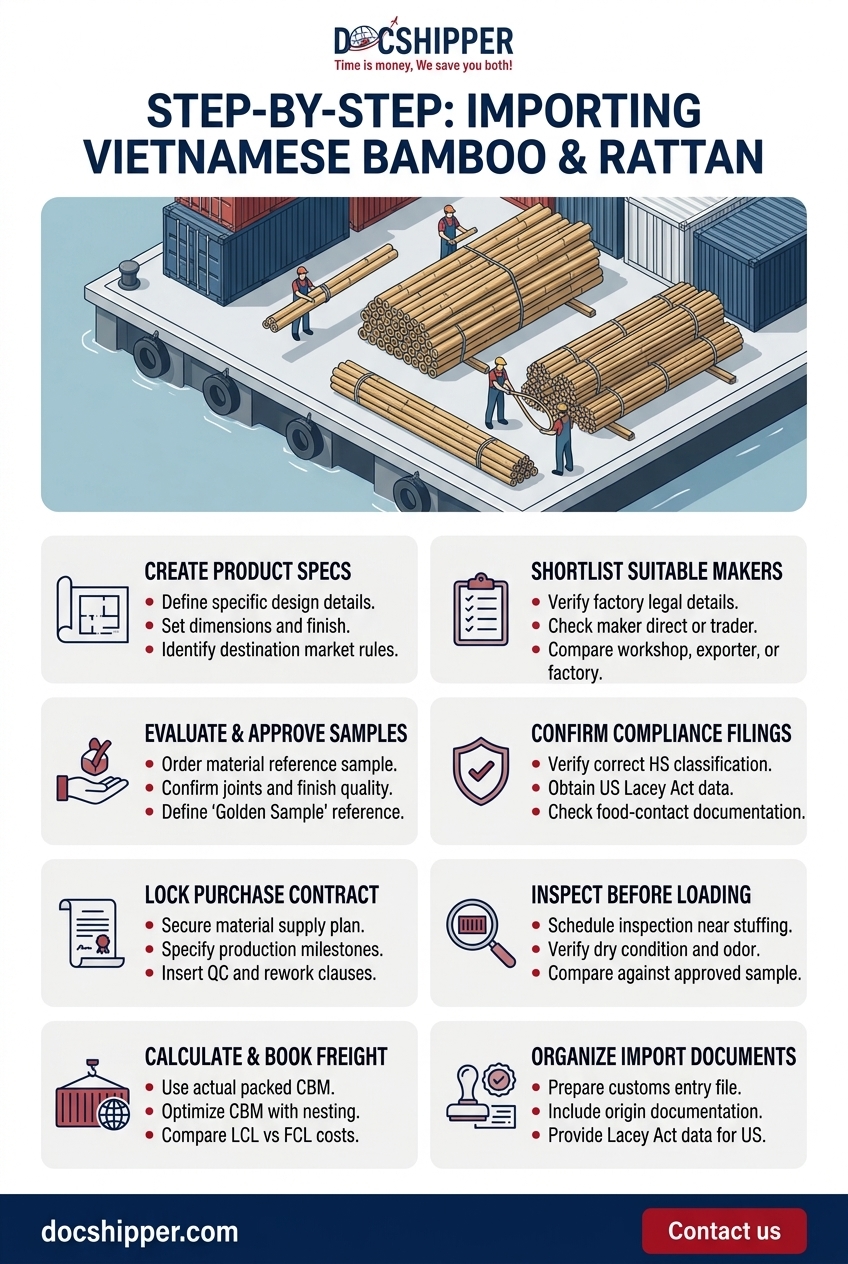
Define the product, shortlist three to five suppliers, approve a golden sample, secure the material plan, inspect before loading, and prepare destination declarations before booking the shipment. This sequence prevents the most expensive mistake: discovering a compliance, quality or volume problem after production is complete.
- Build the specification sheet. Record product dimensions, material, weave, colour, finish, coating, hardware, load requirement, packaging, labels, target quantity and destination market.
- Shortlist three to five suppliers. Compare a workshop, an exporter and a factory where appropriate. Request legal details, workshop address, production photos, material origin and export references.
- Request samples. Ask for a sample made with the proposed material and finish. Test dimensions, stability, smell, surface quality, packaging and assembly before approving it.
- Create the golden sample. Sign off the reference sample, drawing, colour and defect limits. Attach the approved specifications to the purchase order.
- Check compliance. Confirm HS classification, Lacey Act information for the US, food-contact requirements for kitchenware, origin evidence and any Australia biosecurity conditions.
- Lock material and lead time in the purchase order. State the material source, substitution approval process, production milestones and what happens if raw-material shortages delay the order.
- Add a QC clause. Define inspection timing, sampling method, critical defects, rework rights, packaging checks and approval before loading.
- Inspect and load. Complete the pre-shipment inspection close to stuffing, check the dry container, use desiccants where appropriate and photograph the sealed load.
- Book LCL or FCL using real CBM. Compare the packed volume, handling charges, transit plan, insurance and destination costs rather than using the supplier’s estimated volume alone.
- Prepare customs entry. Give your broker the invoice, packing list, origin documents, treatment records and any Lacey Act or destination-specific information before arrival.
Use this first supplier email to obtain comparable offers:
Subject: Bamboo and rattan products for [destination market]
Hello [Supplier name],
We are sourcing [product family] for sale in [country]. Please confirm whether you manufacture the products directly or coordinate production through another workshop.
Our initial requirement is:
- Product: [name and reference]
- Material: [bamboo, rattan, seagrass, water hyacinth or composite]
- Quantity: [quantity]
- Dimensions: [finished dimensions]
- Finish and colour: [details]
- Packaging: [carton, nesting, knock-down or other requirement]
- Destination port: [port]
- Requested quotation: [EXW, FOB or another Incoterm]
Please send your MOQ, sample cost, production lead time, packed dimensions, CBM per unit or carton, material source, export experience, available compliance documents and payment terms. Please also confirm whether you can provide the scientific material information required for a US Lacey Act declaration if the goods are shipped to the United States.
We require a production sample and pre-shipment inspection against an approved golden sample. Please explain how you control drying, treatment and mould prevention before loading.
Best regards,[Name]
Conclusion
Importing bamboo and rattan products from Vietnam works best when product design, compliance and logistics are planned together rather than handled as separate tasks.
- Vietnam is the world’s second exporter of rattan and bamboo products after China, with more than 1,000 craft villages and strong export demand from the United States.
- Choose the supplier channel by product family and volume: village workshop for handmade flexibility, exporter for mixed orders, or factory for repeatable production.
- For the US, prepare Lacey Act declaration information and verify the current tariff stack before shipment.
- For the EU, separate pure bamboo products from bamboo-melamine food-contact composites and obtain a product-specific compliance assessment.
- Prevent mold with controlled drying, inspection close to loading, a dry container and appropriate packaging.
- Design for CBM from the beginning: nesting and knock-down construction can reduce the space you pay to ship.
Tell us your product family, destination and expected volumes. Our Vietnam team can shortlist makers, inspect production before loading, consolidate mixed handicraft orders and arrange LCL or FCL shipping.
FAQ | How to Import Bamboo and Rattan Products from Vietnam
Yes, but unfinished goods can create more biosecurity, treatment and customs risks than finished products. Before ordering, ask your broker and the destination authority whether the specific material requires fumigation, heat treatment, an import permit, or additional inspection. Confirm that the supplier can provide treatment records and that the packaging meets the same requirements. Do not assume that “dried” means the goods will automatically clear customs.
Do not approve a substitution verbally. Require the supplier to send the proposed material, explain the reason, and provide a revised sample if the change could affect colour, strength, smell, moisture behaviour or compliance. Record your approval in writing and update the purchase order, price, lead time and product specifications. If the material is relevant to a Lacey Act declaration or a food-contact claim, reassess the compliance file before production continues.
Avoid paying the full balance before production and inspection are complete. A common risk-control approach is to pay an agreed deposit, keep the balance conditional on conformity with the golden sample and release it only after the pre-shipment inspection has been accepted. Verify the beneficiary name against the supplier’s legal identity, and confirm any bank-account change through an independent contact method. Your contract should also state what happens if production is late, defective or materially different from the approved sample.
Consider testing when the products are painted, varnished, glued, intended for children, used indoors, or sold in markets with chemical restrictions. Ask the supplier for the coating and adhesive specifications, then have a qualified laboratory or compliance adviser identify the relevant tests for your destination. Depending on the product and market, this may include restricted substances, heavy metals, formaldehyde or other emissions. Supplier declarations alone may not be sufficient for a private-label product.
First, separate the affected cartons and avoid selling, cleaning or repacking them before documenting the condition. Photograph the cartons, container, seal, water marks, mould, inner packaging and product quantities, then notify the supplier, freight forwarder, insurer and carrier within the contractual deadlines. Keep the commercial invoice, packing list, inspection report and loading photographs available. A pre-shipment inspection does not automatically remove your obligation to document transit damage, condensation or a change in condition after loading.
Yes, but mixed sourcing requires tighter document and quality control. Ask the exporter to identify each workshop, material source and product reference, and confirm who is responsible for defects, treatment records and export documentation. Use separate packing-list lines for each supplier or product batch where this helps traceability. Before shipment, verify that the declared origin, quantities, materials and compliance information are consistent across the commercial invoice, packing list, certificates and any destination declarations.
Need Help with Logistics
or Sourcing in Vietnam ?
First, we secure the right products from the right suppliers at the right price by managing the sourcing process from start to finish. Then, we simplify your shipping experience - from pickup to final delivery - ensuring any product, anywhere, is delivered at highly competitive prices.


Fill the Form
Prefer email? Send us your inquiry, and we’ll get back to you as soon as possible.
Contact us