In short ⚡
Importing Seafood from Vietnam: Shrimp, Pangasius and Cold Chain requires selecting a destination-approved processor, confirming product-specific documents and controls, checking market-specific duties and eligibility, and maintaining the agreed reefer temperature from loading through delivery. The main checks are:| Product or stage | Key requirements | Main risks or evidence |
|---|---|---|
| Farmed shrimp | Confirm species, count size, format, glazing, packaging, traceability and residue testing. | US anti-dumping exposure, net-weight differences, food-safety documents and laboratory results. |
| Pangasius | Verify the processor’s USDA FSIS eligibility for US imports, product specifications and farm traceability. | FSIS documentation, anti-dumping exposure, health documents and residue tests. |
| Wild-caught seafood | Obtain catch-area, vessel and landing information, plus destination-specific admissibility documents. | IUU catch certificate, SIMP data and MMPA checks for relevant US imports. |
| Frozen seafood contract | Define net weight, glazing, size count, freezing method, packaging, shelf life, labelling and inspection rights. | Glazing, temperature, microbiological and residue non-conformities. |
| Reefer cold chain | Pre-cool the container, use the agreed setpoint, preserve airflow, maintain continuous power and monitor temperatures. | Reefer failure, delayed plug-in, door openings and incomplete temperature records. |
The guidance covers Vietnamese processor approval, shrimp and pangasius specifications, US, EU and UK import rules, contracts and quality control, reefer shipping, and the first-shipment process.
We hope you’ll find this article genuinely useful, but remember, if you ever feel lost at any step, whether it’s finding a supplier, validating quality, managing international shipping or customs, FNM Vietnam can handle it all for you!
Why source seafood from Vietnam
Vietnam exported a record US$11.3 billion of seafood in 2025, led by farmed shrimp at US$4.6 billion and pangasius at US$2.2 billion. Tuna reached US$924.3 million, while crab and other crustaceans generated US$384.9 million, according to SeafoodSource reporting VASEP data.
For a buyer, this scale means you can source standard frozen shrimp, pangasius fillets, tuna, crab, squid, octopus and value-added products from an established processing base. Farmed seafood is particularly relevant for container buyers because processors in the Mekong Delta supply consistent formats, while ports around Ho Chi Minh City and Hai Phong support export programs to the United States, Europe, Japan, China and other Asian markets.
Vietnam’s export momentum continued in the first eight months of 2026: seafood exports reached US$8 billion, up 11.9% year on year. Shrimp represented US$3.28 billion and pangasius US$1.52 billion, although shrimp exports to the United States fell 11.7%, showing why market access and landed-cost analysis matter as much as the supplier’s quoted price.
Tai Kim Anh, Chairman of the Vietnam Association of Seafood Exporters and Producers, described the industry’s approach as follows: “We have adapted with flexibility, maintaining our production momentum while expanding and securing our market presence.” The quote was published by SeafoodSource on 21 January 2026.
Do not treat Vietnam as a single product market. Start with the product format your customers need, then select a processor that is approved for your destination and can provide the documents, testing and cold-chain controls that product requires.
DocShipper Tips
Define farmed or wild-caught status early to avoid costly compliance gaps.
Shrimp, pangasius or wild-caught: what changes for the buyer
Farmed shrimp and pangasius are normally traceable to farms and processing establishments, so they do not require a wild-catch certificate. They still require food-safety controls, residue testing and destination-specific approvals. Wild-caught tuna, crab, squid and octopus add IUU and, for US imports, Marine Mammal Protection Act requirements.
An IUU catch certificate documents where and how eligible wild seafood was caught and helps authorities verify that it was not linked to illegal, unreported or unregulated fishing. Farmed shrimp and pangasius do not use this catch-certificate route, but the importer must still preserve traceability from farm or production site through processing and shipment.
Farmed shrimp
For shrimp, define the species, count size, raw or cooked status, head-on or peeled format, deveining, freezing method, glazing and packaging. The commercial risk is not only microbiological safety. A supplier’s US anti-dumping rate can materially change the landed cost, and a low offer may reflect a different net weight, higher glazing or a weaker specification.
Pangasius
Pangasius is usually sold as frozen fillets, portions or value-added products. In the United States, pangasius belongs to the Siluriformes category and is handled under USDA FSIS inspection requirements rather than only the FDA seafood pathway. Vietnam has been eligible to export pangasius under this system since November 2019, but you must still verify the establishment and current eligibility before contracting.
Wild-caught tuna, crab, squid and octopus
Wild-caught products require more source documentation. Ask for the catch area, vessel information, landing records and the certificate or admissibility documents required by your destination. For US shipments, verify both the Seafood Import Monitoring Program data and the MMPA position of the fishery. For EU and UK shipments, check the catch certificate route and border-control requirements before loading.
| Product family | Main buyer checks | Key documents or controls |
| Farmed shrimp | Species, count, glazing, residues, exporter-specific US duty exposure | Health and food-safety documents, traceability, laboratory results, SIMP data for US imports |
| Pangasius | Fillet yield, size, glazing, FSIS eligibility, anti-dumping exposure | Approved establishment evidence, FSIS documentation for the US, health documents and residue tests |
| Wild-caught tuna | Fishery, vessel, catch area, MMPA admissibility | IUU catch certificate, SIMP data where applicable, MMPA documentation for the US |
| Wild-caught crab, squid and octopus | Origin, fishing method, landing records, destination restrictions | IUU catch certificate, health certificate and market-specific admissibility documents |
| Cooked or value-added seafood | Ingredients, processing steps, allergens, cooking validation and packaging | Food-safety plan, product specification, health documents and destination-specific labelling records |
DocShipper Alert
Verify eligibility and duty exposure before accepting a quotation.
Choosing an approved Vietnamese seafood processor
Only select a processor that is approved or eligible for your destination and product category. A factory may export shrimp to one market but not be eligible for pangasius to the United States, or it may have approval that does not cover the product format you want.
Begin with the relevant official list. For EU imports, check the European Commission’s approved establishments information. For the United States, verify the FDA food-safety position for seafood and the USDA FSIS eligibility of a pangasius establishment. For other markets, ask the processor for the current approval reference and confirm it with the importing authority rather than relying on a certificate sent by email.
Then review the processor’s food-safety system and commercial evidence. Request HACCP documentation, recent BRCGS or IFS certification where relevant, farm or chain-of-custody evidence such as ASC or BAP for farmed seafood, laboratory reports, product specifications, recall procedures and a recent export record for your destination.
For US shrimp, check the company-specific anti-dumping position before comparing offers. In the February 2026 review of frozen shrimp covering February 2023 to January 2024, reported cash-deposit rates were 25.46% for STAPIMEX and Thong Thuan and 4.28% for other eligible companies. The difference is not a small pricing adjustment: it can determine whether the shipment remains commercially viable.
The underlying duty treatment can also change through administrative reviews. For pangasius, the reported POR20 outcome included several exporters at US$0 per kilogram and a Vietnam-wide rate of US$2.39 per kilogram. Treat these figures as a compliance checkpoint for the named exporter and review period, not as a universal rate for every Vietnamese supplier.
Looking for a Reliable Shipping & Sourcing Partner?


Supplier approval checklist
- Confirm the establishment name, address and approval number.
- Match the approval to the product species, processing activity and destination.
- Request HACCP documentation and the latest audit or certification reports.
- Check farm traceability for shrimp and pangasius.
- Request residue, microbiological and heavy-metal test results appropriate to the product.
- Verify the exporter’s current US anti-dumping position when selling to the United States.
- Order samples using the same specification, packaging and glazing as the proposed production batch.
- Arrange an independent inspection before loading the first commercial shipment.
DocShipper Alert
Build the document checklist before booking to prevent border delays.
Import requirements by destination
The document set depends on three variables: whether the seafood is farmed or wild-caught, whether it is raw or processed, and where it will enter. For the United States, combine FDA food-safety and importer obligations with FSIS rules for pangasius, SIMP data for covered seafood, MMPA admissibility for relevant wild fisheries and any applicable trade remedies.
United States
For shrimp and other FDA-regulated seafood, the importer must manage seafood HACCP and the Foreign Supplier Verification Program. FSVP means the US importer verifies that the foreign supplier and the food offer an equivalent level of public-health protection. The FDA explains the importer obligations in its FSVP guidance.
For pangasius, confirm that the Vietnamese processor is eligible under USDA FSIS Siluriformes requirements. For covered wild-caught species and shrimp, prepare the data required by NOAA Fisheries’ Seafood Import Monitoring Program. Wild-catch shipments also require a separate MMPA admissibility assessment.
As of October 2026, the commercial calculation may include the normal MFN duty, the applicable anti-dumping or countervailing measure, and the reported 12.5% Section 301 forced-labor tariff on Vietnamese goods since 24 July 2026. Confirm the current tariff classification and exemptions with your customs specialist before signing the purchase contract.
Since 1 January 2026, the United States has restricted products from 12 Vietnamese fisheries that were denied MMPA comparability, according to Tuoi Tre News. Eleven fisheries were reported as approved with a Certificate of Admissibility. This distinction matters for wild-caught tuna, swordfish, grouper, mackerel, crab and squid, but it does not create the same catch-fishery risk for farmed shrimp or pangasius.
European Union and United Kingdom
EU shipments generally require an establishment approved for the relevant product, an official health certificate and border-control processing. Wild-caught seafood additionally requires an IUU catch certificate. Your importer or customs representative should prepare the TRACES and border-control process before the container departs.
The United Kingdom uses its own post-Brexit process. Confirm the approved establishment, health certificate, catch certificate for wild catch and IPAFFS pre-notification requirements with the importer before booking the shipment. Seafish’s Vietnam import guidance is a useful starting point, but the importer remains responsible for checking the current Border Control Post procedure.
Vietnam’s EU IUU “yellow card” has remained in place since October 2017 and was still reported as active in August 2026. It increases the scrutiny applied to Vietnamese wild-catch documentation. Ask the supplier to reconcile the catch certificate, vessel data, landing information and commercial invoice before loading, not after the container reaches Europe.
Japan and other markets
Japan, China, Australia, the Middle East and other Asian destinations each apply their own establishment, health, labelling and residue requirements. Do not copy a US or EU document list into another market. Give the Vietnamese processor your destination, HS classification, product format and buyer specification so it can identify the correct competent-authority documents.
| Destination | Approvals and certificates | IUU catch certificate? | Specific risk |
| United States | FDA seafood HACCP and FSVP controls; FSIS eligibility for pangasius; SIMP data where applicable | Required for relevant wild-catch documentation, alongside MMPA checks | AD duties, 12.5% Section 301 tariff as reported, MMPA restrictions and fishery-specific admissibility |
| European Union | Approved establishment, official health certificate and border-control processing | Yes for wild-caught seafood | Vietnam IUU yellow card and document scrutiny |
| United Kingdom | Approved establishment, health certificate, IPAFFS pre-notification and Border Control Post checks | Yes for wild-caught seafood | Pre-notification errors, missing certificates and catch-traceability gaps |
| Japan and other markets | Destination-specific establishment, health, labelling and residue requirements | Confirm with the importing authority for wild catch | Do not assume EU or US documents satisfy local rules |
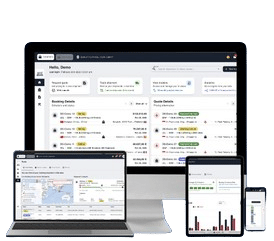
DocShipper Platform
One platform. Your entire supply chain
Sourcing, freight, customs & documents — all centralised, all visible, 24/7.
Contracts and quality control for frozen seafood
Put the physical specification into the sales contract, not only into an email or sample approval. The contract should define species, scientific name where relevant, product form, size count, tolerances, net weight, glazing, packaging, freezing method, storage temperature, shelf life, labelling and the inspection procedure.
Glazing is the protective layer of ice applied to frozen seafood. It can reduce dehydration, but it also affects the difference between gross weight and the seafood quantity the buyer actually receives. State whether the price is based on net product weight or includes glaze, and define the acceptable glazing percentage and weighing method.
Specify whether the product is IQF, meaning individually quick frozen, or block frozen. Add carton dimensions, inner-pack configuration, pallet requirements, lot coding and the documents that must be supplied before release. For cooked or value-added products, include ingredients, allergens, cooking validation and any claims printed on the label.
Use pre-shipment inspection to compare the production lot with the signed sample. An inspector can verify count size, carton markings, net weight, glazing, packaging integrity, visible defects, loading conditions and temperature records. Laboratory testing should address the risks relevant to the product and destination, including microbiological criteria, antibiotic residues and other contaminants required by the buyer or authority.
Low market prices increase the need for verification. Le Van Quang, CEO of Minh Phu Seafood, told SeafoodSource: “Prices are so low that Ecuadorian shrimp farmers are also losing money.” The comment does not prove that a particular supplier has reduced quality, but it is a reason to protect the agreed specification when market pressure encourages cost-cutting.
Frozen seafood QC checklist
- Species and product form match the approved sample.
- Size count and count tolerance are recorded.
- Net weight is measured separately from glazing.
- Glazing percentage follows the contract.
- IQF or block-freezing method is confirmed.
- Cartons, inner packs, labels and lot codes are correct.
- Residue and microbiological tests meet the destination requirement.
- Temperature is recorded during inspection and loading.
- Seal number, container number and loading photographs are retained.
- Non-conformity procedures define rejection, rework or price adjustment.
DocShipper Alert
Track every reefer handoff and retain temperature evidence throughout transit.
Cold-chain shipping from Vietnam
Frozen seafood normally moves in a reefer container, which is an insulated container equipped with an active refrigeration unit. The correct temperature setpoint must be agreed according to the product, buyer specification and applicable requirement. Do not use a generic setting simply because the cargo is labelled “frozen.”
Book the reefer only after confirming the product’s ready date, port, container availability and documentation timeline. Vietnam’s main export gateways for this planning are ports serving Ho Chi Minh City, including Cat Lai, and Hai Phong in the north. The route, vessel schedule and terminal process should leave enough time for inspection, customs documentation and any official release.
Before loading, pre-cool the container and ensure the cargo is already at the required condition. Load quickly, maintain airflow around the cartons, avoid blocking the return-air path and record the container setpoint, pulp or product temperature where required, seal number and loading time.
Use an independent data logger in addition to the reefer’s own telemetry when the shipment value or buyer requirement justifies it. Confirm how the container will remain powered during terminal handling, transshipment and any customs inspection. A reefer failure, delayed plug-in or prolonged door opening can damage the cargo even when the shipping documents are perfect.
Prepare the commercial invoice, packing list, bill of lading instructions, health certificate, catch certificate where applicable, origin or preference documents where required, inspection report and importer instructions before loading. Cargo insurance should reflect the product’s temperature sensitivity and the agreed Incoterm.
| Stage | Action | Evidence to retain |
| Booking | Confirm reefer equipment, port, schedule and destination requirements | Booking confirmation and cargo instructions |
| Before loading | Pre-cool container and verify cargo condition | Temperature record and photographs |
| Loading | Load quickly, preserve airflow and apply the seal | Container number, seal number and loading report |
| At origin terminal | Confirm reefer plug-in and document release status | Terminal or carrier confirmation |
| During transit | Monitor data logger and respond to alarms | Temperature log and incident records |
| At destination | Coordinate inspection, customs clearance and continuous power | Release documents and final temperature report |
DocShipper Info
Use one specification across every supplier to compare offers accurately.
Step by step: your first seafood import from Vietnam
The safest first shipment is built around a defined product, an eligible processor and a destination-specific document checklist. Follow the sequence below before requesting a final freight quotation.
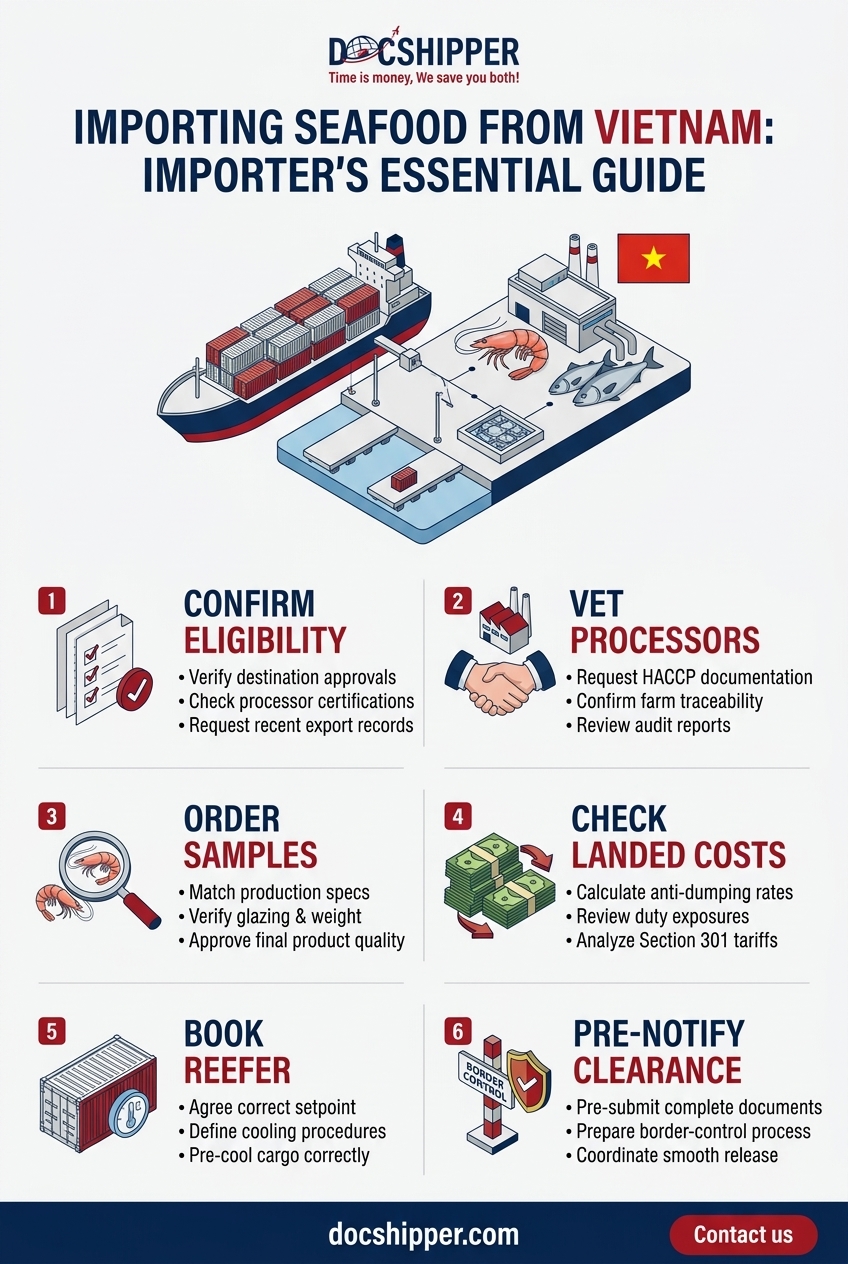
- Define the product. State species, farmed or wild-caught origin, raw or cooked format, size count, glazing, packaging, quantity and required shelf life.
- Identify the destination rules. Confirm the importer of record, HS classification, approved-establishment requirement, health certificate, catch certificate, SIMP or MMPA obligations and pre-notification process.
- Shortlist eligible processors. Check the official approval or eligibility list and request the establishment number, certifications, traceability records and recent laboratory reports.
- Check landed-cost exposure. For US imports, verify the exporter-specific anti-dumping rate, applicable tariff treatment and any Section 301 or MMPA issue before comparing supplier prices.
- Request and test samples. Approve the same count, glazing, packaging and labelling that will be used in production. Record acceptance criteria in writing.
- Issue a detailed RFQ. Send the same specification to each supplier so the offers are comparable.
- Negotiate the contract. Include net weight, glazing, tolerances, residue limits, inspection rights, temperature requirements, documents, Incoterm and remedies for non-conformity.
- Inspect before loading. Verify the production lot, cartons, weights, labels, temperature, container condition and seal.
- Book the reefer shipment. Confirm the setpoint according to the product and buyer specification, pre-cooling procedure, data logger and plug-in arrangements.
- Pre-notify and clear. Send the complete document pack to the importer or customs representative before arrival and monitor any border, FDA, FSIS or BCP requests.
RFQ template for Vietnamese seafood
Copy the following fields into your supplier request so every quotation answers the same commercial and compliance questions:
- Product: species, scientific name if required, farmed or wild-caught, origin and production area.
- Format: raw, cooked or value-added; whole, head-on, peeled, fillet, portion, squid tube or other form.
- Size: count range, weight per piece and permitted tolerance.
- Freezing: IQF or block, requested setpoint and shelf life.
- Glazing and weight: glazing percentage, net weight basis and carton weight.
- Packing: inner-pack size, cartons per pallet, labelling language and private-label requirements.
- Compliance: destination approval, HACCP, BRCGS, IFS, ASC or BAP evidence, health certificate, catch certificate if applicable, and laboratory testing.
- Quantity: trial order, full reefer quantity or smaller lot, with requested shipment window.
- Commercial terms: currency, price basis, Incoterm, payment terms and quote validity.
- Destination: port, country, importer requirements and any US AD, FSIS, SIMP or MMPA checks.
- Inspection: independent pre-shipment inspection, sampling plan, temperature records and non-conformity remedy.
When you import seafood from Vietnam, the supplier’s export price is only one part of the decision. Tell us your species, specification and destination: we can check the processor, coordinate inspection at loading and arrange reefer shipping from Vietnam while keeping the document and cold-chain requirements aligned.
Conclusion
- Vietnam exported US$11.3 billion of seafood in 2025, led by shrimp and pangasius.
- Farmed or wild-caught origin determines the document route and the main compliance risks.
- Buy only from a processor approved for your product and destination.
- For the United States, check the exporter’s anti-dumping rate, FSIS status, SIMP data, MMPA admissibility and the reported 12.5% Section 301 tariff.
- For the EU and UK, prepare approved-establishment, health-certificate, catch-certificate and border-notification requirements before loading.
- Protect the cold chain with pre-cooling, the agreed setpoint, data logging and continuous reefer power.
- Write glazing, net weight, size count, residues, inspection and temperature obligations into the contract.
Share your species, product specifications, volume and destination with us. We can help verify the Vietnamese processor, arrange pre-shipment inspection and coordinate reefer shipping so your seafood clears the border and stays at temperature from plant to port.
FAQ | How to Import Seafood from Vietnam: Suppliers, Documents, US Rules and Reefer Shipping
Yes, but a smaller shipment can be more complex and expensive per kilogram. Ask the supplier and freight forwarder whether the cargo will move as refrigerated LCL, in a shared reefer, or as a dedicated container with unused capacity.
Before confirming, check that the consolidation service can maintain the required temperature, separate your seafood from incompatible products and provide clear responsibility for any delay, cross-docking or temperature excursion. For a first order, compare the landed cost of a small trial shipment with a partially filled dedicated reefer.
Do not allow the container to load simply because the difference appears minor. Compare the lot against the signed specification, including species, count, glazing, net weight, packaging, labels, temperature and laboratory requirements.
Record the discrepancy with photographs, inspection findings and sample references. Then require a written corrective action: rework, replacement, price adjustment or cancellation. The contract should state who pays for additional inspection, storage, reworking and any missed vessel departure.
Treat certificates sent by email as supporting documents, not final proof. Check that the legal company name, factory address, approval number and product scope match across the certificate, commercial documents and official authority records.
Also verify the validity period, destination coverage and whether the approval applies to the exact species and processing activity. If the supplier’s bank account name differs from the contracted legal entity, pause the transaction until the relationship is documented and independently confirmed.
Even when the supplier has prepared the health and export documents, the US importer or customs broker may still need to complete separate entry requirements. Confirm these items before the cargo is loaded:
- FDA prior notice and any applicable food-facility registration details;
- Importer-of-record information, customs power of attorney and bond arrangements;
- FSVP records for the covered seafood product;
- SIMP data submission and recordkeeping where the species is covered; and
- Correct tariff classification, country-of-origin marking and any required trade-remedy documentation.
The broker should confirm the filing deadlines and data format for the specific product. A missing electronic filing can delay release even when the physical cargo and commercial invoice are correct.
Avoid treating the Incoterm as payment protection. Incoterms allocate transport costs, risk and certain responsibilities, but they do not guarantee product quality or determine when ownership transfers.
For a first transaction, negotiate a payment structure linked to measurable milestones, such as a deposit after contract signing, balance after satisfactory inspection and document review, or a documentary letter of credit when the order value justifies the bank fees. Confirm that the inspection right survives payment and that the contract explains what happens if the shipment fails the agreed specification.
Ask the carrier or forwarder for the alarm history, current container temperature, setpoint, location, power status and door-opening record immediately. Preserve the independent data-logger file and all written communications rather than relying only on a verbal explanation.
Have the destination team prepare for a controlled inspection on arrival. Do not authorize disposal, relabelling or release of affected goods before the insurer, importer, carrier and relevant authority have agreed on the next step. Your sales contract and insurance policy should define the evidence required for a claim and who pays for survey, storage, testing or disposal.
Need Help with Logistics
or Sourcing in Vietnam ?
First, we secure the right products from the right suppliers at the right price by managing the sourcing process from start to finish. Then, we simplify your shipping experience - from pickup to final delivery - ensuring any product, anywhere, is delivered at highly competitive prices.


Fill the Form
Prefer email? Send us your inquiry, and we’ll get back to you as soon as possible.
Contact us