In short ⚡
Top Inspection Companies in Vietnam are best evaluated by service scope, local coverage, inspector expertise, reporting quality, accreditation and total cost rather than by brand recognition alone. The main options fall into global TIC groups, QC specialists and sourcing-QC teams. The companies and provider categories highlighted for comparison are:| Company | Provider category | Relevant strengths or positioning |
|---|---|---|
| SGS | Global TIC group | Inspection, testing and certification; operated in Vietnam since 1989 and has more than 600 staff in the country |
| TÜV Rheinland | Global TIC group | Testing and certification expertise, with softlines, hardlines, EMC/electrical and packaging laboratory capabilities in Vietnam |
| Bureau Veritas | Global TIC group | Global inspection, testing and certification provider to include in a comparison |
| Intertek | Global TIC group | Global inspection, testing and certification provider to include in a comparison |
| QIMA | QC specialist | Specialist quality-control provider for factory audits and product inspections |
| FNM/DocShipper | Sourcing-QC team | Coordinates factory audits and inspections with supplier management and freight arrangements |
Key themes include inspection types by production stage, global TIC groups and QC specialists, provider comparison criteria, AQL and report requirements, accreditation, and the booking process in Vietnam.
We hope you’ll find this article genuinely useful, but remember, if you ever feel lost at any step, whether it’s finding a supplier, validating quality, managing international shipping or customs, FNM Vietnam can handle it all for you!
Choosing among inspection companies in Vietnam is not only a question of finding the lowest man-day price. The right provider depends on your production stage, product risk, factory location, reporting needs and whether you also need laboratory testing or certification.
A well-timed inspection can help you catch defects before you pay the balance and before the container leaves Vietnam. This guide explains which inspection to book, how to compare provider categories and what to include in your booking request.
DocShipper Info
Need help choosing the right inspection? Get expert guidance before booking
Types of quality inspections and audits
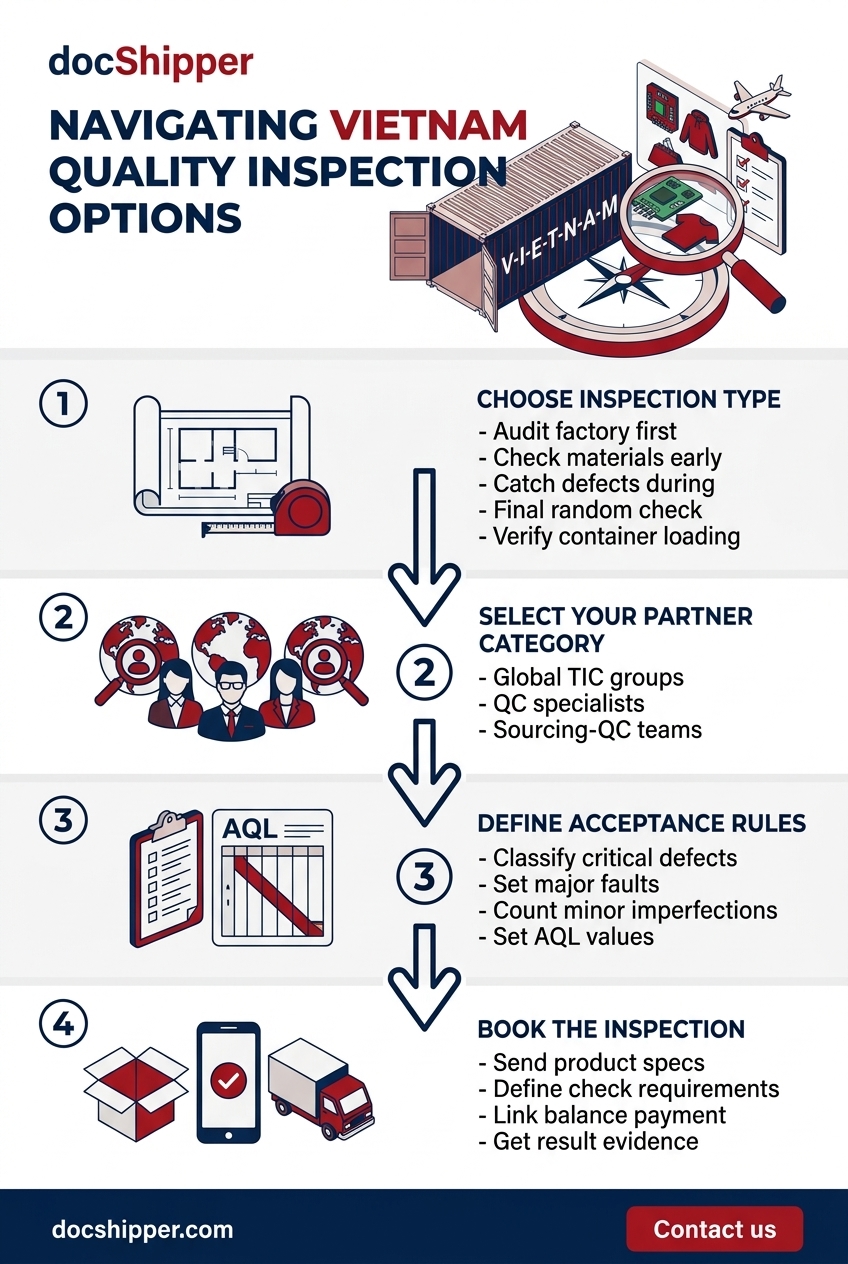
Choose the inspection according to the production stage: audit the factory before ordering, check materials before production, inspect during production to catch recurring defects, perform a final random inspection when the order is nearly complete, and verify the container loading before shipment.
A factory audit takes place before you commit to a supplier. The inspector reviews production capacity, equipment, processes, quality controls, worker practices and relevant compliance documents. It does not prove that a specific order will be defect-free, but it can reveal whether the supplier appears capable of producing it.
A pre-production inspection focuses on raw materials, components, packaging and the approved reference sample before mass production starts. During-production inspection then checks the first output and the manufacturing process while there is still time to correct a tooling, assembly or workmanship problem.
A final random inspection is used when the order is complete enough to assess the finished lot. According to SGS’s service definition, the goods should be 100% produced and at least 80% packed, with sampling based on ANSI/ASQ Z1.4, also known as ISO 2859-1. A container-loading inspection checks quantity, carton condition, shipping marks and the loading process. It is useful when the risk is that the correct goods may not be loaded in the correct quantity or condition.
Do not confuse an inspection with laboratory testing. An inspection normally evaluates the goods, documents, workmanship, quantity or process against your checklist. A product testing laboratory performs defined tests such as safety, chemical, electrical, mechanical or performance tests, and you should verify that the laboratory’s ISO/IEC 17025 accreditation covers the tests you need.
| Inspection type | When to book | What is checked |
| Factory audit | Before placing the order | Capacity, processes, equipment, quality controls and compliance documents |
| Pre-production inspection | Before or at the start of production | Raw materials, components, packaging and approved samples |
| During-production inspection | Once production has started | First output, workmanship, recurring defects and process control |
| Final random inspection | When 100% is produced and at least 80% is packed | Finished-product quality and quantity using an AQL sampling plan |
| Container-loading inspection | During loading for shipment | Carton count, markings, packaging condition and loading evidence |
Shortlist of inspection companies in Vietnam by category
Inspection providers in Vietnam generally fall into three groups: global testing, inspection and certification groups; QC specialists focused on product inspections; and sourcing or logistics teams that combine factory follow-up with quality control.
Global TIC groups are relevant when you need a broad service portfolio, formal testing or certification support across several markets. SGS states that it has operated in Vietnam since 1989, became the first international independent inspection company with a 100% foreign-owned licence there in 1997 and has more than 600 staff in the country. These details come from the SGS Vietnam company page.
TÜV Rheinland is another provider to evaluate when your product requires testing or certification expertise. Its Vietnam overview states that the company was established in Ho Chi Minh City in 2001, opened a Hanoi office in 2003, and subsequently developed softlines, hardlines, EMC/electrical and packaging laboratory capabilities. Check the relevant service scope rather than assuming that every local office performs every test.
Bureau Veritas and Intertek are also examples of global TIC groups to include in a comparison, while QIMA is commonly considered among specialist quality-control providers. The practical question is not which logo is most familiar, but whether the provider can send a qualified inspector near your factory, follow your product-specific checklist and deliver a report that supports a payment decision.
Our FNM/DocShipper team belongs to the sourcing-QC category. We can coordinate factory audits and inspections with supplier management and freight arrangements under one contact. The company presents counters of 6,100+ clients, 9,200+ operations, 600+ sourcing projects and 700+ QC and conformity projects on its about-us page. Those counters describe our overall activity, not a guarantee for a particular inspection.
| Provider category | Strengths | Best for |
| Global TIC group | Inspection, testing and certification services with international coverage | Brands needing formal testing, certification or multi-country consistency |
| QC specialist | Focused inspection workflows and consumer-goods reporting | Importers mainly needing factory audits or product inspections |
| Sourcing-QC team | Quality control connected to supplier follow-up and logistics | First orders where production, inspection and shipping must be coordinated |
DocShipper Info
Compare qualified inspectors, report samples and total costs before confirming your booking
Looking for a Reliable Shipping & Sourcing Partner?


How to compare inspection providers
Compare local coverage, booking availability, inspector competence, report quality, accreditation and total cost, not only the quoted inspection fee. A low price is of limited value if the provider cannot reach the factory on the required date or produces a report too vague to support a rejection or rework decision.
Start with coverage and timing. Ask whether the provider has inspectors near the production site, how quickly it can confirm an appointment and what happens if the factory changes the production date. Request the inspector’s relevant product experience, particularly for electrical goods, textiles, furniture, food-contact products or other categories with specialised risks.
Then request a redacted sample report. It should show the purchase order or lot reference, inspection date, factory identity, product description, quantities checked, checklist results, photographs and a clear classification of defects. A useful report should make it possible to connect each finding to your specification and decide whether to release, hold or rework the order.
For inspection bodies, ask about ISO/IEC 17020 accreditation and request the certificate scope. For laboratories, ask about ISO/IEC 17025 accreditation and confirm that the scope covers the exact test method and product category. You can also verify relevant accreditation information through the Bureau of Accreditation Vietnam or the accreditation body identified on the certificate.
Finally, compare the complete cost. Clarify whether travel, remote locations, additional samples, laboratory tests, translations, re-inspections and urgent scheduling are included. Treat a provider that refuses to explain its checklist, accreditation scope, defect definitions or report format as a warning sign.
DocShipper Alert
Verify the AQL basis before releasing payment or approving shipment
Understanding AQL and the inspection report
AQL is a sampling method, not a promise that every item is perfect. Under ISO 2859-1, the inspector selects a sample from the lot and applies acceptance and rejection rules. You should define the sampling standard, defect classes and pass/fail decision before production begins.
AQL means acceptable quality limit in the context of the sampling system. The result applies to the inspected lot under the chosen plan, not automatically to every future shipment. Ask the provider to state the lot size, sample size, inspection level, AQL values and acceptance numbers in the report instead of accepting an unexplained “passed” label.
Classify defects in advance. A critical defect may create a safety or regulatory risk, a major defect can affect function, usability or saleability, and a minor defect may depart from the specification without preventing normal use. Your product specification should define examples for each class, because the same visual issue may have different commercial importance across products.
When an inspection fails, do not simply ask the factory to “improve quality.” Freeze the balance payment according to your contract, send the report and photographs to the supplier, request a corrective-action plan, and decide whether to rework, replace, sort or reinspect the goods. If the defect concerns safety or compliance, consider laboratory testing before shipment rather than relying on a visual inspection alone.
| Report element | Question to ask |
| Lot and sample | Which production lot and quantity were covered, and how was the sample selected? |
| Defect classification | Are critical, major and minor defects defined in the inspection instructions? |
| Acceptance decision | Does the report show the applicable ISO 2859-1 or ANSI/ASQ Z1.4 decision rules? |
| Evidence | Are defects supported by clear photographs, measurements and specification references? |
| Next action | Does the result state whether to release, hold, rework or reinspect the shipment? |
DocShipper Tips
Prepare your documents early to secure the right date and inspector
DocShipper Platform
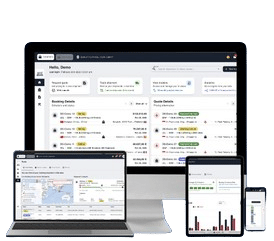
One platform. Your entire supply chain
Sourcing, freight, customs & documents — all centralised, all visible, 24/7.
How to book an inspection in Vietnam
Send the purchase order, product specifications, approved sample and inspection checklist to the provider, align the date with the factory, and connect balance-payment release to the agreed result. For a standard booking, plan to contact the provider 3 to 5 working days before the desired inspection date, while allowing more time for complex products or laboratory testing.
- Define the decision. Decide whether you need a factory audit, pre-production check, during-production inspection, final random inspection, container-loading check or laboratory test.
- Prepare the documents. Share the purchase order, technical specifications, packaging requirements, approved “golden sample,” product photographs, shipping marks and any regulatory requirements.
- Write the acceptance rules. State the critical, major and minor defect definitions, the sampling method, the AQL instructions where applicable and the tests or measurements required.
- Confirm the appointment. Give the factory address, contact person, production status and preferred date. Ask the provider to confirm inspector availability, travel arrangements and any additional charges.
- Review the report. Check the quantities, photographs, defect counts, measurements and final decision. Send any discrepancy to the provider immediately while the inspector and factory records are still available.
- Decide before shipment. Release payment only under the conditions agreed in your contract. If the inspection fails, document the corrective action and book a reinspection before loading where necessary.
Use this booking checklist when contacting inspection companies in Vietnam:
- Factory name, address and production contact
- Product name, model, quantity and purchase-order reference
- Inspection type and preferred date
- Approved sample, drawings, measurements and workmanship requirements
- Packaging, labelling, carton and loading instructions
- Defect definitions and AQL or other acceptance rules
- Required photographs, tests and report language
- Payment condition linked to the inspection outcome
- Procedure for corrective action and reinspection
The inspection is most effective when it is part of the purchasing process, not an isolated document received after the balance has already been paid. Combining QC with supplier follow-up and shipping coordination can also reduce the risk of discovering a quality problem only after the container has departed.
Conclusion
- Pick the inspection type according to the production stage and the risk you need to control.
- Compare global TIC groups, QC specialists and sourcing-QC teams according to your actual need.
- Check local coverage, booking availability, inspector experience, report quality and total cost.
- Define AQL, defect classes and acceptance rules before the inspection takes place.
- Use ISO/IEC 17020 for inspection-body accreditation and ISO/IEC 17025 for laboratory accreditation where relevant.
- Link balance-payment release to a clearly documented inspection result and corrective-action process.
Need an inspection next week? Our Vietnam QC team can inspect at your factory and coordinate shipping right after.
FAQ | Inspection Companies in Vietnam: How to Choose the Right Quality Partner
Treat this as a commercial warning, especially if the inspection was agreed in the purchase contract. Ask the supplier to explain the reason in writing and propose a new date only after confirming that the goods will be ready. Do not release the balance payment or allow shipment simply because the factory is requesting an exception. If postponements continue, consider escalating through the supplier’s management or arranging an independent factory visit.
Usually not. Each factory or production site should be assessed separately because materials, equipment, operators and quality controls may differ. Tell the inspection company if the order is split between locations, subcontractors or different production lines. The provider can then confirm whether you need separate inspections and whether the same checklist applies to every site.
A good previous result does not remove the need for inspection. Continue checking orders when the product, materials, tooling, factory location or production team changes. For stable, low-risk products, you may reduce the frequency after reviewing several consistent results, but increase it again after a failed inspection, complaint or unexplained change in defect rates.
It can be useful for a preliminary review, urgent follow-up or simple visual checks, but it does not provide the same control as an independent on-site inspection. A remote session may not reveal hidden defects, inaccurate quantities, substituted materials or conditions outside the camera view. Use it only when the product risk and contractual conditions justify the limitation, and document what could not be verified.
The approved reference sample should be uniquely identified and linked to the purchase order. Mark it with a date, version number or signed approval, and provide the same information to the factory and inspector. If several samples exist, the inspector should not choose between them without written confirmation; otherwise, the inspection may be based on the wrong standard and become difficult to enforce.
First, check whether the affected units were included in the inspected lot and whether the defect was visible or testable under the agreed checklist. A passed sample inspection does not guarantee that every unit is defect-free. Preserve photographs, samples, packaging and batch information, then notify the supplier and inspection provider promptly. For repeated or serious defects, request a root-cause analysis and consider tightening the checklist, increasing the inspection frequency or adding laboratory and functional tests.
Need Help with Logistics
or Sourcing in Vietnam ?
First, we secure the right products from the right suppliers at the right price by managing the sourcing process from start to finish. Then, we simplify your shipping experience - from pickup to final delivery - ensuring any product, anywhere, is delivered at highly competitive prices.


Fill the Form
Prefer email? Send us your inquiry, and we’ll get back to you as soon as possible.
Contact us