How small businesses can reduce shipping costs without hurting customer satisfaction

  • admin 16 Min
  • Published on November 1, 2022 Updated on May 30, 2026
img

In short ⚡

Reduce shipping costs for small businesses by first auditing your real cost drivers—billable (DIM) weight, zones, service levels, and surcharges—then applying structured rules to packaging, carrier selection, and pricing. Focus on right-sized cartons, multi-carrier rate shopping, shipment consolidation, accurate customs data, and smart free-shipping thresholds so you cut expenses without hurting delivery speed or customer satisfaction.

In this article, you will find practical workflows to diagnose shipping costs, optimize packaging, choose the right carrier mix (including Vietnam-specific tactics), and use pricing strategies like free shipping thresholds to turn logistics into a growth lever.

We hope you’ll find this article genuinely useful, but remember, if you ever feel lost at any step, whether it’s finding a supplier, validating quality, managing international shipping or customs,  FNM Vietnam can handle it all for you!

Free shipping quote 24h      I want to talk to a sourcing expert

Understand what drives your shipping costs as a small businessUnderstand what drives your shipping costs as a small business

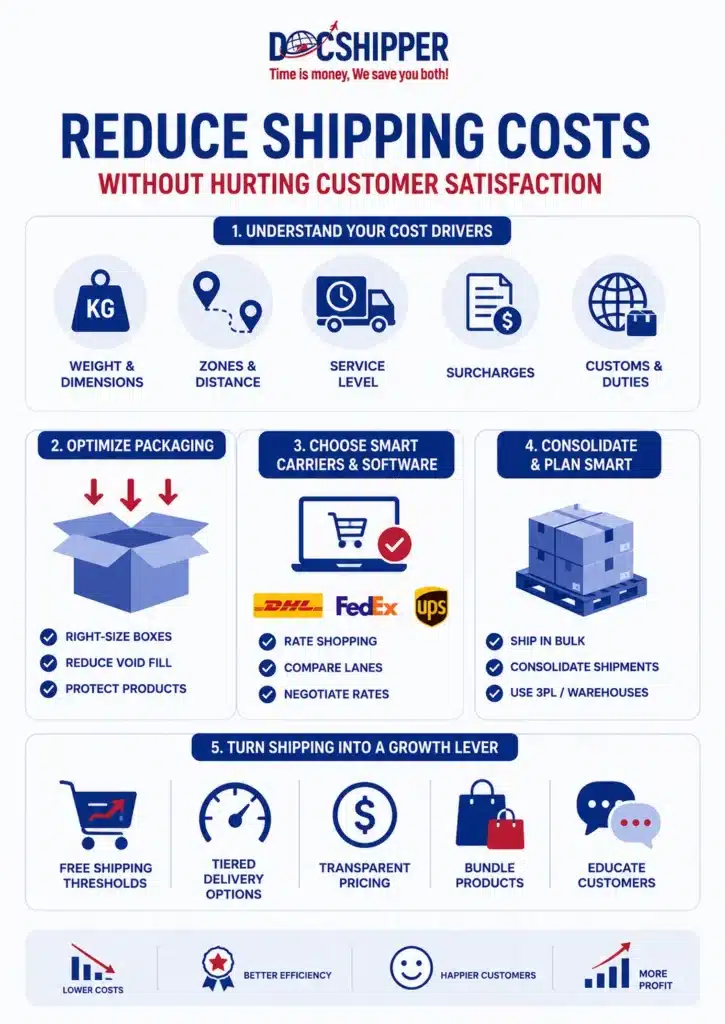
If you want to Reduce Shipping Costs for small businesses, you first need to see what’s really inside your freight invoice, not what your carrier marketing page says.

From experience, most “mysterious” increases come from tiny operational details, a wrong box size, a zone jump, or a service level you didn’t realize you selected at checkout.

We’ve seen sellers optimize product margins all day, then lose them during cargo handling, last mile delivery, and customs clearance because nobody mapped the cost drivers end-to-end in the supply chain.

Quick checklist, what to pull before you change anything:

  • Your last 30 to 90 days of shipment tracking exports
  • Carrier contracts and surcharge tables, especially fuel, remote area, oversized
  • Packaging specs, box dimensions, filler, palletizing rules if applicable
  • Declared values, cargo insurance, and any claims history
  • Incoterms and delivery terms used with suppliers, plus any bill of lading or airway bill copies for international legs

Workflow, diagnose your shipping cost for business in 20 minutes:

1) Export orders and label data, 2) group by destination zone and service, 3) flag DIM weight hits, 4) list surcharges per carrier, 5) compare actual billed vs quoted freight rates, 6) pick the top 3 leakage points to fix first.

DocShipper Advice

Before changing suppliers or packaging, let us audit your freight invoices end to end.
We identify hidden DIM, surcharge, and customs leaks in days, not months.

Key cost factors: weight, dimensions, zones, and service levels

To Reduce Shipping Costs for small businesses, you need to treat weight and dimensions like pricing inputs, not packaging afterthoughts.

Here’s the thing, carriers don’t charge you for “space taken,” they charge you for billable weight, and DIM rules are where you silently lose money.

We once audited a cosmetics brand shipping 300 parcels a week, same product, same destination mix, yet their bills kept creeping up.

The culprit was a supplier change in inner trays that forced a slightly taller box, pushing the parcels into a higher DIM bracket, the “invisible” increase was bigger than their ad spend.

Main cost drivers you can control fast:

  • Actual weight vs dimensional weight, box size can cost more than product weight
  • Zones and distance bands, cross-country last mile delivery costs spike quickly
  • Service level, economy vs express, cutoff times and weekend delivery
  • Accessorials, residential, remote area, signature, address correction
  • International add-ons, customs declaration accuracy, duties and taxes, customs broker fees
Driver What it changes Typical “gotcha” How we usually fix it
Dimensions (DIM) Billable weight Box 2 cm taller triggers a higher bracket Right-size cartons, test mailers, reduce void fill
Zones Base freight rates Shipping from the “wrong” warehouse Split inventory, use a distribution center, cross docking
Service level Transit time and price Checkout defaults to express Offer economy, set rules by cart value and destination
Surcharges Total invoice Residential, oversized, peak season fees Negotiate carrier contract, adjust packaging, validate addresses

Checklist, spot the fastest “lower shipping cost” wins:

  • Any shipment where DIM weight is higher than actual weight
  • Any lane where zones 6 to 8 represent a large share of orders
  • Any SKU that triggers oversized rules or special handling
  • Any service that could be downgraded without harming customer satisfaction
How small businesses can reduce shipping costs without hurting customer satisfaction

How to calculate shipping cost for business orders accurately

If your goal is to Reduce Shipping Costs for small businesses, you must calculate shipping cost for business orders using billed reality, not just the checkout estimate.

You’ll notice fast that “shipping rate” is only one line, the rest is DIM, surcharges, packaging, returns, and trade compliance when you ship cross-border.

We’ve seen a founder quote “low cost shipping” to customers, then get hit with address correction fees and import export documentation mistakes that turned every parcel unprofitable.

One wrong harmonized system code during tariff classification can trigger delays, inspections, and extra handling charges that snowball into customer complaints.

Step-by-step workflow, build a true landed shipping cost per order:

1) Start with the carrier base rate (your freight quote), 2) calculate billable weight (actual vs DIM), 3) add zone-based pricing, 4) layer surcharges, 5) add packaging cost, 6) add fulfillment costs (pick and pack), 7) add insurance, 8) for international, include customs broker, duties and taxes, and transport documentation like commercial invoice and customs declaration.

What to include in your “shipping for business” calculator:

  • Carrier charge based on billed weight and service level
  • Packaging materials and labor
  • Warehouse handling, order fulfillment, and any cross docking fees
  • Returns allowance by SKU category
  • International extras, export license checks when relevant, customs clearance fees

Checklist, invoice controls that prevent surprises:

  • Match label data vs billed data, line by line
  • Audit accessorials weekly, especially address correction and residential
  • Validate HS codes and declared values for cross-border shipments
  • Track claims and cargo insurance decisions by lane and product type

DocShipper Info

If your billed reality differs from checkout estimates, you are leaking margin.
Ask for a landed cost review to align rates, surcharges, and compliance before scaling.

Looking for a Reliable Shipping & Sourcing Partner?

We handle the entire sourcing process, supplier research, negotiation, production, and inspections, so you can focus on what matters most: growing your business.

Practical tactics to lower shipping cost on every parcelPractical tactics to lower shipping cost on every parcel

Once you understand the drivers, you can Reduce Shipping Costs for small businesses with repeatable rules, not one-off hacks.

This is where we see small teams win, a few smart defaults in your logistics stack can lower shipping cost across hundreds of orders without adding workload.

Think freight forwarding logic applied to parcels, standardize decisions, consolidate where you can, and use data to choose the right service for each lane.

Checklist, the “reduce parcel costs” basics to implement this week:

  • Turn on rate shopping across at least 2 to 3 carriers
  • Create packaging rules per SKU, not per order
  • Set service-level rules by promised delivery date, not by habit
  • Add address validation before label purchase
  • Review carrier invoices and dispute errors monthly

DocShipper Advice

Apply freight forwarding logic to parcels and automate decisions.
We help set rate shopping rules, packaging standards, and invoice controls that scale with volume.

Choose low cost shipping options, carriers, and software for your needs

To Reduce Shipping Costs for small businesses, you need carrier selection that matches your lanes, not whatever you started with two years ago.

We’ve watched brands stay loyal to one carrier, then realize their “low cost shipping” claim only held for local zones, while zones 7 to 8 bled cash.

A real scenario we see a lot, you negotiate a better discount, celebrate, then peak season surcharges wipe out the win.

That’s why we push you to evaluate the full carrier contract, including accessorials and how disputes are handled, not just the headline rate.

What to compare when you want low cost shipping (without surprises):

  • Lane strength, which zones and destinations the carrier prices best
  • DIM factor and oversized rules, critical for e-commerce packaging
  • Surcharges, fuel, residential, remote area, peak
  • Delivery performance, failed deliveries cost you twice
  • Tech, API, shipment tracking, label creation, returns portal
Option Best for Risk How we mitigate it at DocShipper
Single national carrier Simple operations Weak lanes get expensive fast Lane audit, add a second carrier, rate shopping rules
Multi-carrier software Automated “cheapest eligible” selection Wrong rules pick slow services Service mapping and customer promise alignment
3PL / fulfillment partner Faster delivery via distributed inventory Hidden handling fees Transparent SLA, cost model review, invoice audits
Freight consolidation for bulk replenishment Lower inbound costs to your warehouse Longer lead time if unmanaged Plan reorder points, inventory management, multimodal transport

Workflow, pick the right carrier mix in 5 steps:

1) Map your top destinations by volume and revenue, 2) split by zone and parcel profile, 3) request apples-to-apples quotes including surcharges, 4) run a two-week A/B test with rate shopping, 5) lock rules into your shipping software and monitor invoice variance.

When you want a neutral view, we can help you benchmark freight rates, negotiate smarter, and set up a shipping workflow that doesn’t collapse when volume spikes.

You can also explore our logistics and freight forwarding support here, DocShipper.

DocShipper Info

Carrier discounts mean little without lane analysis.
Benchmark your contract with us to compare zones, DIM factors, and peak surcharges before you commit.

Optimize packaging to reduce parcel costs while protecting productsOptimize packaging to reduce parcel costs while protecting products

Packaging is one of the fastest levers to Reduce Shipping Costs for small businesses, because it directly controls DIM weight and damage rate.

And yes, you can reduce parcel costs without turning your unboxing into a sad experience.

We remember a small electronics seller who switched to thinner boxes to lower shipping cost, then returns spiked because corners crushed in transit.

The “savings” vanished once they paid reshipments, refunds, and extra customer support time.

Packaging moves that reduce parcel costs safely:

  • Right-size cartons per SKU, not “one box fits all”
  • Use mailers for non-fragile items to cut dimensions
  • Standardize box library sizes to improve packing speed
  • Add protective design where it matters, inserts beat extra void fill
  • Test drop resistance and compression for worst-case carrier handling
Packaging choiceCost impactProtection levelBest use case
Poly mailerLowest DIM exposureLowSoft goods, apparel, non-fragile items
Right-sized corrugated boxBalancedMedium to highMost e-commerce SKUs
Custom insert + smaller boxLower DIM, fewer damagesHighFragile goods, cosmetics, electronics

Checklist, packaging KPI control:

  • Track DIM weight share by SKU
  • Measure damage and return rate by packaging type
  • Compare packaging cost vs shipping savings per order
  • Audit packing compliance in your warehouse or 3PL

Workflow, implement packaging optimization without chaos:

1) Identify top 20 SKUs by volume, 2) test two packaging options each, 3) validate carrier scan dimensions, 4) run a two-week damage check, 5) lock the winning packaging into pick and pack instructions, 6) revisit quarterly.

“`html
DocShipper Alert

Cutting box quality can silently increase returns and reshipments.
Test packaging with real carrier conditions before rolling out changes at scale.

DocShipper Platform

One platform. Your entire supply chain

Sourcing, freight, customs & documents — all centralised, all visible, 24/7.

Smart ways to reduce shipping costs for small businesses in Vietnam

If you operate in Vietnam, you face a unique mix of domestic courier competition and complex international export procedures. You can reduce shipping costs significantly by structuring your logistics strategy around local strengths.

  • Leverage domestic carrier competition, compare Viettel Post, VNPost, GHTK, and GHN for last-mile pricing.
  • Consolidate international shipments, ship weekly instead of daily to reduce per-unit freight cost.
  • Use cross-border hubs, route exports through Ho Chi Minh City or Hanoi for better air freight capacity.
  • Negotiate export rates, request volume-based contracts even if your volume is modest but consistent.
  • Optimize Incoterms, choose FOB instead of EXW to control freight and avoid supplier markups.

International shipping from Vietnam often becomes expensive due to fragmented bookings and poor consolidation. When we manage freight for clients, we typically reduce costs by 10% to 25% through structured consolidation and rate negotiation.

Strategy Cost Impact Operational Benefit
Air freight consolidation Lower per kg rate Predictable weekly departures
Sea LCL optimization Reduced minimum charges Better container space usage
Switch to FOB Avoid supplier margins Full logistics control
Local 3PL warehousing Lower last-mile cost Faster domestic delivery

You should also audit customs classification carefully because incorrect HS codes increase duties and inspection risk. We help you secure proper documentation and compliant declarations through our Vietnam freight services at DocShipper Vietnam.

If you export regularly, you can consider bonded warehouses to defer duty payments and improve cash flow. This approach improves working capital efficiency while keeping inventory closer to customers.

Turn shipping into a growth lever with smart pricing and customer education

You should stop seeing shipping only as a cost center and start using it as a pricing strategy tool. Smart positioning allows you to protect margins while maintaining customer satisfaction.

  • Set free shipping thresholds, increase average order value strategically.
  • Offer tiered delivery speeds, let customers pay for urgency.
  • Display real-time rates, avoid undercharging or overabsorbing costs.
  • Bundle products, reduce per-item shipping ratio.
  • Be transparent, explain delays and service levels clearly.

For example, if your average shipping cost is $8, you can set free shipping at $60 instead of $40. This simple adjustment can increase average cart value by 15% or more without aggressive discounting.

Pricing Model Customer Perception Margin Impact
Flat rate shipping Simple and predictable Stable but risky if miscalculated
Free shipping threshold High incentive to buy more Higher AOV, better absorption
Real-time carrier rates Transparent and fair Low margin distortion

You should also educate your customers about international shipping realities such as customs delays and peak season surcharges. When customers understand transit time variability, satisfaction improves even if delivery is not express.

At DocShipper, we often redesign both logistics flow and pricing structure together. This dual approach transforms logistics into a competitive advantage rather than a margin drain.

Conclusion

You now have concrete strategies to reduce shipping expenses without harming customer experience. The key is operational discipline combined with smart commercial positioning.

  • Analyze your Vietnam-specific freight structure carefully.
  • Consolidate shipments and negotiate structured carrier contracts.
  • Optimize Incoterms and customs declarations.
  • Use pricing psychology such as free shipping thresholds.
  • Educate customers and offer tiered delivery options.
  • Work with an experienced freight partner to secure long-term savings.

If you want to structurally reduce shipping costs while scaling your business, we can audit your logistics and build a tailored action plan. Shipping should support growth, not limit it.

“`

FAQ | How small businesses can reduce shipping costs without hurting customer satisfaction

When your volume is still low, you win by using the same infrastructure bigger shippers use. Start by using multi‑carrier shipping software or a 3PL that gives you access to their pre‑negotiated rates instead of opening a direct contract too early. Combine that with strict packaging rules (use mailers whenever possible, avoid “one box fits all”) and turn off automatic express options at checkout so you’re not forced into pricey services just to keep promises you never clearly made.

Ask us anything!

Need Help with Logistics
or Sourcing in Vietnam ?

First, we secure the right products from the right suppliers at the right price by managing the sourcing process from start to finish. Then, we simplify your shipping experience - from pickup to final delivery - ensuring any product, anywhere, is delivered at highly competitive prices.

Component-15-2.png

Live Chat

Get instant assistance from our team—
just click and start chatting!

Live Chat Now
image

Fill the Form

Prefer email? Send us your inquiry, and we’ll get back to you as soon as possible.

Contact us
image
Component-15-2.png

Call us

Reach out to us on WhatsApp for quick, convenient, and personal support.

Call us
image
Component-15-2.png