In short ⚡
Sourcing from Vietnam is most effective when you align with the country’s strengths: cost-competitive labor, strong FTAs, and mature export ecosystems in textiles, footwear, furniture, and electronics assembly, while managing constraints like capacity limits, imported raw materials, and uneven infrastructure through disciplined specs, clear Incoterms, inspections, and structured logistics planning. In this article, you will find a comparison of Vietnam vs China, best-fit and high-risk product categories, step-by-step sourcing workflows, factory evaluation checklists, Incoterm and customs guidance, and concrete tips to stabilize freight, lead times, and total landed cost.We hope you’ll find this article genuinely useful, but remember, if you ever feel lost at any step, whether it’s finding a supplier, validating quality, managing international shipping or customs, FNM Vietnam can handle it all for you!
Why sourcing from Vietnam is attractive for global brands today 
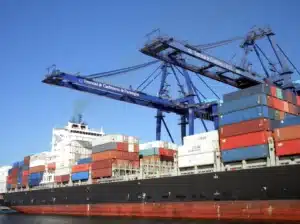
If you’re considering sourcing from Vietnam, you’re not alone, you’ll notice fast that Vietnam sits in a sweet spot between cost, capability, and market access.
From experience, the real win is that you can build a diversified supply base without adding chaos to your supply chain.
Vietnam also makes your trade compliance life easier in specific corridors thanks to active FTAs, which often translate into lower customs duties when your HS code and tariff classification are clean.
That’s exactly where many importers get stuck, one wrong HS code on the bill of lading, and your customs clearance timeline explodes.
Quick reality check, Vietnam rewards disciplined operations, clean specs, clear incoterms, and tight supplier follow-up.
If you like vague POs and “we’ll confirm later” shipment dates, Vietnam will punish you with missed ETDs and expensive spot rate bookings.
- Trade leverage: FTAs can reduce duties, but only if documentation and origin rules match your product.
- Manufacturing momentum: growing depth in assembly, cut-and-sew, wood, and electronics ecosystems.
- Logistics options: strong ocean freight out of HCMC area and Hai Phong, plus competitive air freight lanes.
- Risk diversification: reduces dependency on a single country and stabilizes lead-time exposure.
We’ve seen a buyer switch a consumer goods line from South China to the South of Vietnam and celebrate the unit cost, then lose the savings on rushed air waybill shipments because packaging specs weren’t locked.
That’s the moment you remember sourcing is not only about the factory price, it’s about total landed cost and predictable shipment tracking.
Checklist, before you commit to sourcing products from Vietnam at scale:
- Confirm your target incoterms (EXW, FOB, FCA) and who controls export documentation.
- Validate the HS code and duty scenario with a customs broker before mass production.
- Map your port of loading and port of discharge, then estimate FCL vs LCL options.
- Plan warehousing, inventory management, and distribution center needs for your destination market.
- Decide whether you need a bonded warehouse strategy for duty deferral or re-export flows.
Workflow we use with clients for low-friction ramp-up:
Define product specs and compliance, shortlist factories, request samples, align incoterms and payment, run a pilot order, book freight (LCL or FCL), manage cargo handling and containerization, clear customs, then measure defects and on-time delivery.
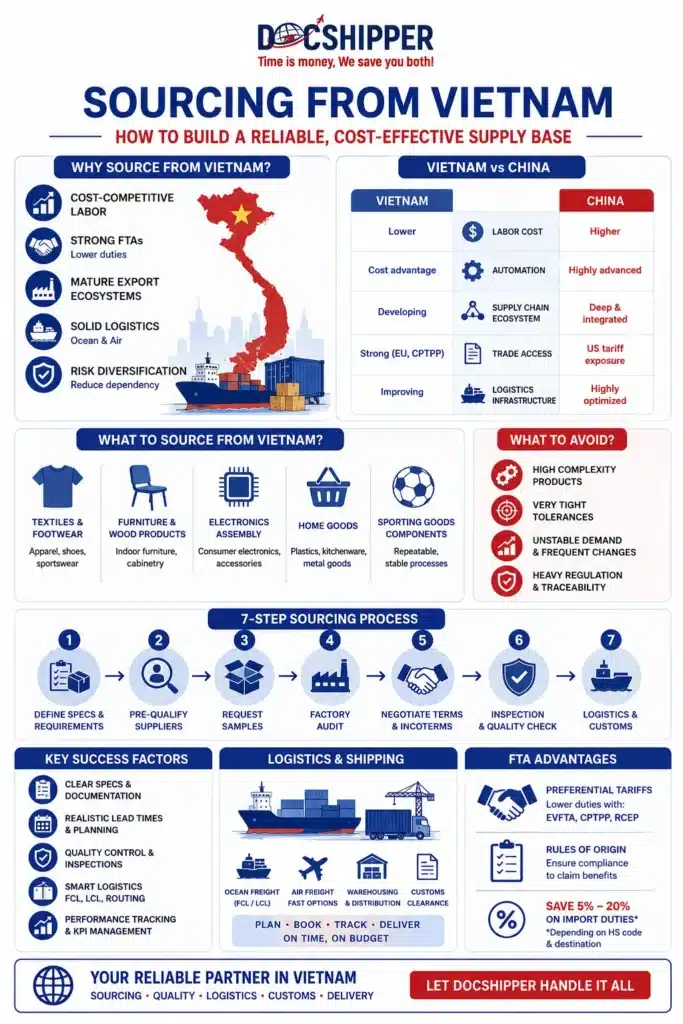
How Vietnam compares to China and other Asian manufacturing hubs
When you compare sourcing from Vietnam vs China, here’s the thing, Vietnam can feel simpler on labor cost, but stricter on planning and production bandwidth.
You’ll often get less “instant capacity” than China, so you need tighter supply chain management and earlier freight contract planning.
China still wins on deep-tier supplier networks and ultra-mature industrial clusters, especially when you need complex tooling, advanced automation, or rapid engineering iterations.
Vietnam wins when your product fits its strengths and you run disciplined vendor management with realistic lead times.
| Factor | Vietnam | China |
| Typical advantage | Cost-competitive labor, FTAs, diversification | Scale, supplier depth, speed of iteration |
| Common constraint | Capacity limits, upstream dependency for some materials | Geopolitical and tariff exposure in some lanes |
| Logistics pattern | Strong ocean freight corridors, improving multimodal transport | Highly optimized port network and freight consolidation |
| Best operating style | Structured POs, locked specs, planned bookings | Fast engineering loops, high SKU complexity |
One practical scenario we see a lot, you negotiate EXW in Vietnam to “control costs”, then realize you now own inland trucking, export customs, and cargo readiness at pickup.
Switching to FCA or FOB often stabilizes your process because the factory supports export paperwork and you get clearer handover points for freight forwarding.
If you’re benchmarking against Thailand, Malaysia, or Indonesia, Vietnam often comes out strong for export-oriented manufacturing density and ease of integrating with 3PL networks.
The World Bank logistics performance benchmarks are worth keeping in mind when you compare reliability, lead times, and infrastructure maturity.
DocShipper Advice
We benchmark Vietnam against China and ASEAN alternatives to align capacity, Incoterms, and freight control with your real growth plan.
Key export sectors where Vietnam manufacturing products lead the market

If your shortlist for sourcing from Vietnam includes proven export sectors, you reduce risk immediately because you’re riding established ecosystems.
This is where vietnam manufacturing products really shine, you get experienced factories, known testing standards, and a smoother path for export documentation.
In the field, we repeatedly see strong outcomes in:
- Textiles and footwear: cut-and-sew, athletic shoes, performance apparel.
- Furniture and wood products: indoor furniture, cabinetry, engineered wood lines.
- Electronics assembly: consumer electronics, accessories, sub-assemblies.
- Home goods: plastics, kitchenware, basic metal goods depending on spec complexity.
Here’s a micro-story you’ll recognize, a brand wants “premium” packaging for a made-in-Vietnam accessory line, the factory nails the assembly but sources cartons from a different province with inconsistent compression strength.
The fix wasn’t complicated, we added a packaging spec sheet, pre-shipment checks, and aligned palletization rules for safer containerization and fewer claims under cargo insurance.
From a logistics standpoint, export-heavy sectors usually ship in predictable patterns, which helps you lock better freight quotes, optimize FCL loads, and reduce last-minute LCL surcharges.
When your volumes justify it, freight consolidation and a stable pickup calendar also make cross-docking and route planning easier on the destination side.

DocShipper Info
Our team validates packaging, containerization, and cargo insurance exposure before you scale volumes or lock long term freight contracts.
Looking for a Reliable Shipping & Sourcing Partner?
What products you should source from Vietnam (and what to avoid)
Sourcing from Vietnam works best when your product matches the country’s manufacturing DNA and your QA plan is not an afterthought.
You’re aiming for the sweet spot, stable processes, repeatable materials, and shipment plans that don’t crumble when a vessel rolls.
The frustrating part is that many buyers start with “Vietnam is cheaper”, then discover hidden costs in rework, inspection, and delayed bookings.
We help you prevent that by matching product complexity to factory maturity and building the shipping plan around realistic lead times and customs brokerage.
Checklist, use this before you commit to manufacture outsourcing Vietnam for a new SKU:
- Can the factory control upstream materials locally, or will it import key inputs and add lead time?
- Do you need tight tolerances, complex tooling, or frequent engineering changes?
- Is testing required (mechanical, chemical, electrical), and who pays when it fails?
- What incoterms protect you best, and who issues export documentation?
- Can you buffer with warehousing or a bonded warehouse if demand is volatile?
Workflow we recommend for safer Vietnam product sourcing decisions:
Define product risk level, shortlist factories by sector, verify capacity and certifications, sample and lab-test, pilot order with inspection, finalize incoterms and packaging, book freight (FCL or LCL), plan customs clearance and duties, then scale with performance KPIs.
Best-fit categories for Vietnam product sourcing by industry
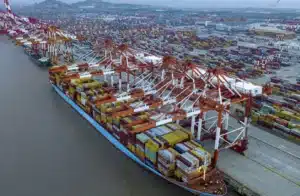
If you want results fast in vietnam product sourcing, start with categories where Vietnamese suppliers have long export experience and stable process control.
This is the practical path for sourcing products from Vietnam without betting your launch date on a factory learning curve.
- Apparel and soft goods: consistent sewing lines, grading, labeling, and packing workflows.
- Furniture: strong finishing capabilities, export packaging know-how, container load optimization.
- Consumer accessories: assembly-focused products with manageable BOM complexity.
- Sporting goods components: where processes are repeatable and QC checkpoints are clear.
We once supported a brand moving a mid-range furniture SKU to Vietnam, the factory price looked great, but the first container arrived with scuffed corners from poor palletization and loose carton stacking.
After we enforced carton drop-test requirements and container loading photos, damage rates dropped and proof of delivery claims basically disappeared.
For these categories, your logistics plan matters as much as vendor selection.
We often build a playbook around freight forwarding, containerization rules, booking cadence, and destination warehousing so you don’t bleed cash on demurrage or emergency re-routing.
DocShipper Advice
We build a freight and warehousing playbook around your category to reduce damage, demurrage, and emergency re-routing costs.
When “manufactured in Vietnam” is a bad fit for your product
Sometimes the smartest move in vietnam factory sourcing is deciding not to source in Vietnam, at least not yet for that SKU.
If your product needs ultra-complex machining, highly specialized components, or constant engineering changes, “manufactured in Vietnam” can become a slow, expensive experiment.
Typical red flags we see in the field:
- High complexity BOMs with multiple precision parts that require deep local sub-supplier tiers.
- Very tight tolerances where process capability and metrology need to be world-class from day one.
- Unstable demand that forces frequent rescheduling and breaks production planning.
- Regulated products where testing, traceability, and audit readiness must be flawless.
A real example, a buyer pushed a complex electromechanical product into Vietnam to save cost, then discovered the key sub-component still came from abroad, adding weeks and creating split shipments.
They ended up paying for partial air freight, partial ocean freight, and messy customs clearance because commercial invoices didn’t match shipment splits.
If you’re in that situation, you still have options.
We often recommend a hybrid strategy, keep complex parts in a mature hub, do final assembly or packaging in Vietnam, then ship via a controlled multimodal transport plan with clear export documentation and freight audit checkpoints.
“`htmlDocShipper Alert
We design split sourcing and multimodal transport strategies to avoid air freight spikes and customs inconsistencies.
DocShipper Platform
One platform. Your entire supply chain
Sourcing, freight, customs & documents — all centralised, all visible, 24/7.
Step-by-step guide to sourcing products from Vietnam with less risk
You cannot approach sourcing from Vietnam the same way you approached China ten years ago. You need structure, on-the-ground validation, and tight supply chain control from day one.
Here is the operational workflow we use at DocShipper when supporting importers in Vietnam.
- Step 1: Define technical specifications clearly, including materials, tolerances, packaging, labeling, and compliance standards.
- Step 2: Pre-qualify suppliers through business license verification, export history, and production capability assessment.
- Step 3: Request samples under controlled conditions with clear quality benchmarks.
- Step 4: Conduct factory audits on-site or via trusted local inspectors.
- Step 5: Negotiate Incoterms and payment terms based on risk exposure and logistics control.
- Step 6: Implement pre-production and pre-shipment inspections before releasing final payment.
- Step 7: Secure freight and customs planning aligned with your destination market regulations.
You should pay special attention to payment structure. In Vietnam, a typical model is 30% deposit and 70% before shipment, but this must be tied to inspection approval.
When negotiating Incoterms, you should compare risk allocation carefully.
| Incoterm | Who controls freight | Risk level for you | Recommended? |
| EXW | You | High | Only if you manage local pickup |
| FOB | Shared | Medium | Most balanced option |
| CIF | Supplier | Medium to High | Use with caution |
| DDP | Supplier | Low operational effort | Check tax transparency |
Vietnam’s infrastructure is improving but still uneven. You should factor in port congestion risks in Ho Chi Minh City and limited rail connectivity compared to China.
We recommend building buffer stock during your first production cycles. Lead times can fluctuate due to raw material imports from China, which still impacts regional supply chains.
How to evaluate Vietnam factory sourcing, compliance, and supply chain performance
Not all factories in Vietnam are equal, even within the same industrial zone. You need a structured evaluation model covering compliance, capacity, and long-term reliability.
Here is a practical checklist you can apply before confirming mass production.
- Legal registration verification with Vietnamese authorities.
- Export license confirmation and customs history review.
- Production capacity analysis including machinery age and automation level.
- Quality management system check, ISO, BSCI, or sector-specific certifications.
- Workforce stability and labor turnover rate.
- Environmental compliance and wastewater treatment systems.
- Traceability systems for raw materials, especially for EU or US markets.
Labor cost is attractive but rising steadily. Average manufacturing wages remain below China, but productivity per worker can be lower depending on industry.
| Factor | Vietnam | China |
| Labor cost | Lower | Higher |
| Automation level | Medium | High |
| Supply chain ecosystem | Developing | Highly integrated |
| Trade agreements | Strong EU and CPTPP access | US tariff exposure |
Trade policy is one of Vietnam’s strongest advantages. Through EVFTA and CPTPP, you can access preferential tariffs that reduce import duties significantly, sometimes by 5% to 20% depending on HS code.
However, rules of origin are strict. If your product relies heavily on Chinese components, you may not qualify for preferential treatment.
You should also evaluate supplier concentration risk. Vietnam has strong clusters in textiles, furniture, and electronics assembly, but upstream materials often remain imported.
At DocShipper, we conduct supplier audits, lab testing coordination, and full compliance reviews to secure your sourcing strategy. Our local teams ensure your production aligns with both Vietnamese law and your destination market regulations.
DocShipper Info
Our audits, lab testing, and compliance reviews ensure your sourcing aligns with destination regulations and tariff eligibility.
Conclusion
You should treat sourcing from Vietnam as a strategic diversification move, not just a cost-cutting exercise. When structured properly, it can strengthen your global supply chain resilience.
- Vietnam offers competitive labor costs and strong trade agreement advantages.
- Infrastructure and supply ecosystems are improving but not as mature as China.
- Supplier verification and audits are essential to reduce operational risk.
- Rules of origin and compliance must be analyzed before claiming tariff benefits.
- Structured logistics planning protects you from delays and hidden costs.
- Professional sourcing support helps you build a reliable and scalable Vietnamese supply base.
If you want to secure your Vietnam manufacturing strategy, we can support you from supplier identification to final delivery. The right preparation will determine whether your sourcing project becomes a competitive advantage or a costly mistake.
“`FAQ | Sourcing from Vietnam: how to build a reliable, cost-effective supply base
Vietnam gives you a different mix of cost, risk, and market access. You often get lower labor costs, access to powerful FTAs (like EVFTA and CPTPP), and reduced tariff exposure in the EU, UK, and some Asia-Pacific lanes. It also helps you diversify away from single‑country dependence, which reduces disruption risk when policies, freight rates, or lockdowns hit one market hard. The trade‑off is that you must accept more planning discipline and sometimes longer or less flexible lead times than in China.
Think in terms of mature export ecosystems rather than “anything and everything.” Vietnam is particularly strong in apparel and textiles, footwear, indoor and outdoor furniture, wood products, basic metal and plastic homewares, consumer electronics assembly, and a range of sporting goods and accessories. More specialized or highly engineered components are often still imported from China or other Asian hubs, so Vietnam typically works best where processes are repeatable, not ultra‑high tech.
Start by narrowing down to 1–2 proven export clusters (for example, furniture near Binh Duong/Dong Nai, or textiles around Ho Chi Minh City and the North). From there, combine targeted directory searches (export‑oriented trade portals, industry associations) with trade show exhibitor lists and freight forwarder recommendations. Shortlist only factories with clear export history in your product type, then filter them further by MOQ, available certifications, and willingness to support audits and third‑party inspections before you even talk pricing.
Treat it as a structured project, not a trial purchase. Begin by locking precise product specs and compliance requirements for your destination market, then build a shortlist of Vietnam‑based factories already exporting similar SKUs. Run controlled sampling rounds, verify licenses and export capability, and only then negotiate Incoterms and payment terms tied to inspections. Use one or two pilot orders to test lead times, defect rates, and communication before shifting significant volume.
Go beyond email and glossy brochures. At a minimum, you should match their legal name and tax code with Vietnamese authorities, validate their export license and customs track record, and request copies of key certificates (ISO, BSCI, sector‑specific). Whenever possible, arrange an on‑site factory audit or use a trusted local auditor to confirm machinery, staffing levels, and actual production lines. A credible manufacturer will accept third‑party inspections and provide consistent documentation without resistance.
The most damaging ones usually come from treating Vietnam “like China 10 years ago.” People assume factories can handle complex engineering changes at the last minute, underestimate how much upstream material still comes from abroad, or push for EXW terms without being ready to manage inland logistics and export customs. Others skip proper sampling, testing, and inspection to “save time”, then pay for it in rework, urgent air freight, and rejected shipments at destination.
Yes, and they often show up early in communication. Watch for vague or constantly shifting lead times, reluctance to share company registration details, inconsistent bank account names versus company names, and resistance to audits or third‑party inspections. Over‑eager promises like “we can make any product” or drastically lower quotes than other factories in the same region are also warning signs that capability, quality, or capacity may not match what is being sold.
Need Help with Logistics
or Sourcing in Vietnam ?
First, we secure the right products from the right suppliers at the right price by managing the sourcing process from start to finish. Then, we simplify your shipping experience - from pickup to final delivery - ensuring any product, anywhere, is delivered at highly competitive prices.
Fill the Form
Prefer email? Send us your inquiry, and we’ll get back to you as soon as possible.
Contact us