In short ⚡
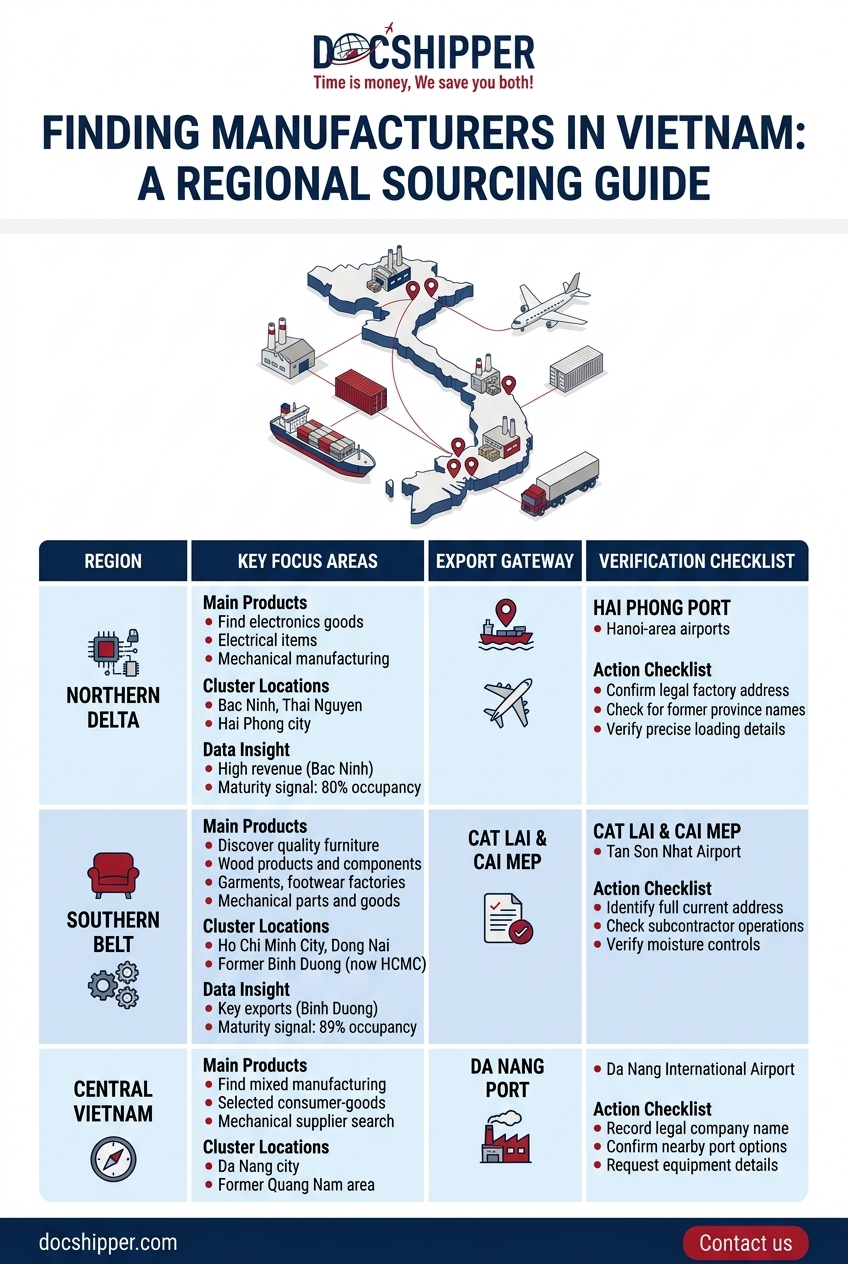
Industrial Zones in Vietnam: Where to Find Manufacturers by Industry depends on matching each product category with its established regional cluster and nearest export gateway. Use both current and former province names when searching because of the 1 July 2025 administrative merger. The main sourcing clusters are:| Industry | Key manufacturing clusters | Typical export gateway |
|---|---|---|
| Electronics and electrical products | Bac Ninh, Thai Nguyen and Hai Phong | Hai Phong Port and Hanoi-area airports |
| Furniture and wood products | Ho Chi Minh City, former Binh Duong and Dong Nai | Cat Lai, Cai Mep and Tan Son Nhat International Airport |
| Garments and textiles | Hanoi-area and Red River Delta clusters; Ho Chi Minh City and Dong Nai | Hai Phong, Cat Lai or Cai Mep |
| Footwear | Northern and southern delta manufacturing belts | Hai Phong, Cat Lai or Cai Mep |
| Mechanical and metal parts | Bac Ninh, Hai Phong, Ho Chi Minh City, Dong Nai and surrounding parks | The closest regional port |
| Mixed or central manufacturing | Da Nang, including former Quang Nam references | Da Nang Port and Da Nang International Airport |
Key topics include Vietnam’s northern, central and southern industrial map, provincial name changes, industry-specific manufacturer clusters, port selection, supplier verification, factory visits, audits and inland freight planning.
We hope you’ll find this article genuinely useful, but remember, if you ever feel lost at any step, whether it’s finding a supplier, validating quality, managing international shipping or customs, FNM Vietnam can handle it all for you!
Vietnam’s industrial map at a glance
Vietnam has approximately 300 operating industrial parks, concentrated in the Red River Delta around Hanoi and Hai Phong, in the southern manufacturing belt around Ho Chi Minh City and Dong Nai, and in a smaller central hub around Da Nang. For an importer, this map is useful because it narrows supplier research, factory visits and inland transport before you contact manufacturers.
The North is the strongest starting point for electronics, electrical products and some mechanical manufacturing. The South has a broader industrial base, with important furniture, wood-processing, garments, footwear, mechanical and consumer-goods clusters around Ho Chi Minh City, Dong Nai and neighbouring areas.
Central Vietnam is smaller but can be relevant when your suppliers are based around Da Nang or the former Quang Nam province. Its main export gateway is Da Nang Port, while northern and southern suppliers generally use Hai Phong and Cat Lai or Cai Mep respectively.
Occupancy is a useful maturity signal, not a direct measure of supplier quality. Vietnam Briefing reported average industrial-park occupancy of 80% in the North and 89% in the South in 2024, while end-2024 industrial land rents were reported at US$137 per m² in the North and US$175 per m² in the South. These figures indicate strong demand for industrial capacity, but they do not replace factory-level checks.
The most important naming issue is the provincial merger effective 1 July 2025. Vietnam moved from 63 to 34 provinces and cities, including the incorporation of former Binh Duong and Ba Ria-Vung Tau into Ho Chi Minh City, former Bac Giang into Bac Ninh, former Hai Duong into Hai Phong, former Quang Nam into Da Nang, former Long An into Tay Ninh and former Binh Phuoc into Dong Nai. Suppliers may still use the former names in websites, catalogues, export documents and map listings.
For example, search for both “Binh Duong furniture factory” and “Ho Chi Minh City wood manufacturer”. When checking a legal address, retain the address exactly as it appears on the company registration, while using the current administrative name for transport bookings and official correspondence.
| Region | Main sourcing profile | Typical export gateway |
| North | Electronics, electrical products, mechanical parts, garments | Hai Phong Port and Hanoi-area airports |
| Centre | Mixed manufacturing, selected mechanical and consumer-goods suppliers | Da Nang Port and Da Nang International Airport |
| South | Furniture, wood products, garments, footwear, mechanical parts and consumer goods | Cat Lai, Cai Mep and Tan Son Nhat International Airport |
Source: Vietnam Briefing, Vietnam’s Industrial Zones: 2025-2030 Growth Outlook, published 11 February 2025 and updated 14 March 2025; and Vietnam’s provincial merger plan, 12 June 2025.
Where to find manufacturers by industry
Start your Vietnam supplier search with the product category, then target the cluster where that category is already established. Electronics are concentrated in Bac Ninh, Thai Nguyen and Hai Phong; furniture and wood processing are particularly strong around former Binh Duong, now part of Ho Chi Minh City, and Dong Nai; garments, footwear and mechanical parts are distributed across both the northern and southern deltas.
Electronics and electrical products. Search Bac Ninh, Thai Nguyen and Hai Phong first, while keeping the former province names visible in your queries. Vietnam Briefing reports electronics net revenue of approximately US$42 billion in Bac Ninh, US$25 billion in Thai Nguyen and US$16 billion in Hai Phong. Bac Ninh therefore represents roughly one third of national electronics revenue according to that source, making it a logical starting point for components, consumer electronics and contract-manufacturing enquiries.
Do not assume that a company listed in an electronics cluster owns the production site. Ask for the exact factory address, production process, installed equipment, monthly capacity, minimum order quantity, lead time and recent export markets. Verify whether the company performs assembly, injection moulding, PCB work, testing or only trading, because these activities can appear under similar search terms.
Furniture and wood products. Search Ho Chi Minh City, former Binh Duong and Dong Nai for furniture, wooden components and home products. A 2024 report from Vietnam Agriculture states that Binh Duong had 1,215 wood-processing and exporting enterprises in 2022 and accounted for 43% of Vietnam’s wood-product exports in 2021. Because former Binh Duong is now administratively within Ho Chi Minh City, use both names when searching directories and contacting factories.
For furniture, verify whether the factory cuts and finishes wood itself or subcontracts key stages. Your checklist should cover kiln-drying or moisture-control procedures, material traceability, finishing systems, packaging tests, container loading plans and compliance documents required in your destination market. A large export cluster improves the chance of finding experienced factories, but it does not guarantee that every supplier can meet your design, certification or volume requirements.
Garments and footwear. Look across both deltas rather than limiting the search to one city. Northern clusters can be practical when your other suppliers are near Hanoi, Bac Ninh or Hai Phong, while southern clusters around Ho Chi Minh City and Dong Nai offer access to a large manufacturing and logistics network. During qualification, separate factories that cut, sew or assemble in-house from buying offices and trading companies.
Ask for the production calendar, sample approval process, fabric or component sourcing policy, quality-control checkpoints and capacity during peak season. For footwear, also confirm whether the supplier makes lasts, cuts uppers, assembles soles and performs final packing internally or through approved subcontractors.
Mechanical, metal and industrial parts. Search industrial parks in the northern and southern manufacturing belts, then filter candidates by process rather than by province alone. CNC machining, stamping, metal fabrication, casting and tooling require different equipment and quality systems, so the supplier’s advertised industry may not describe its actual capability.
Request an equipment list, drawings of comparable parts, inspection records, material certificates and the proposed production route. A factory audit should confirm that the machines shown in a quotation are operating at the stated site and that critical operations are not transferred to an undisclosed subcontractor.
| Industry | Main clusters to search | Nearest practical port or airport |
| Electronics | Bac Ninh, Thai Nguyen, Hai Phong, including former Bac Giang references | Hai Phong Port; Hanoi-area airports |
| Furniture and wood | Ho Chi Minh City, former Binh Duong, Dong Nai | Cat Lai or Cai Mep; Tan Son Nhat International Airport |
| Garments and textiles | Hanoi-area and Red River Delta clusters; Ho Chi Minh City and Dong Nai | Hai Phong in the North; Cat Lai or Cai Mep in the South |
| Footwear | Southern and northern delta manufacturing belts | Cat Lai or Cai Mep in the South; Hai Phong in the North |
| Mechanical and metal parts | Bac Ninh, Hai Phong, Ho Chi Minh City, Dong Nai and surrounding parks | Pair the factory with the closest regional port |
| Mixed or central manufacturing | Da Nang, including former Quang Nam references | Da Nang Port; Da Nang International Airport |
DocShipper Alert
Confirm the exact address and export route before comparing quotations.
Looking for a Reliable Shipping & Sourcing Partner?


North or South: how location affects lead time and freight
Choose the supplier region that is naturally connected to the export port serving your destination. Northern factories generally ship through Hai Phong, southern factories through Cat Lai or Cai Mep, and central factories through Da Nang; a supplier located far from the relevant gateway adds inland trucking, handling coordination and schedule risk.
At quotation stage, request the factory’s complete address, industrial-park name, loading conditions and preferred port. The address should be precise enough for a transport quotation, not just “Hanoi” or “Ho Chi Minh City”. A factory may use a city name for marketing while operating in a more distant industrial zone in a neighbouring former province.
Compare offers on the same basis. Ask whether the price is EXW, FCA, FOB or another Incoterm, and identify who pays for factory loading, inland trucking, export customs, port handling and documentation. The Incoterm defines the division of cost and responsibility between buyer and seller, so an apparently cheaper factory price may exclude substantial transport operations.
When suppliers are split between regions, avoid treating Vietnam as one compact sourcing area. Consolidating northern and southern cargo can require separate factory collections, different trucking plans and coordination at a consolidation warehouse. If the order is not large enough to justify this complexity, compare the cost of using one regional supplier against the commercial benefit of keeping multiple factories.
For a multi-supplier project, build a routing sheet with five fields: factory address, industrial park, cargo readiness date, nominated port and loading method. Then ask your forwarder to validate the inland leg before confirming the purchase order. DocShipper can confirm inland trucking times and costs only after receiving the actual factory locations and shipment details.
Port selection also affects factory-visit planning. A northern trip can group suppliers around Hanoi, Bac Ninh, Thai Nguyen and Hai Phong, while a southern trip can group factories around Ho Chi Minh City, former Binh Duong and Dong Nai before inspecting loading arrangements for Cat Lai or Cai Mep.
| Supplier location | Likely export gateway | What to verify before ordering |
| Bac Ninh, Thai Nguyen or Hai Phong | Hai Phong Port | Factory address, cargo readiness, container access and export experience |
| Ho Chi Minh City or former Binh Duong | Cat Lai or Cai Mep | Distance to port, loading restrictions, consolidation requirements |
| Dong Nai or former Binh Phuoc | Cat Lai or Cai Mep | Current administrative address and inland trucking quotation |
| Da Nang or former Quang Nam | Da Nang Port | Port suitability, sailing options and factory loading conditions |
DocShipper Tips
Build a cluster-based shortlist and coordinate audits with freight planning.
Using industrial zones in your supplier search
Use industrial zones as a filtering method, not as proof that a company is a manufacturer. Search by product, cluster and park, verify the registered factory address, and plan visits around geographic concentration. This approach reduces irrelevant leads and makes it easier to compare factories that serve similar export markets.
1. Build a cluster-based search list. Start with a search formula such as “Bac Ninh electronics manufacturer”, “former Binh Duong furniture factory”, “Dong Nai wood products factory” or “Hai Phong metal parts supplier”. Repeat the search with current and former province names because directories and supplier websites are not updated at the same speed as administrative records.
Use B2B platforms, industrial-park directories, trade associations and the business registration portal to create a longlist. Record the legal company name, website, factory address, park name, product category, contact person and evidence of production. A supplier that only lists a sales office should remain separate from a supplier that provides a verifiable production site.
2. Verify the factory before scheduling a visit. Compare the address on the quotation, business registration, website, map listing and export documents. Ask for photographs or a video call showing the entrance, production floor, machinery, warehouse and quality-control area, then check that the company name is visible where possible.
Evaluate years of operation, capacity, MOQ, lead time and quality systems. Confirm the ownership of the facility, the use of subcontractors and the company’s ability to issue the documents required for export. These checks help screen out brokers presenting themselves as factories, but an on-site audit remains necessary before a significant order.
3. Group the factory visits. Select factories by cluster and keep one region per trip whenever possible. A practical visit plan can target three to five suppliers in two days when their addresses are genuinely close, while reserving time for traffic, production-floor access, document review and follow-up questions.
Send each factory a standard agenda before arrival. Include product specifications, sample references, production stages to inspect, questions about capacity and a request to meet the person responsible for quality. After each visit, score the supplier using the same criteria instead of relying on the most polished showroom.
4. Convert the shortlist into an audit and freight plan. Once the preferred factories are identified, confirm the factory address again before requesting a final logistics quotation. Audit the production site, approve samples, validate packaging and agree on inspection points before placing the purchase order.
- Before the trip: define the product specification, target quantity, required certifications, acceptable MOQ and delivery window.
- For each supplier: record the legal name, current and former province name, industrial park, factory address, contact person and production scope.
- During the visit: inspect incoming materials, machinery, production flow, quality controls, finished-goods storage and loading access.
- Ask for evidence: capacity records, comparable export orders, quality documents, subcontractor details and a production lead-time schedule.
- After the visit: compare suppliers using the same scorecard, request corrective actions and obtain a confirmed inland transport quotation.
The result should be a sourcing map that connects product category, factory capability and export route. If a factory is attractive but far from the relevant port, calculate the complete landed-cost and schedule impact before treating its unit price as competitive.
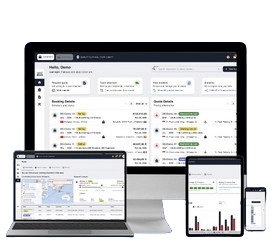
DocShipper Platform
One platform. Your entire supply chain
Sourcing, freight, customs & documents — all centralised, all visible, 24/7.
Conclusion
Industrial zones in Vietnam are most useful to importers when they are treated as a supplier-search and logistics tool rather than an investment map. Match the product to an established cluster, verify the real factory address and connect the factory to the nearest suitable port before arranging visits or comparing quotations.
- Vietnam has approximately 300 operating industrial parks, concentrated mainly in the North and South.
- Electronics are strongly clustered in Bac Ninh, Thai Nguyen and Hai Phong.
- Furniture and wood suppliers are concentrated around Ho Chi Minh City, former Binh Duong and Dong Nai.
- Supplier addresses may use either current or former province names after the 1 July 2025 merger, so search both.
- Pair northern factories with Hai Phong, southern factories with Cat Lai or Cai Mep, and central factories with Da Nang.
- Plan factory visits by cluster so you can compare several suppliers without creating unnecessary inland travel.
Tell us your product and destination market. We will identify the clusters to target, shortlist factories there, audit their capabilities and coordinate the freight plan from the appropriate Vietnamese port.
FAQ | Industrial Zones in Vietnam: Where to Find Manufacturers by Industry
Yes. Some smaller manufacturers operate in standalone workshops, rural production areas or specialised craft clusters. However, you should apply stricter checks because they may have less formal infrastructure. Confirm the legal operating address, production capacity, machinery ownership, environmental compliance, truck access and ability to load export cargo safely before placing an order.
No. An industrial-park address confirms that the company operates in an established manufacturing area, but it says nothing by itself about export experience, quality consistency or documentation. Ask for recent export references, sample shipping documents, product-specific certifications and evidence that the quoted production process is performed at that site.
The legal entity may have its headquarters, sales office and production site at different locations. This is common, but the distinction must be documented. Ask the supplier to identify which address appears on the enterprise registration, which location manufactures your goods and which entity will sign the purchase contract and issue the commercial invoice.
Treat the refusal as a qualification risk, especially for a high-value or customised order. First request a live video inspection showing the entrance, company name, production lines, machinery, warehouse and current work orders. You can also use an independent inspection company, but avoid approving a large order until the actual production site and subcontractors have been verified.
Not necessarily. Rent levels can indicate strong demand for manufacturing space, but they do not directly determine a factory’s unit cost. Compare the complete commercial offer instead: material costs, labour, tooling, quality controls, packaging, inland transport, Incoterms and expected production volume. A factory with a higher local cost base may still be more competitive if it has better productivity or fewer subcontracted processes.
Do not rely only on the supplier’s industrial-zone location or general quality certificates. Ask which production stages involve chemicals, emissions, waste or regulated materials, and request the relevant operating permits, test reports and compliance records for your destination market. Confirm that the documents belong to the manufacturing entity and cover the exact factory address, product and production process.
Not automatically. Large industrial suppliers may prioritise recurring, high-volume customers and impose higher minimum order quantities. Before comparing prices, confirm whether the factory accepts pilot orders, charges for tooling or sampling, reserves production capacity for small batches and can maintain the same quality standards when volume increases. A smaller qualified supplier may be more appropriate for initial market testing.
Need Help with Logistics
or Sourcing in Vietnam ?
First, we secure the right products from the right suppliers at the right price by managing the sourcing process from start to finish. Then, we simplify your shipping experience - from pickup to final delivery - ensuring any product, anywhere, is delivered at highly competitive prices.


Fill the Form
Prefer email? Send us your inquiry, and we’ll get back to you as soon as possible.
Contact us