In short ⚡
Export customs clearance is the formal process by which customs authorities authorize goods to legally leave a country, based on accurate data, complete documentation, and compliance checks on security, fiscal rules, and trade regulations. It links logistics, legal compliance, and payment flows, and any error (wrong HS code, missing license, mismatched documents) can trigger inspections, delays, and extra costs.In this article, you will find core pre‑export requirements, detailed document lists, step‑by‑step clearance stages, broker and forwarder roles, typical timelines and delay causes, Vietnam‑specific procedures, and practical workflows to plan smooth, compliant export shipments.
We hope you’ll find this article genuinely useful, but remember, if you ever feel lost at any step, whether it’s finding a supplier, validating quality, managing international shipping or customs, FNM Vietnam can handle it all for you!
What export customs clearance is and how it fits into global trade
Export customs clearance is the set of formalities you complete so customs can legally let your shipment leave the country, with the right data, documents, and controls.
Here’s the thing, it’s not “paperwork for paperwork’s sake”, it’s how your cargo becomes traceable in the global supply chain, from warehousing and freight forwarding to transportation and final distribution.
In practice, export clearance sits right at the intersection of logistics, compliance, and money flow.
If one piece is off, wrong HS code, missing license, mismatch between packing list and airway bill, your lead time explodes.
DocShipper Alert
Let our experts audit your export data before filing and protect your vessel cut-off and lead time.
The role of customs authorities in export and import clearance
One Monday morning at a busy port, we saw a container held because the exporter’s invoice said “machine parts”, while the declaration used a more specific HS description.
Customs didn’t “punish”, they simply did their job, verify identity, value, safety, and whether the export is allowed.
For export customs clearance, customs authorities validate your export declaration, assess risk, and decide if they release the goods or inspect them.
On the import clearance side, they also calculate duties and tariffs, check licensing, and enforce product rules at destination.
To make it concrete, customs typically focuses on a few control pillars.
- Security and prohibited goods, dual-use items, restricted chemicals, counterfeit risk
- Fiscal integrity, valuation, currency controls, export tax where applicable
- Trade compliance, licensing, sanctions, quotas, origin claims
- Supply chain visibility, matching cargo, container numbers, seals, and manifests
From experience, you’ll notice fast that good customs officers love one thing, clean data that matches across every document.
Many administrations align their controls with the World Customs Organization (WCO) framework, which is why consistent classification and documentation matters in almost every corridor.
Key differences between export customs, import customs, and transit procedures
Direct tip, stop treating export clearance like a “small step” compared to import.
In the customs clearance process, export errors are the ones that ruin your vessel cut-off, cause storage fees, and trigger rework with your forwarder.
So what changes between export customs, import customs, and transit.
| Procedure | Main goal | Typical trigger | Operational impact |
| Export customs | Authorize goods to leave, validate compliance | Export declaration, booking, cargo gate-in | Port cut-off risk, inspection, export release |
| Import customs | Authorize entry, collect duties and taxes | Arrival notice, manifest, import declaration | Demurrage, duty payment, delivery scheduling |
| Transit | Move under control without local duties | Bonded move, intermodal connection | Guarantees, seals, routing constraints |
You’ll also see a practical split in responsibility.
Export clearance often sits with your shipper side processes, while import clearance depends heavily on your buyer, local broker, and the destination’s rules.
Core requirements you must meet before export customs clearance
Before you even think about the port gate, your export customs clearance depends on a few basics, who you are legally, what you’re shipping, and who is responsible under Incoterms.
This is the moment most exporters get stuck, everything looks ready, but customs can’t accept the declaration because one upstream prerequisite is missing.
DocShipper Advice
We help you validate registrations, bank setup, and exporter codes so your declaration is accepted first time.
Exporter registrations, export codes, and bank/foreign exchange setup
Two weeks before departure, we once watched a supplier scramble because their export code wasn’t active, so their forwarder couldn’t lodge the declaration.
The container was booked, trucking was arranged, and yet nothing moved, pure administrative blockage.
For export customs clearance, you typically need a valid exporter registration, the right tax identity, and any national export identifier your country requires.
Then comes the part many people underestimate, your bank and foreign exchange setup must match your contract and payment terms, especially for regulated countries or controlled currencies.
Use this short checklist to confirm you’re “declaration-ready” before you allocate freight capacity.
- Exporter registration active and matching your legal entity name
- Authorized signatories aligned with your customs filings
- Bank details consistent with the commercial invoice and contract
- Foreign exchange documentation ready if required for settlement
- Digital access to the customs portal for you or your customs broker
Get this right and your lead time becomes predictable, which is gold for capacity planning and just-in-time delivery.
Choosing Incoterms and assigning customs responsibilities
Question, do you know who is actually filing export clearance in your deal, you or your buyer?
In the real world, confusion around Incoterms is one of the fastest ways to create a customs clearance process mess, especially when your forwarder receives last-minute instructions.
For export customs clearance, Incoterms define who arranges transportation, who pays which costs, and who carries risk, but you still need to align them with who controls documents.
Here’s a simple workflow we use to lock responsibilities before booking.
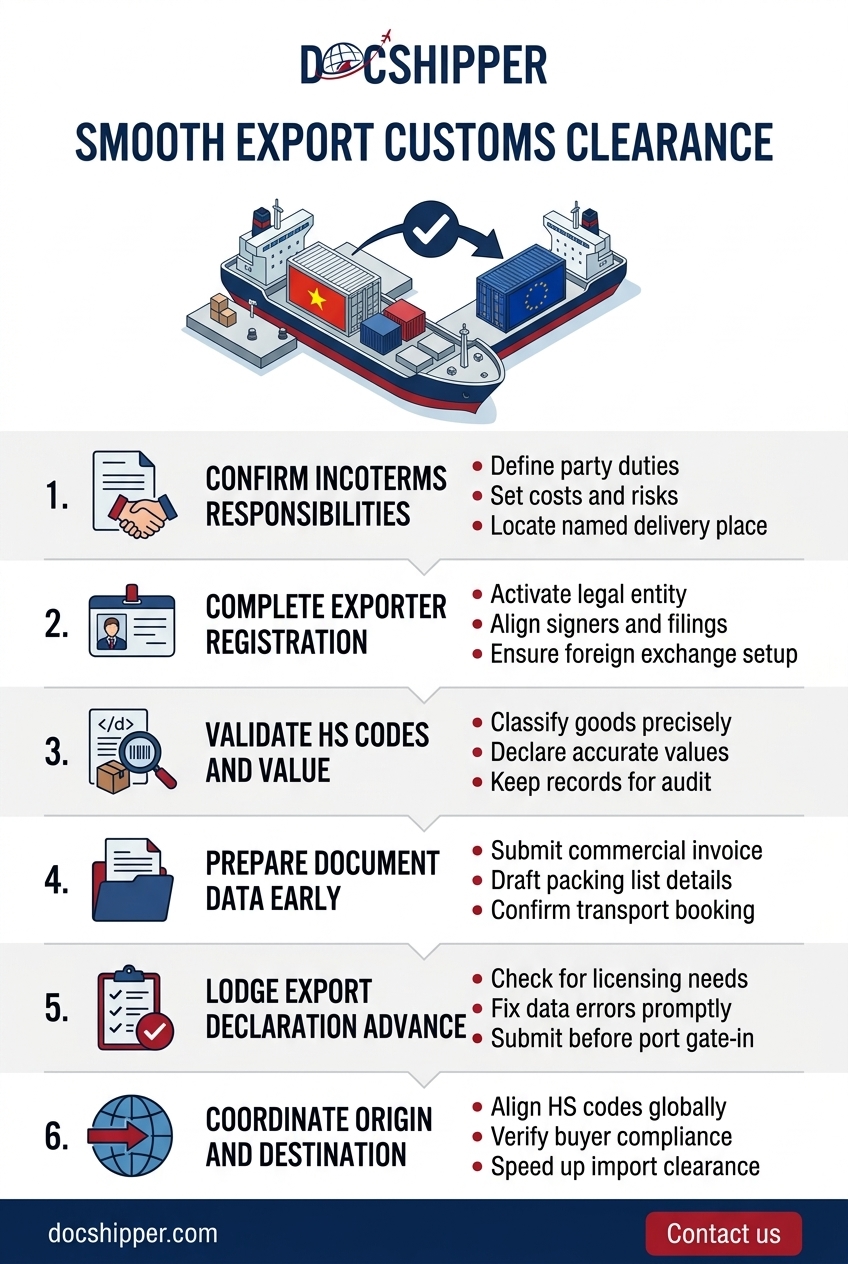
- Step 1, confirm Incoterm and named place, not just “FOB” but “FOB Cat Lai”
- Step 2, decide who files export clearance and who provides the data set
- Step 3, align freight mode and documents, bill of lading vs airway bill
- Step 4, confirm insurance point, cargo insurance scope and claims contacts
- Step 5, validate handover timing, warehouse pickup, cross-docking, or port gate-in
If you want a practical refresher on responsibilities and common pitfalls, you can review our guide on customs clearance.
When you need export licenses, permits, and special scheme approvals
Bold statement, “We’ll fix the license after booking” is how shipments miss sailings.
When your goods fall under controlled categories, your export clearance depends on permits that customs may verify before granting export release.
You’ll typically need authorizations for controlled tech, medical items, food, chemicals, batteries, or goods under quota, plus any special economic scheme approvals if you’re claiming exemptions.
To help you triage quickly, use these red flags.
- Dual-use potential, industrial components, sensors, telecom gear
- Regulated materials, lithium batteries, liquids, aerosols, hazardous cargo
- Health-related products, supplements, cosmetics, medical devices
- Origin-sensitive goods, subject to sanctions or additional screening
If you’re unsure, don’t guess.
We usually recommend you ask your forwarder and customs broker to run a pre-check based on HS code, end-use, and destination restrictions before you confirm freight rates.
Documents you need for export customs clearance
Your export customs clearance is only as strong as your document set, because customs systems cross-check fields across documents automatically.
You’ve probably dealt with that frustrating moment when one typo on the invoice forces your broker to amend the declaration and your truck misses the terminal window.
DocShipper Info
Need a pre-shipment document check? We review invoices, declarations, and transport records to avoid last-minute amendments.
Commercial documents: invoices, packing list, contract, and payment terms
Last quarter, we saw a shipment delayed because the packing list showed 98 cartons, but the invoice showed 100.
No one thought it mattered until customs selected it for a quick check and the warehouse had to reopen pallets.
For export customs clearance, your commercial documents prove the transaction and the “story” of the cargo, what it is, how much, for whom, and under what terms.
At minimum, your set should be consistent and specific.
- Commercial invoice, correct buyer, seller, currency, Incoterm, unit price, total value
- Packing list, net and gross weights, carton count, palletizing details, marks and numbers
- Sales contract or PO, product scope, tolerances, delivery terms, penalties
- Payment terms, TT, LC, DP, plus bank coordinates and references
Small insider tip, customs and banks hate vague descriptions like “spare parts”.
If you can’t explain the product in one precise line, you’ll struggle later with HS code, valuation, and inspection questions.
Transport and customs documents: shipping bill, bill of lading, export declarations
Direct tip, treat transport documents as operational control tools, not admin clutter.
In the customs clearance process, the declaration and transport record must align so your cargo can be tracked through containerization, gate-in, loading, and final departure.
Depending on mode and country, you’ll deal with documents like shipping bill, export declaration, and the transport document.
| Document | What it does | Where it bites you if wrong |
| Export declaration | Declares goods, value, HS code, exporter, destination | Stops export release, triggers inspection or amendments |
| Shipping bill (where applicable) | Formal export filing reference used by customs and ports | Breaks port processes, blocks loading confirmation |
| Bill of lading / Airway bill | Transport contract and tracking reference | Misroutes cargo, delays consignee import clearance |
Once these are clean, your forwarder can plan consolidation, intermodal transport, and delivery schedule with less drama.
Origin, compliance, and tax documents: certificates, duty drawback, and VAT/GST links
Question, are you exporting with a preferential tariff claim at destination, or just shipping standard terms?
For export customs clearance, origin and compliance documents can be the difference between smooth import clearance and a customs query that freezes your buyer’s inventory.
Common documents include certificates of origin, compliance declarations, and tax-related evidence to support duty drawback or VAT/GST zero-rating where applicable.
Use this checklist before you promise your buyer a landed cost.
- Certificate of origin ready, and matches HS code and product description
- Compliance evidence if required, test reports, standards references, labeling proofs
- Proof of export plan, you know which document will support VAT/GST treatment
- Drawback file prepared if you’re reclaiming duties on inputs
We’ve seen exporters lose refunds simply because the proof of export didn’t match the commercial invoice number.
It’s boring, yes, but it’s real money.
Step-by-step export customs clearance process
The export customs clearance process looks linear on paper, but in operations it overlaps with trucking, terminal cut-offs, and freight consolidation.
If you want fewer delays, you plan the sequence like a supply chain manager, not like a document clerk.
DocShipper Advice
Coordinate booking, declaration, and gate-in with us to secure release before terminal cut-off hits.
Before cargo reaches the port: booking, declarations, and pre-clearance
One exporter we supported booked space first, then discovered their HS code triggered an export license requirement.
The result was painful, the booking rolled, the spot rate changed, and they paid extra warehousing while waiting.
For export customs clearance, your best move is to run pre-clearance thinking before your cargo leaves the warehouse.
Here’s a practical workflow you can follow with your forwarder and customs broker.
- Step 1, confirm cargo readiness, counts, weights, packaging, palletizing
- Step 2, book freight, choose route and mode, ocean, air, multimodal transport
- Step 3, prepare export data, HS code, value, origin, Incoterm, parties
- Step 4, file draft declaration for validation, fix errors early
- Step 5, schedule pickup and gate-in to respect terminal cut-off
When you do this, you protect your delivery schedule and avoid panic amendments at the last minute.
At the port or airport: document submission, inspection, and “let export” order
Direct tip, assume you’ll get questions if your description is vague or your weights don’t reconcile.
During export clearance, customs reviews the declaration, may request supporting documents, and can select your cargo for inspection.
Inspections can be documentary, scanning, or physical, and each one changes your handling plan, equipment, labor, and timing.
To keep control, align responsibilities across the parties on the ground.
- Customs broker, submits entries, answers queries, manages amendments
- Freight forwarder, coordinates terminal/airline requirements and cut-offs
- Trucker, manages gate appointments and seal control
- Warehouse, provides repacking support if inspection requires opening cargo
Once customs issues the “let export” style release, your shipment can proceed to loading.
This is also where tight tracking and tracing helps you avoid blind spots.
After loading: export manifest, proof of export, and drawback or tax refund
Bold statement, your work isn’t done when the container is on the vessel.
In the customs clearance process, post-loading steps matter because they create the audit trail you’ll need for payment, claims, and tax recovery.
After departure, the carrier files the export manifest, and you collect proof of export documents, then you use them for duty drawback or VAT/GST processes where applicable.
| Post-loading item | Why you need it | Who usually provides it |
| Final BL/AWB | Ownership, transport confirmation, tracking reference | Carrier or freight forwarder |
| Departure confirmation | Supports proof of export and timelines | Forwarder, airline, or shipping line |
| Export release record | Evidence your export customs clearance was granted | Customs portal or customs broker |
If your buyer needs fast import clearance, this is where you win time.
Send clean scanned sets early, not after the ship arrives.
How customs brokers and freight forwarders support export clearance
You can handle parts of export customs clearance internally, but most smooth operations rely on a good customs broker and a forwarder who actually understands end-to-end logistics.
When those two roles coordinate, you reduce amendments, protect cut-offs, and keep freight rates from spiraling due to rework.
DocShipper Info
We synchronize HS codes, filings, and transport milestones to keep your export flow stable end to end.
What customs brokers actually do for exporters
We once stepped into a case where an exporter blamed the port for delays, but the real issue was a broker filing with an outdated HS code mapping.
Customs flagged it, inspections followed, and the exporter paid storage and trucking re-attempts.
For export customs clearance, a customs broker doesn’t just “submit forms”, they translate your commercial reality into compliant customs data.
Here’s what you should expect them to own.
- Classification support, HS codes and product descriptions that stand up to scrutiny
- Declaration filing, accurate entries, amendments, and customs communications
- Compliance checks, licenses, permits, restricted goods screening
- Release management, monitoring status, resolving holds fast
If your volumes are growing, you’ll benefit from a broker who can standardize templates across SKUs and reduce variability.
Looking for a Reliable Shipping & Sourcing Partner?


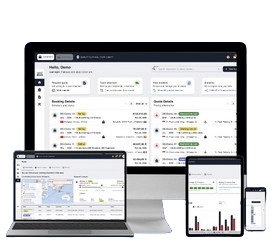
DocShipper Platform
One platform. Your entire supply chain
Sourcing, freight, customs & documents — all centralised, all visible, 24/7.
Working with a freight forwarder for end-to-end export and import clearance
Direct tip, pick a forwarder who asks uncomfortable questions early, HS code, Incoterms, packaging, and cut-offs.
That’s how you avoid surprises later in the export customs clearance flow and in the destination import clearance.
A freight forwarder ties together transportation, warehousing, consolidation, and document timing, especially in multimodal transport chains.
To set the relationship up right, align on these operational expectations.
- Routing plan, transit time, intermodal legs, and contingency options
- Milestones, pickup, gate-in, customs filing, loading, departure, arrival
- Document deadlines, when they need invoice/packing list to avoid amendments
- Exception handling, who pays what if inspection triggers extra handling
If you want us to review your flow and tighten the handoffs between broker, forwarder, and warehouse, you can Contact us.
How long export customs clearance takes and what causes delays
When you plan your export customs clearance, the first question you ask is simple, how long will it take? In reality, timelines vary depending on the country, the cargo profile, and how well you prepared your file before the goods reached the port.
From experience, most delays do not come from customs being “slow”. They come from missing data, inconsistent documents, or poor coordination between you, your forwarder, and your broker.
DocShipper Alert
Ask us for a clearance risk review and eliminate data gaps before customs systems flag your file.
Typical clearance timelines and inspection scenarios
Last year, we handled a shipment of consumer electronics where the exporter expected same‑day export customs clearance. The documents were clean, but the HS code triggered a random inspection, and the cargo stayed at the port for three extra days.
You’ll usually see three main scenarios during export customs clearance.
Here is a simplified overview to help you anticipate timing:
| Scenario | What happens | Typical timeline |
| Green channel | Automatic document validation, no inspection | 1 to 24 hours |
| Document check | Customs reviews invoice, HS code, value | 1 to 3 days |
| Physical inspection | Container or packages opened and verified | 2 to 7 days |
Risk management systems used by customs administrations, aligned with World Customs Organization standards, determine which channel your shipment enters. You don’t control the channel, but you absolutely control the quality of your declaration.
Before each shipment, you should verify this quick checklist to reduce inspection risks:
- Correct HS code matching product description
- Consistent value between invoice and declaration
- Clear and precise product description
- Valid export license if required
- No discrepancy between weight and packing list
If one of these elements looks suspicious, customs systems will flag your file automatically.
Common issues that slow export customs and how to avoid them
What really slows down export customs clearance in practice? It’s rarely a dramatic problem, it’s usually small inconsistencies that accumulate.
You’ve probably dealt with suppliers who copy old invoices and forget to update the product description. That single mistake can trigger a document query and freeze your container at the terminal.
Here are the most frequent causes of delay we see:
- Mismatched HS code and product specification
- Undervaluation or inconsistent pricing history
- Missing export permit for controlled goods
- Late submission of export declaration
- Incorrect Incoterm stated on invoice
To avoid these issues, you can follow a simple operational workflow:
Step 1: Validate HS code internally or with your broker. Step 2: Cross‑check invoice, packing list, and contract. Step 3: Submit declaration before cargo arrives at port. Step 4: Prepare inspection readiness, photos, and product specs. Step 5: Monitor customs status daily until “let export” is granted.
This structured approach keeps your clearance risk under control and protects your shipping schedule.
Export customs clearance in Vietnam and key country‑specific points
If you handle export customs clearance in Vietnam or similar emerging markets, you’ll notice the process is digitized but still very document‑driven. The legal framework is clear, yet operational reality requires local experience.
We’ve seen exporters assume that electronic submission guarantees speed. In practice, local inspections, valuation checks, and sector‑specific permits can still slow you down.
DocShipper Info
Our Vietnam team aligns permits, HS codes, and sector rules to keep your export compliant and predictable.
Particularities of export clearance in Vietnam and similar emerging markets
A client exporting wooden furniture from Ho Chi Minh City once forgot to attach the correct origin documentation. The customs system accepted the declaration, but the shipment was blocked pending verification of timber legality.
In Vietnam, your export customs clearance often depends on sector compliance, especially for:
- Wood and agricultural products
- Seafood and food items
- Electronics and dual‑use goods
- Textiles under preferential trade agreements
The General Department of Vietnam Customs applies risk management aligned with international standards, but local interpretation matters. You need to double‑check licensing requirements and product conformity before filing.
Before exporting from Vietnam, review this operational checklist:
- Valid business registration and tax code
- Correct export declaration in the electronic system
- Sector‑specific permit if required
- Consistent HS code with Vietnam tariff schedule
- Transport booking aligned with customs timeline
Emerging markets often combine strict formal rules with practical flexibility, so coordination with a local broker is critical.
Coordinating export and import clearance between origin and destination
Here’s a question you should always ask yourself, does your import customs broker at destination agree with your export declaration at origin?
Many delays in export customs clearance actually start with poor coordination between the exporting and importing sides. If the HS code declared in Vietnam differs from the one used for import clearance in Europe, authorities may question the transaction value.
You can prevent this by aligning both sides before shipment:
- Share draft export documents with your import broker
- Confirm HS code consistency in both countries
- Validate Incoterms and declared customs value
- Anticipate destination compliance requirements
According to UNCTAD trade facilitation guidance, transparency and data consistency between trading partners significantly reduce border delays. In practice, this means your export and import teams must talk before the container sails.
When we coordinate both ends for our clients, clearance becomes predictable rather than stressful.
Practical tips to build a successful customs clearance plan
You don’t improvise export customs clearance. You design it like a project, with timelines, responsibilities, and validation steps built in from the start.
If you treat customs as an afterthought, you’ll pay with demurrage, storage fees, and missed delivery deadlines.
DocShipper Advice
Build a structured clearance plan with our specialists and turn compliance into a competitive advantage.
Preparing data and documents early to prevent port congestion
One peak season, a shipment arrived at port before the export declaration was filed. The terminal was congested, and the container waited five days just for document validation.
You can avoid this scenario by preparing your customs file before the cargo moves.
Here’s a simple pre‑shipment workflow you can implement:
Step 1: Finalize commercial invoice and packing list. Step 2: Validate HS codes and export control status. Step 3: Send draft documents to your broker for review. Step 4: Submit export declaration in advance. Step 5: Book transport only after confirmation of acceptance.
This approach reduces exposure to port congestion and gives you room to react if customs requests clarification.
To make sure nothing is forgotten, use this control checklist:
- Invoice signed and consistent with contract
- Packing list with exact weights and volumes
- Export permit attached if required
- Correct Incoterm stated clearly
- Broker contact confirmed and responsive
Using correct HS codes, values, and descriptions to manage duties and checks
Correct classification is non‑negotiable. Your entire export customs clearance process relies on the HS code you declare.
If you underestimate value or use a vague product description, customs systems may flag your shipment for risk analysis. The World Trade Organization framework for tariff classification is clear, but interpretation at national level can differ.
You should always:
- Use precise, technical product descriptions
- Avoid generic terms like “parts” or “accessories”
- Maintain historical consistency in declared values
- Keep internal classification records for audit purposes
When you manage HS codes and valuation properly, your export customs clearance becomes faster, more predictable, and easier to defend during audits.
Conclusion
Export customs clearance is not just paperwork, it’s a structured compliance process that determines whether your goods move smoothly or get stuck at the border.
If you anticipate requirements, coordinate origin and destination, and control your data quality, you turn customs from a risk into a competitive advantage.
Here are the key takeaways you should remember:
- Plan your clearance timeline before booking transport
- Align export and import data to avoid cross‑border discrepancies
- Prepare documents early and verify every detail
- Use accurate HS codes and realistic declared values
- Work with experienced brokers when operating in emerging markets
When you approach customs strategically, you protect your margins, your delivery deadlines, and your reputation with international partners.
FAQ | Export customs clearance: how to move your goods across borders without delays
Export customs clearance is the moment where your internal operations (sales, production, packing) connect with the legal world of cross‑border trade. Its role is to verify that what you sold, packed, and loaded is legally allowed to leave the country, correctly classified, and supported by the right evidence. In practice, it turns your shipment from “warehouse stock” into officially declared export cargo, with a traceable identity customs, carriers, banks, and tax authorities can all rely on.
When people say “customs clearance” they often mean import, where duties and taxes are paid. Export clearance is narrower but just as critical. It focuses on permission to leave (controls, licenses, origin, sanctions, export schemes), while import clearance focuses on permission to enter and taxation. Skipping or treating export clearance lightly can still trigger penalties, blocked refunds, and investigations, even if no duty is due at origin.
You can often file export declarations yourself if you’re registered and have access to the customs IT system, but it’s rarely efficient once your volumes or product mix grow. A broker will know how to code complex products, manage licenses, and react when customs asks questions. A good rule of thumb: manage simple, repetitive flows internally if you have expertise, and use a licensed customs broker for multi‑SKU, controlled, or high‑value exports where mistakes are expensive.
Minor errors can have major operational consequences. A weight mismatch, a typo in HS code, or a vague description can be enough for customs’ risk engine to flag your file. That can mean extra questions, documentary checks, or physical inspections, all of which add time, storage costs, and sometimes re‑packing. The real risk is not only delay, but also that your shipment record becomes “sensitive”, which can increase scrutiny on your future export customs clearance filings.
In most countries, there is a minimum value threshold or simplified regime for low‑value shipments (for example express parcels). However, that doesn’t mean “no export customs”, it usually means simplified data or consolidated declarations by a carrier. As soon as you send commercial cargo, especially B2B goods, dual‑use items, or regulated products, you should assume an export declaration is required, even if your invoice amount is relatively small. Always check the rule for your product and country, not just the invoice value.
Your tax or duty refunds depend entirely on the “paper trail” created during export clearance. If declaration data, commercial invoice, and proof of export don’t match, authorities can reject your claim, even if the goods physically left. That’s why you should coordinate with finance and tax teams before the first shipment, decide which documents will be used as proof, and make sure your export customs clearance data fields (values, HS code, exporter name) are aligned with what the tax office expects to see.
Read more
Looking for more? Check out these articles.
Need Help with Logistics
or Sourcing in Vietnam ?
First, we secure the right products from the right suppliers at the right price by managing the sourcing process from start to finish. Then, we simplify your shipping experience - from pickup to final delivery - ensuring any product, anywhere, is delivered at highly competitive prices.


Fill the Form
Prefer email? Send us your inquiry, and we’ll get back to you as soon as possible.
Contact us