Air, sea, rail and road freight: how to choose the best mode for your shipment

  • admin 18 Min
  • Published on August 15, 2022 Updated on May 19, 2026
img

In short ⚡

Air, Sea, Rail and Road Freight difference mainly lies in cost, speed, reliability and flexibility: air is fastest but most expensive, ideal for urgent high‑value cargo; sea is slowest but cheapest per unit for heavy, bulky goods; rail offers mid-range price and transit time on long corridors; road provides flexible, door‑to‑door regional delivery but faces traffic and border risks.

In this article, you will find detailed mode comparisons by cost, transit time and risk, decision checklists to match modes with your cargo and deadlines, multimodal routing patterns, pros and cons tables, and specific freight recommendations for shipping to and from Vietnam.

We hope you’ll find this article genuinely useful, but remember, if you ever feel lost at any step, whether it’s finding a supplier, validating quality, managing international shipping or customs,  FNM Vietnam can handle it all for you!

Free shipping quote 24h      I want to talk to a sourcing expert

How do air, sea, rail and road freight differ in cost, speed and reliability?

If you’re trying to understand the Air, Sea, Rail and Road Freight difference, start with three levers you actually control in freight forwarding, cost, lead time, and how predictable your on-time delivery will be.

From experience, most “bad shipping decisions” aren’t about picking the wrong carrier, they’re about choosing a mode that clashes with your Incoterms, your inventory management buffer, or your customs clearance reality at destination.

We see this a lot when you’re juggling production delays, a packing list that changes last minute, and a consignee who still expects the same delivery window.

Quick workflow to compare modes before you book

1) Lock your shipping deadline, including customs declaration and last-mile delivery.

2) Define cargo constraints, dimensions, hazardous rules, palletization, temperature, theft sensitivity.

3) Choose the mode, then validate routing, cut-offs, and cargo handling points.

4) Only then negotiate freight rate, spot rate vs contract logistics, and cargo insurance.

Checklist: the 7 questions you should answer first

  • What’s your true required arrival date, not your “wish date”?
  • Do you need door-to-door, or port-to-port with your own freight brokerage?
  • Will your goods move as FCL, LCL, or freight consolidation?
  • What’s the value density, and does air freight risk make sense with cargo insurance?
  • Which Incoterms apply, and who controls customs brokerage and import duties?
  • Are there known chokepoints, border crossings, rail terminals, port congestion?
  • Do you need shipment tracking milestones integrated into a transportation management system?

DocShipper Info

Need a clearer comparison before booking?
DocShipper models cost, lead time and risk across air, sea, rail and road to prevent expensive last-minute upgrades.
Get a data-backed recommendation for your lane.

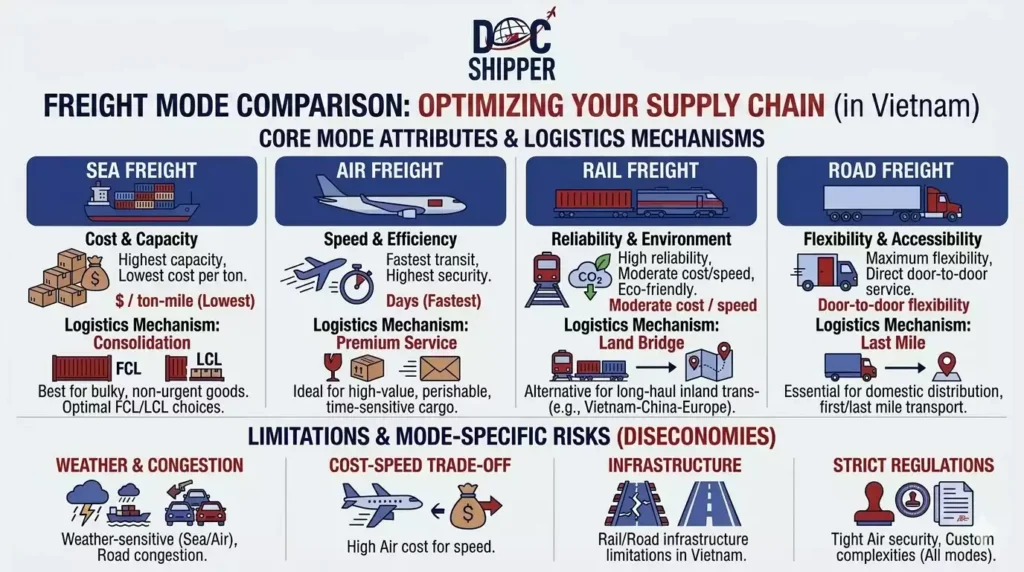
Core characteristics of each freight mode at a glance

Here’s the thing, the Air, Sea, Rail and Road Freight difference becomes obvious when you look at how each mode behaves operationally, not just price per kilo.

We once handled a consumer electronics shipment where the shipper insisted on ocean freight to save money, but the consignee had a promotion date locked, and one missed vessel cut-off forced a last-minute air upgrade with a painful freight invoice.

What you’ll notice fast by mode

  • Air freight: fastest lead time, tight airport cut-offs, higher risk of cost spikes, strong shipment tracking, often smoother short-haul cargo handling.
  • Sea freight: best for containerization and heavy cargo, slower transit, more variability at ports, documentation centered on the bill of lading.
  • Rail freight: strong middle ground for long land corridors, schedule-based, terminal constraints, great when you want stability versus road on cross-border lanes.
  • Road freight transportation: flexible pickup and last-mile delivery, ideal for regional moves, exposed to border delays and driver capacity swings.

Practical “mode fit” signals

  • If your cargo is urgent and high value, air freight usually wins even if it hurts your unit economics.
  • If your cargo is bulky and stable demand, sea freight plus warehousing can beat everything on landed cost.
  • If you’re evaluating rail vs sea freight on Eurasia-style corridors, rail often trades a higher rate for a meaningful time gain.
  • If you need door delivery and frequent partials, road plus cross-docking is often the simplest play.

DocShipper Advice

Before locking a mode, validate the real operational fit.
We simulate routing, cut-offs and customs constraints to avoid rollovers, storage and compliance surprises.
Stress-test your scenario with our team.

Comparing cost, transit time, reliability and risk across the four modes

To compare the Air, Sea, Rail and Road Freight difference properly, you need to separate the pure freight rate from the hidden logistics costs, demurrage, storage, damage, and the working capital tied up in inventory.

We’ve seen importers choose the cheapest mode, then lose the savings to port dwell time, tariff classification surprises, and avoidable inspections because export compliance paperwork didn’t match the goods.

For reliability benchmarks and lane-level constraints, you’ll often see shippers reference IATA for air cargo standards, especially when documentation and security screening drive real-world timelines.

Mode Typical cost level Typical speed Reliability Main operational risks Best use cases
Air freight Highest, volatile spot rate Fastest, days High, but cut-off driven Capacity crunch, dimensional pricing, strict DG rules Urgent spare parts, pharma, high value SKUs, launch dates
Sea freight Lowest per unit, strong for FCL Slow, weeks Medium, port variability Congestion, rollovers, damage from poor palletization High volume, heavy goods, stable demand planning
Rail freight Mid-range Medium, days to 2 weeks Medium to high, corridor dependent Terminal slots, border checks, limited last-mile reach Time-sensitive replenishment, long inland lanes
Road freight transportation Variable, lane dependent Fast for regional, slower cross-border Medium, traffic and border dependent Driver shortages, theft, paperwork errors at borders Door-to-door, short lead time regional distribution

Mini workflow: how we stress-test your mode choice at DocShipper

1) We map your end-to-end route, including air sea rail road routing options.

2) We calculate landed cost, freight tender options, and buffer stock impact.

3) We validate customs clearance and documents, commercial invoice, packing list, HS codes, export compliance.

4) We propose a booking plan, freight consolidation or FCL, plus warehousing or bonded warehouse if needed.

If you want help comparing air freight sea freight land freight with real quotes and realistic cut-offs, we handle the full chain, routing, carrier selection, customs brokerage, cargo insurance, and shipment tracking through one team at DocShipper.


Talk to DocShipper about your shipment

DocShipper Alert

The cheapest freight rate can become the most expensive decision.
Hidden costs like demurrage, inspections and delays erase savings fast.
Let DocShipper calculate your true landed cost before you commit.

Looking for a Reliable Shipping & Sourcing Partner?

We handle the entire sourcing process, supplier research, negotiation, production, and inspections, so you can focus on what matters most: growing your business.

How to match freight modes to your cargo, route and deadlines

Choosing the right mode is where the Air, Sea, Rail and Road Freight difference stops being theory and starts protecting your margin, your SLA, and your sanity.

You’ve probably dealt with suppliers who say “ready tomorrow”, then miss the factory gate date, and suddenly your whole supply chain management plan depends on whether you can switch modes without breaking trade compliance.

We’ve also seen the opposite, you rush into air, then realize the real bottleneck was customs clearance at destination, not transit time.

Checklist: match mode to constraints, not opinions

  • Confirm cargo readiness date with a buffer, then align booking cut-offs.
  • Decide if you need freight consolidation, or if split shipments reduce stockout risk.
  • Verify packaging, palletization, labeling, and whether rework is needed before pickup.
  • Build an import duties estimate early, so speed doesn’t create cash-flow shock.
  • Plan receiving, cross-docking, reverse logistics, and storage capacity before arrival.

DocShipper Advice

Mode selection should protect your margin, not just your timeline.
We align cargo readiness, customs clearance and booking cut-offs to avoid costly switches.
Secure the right plan from day one.

Choosing between air, sea and land freight for different products and urgencies
When you compare Air, Sea, Rail and Road Freight difference by product type, the best answer usually sits between “how fragile is your timeline” and “how painful is a stockout”.

We handled a tooling shipment where the supplier finished late, and the buyer tried to “save” the budget with sea freight, then lost two weeks and paid more in factory downtime than the entire air sea and train freight upgrade would have cost.

Practical decision rules you can actually use

  • High value, urgent: air freight, or air plus road for final delivery, backed by tight shipment tracking.
  • Bulky, low value, steady demand: sea freight with containerization, plus destination warehousing for smoother inventory management.
  • Long inland lanes with schedule pressure: rail, especially when road capacity is inconsistent.
  • Regional distribution: road freight transportation, often paired with cross-docking to cut storage time.

Micro workflow: how to decide in under 10 minutes

1) Compute your “latest ship date” backward from delivery, including customs brokerage.

2) If sea misses it, check rail, if rail misses it, check air.

3) If air is too expensive, split the shipment, critical SKUs by air, the rest by sea or rail.

4) Lock Incoterms responsibilities, who pays, who clears, who insures, who is shipper vs consignee.

DocShipper Info

Urgency and product value change everything.
DocShipper helps you split shipments smartly, combining air, sea or rail to balance cost and downtime risk.
Optimize speed without overspending.

How air–sea–rail–road routing works in multimodal and intermodal solutions

In real life, the Air, Sea, Rail and Road Freight difference matters most when you blend them, because multimodal transport is often how you hit both cost and timing targets.

We’ve seen shipments where sea freight arrived on time, but a missing pre-alert to the road carrier delayed pickup, and the container sat, racking up fees, just because nobody orchestrated the handoffs like a third-party logistics team should.

Multimodal vs intermodal, in plain terms

  • Multimodal: one logistics provider manages the end-to-end move under a coordinated plan, fewer gaps, clearer accountability.
  • Intermodal: multiple legs and operators, often with separate documents and handovers, great when optimized, messy when unmanaged.

Common air sea rail road routing patterns

  • Sea + road: the classic, port-to-door with drayage and last-mile delivery.
  • Rail + road: inland corridor by train, then distribution by truck.
  • Air + road: airport arrival, immediate delivery for critical freight.
  • Sea + rail + road: cost-efficient long-haul, with faster inland reach than road-only.

Step-by-step routing workflow we use to prevent handoff failures

1) We lock the route and handover points, port, rail terminal, airport, cross-dock.

2) We align documents per leg, bill of lading, CMR, rail waybill, airway bill, plus customs declaration packs.

3) We schedule bookings with buffer time for cargo handling and inspections.

4) We coordinate freight consolidation, container stuffing, and load planning to reduce damage and claims.

5) We monitor milestones with shipment tracking and update your receiving plan.

If you’re building freight modes vietnam plans or evaluating complex corridors, we can design the routing, negotiate carriers, and run customs clearance end-to-end so you don’t get stuck at a border or terminal with no leverage.

Request a routing plan from DocShipper

DocShipper Alert

Most delays happen at handoff points, not at sea or in the air.
We coordinate every leg and document to prevent storage fees and border blocks.
One team, full multimodal control.

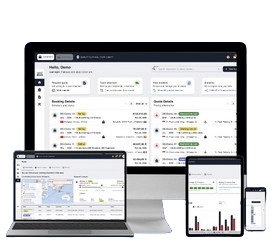
DocShipper Platform

One platform. Your entire supply chain

Sourcing, freight, customs & documents — all centralised, all visible, 24/7.

Key pros and cons of air, sea, rail and road freight

You cannot decide on the right mode without understanding the operational trade-offs behind each option. Each transport solution solves a different logistics equation.

Mode Main Advantages Main Disadvantages Best For
Air Freight
  • Fastest transit time
  • High schedule reliability
  • Lower inventory holding cost
  • Highest cost per kg
  • Strict cargo limitations
  • Weather and capacity volatility
Urgent, high-value, lightweight goods
Sea Freight
  • Lowest cost per unit
  • Ideal for heavy and bulky cargo
  • Global port connectivity
  • Long transit time
  • Port congestion risk
  • Complex documentation
Large volumes, non-urgent shipments
Rail Freight
  • Stable transit time
  • Mid-range pricing
  • Lower carbon footprint
  • Limited geographic coverage
  • Border crossing constraints
  • Less flexible than road
Europe-Asia corridors, medium urgency cargo
Road Freight
  • Door-to-door flexibility
  • Fast regional transport
  • Ideal for short distances
  • Fuel price sensitivity
  • Traffic delays
  • Limited long-distance efficiency
Domestic and cross-border regional trade

You should also consider risk exposure and cargo sensitivity before deciding. For example, air freight reduces theft and handling risk, while sea freight increases exposure due to multiple transshipments.

  • High-value electronics, prioritize speed and security.
  • Heavy machinery, prioritize cost efficiency.
  • Seasonal goods, prioritize transit predictability.
  • Temperature-sensitive cargo, evaluate equipment availability.

At DocShipper, we do not just compare prices. We model your full supply chain cost including inventory carrying, customs lead time, and buffer stock strategy.

DocShipper Info

Comparing pros and cons is not enough without numbers.
We model inventory carrying, customs lead time and risk exposure to reveal the real best mode.
Turn trade-offs into clear decisions.

Freight mode choices for shipping to and from Vietnam

Vietnam is a strategic manufacturing hub in Southeast Asia, but infrastructure varies by region. Your freight strategy must adapt to local logistics realities.

Route Type Recommended Mode Why
Vietnam to USA Sea Freight or Air Freight Sea for bulk shipments, air for urgent retail restocking
Vietnam to Europe Sea or Rail + Sea Sea for cost control, rail-sea for balanced timing
Vietnam to China Road or Rail Fast cross-border trucking via northern checkpoints
Vietnam domestic Road Freight Flexible inland distribution between ports and factories

You should pay close attention to port selection. Ho Chi Minh City and Hai Phong handle most container exports, but congestion can impact sailing schedules.

  • For garments and furniture, sea freight from Cat Lai port is usually optimal.
  • For electronics, air freight from Tan Son Nhat or Noi Bai airport ensures shorter lead times.
  • For cross-border trade with China, Lang Son road corridors offer fast clearance when documentation is correct.

We often design multimodal solutions combining truck pickup, ocean freight, and destination trucking. This reduces coordination risk and gives you a single point of accountability.

If you want tailored support for Vietnam routes, you can consult our team via DocShipper Freight Experts.

DocShipper Advice

Vietnam routes require local insight and tight coordination.
Our freight experts design sea, air, rail and road solutions tailored to each corridor and port.
Get a customized Vietnam shipping plan.

Conclusion

Choosing between air, sea, rail and road freight is not about preference. It is about aligning your cargo profile with the right logistics strategy.

  • Air freight, best for speed and high-value goods.
  • Sea freight, most economical for large and heavy shipments.
  • Rail freight, balanced solution for specific international corridors.
  • Road freight, essential for regional and door-to-door flexibility.
  • Your final decision should integrate cost, timing, risk, customs and inventory impact.
  • Working with an integrated freight partner simplifies multimodal coordination.

At DocShipper, we help you compare scenarios, optimize routes, and manage suppliers end-to-end. You gain clarity, cost control, and operational reliability in every shipment.

FAQ | Air, sea, rail and road freight: how to choose the best mode for your shipment

On paper, modes differ in price and speed; in reality, they behave very differently in execution. Air freight is highly cut‑off driven, with strict security screening and dimensional weight rules, so late cargo or wrong packaging quickly turns into rollovers or re-booking fees. Sea freight concentrates most of the risk at ports, where poor container stuffing, missing documents or customs holds create demurrage and detention. Rail freight is timetable-based and sensitive to terminal slots and border checks, so small documentation errors can block an entire container at an inland hub. Road freight adds flexibility but exposes you more to traffic, local regulations, driver shortages and theft hotspots. Understanding where most failures happen for each mode is what really defines the operational difference between them.

Ask us anything!

Need Help with Logistics
or Sourcing in Vietnam ?

First, we secure the right products from the right suppliers at the right price by managing the sourcing process from start to finish. Then, we simplify your shipping experience - from pickup to final delivery - ensuring any product, anywhere, is delivered at highly competitive prices.

Component-15-2.png

Live Chat

Get instant assistance from our team—
just click and start chatting!

Live Chat Now
image

Fill the Form

Prefer email? Send us your inquiry, and we’ll get back to you as soon as possible.

Contact us
image
Component-15-2.png

Call us

Reach out to us on WhatsApp for quick, convenient, and personal support.

Call us
image
Component-15-2.png