In short ⚡
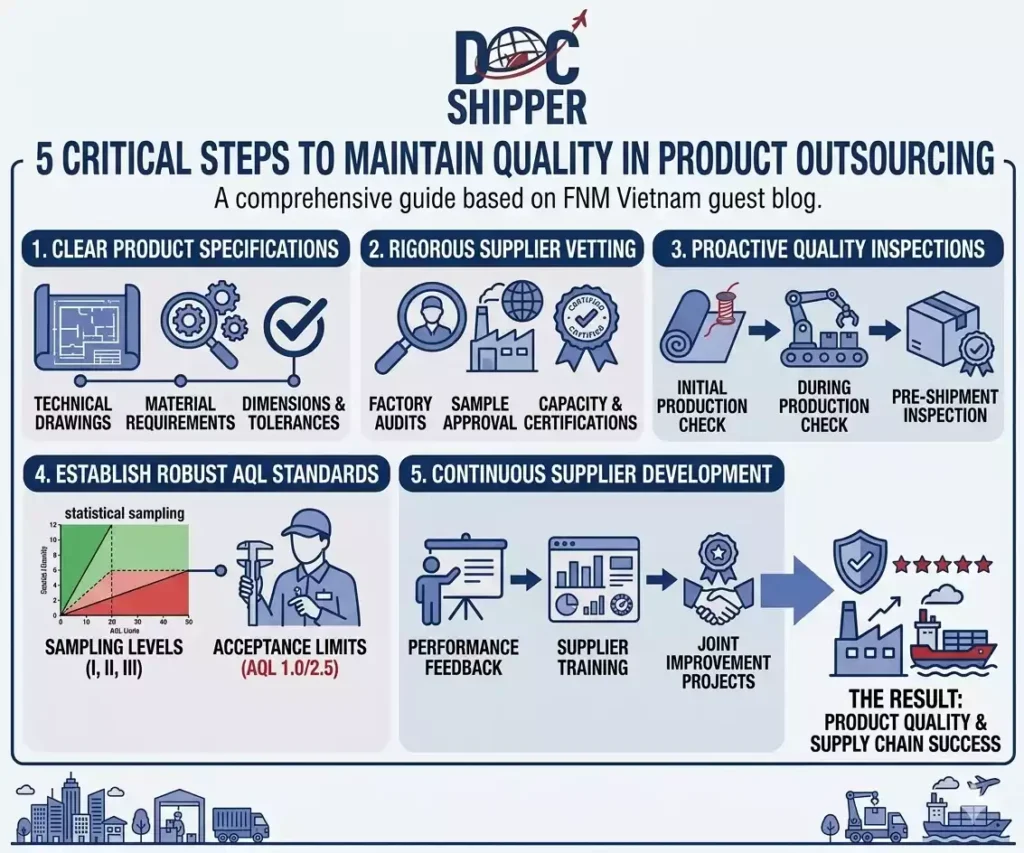
Maintain quality when outsourcing product by treating it as a full end‑to‑end system, not just a factory issue: lock detailed specs and a golden sample, embed inspections into production, and align incentives so suppliers are paid only after meeting clear quality gates, packaging standards, and documentation requirements.In this article, you will find concrete risk checklists, inspection workflows, Vietnam-specific governance tactics, KPI tracking methods, and payment structures that help you protect product quality and customer trust when outsourcing.
We hope you’ll find this article genuinely useful, but remember, if you ever feel lost at any step, whether it’s finding a supplier, validating quality, managing international shipping or customs, FNM Vietnam can handle it all for you!
Key risks to product quality when you outsource manufacturing
To maintain quality when Outsourcing product, you first need to see where quality actually breaks, not in the factory, but across your supply chain handoffs, specs, and incentives.
You’ve probably lived it already, the sample looks perfect, then the cargo arrives, you open cartons at your distribution center, and suddenly you’re dealing with returns, bad reviews, and a nightmare reverse logistics loop.
From experience, the risk spikes the moment your product leaves “your” processes and enters someone else’s, their procurement, their inventory management, their subcontractors, their packaging line, and their shipping plan.
That’s why we treat quality as a full chain topic at DocShipper, tied to lead time, containerization, customs clearance documentation, and even how palletization is executed for ocean freight or air freight.
Micro-story from the field: we once supported an importer who blamed “factory quality” after a damaged shipment.
Turns out the defect rate didn’t change, the issue came from weak master cartons that collapsed during cross‑docking, and the proof of delivery photos made it obvious once we asked the consignee to share them.
Checklist, spot these early quality risk signals before you scale:
- Your supplier won’t lock a golden sample and tolerances in writing.
- You don’t control packaging specs for multimodal transport.
- Your Incoterms push risk to you too early, without matching controls.
- Your bill of lading, packing list, and labeling rules aren’t aligned with your SKU specs.
- There’s no clear “stop-ship” rule when defects appear during production.
Quick workflow we use to map risk before the first shipment:
Step 1, map every handoff from raw material to last‑mile delivery, including warehousing and any 3PL touchpoints.
Step 2, assign a measurable quality gate to each handoff, with who approves and who pays if it fails.
Step 3, align the gate timing with transit time and booking cutoffs so you don’t discover issues after container sealing.
Why outsourcing can threaten your brand’s quality perception

When you maintain quality when Outsourcing product, you’re not just protecting the item, you’re protecting the story your customer tells themselves when they touch it.
You’ll notice fast that customers don’t separate “your brand” from “your supplier”, they just see you.
Here’s the thing, outsourcing often introduces invisible variation, new operators, different machines, alternate materials, or “equivalent” components sourced to hit a price.
Even a small change, like a slightly different coating, can feel like a downgrade and damage repeat purchase behavior.
Micro-story: a consumer brand launched a re-order after a successful first run, then got hit with complaints about “cheap feel”.
The factory quietly swapped packaging foam to reduce dimensional weight for air freight, the product arrived intact, but the unboxing felt worse, and the reviews followed.
Quality perception also collapses when your logistics execution contradicts your positioning.
If you sell “premium”, but the shipment arrives with scuffed cartons, messy labeling, or missing delivery order paperwork, your customer reads it as sloppy, even if the product is fine.
To keep brand perception stable, you need quality outsourcing decisions to connect with shipment planning, carrier agreement expectations, and track and trace discipline.
This is where recognized baselines help, we often align inspection logic with ISO 2859-1 sampling principles so your acceptance rules stay consistent across suppliers and countries.
Where brand perception gets hit first in quality outsourcing:
- Unboxing, packaging, labeling, inserts, barcodes.
- Fit and finish, surface defects, odor, color variance.
- Consistency across batches, “the second order problem”.
- Delivery experience, damaged cartons, late delivery, missing proof of delivery.
Typical quality failures in products outsourcing and how they start
To maintain quality when Outsourcing product, you need to think in failure patterns, because most defects aren’t random, they’re predictable.
In products outsourcing, quality failures usually start with tiny misunderstandings that compound through production and export steps.
Micro-story: we handled a case where the factory passed internal QC, but the importer failed customs clearance due to labeling non-compliance.
The goods sat, duties and taxes accrued, and humidity during storage degraded packaging, the “quality issue” was triggered by compliance and delay, not manufacturing.
Typical failure roots are boring, but brutal, a missing tolerance, a wrong harmonized system code impacting product testing expectations, or an Incoterms mismatch that shifts who controls pre-shipment checks.
And once the container is sealed and the bill of lading is issued, you’ve lost leverage unless your contract includes clear remedies.
Common failure modes you should expect in quality outsourcing:
- Spec drift: materials or components change without your written approval.
- Process shortcuts: curing time, drying time, torque settings, glue quantity.
- Packaging under-design: carton strength not built for LTL transfers or pallet stacking.
- Labeling and documentation errors: wrong carton marks, missing compliance icons, inconsistent packing list.
- Rework and mixing: rejected units reintroduced into “good” cartons to hit shipment deadlines.
Fast diagnostic workflow when a defect shows up at destination:
Step 1, quarantine inventory in your warehouse and separate by lot and production date.
Step 2, compare against the golden sample and your approved packaging spec, not the supplier’s internal standard.
Step 3, trace back using shipment documents, packing list, container number, and photos at stuffing, then decide chargeback or remake before the next booking.
If you’re sourcing in Asia, especially when you outsource production Vietnam for cost and capacity, these patterns still apply.
The difference is speed, Vietnam can move fast, so your outsourcing quality management has to be even faster to keep up with production rhythm and export cutoffs.
Build a quality-first outsourcing strategy before you sign any contract
If you want to maintain quality when Outsourcing product, the smartest move happens before you negotiate price, you engineer control.
This is the moment most importers get stuck, you’re excited about the quote, but you haven’t locked what “acceptable” means, or what happens when it isn’t.
At DocShipper, we look at quality as a system tied to freight forwarding execution, shipment milestones, and customs brokerage requirements.
Because a perfect product that misses labeling rules, arrives late, or gets damaged in transit still destroys customer trust.
Checklist, what you must have before any PO or tooling payment:
- A written product specification pack with tolerances, photos, and test methods.
- AQL or acceptance rules, plus clear rework, replacement, and refund terms.
- Packaging and palletization standards designed for your transport mode.
- Incoterms selection that matches who controls inspections and export paperwork.
- A supplier escalation path and stop-ship authority, in writing.
Practical workflow before signing:
Step 1, lock your spec and packaging standards, then ask the supplier to countersign them.
Step 2, define inspection points, pre-production, during production, pre-shipment, and container loading.
Step 3, align payment milestones with quality gates, never with “shipment date promises”.

Looking for a Reliable Shipping & Sourcing Partner?
Define clear quality standards, specs, and KPIs for consumer goods outsourcing
To maintain quality when Outsourcing product in consumer goods outsourcing, your spec can’t be a product page and a few photos.
You need a technical pack that a factory, an inspector, and a warehouse team can all execute without guessing.
Micro-story: an importer sent “matte black” as the only color requirement, then rejected a full order because it looked “too glossy”.
When we asked for the gloss unit target and measurement angle, there was none, the factory delivered exactly what the vague spec allowed.
Good specs also prevent logistics-created defects.
If you don’t define carton drop resistance, stacking limits, and humidity protection, you’ll keep blaming the supplier for damage caused during ocean freight or during cross-docking transfers.
KPIs that actually work for product quality sourcing and quality outsourcing:
- Defect rate by type: critical, major, minor, by lot.
- First-pass yield: how much passes without rework.
- On-time at quality gate: not “on-time shipment”, but “passed inspection by cutoff”.
- Packaging integrity rate: carton crush, seal failure, barcode readability.
- Correct documentation rate: packing list accuracy, labeling compliance, export docs completeness.
Mini comparison table, vague vs executable quality requirements:
| Vague requirement | Executable requirement |
| “High quality finish” | Surface defect limit with photo examples and max scratch length tolerance |
| “Strong packaging” | Carton burst strength target, drop test height, pallet stacking limit |
| “Accurate labeling” | Label artwork version control, barcode standard, carton marks and placement |
| “Works well” | Functional test steps, pass criteria, sampling plan per lot size |
If you’re dealing with outsourcing quality Vietnam, you’ll benefit even more from this structure.
Local teams move quickly, and a crisp spec pack prevents last-minute substitutions made to protect lead time.
Design your supplier selection, RFP, and auditing process to protect product quality

To maintain quality when Outsourcing product, don’t treat your RFP like a price hunt, treat it like a risk filter.
The supplier that answers fastest isn’t the supplier that will protect your customer experience after three reorder cycles.
Micro-story: a buyer chose the cheapest quote, then discovered during the first audit that the “factory” was a trading office.
Production got subcontracted, no one owned root cause analysis, and when defects showed up, everyone pointed at someone else while the shipment was already booked.
Your RFP should force transparency on capacity, subcontracting, QC capability, and export readiness.
And yes, export readiness matters, because if your supplier can’t produce correct documents, your customs brokerage and clearance timeline becomes your quality bottleneck.
What to request in your RFP for outsourcing quality management:
- Factory license, ownership structure, and proof of production site.
- Quality system overview, sampling method, and corrective action process.
- Equipment list and maintenance plan for critical processes.
- Packaging line capability tied to your shipment mode and pallet requirements.
- Export documentation experience, HS code familiarity, and compliance handling.
Audit focus areas that prevent quality surprises later:
- Incoming material controls and traceability by lot.
- In-process QC points, not just final inspection.
- Rework area controls, to avoid mixing rejected goods into good stock.
- Warehouse conditions, humidity, FIFO discipline, and inventory management.
- Shipping area discipline, carton marks, sealing, photos at container loading.
If you want, we can run this end-to-end with you at DocShipper, from supplier vetting to inspection booking, freight quote and rate negotiation, then freight forwarding with track and trace until final delivery.
You can start by checking our service scope here: DocShipper global sourcing and logistics support.
“`html
Practical quality controls you need during outsourced production (including Vietnam)
If you want to maintain quality when Outsourcing product, you cannot rely on trust alone. You need structured, documented, and measurable controls embedded directly into the production cycle.
In Vietnam and similar manufacturing hubs, factory capability varies widely. Your job is to create checkpoints that make quality visible before it becomes a customer complaint.
- Pre-production inspection, validate raw materials, components, labels, and packaging before mass production starts.
- Golden sample approval, sign and seal a reference sample that becomes the legal quality benchmark.
- In-line inspection, check production during 20 to 50 percent completion to detect deviations early.
- Final random inspection, statistically verify finished goods before shipment release.
- Pre-shipment lab testing, ensure regulatory compliance for EU, US, or Middle East markets.
- Container loading supervision, prevent product substitution or carton mix-ups.
You should never skip in-line inspection in low-cost environments. Most quality failures originate from unmonitored production shifts or subcontracted workshops.
| Control Stage | Main Objective | Risk Prevented |
| Pre-production | Validate materials and specs | Wrong inputs or non-compliant components |
| In-line inspection | Monitor live production | Mass defects amplification |
| Final inspection | Approve shipment release | Customer returns and claims |
| Loading control | Secure shipment integrity | Product substitution fraud |
At DocShipper, we coordinate these checkpoints locally through our Asian teams. This allows you to detect deviations before they scale into a 20% batch rejection scenario.
DocShipper Platform
One platform. Your entire supply chain
Sourcing, freight, customs & documents — all centralised, all visible, 24/7.
How to manage outsourcing quality in Vietnam and other low-cost countries

Low-cost sourcing markets like Vietnam offer competitive pricing but require disciplined supplier governance. You must manage quality as a system, not as an occasional inspection.
Start by mapping your supplier structure. Many Vietnamese factories subcontract discreetly during peak season.
- Verify production site ownership and subcontracting policy.
- Audit machinery capacity versus your volume forecast.
- Confirm workforce stability and training level.
- Review quality management system, ISO, internal QC team.
- Implement written corrective action procedures.
You should also implement a clear communication workflow. Cultural alignment and documentation discipline directly impact consistency.
| Risk Area | Vietnam Context | Mitigation Strategy |
| Subcontracting | Common during overload | Contractual prohibition and audit clause |
| Material substitution | Cost-saving pressure | Approved vendor list and material validation |
| Compliance gaps | Export regulation knowledge varies | Pre-shipment third-party lab testing |
| Communication delays | Time zone and language | Weekly structured production reporting |
You maintain leverage by structuring payments strategically. Never release 100 percent before shipment validation.
We typically recommend a staged payment model:
- 30 percent deposit after contract and golden sample approval.
- 40 percent after successful in-line inspection.
- 30 percent after final inspection and shipment confirmation.
This structure aligns supplier incentives with your quality objectives. It transforms quality from a promise into a financial condition.

DocShipper Info
Our Vietnam team audits factories, monitors subcontracting, and aligns payments with quality milestones to protect your margins.
Quality outsourcing metrics, costs, and governance you should track
If you cannot measure quality, you cannot protect your brand. Outsourcing governance requires quantified performance indicators.
- Defect rate percentage, per batch and per SKU.
- First pass yield, units approved without rework.
- On-time delivery rate, linked to production stability.
- Cost of poor quality, rework, returns, warranty claims.
- Corrective action closure time, supplier responsiveness.
Track these KPIs quarterly and compare across suppliers. A factory with slightly higher pricing but lower defect rate often generates better long-term margin.
| Metric | Why It Matters | Business Impact |
| Defect Rate | Measures production consistency | Customer satisfaction and returns |
| Cost of Poor Quality | Reveals hidden outsourcing cost | Profit margin erosion |
| On-Time Delivery | Indicates operational control | Inventory and cash flow stability |
You should also calculate your total landed cost including inspection and compliance. In many cases, quality prevention costs represent less than 3 to 5 percent of order value, while failure costs can exceed 25 percent.
Governance means documentation. Maintain written SOPs, inspection reports, signed samples, and deviation logs for every production cycle.
DocShipper Alert
We build supplier scorecards and landed cost analysis to expose hidden quality costs before they exceed 25 percent of order value.
Conclusion
Outsourcing does not automatically reduce quality. Poorly managed outsourcing does.
- Define measurable quality standards before production starts.
- Implement structured inspections at every production milestone.
- Control subcontracting risks in Vietnam and similar markets.
- Align supplier incentives with staged payment structures.
- Track defect rates, cost of poor quality, and corrective actions.
- Work with local experts who protect your brand on the ground.
If you want to confidently maintain quality when Outsourcing product, you need operational discipline and local execution. At DocShipper, we combine sourcing, inspection, and logistics control so you never sacrifice customer trust for cost savings.
“`FAQ | How to maintain quality when outsourcing your product without losing customer trust
Outsourcing quality management is the system you put around your external suppliers so that quality is defined, checked, and corrected without you being on the factory floor. It typically combines a written spec pack, clear acceptance criteria (AQL), independent inspections, a corrective action process, and commercial levers (like staged payments) that make your partners financially accountable for defects and delays, not just for shipping “something” on time.
The key is to separate “policing” from “partnership”. You stay firm on standards, but you co-design how to reach them. Share your defect data, agree upfront on what happens when quality slips, and review it together after each shipment. When suppliers see that better quality leads to smoother bookings, fewer disputes, and faster payments, they start treating your quality system as a shared performance target, not a threat.
You replace physical presence with structured visibility. Use a mix of detailed spec packs, geo‑tagged and time‑stamped production photos, third‑party inspections, and mandatory container loading reports (with carton counts and seal numbers). When this is reinforced by a contract that ties balance payments to passed inspections, your overseas factory has strong reasons to keep quality aligned with your golden sample and documentation.
Watch for small behavioral changes before defects explode. If they start pushing you to skip inspections “to save time”, resist sharing factory photos, suddenly offer cheaper “equivalent” materials, or keep delaying confirmation of production milestones, it usually means capacity or cost pressure is rising. Treat any unexplained last‑minute change in lead time or packaging as a signal to tighten on-site checks and approval steps on the next batch.
In Vietnam, you need to tackle subcontracting head‑on in both contracts and operations. Specify whether subcontracting is allowed, for which processes, and under what approval conditions. Then verify it with surprise audits, location‑stamped loading photos, and cross‑checking factory registration details against what’s printed on packing lists and export documents. If you detect unauthorized subcontracting, your agreement should give you the right to stop shipment or demand corrective action before future orders.
Start by treating every “savings” proposal with a total‑landed‑cost lens. Before accepting a cheaper quote, run a quick scenario that includes potential rework, returns, relabeling, and delays. Best-in-class buyers keep a simple log where each defect incident is translated into actual euros or dollars. Over a few cycles, this shows which suppliers really protect your margin and which ones only look cheap on the initial unit price.
Need Help with Logistics
or Sourcing in Vietnam ?
First, we secure the right products from the right suppliers at the right price by managing the sourcing process from start to finish. Then, we simplify your shipping experience - from pickup to final delivery - ensuring any product, anywhere, is delivered at highly competitive prices.
Fill the Form
Prefer email? Send us your inquiry, and we’ll get back to you as soon as possible.
Contact us