In short ⚡
Ports of Vietnam: Haiphong, Cat Lai, Cai Mep and Da Nang Compared. Haiphong and Lach Huyen serve northern suppliers, Cat Lai and Cai Mep-Thi Vai serve the South, while Da Nang is the practical gateway for central Vietnam. The best choice depends on supplier location, destination, cargo type and vessel service.
Key differences between Vietnam’s main port options:
| Port | Region | Port type and service | Best suited to |
|---|---|---|---|
| Haiphong and Lach Huyen | North Vietnam | Lach Huyen provides deep-water access and potential direct mainline services | Suppliers in Hanoi, Bac Ninh, Haiphong and the northern industrial belt |
| Cat Lai | Ho Chi Minh City area | River terminal commonly used for feeder and intra-Asia services | Factories near Ho Chi Minh City and regional Asian destinations |
| Cai Mep-Thi Vai | Southern Vietnam | Deep-water cluster with direct services to the US, Europe and other long-haul markets | Long-haul FCL cargo requiring direct mainline calls |
| Da Nang, including Tien Sa | Central Vietnam | Regional gateway; Lien Chieu deep-water port is under development | Suppliers in central Vietnam, with some cargo routed through regional hubs |
In this guide, you will find details on Hai Phong and Lach Huyen, Cat Lai and Cai Mep-Thi Vai, Da Nang’s gateways, and how destination, cargo type, inland transport and direct services determine the right port of loading.
We hope you’ll find this article genuinely useful, but remember, if you ever feel lost at any step, whether it’s finding a supplier, validating quality, managing international shipping or customs, FNM Vietnam can handle it all for you!
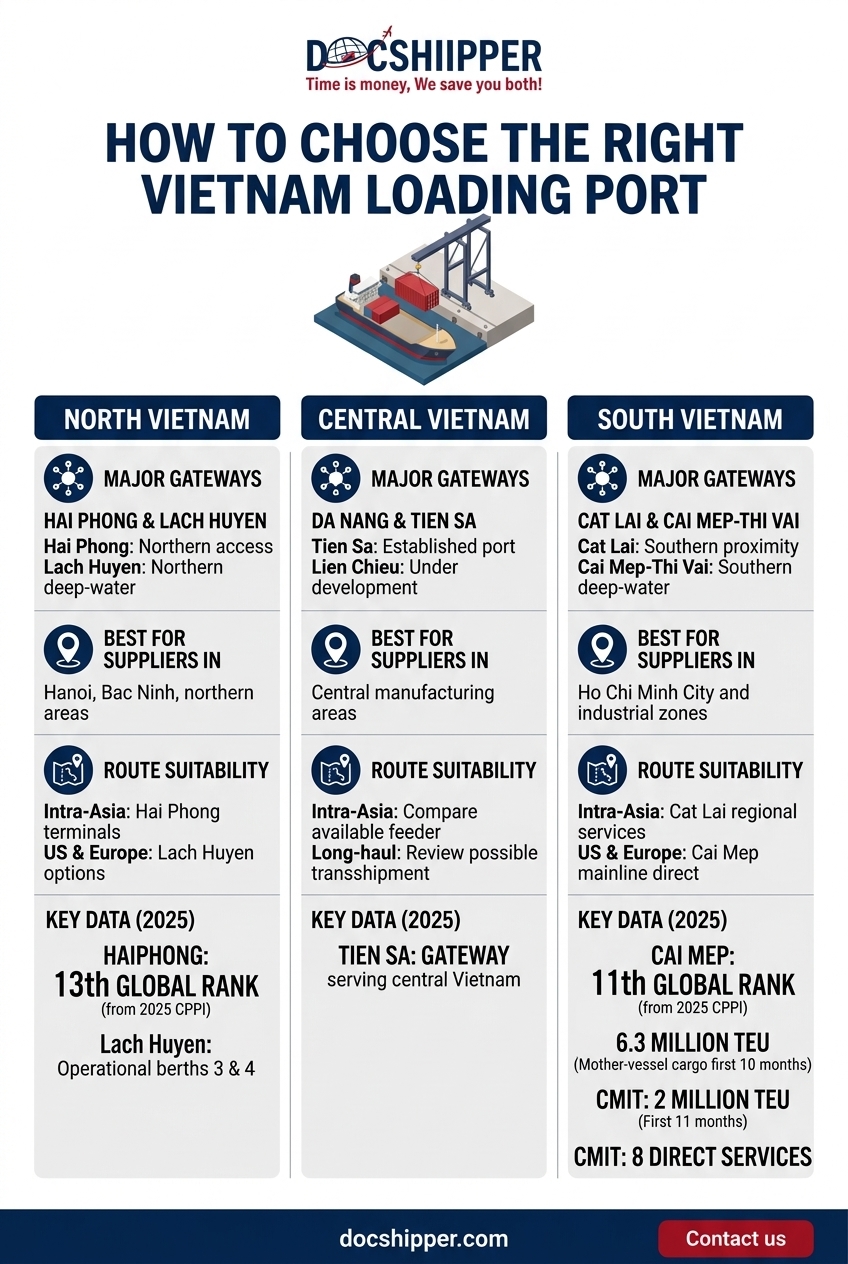
The best port of Vietnam is usually the one closest to your supplier that also offers the service your destination requires. Hai Phong and Lach Huyen serve the North, Cat Lai and Cai Mep-Thi Vai serve the South, while Da Nang is the practical gateway for central Vietnam.
Your decision should balance four factors: supplier location, destination, cargo type and available vessel service. Choosing a deep-water terminal can provide a direct mainline call to the US or Europe, while a river terminal may be more convenient for intra-Asia cargo and factories near Hanoi or Ho Chi Minh City.
DocShipper Info
Choose the port that fits your routing, not just your supplier’s address.
Vietnam’s main container ports at a glance
Vietnam’s container trade is concentrated in two major gateways, Hai Phong in the North and Ho Chi Minh City with Cai Mep-Thi Vai in the South. Da Nang completes the main national network for central Vietnam, although many services from the Centre connect through regional hubs.
Vietnam’s port network includes 34 seaports and 320 berths, according to VietNamNet’s report on the country’s 2026 maritime development. The same report cites the 2025 Container Port Performance Index, produced by the World Bank and S&P Global Market Intelligence, which ranked Cai Mep 11th and Hai Phong 13th globally.
A deep-water terminal is designed to accommodate larger ocean-going vessels and can receive direct mainline services. A river or inner-city terminal is often closer to industrial areas, but cargo may need to move by barge, feeder vessel or transshipment hub before reaching the final long-haul service.
This distinction matters more than the port’s name alone. A supplier near Ho Chi Minh City may be close to Cat Lai, but Cai Mep can be the better option for a direct US or European sailing. Similarly, a factory near Hanoi may use a conventional Hai Phong terminal for regional cargo, while Lach Huyen may be preferable when a direct deep-sea call is available.
| Port or cluster | Region | Deep-water and direct mainline capability | Best suited to |
| Hai Phong and Lach Huyen | North Vietnam | Lach Huyen provides deep-water access and direct mainline potential | Suppliers in Hanoi, Bac Ninh, Hai Phong and the northern industrial belt |
| Cat Lai | Ho Chi Minh City area | River terminal, commonly used for feeder and intra-Asia services | Factories close to Ho Chi Minh City and regional Asian destinations |
| Cai Mep-Thi Vai | Southern Vietnam | Deep-water cluster with direct services to the US, Europe and other markets | Long-haul FCL cargo requiring direct mainline calls |
| Da Nang, including Tien Sa | Central Vietnam | Regional gateway; Lien Chieu deep-water port is under development | Suppliers in central Vietnam, with some cargo routed through hubs |
DocShipper Tips
Direct service availability should guide the final choice.
Hai Phong and Lach Huyen: the northern gateway
Hai Phong is the main port gateway for northern suppliers, including factories around Hanoi, Bac Ninh and Hai Phong. Lach Huyen adds deep-water capacity for larger vessels and is the northern option to examine first when you need a direct mainline service.
The Hai Phong port area includes several terminal facilities, while HICT operates at Lach Huyen. The practical difference is not simply terminal size: it is the relationship between the terminal, the supplier’s factory and the carrier’s planned service. A shipment from an industrial zone near Hanoi may incur a manageable inland leg to Hai Phong, but the best terminal depends on whether the booking is an intra-Asia feeder movement or an ocean mainline call.
Lach Huyen’s deep-water position makes it particularly relevant for cargo bound for the US or Europe. Direct service availability must still be checked for the requested sailing date, equipment type and carrier, because a port’s ability to receive large ships does not guarantee that every carrier operates a direct call on every route.
Hai Phong also remains important for regional cargo and suppliers that value proximity over a possible direct sailing. Hai Phong Port JSC passed 2 million TEU on 14 December 2025, according to VnEconomy, with the result supported by Lach Huyen berths 3 and 4 becoming operational earlier in 2025.
For an importer, the booking check should therefore compare the full routing, not only the port name. Ask whether the container loads at an inner Hai Phong terminal or Lach Huyen, whether a feeder connection is required, where transshipment takes place if applicable, and whether the proposed schedule matches the cargo readiness date.
| Question | What to check for Hai Phong |
| Where are the suppliers? | Hanoi, Bac Ninh, Hai Phong and other northern manufacturing areas generally point toward Hai Phong or Lach Huyen. |
| Is the destination US or Europe? | Check Lach Huyen for a direct deep-water mainline service before accepting a feeder routing. |
| Is the destination intra-Asia? | Compare available Hai Phong services, frequency and inland cost rather than assuming the deep-water option is automatically better. |
| What is the operational risk? | Confirm terminal, cut-off, equipment availability and whether transshipment is included in the quoted routing. |
DocShipper Info
Check inland transport, transshipment and direct-service availability together.
Looking for a Reliable Shipping & Sourcing Partner?


Cat Lai and Cai Mep: the southern gateways
Cat Lai is the busy river terminal close to Ho Chi Minh City factories, while Cai Mep-Thi Vai is the southern deep-water cluster for direct long-haul services. Cat Lai often fits intra-Asia and feeder cargo; Cai Mep is usually the first option to investigate for direct services to the US and Europe.
Cat Lai’s proximity can reduce the inland movement for suppliers located in or around Ho Chi Minh City. The port is connected to the southern manufacturing network through roads and barge services, which can be useful when factories are closer to the urban and industrial areas than to Cai Mep. However, a shorter inland distance does not by itself prove that Cat Lai is the lower-cost option: the complete ocean routing, handling charges and transshipment plan must be compared.
Cai Mep-Thi Vai offers a different operating model. Its deep-water terminals, including facilities such as CMIT and TCIT, can handle larger mainline vessels and support direct services to long-haul markets. The Vietnam Port Association reported that the Cai Mep-Thi Vai cluster handled approximately 6.3 million TEU of mother-vessel cargo in the first 10 months of 2025, up 18% year on year.
At terminal level, CMIT passed 2 million TEU in the first 11 months of 2025 and had eight direct services covering Europe, the US East and West Coasts, the Mediterranean and intra-Asia routes. These figures describe different scopes, so they should not be added together: the first is a cluster-level figure, while the second concerns CMIT.
The administrative map can also create confusion. Following the provincial merger effective 1 July 2025, Ba Ria-Vung Tau became part of Ho Chi Minh City, so Cai Mep may now appear administratively as being in Ho Chi Minh City even though it remains geographically separate from Cat Lai. For a booking, use the terminal name and port code rather than relying only on the city shown in a supplier address.
Cat Lai or Cai Mep?
Choose Cat Lai when supplier proximity, intra-Asia frequency or a feeder connection is more important than a direct mainline call. Choose Cai Mep when the destination and carrier offer a suitable direct deep-water service that can avoid unnecessary transshipment.
| Criterion | Cat Lai | Cai Mep-Thi Vai |
| Location advantage | Closer to many Ho Chi Minh City factories and southern industrial areas | Further from central Ho Chi Minh City, but connected to the southern manufacturing region |
| Port type | River terminal | Deep-water terminal cluster |
| Typical routing logic | Intra-Asia, feeder and regional services | Direct mainline services to the US, Europe and other long-haul markets |
| Best decision test | Compare inland convenience and total feeder routing | Check direct service, vessel schedule and inland cost to the terminal |
DocShipper Tips
Confirm the current service and transshipment plan before booking.
DocShipper Platform
One platform. Your entire supply chain
Sourcing, freight, customs & documents — all centralised, all visible, 24/7.
Da Nang: shipping from central Vietnam
Da Nang’s Tien Sa port is the main practical gateway for suppliers in central Vietnam. Lien Chieu is being developed as a deep-water port, while Chu Lai provides another relevant logistics option for cargo originating around the central industrial belt.
Da Nang can be the right choice when the supplier is located in or near the Centre and moving cargo south to Cai Mep or north to Hai Phong would add an unnecessary inland leg. This is particularly important for heavy, oversized or temperature-sensitive cargo, where distance by road can affect cost, handling and operational risk.
Tien Sa is an established port serving central Vietnam, but shippers should not assume that every destination has a direct mainline call from Da Nang. Many services connect through regional hubs, so the quotation should identify the transshipment port, the number of legs and the planned connection window.
Lien Chieu’s development may strengthen Da Nang’s deep-water role over time. Until the relevant terminal and service are available for a specific booking, however, use the current operational option confirmed by the carrier or forwarder. The 2025 merger between Da Nang and Quang Nam also means that port searches may show Tien Sa, Lien Chieu and Chu Lai under one broader administrative area.
Da Nang is therefore not a fallback port reserved only for small shipments. It is a location-based solution for central suppliers, especially when the alternative requires long inland transport. The right comparison is between the complete door-to-port cost and transit plan, not between headline ocean freight rates alone.
| Port option | Role in central Vietnam | When to investigate it |
| Tien Sa | Operating Da Nang gateway | Suppliers around Da Nang and central manufacturing areas |
| Lien Chieu | Deep-water port under development | Future capacity and services, subject to operational confirmation |
| Chu Lai | Port option for the wider central region | Suppliers around Quang Nam and nearby industrial areas |
DocShipper Tips
Request comparable door-to-port quotations before choosing.
How to choose your port of loading
Choose the port closest to your suppliers that offers a suitable service to the destination, then compare the complete cost and routing. For multi-region sourcing, consolidate at one gateway only when the inland collection, warehouse handling and ocean-service advantages outweigh the extra domestic movements.
- Map every supplier. Record the factory address, province, cargo-ready date, container quantity and whether the supplier can deliver to a nominated warehouse or terminal. Group factories into North, Centre and South before requesting rates.
- Match the destination to the service type. For a US or European destination, check direct mainline options from Lach Huyen or Cai Mep-Thi Vai. For intra-Asia cargo, compare Cat Lai and Hai Phong services, including feeder routings and sailing frequency.
- Separate port choice from cargo requirements. FCL means one shipper uses a full container, while LCL combines several shippers’ cargo in one container. Reefer cargo needs a controlled-temperature connection, and OOG cargo requires confirmation of dimensions, lifting equipment and terminal acceptance.
- Compare the door-to-port total. Request inland pickup, export customs, origin charges, terminal handling, documentation, ocean freight, transshipment and destination assumptions in the same quotation. A lower ocean rate may be offset by a longer truck move or additional feeder handling.
- Validate the booking before production is finished. Confirm the actual terminal, vessel, cut-off, equipment release, direct or transshipment status and contingency plan. Port capability is not the same as space availability on your chosen sailing.
Use this request template with your forwarder: “Supplier location: [province and address]. Destination: [port and country]. Cargo: [FCL/LCL, reefer or OOG]. Quantity: [containers or cubic metres]. Cargo-ready date: [date]. Please compare Hai Phong/Lach Huyen, Cat Lai, Cai Mep and Da Nang where relevant, showing inland cost, terminal, direct or transshipment routing, cut-off and total quotation.”
For FCL cargo, a direct mainline service can be valuable when it removes a transshipment step and better matches the destination schedule. For LCL, consolidation availability and warehouse location may matter more than the port’s deep-water status, because the cargo must first reach the consolidator and be packed into a shared container.
Reefer and OOG shipments need an earlier operational check. A reefer booking requires confirmation of plug availability, temperature instructions and monitoring procedures, while OOG cargo requires the exact packing dimensions, weight, lashing method and terminal acceptance. Do not select a port solely from a standard dry-container rate.
| Supplier location | Destination | Port to investigate first | Reason |
| Hanoi, Bac Ninh or northern industrial zones | US or Europe | Lach Huyen | Deep-water access and potential direct mainline service |
| Hanoi, Bac Ninh or northern industrial zones | Intra-Asia | Hai Phong terminals | Regional services and proximity to northern suppliers |
| Ho Chi Minh City and nearby factories | Intra-Asia | Cat Lai | Urban and industrial proximity with feeder and regional options |
| Southern industrial zones | US or Europe | Cai Mep-Thi Vai | Deep-water cluster with direct long-haul services |
| Da Nang, Quang Nam and central Vietnam | Any destination | Tien Sa or relevant central gateway | Avoids unnecessary inland transport to a northern or southern port |
| Suppliers in several regions | One destination | Consolidate after a cost comparison | One port may simplify ocean booking, but collection and handling costs must be included |
Conclusion
The main ports of Vietnam serve different shipper profiles. The right choice depends on the relationship between your supplier, destination and required service, not on a national ranking alone.
- Hai Phong and Lach Huyen are the main northern gateways for Hanoi, Bac Ninh, Hai Phong and surrounding manufacturing areas.
- Cai Mep-Thi Vai and Lach Huyen are the deep-water options to examine for direct US and European mainline services.
- Cat Lai and inner Hai Phong terminals can be practical for intra-Asia services, feeders and suppliers located close to the river terminals.
- Da Nang is the logical starting point for central Vietnam, with Tien Sa operating today and Lien Chieu under development.
- FCL, LCL, reefer and OOG cargo require different checks before the port is confirmed.
- Always compare the full door-to-port routing, including inland transport, terminal, transshipment and cut-off requirements.
Not sure which port fits your shipment? Send us your supplier location, cargo details and destination. We can compare sea freight options from Hai Phong, Ho Chi Minh City, Cai Mep or Da Nang and propose the most suitable routing and quotation.
FAQ | Ports of Vietnam: How to Choose the Right Port of Loading
Sometimes, but the change depends on the booking status, carrier rules and whether the container has already been gated in. Changing from Cat Lai to Cai Mep, for example, may require a new inland plan, terminal instruction, documentation update and possibly a cancellation fee. Ask your forwarder to confirm the financial impact and the new cut-off before moving the cargo.
Confirm who will arrange the first-mile transport and where the container will be stuffed. Some factories can load at their premises, while others require delivery to a nearby depot or consolidation warehouse. This affects trucking cost, loading responsibility, cargo security and the time needed before the terminal cut-off.
Do not automatically force every supplier to use one port. Compare the cost and risk of collecting the cargo to one consolidation point with the cost of shipping separate containers from different gateways. A single port may simplify documentation, but separate sailings can be more efficient when inland distances, cargo-ready dates or container quantities differ significantly.
The Incoterm determines which party normally arranges and pays for specific transport and export obligations, but it does not replace a shipment-specific quotation. Confirm in writing whether the price includes factory pickup, export customs, empty-container positioning, terminal handling, documentation, storage and any barge or feeder movement. Misunderstanding the seller's delivery point can create unexpected origin charges.
A direct-service booking does not eliminate schedule risk. Before confirming the shipment, ask for the carrier's next available sailing, the alternative transshipment route and the procedure for rebooking equipment. For urgent, seasonal or production-critical cargo, compare the cost of a backup service with the commercial impact of missing the required arrival window.
Use the exact terminal name, UN/LOCODE or port code in the shipping instructions rather than relying only on “Ho Chi Minh City,” “Da Nang” or another city label. Request written confirmation of the empty depot, stuffing location, load terminal and vessel rotation. This is especially important in southern Vietnam, where Cat Lai and Cai Mep may appear under the same broader administrative area.
Need Help with Logistics
or Sourcing in Vietnam ?
First, we secure the right products from the right suppliers at the right price by managing the sourcing process from start to finish. Then, we simplify your shipping experience - from pickup to final delivery - ensuring any product, anywhere, is delivered at highly competitive prices.


Fill the Form
Prefer email? Send us your inquiry, and we’ll get back to you as soon as possible.
Contact us