In short ⚡
Vietnam takes UK place as U.S largest trading partner mainly because Vietnam has become a cost‑competitive export manufacturing hub with deep trade agreement integration, while the UK faces higher costs and post‑Brexit frictions. Vietnam’s rising goods exports, scalable factories, and role in “China+1” supply chains contrast with the UK’s slower goods‑trade momentum and services‑heavy economic structure.In this article, you will find a breakdown of Vietnam–U.S. trade growth, policy milestones, export and import profiles, comparisons with other partners, and the structural factors that weakened the UK’s position while strengthening Vietnam’s role in global supply chains.
We hope you’ll find this article genuinely useful, but remember, if you ever feel lost at any step, whether it’s finding a supplier, validating quality, managing international shipping or customs, FNM Vietnam can handle it all for you!
How Vietnam rose in the U.S. trade ranking to surpass the UK
If you’ve been tracking headlines about vietnam takes uk place as u.s largest trading partner, you’re really watching a supply chain rewrite happening in real time.
In our day-to-day freight forwarding work, you’ll notice it fast, more FCL container bookings out of Hai Phong and Cat Lai, more air freight space fights out of SGN, and a lot more questions about customs clearance and tariff classification into the U.S.
Here’s the thing, this shift is not “just politics”. It’s a mix of trade policy, manufacturing capacity, and the practical reality of where your suppliers can ship on time, with the right paperwork.
From post-war normalization to strategic partners: a brief timeline
Back in a sourcing project we supported, you could literally see the “before and after” effect when a U.S. buyer moved a consumer-electronics accessory line from the UK to Vietnam, lead times dropped, but quality inspections and packaging specs suddenly mattered a lot more.
That’s the living proof behind why vietnam takes uk place as u.s largest trading partner isn’t a one-year fluke, it’s built on a long timeline of normalization and trade integration.
To keep the chronology straight, here’s a quick timeline you can use when explaining us vietnam trade growth internally.
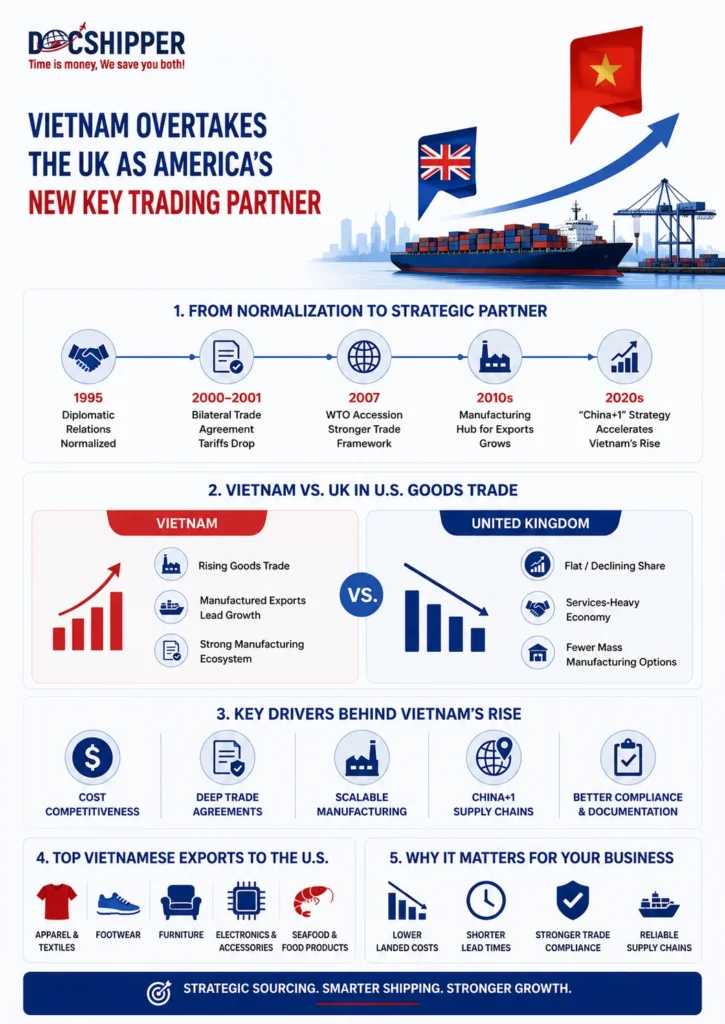
- 1995: Diplomatic relations normalized, trade channels reopen and formalize.
- 2000 to 2001: Bilateral Trade Agreement era, tariffs drop, and customs procedures become more predictable.
- 2007: WTO accession strengthens Vietnam’s role in rules-based trade, which affects tariff schedules and dispute expectations.
- 2010s: Vietnam becomes a manufacturing hub for textiles, furniture, and electronics, tied tightly to U.S. retail cycles.
- 2020s: “China+1” becomes operational, not theoretical, you see it in cargo consolidation, route optimization, and new supplier onboarding.
For trade definitions and how countries align around rules, you’ll often see the WTO referenced when analysts explain why Vietnam’s trade credibility strengthened over time.
Data behind the shift: Vietnam vs. UK in recent U.S. trade tables

Direct tip: don’t rely on a single headline ranking, pull the same period across the same dataset, then compare Vietnam vs. the UK on total goods trade, not “news snippets”.
When you evaluate whether vietnam takes uk place as u.s largest trading partner in a given ranking, you’ll want to separate goods from services, and you’ll want to check whether the table uses total trade or imports only.
This is the simplest way to compare what you’re seeing in us trade partners ranking tables.
| What you compare | Vietnam | United Kingdom |
| Trend in U.S. goods trade | Rising, driven by vietnam exports to us in manufactured goods | Flatter or declining share in many goods categories |
| Typical shipment profile | High-volume ocean freight, plus selective air freight for time-sensitive SKUs | More specialized goods, often lower-volume lanes |
| Operational friction points | HS code accuracy, country-of-origin substantiation, factory compliance | Less origin scrutiny in some categories, but fewer “mass manufacturing” options |
| How you feel it in logistics | Capacity peaks, booking volatility, more tracking and milestone control needed | More stable lanes, fewer “factory ramp-up” shocks |
In practice, the “ranking” only becomes meaningful when you connect it to your inventory management and distribution plan, because bigger trade volumes usually mean more congestion risk at origin and tighter freight markets.
Key drivers that pushed Vietnam ahead of the UK
Why did vietnam takes uk place as u.s largest trading partner become believable so quickly, even to importers who used to buy from Europe?
Bold statement: Vietnam didn’t win on one factor, it won because your total landed cost equation started to favor Southeast Asia when you include tariffs, capacity, and supplier responsiveness.
To make the drivers actionable, here’s a compact checklist you can use when assessing vietnam us top trading partner momentum for your own categories.
- Supplier scalability: factories can ramp, but only if you lock raw material availability and production slots early.
- Freight economics: consistent sea freight lanes support high-volume programs, especially with load planning and FCL vs. LCL strategy.
- Trade diversion: shifts away from China accelerate Vietnam’s role in vietnam trade with united states.
- Buyer behavior: U.S. retailers push vendors toward Vietnam because it delivers repeatable quality once specs and QC are nailed down.
- Compliance maturity: better documentation habits, like clean bill of lading data, consistent packing lists, and fewer “creative” descriptions.
One operational warning from experience, if you switch to Vietnam without rewriting your Incoterms and inspection gates, you’ll pay for it later in chargebacks, rework, and delayed deliveries.
How Vietnam–U.S. trade transformed since diplomatic relations began
You’ve probably dealt with suppliers who say “yes” to everything, then miss the ship date, and that’s exactly why the story of vietnam takes uk place as u.s largest trading partner is also a story about trade rules getting tighter and execution getting more professional.
As us vietnam trade scaled, the bar rose on regulatory compliance, traceability, and the way you structure contracts across borders.
DocShipper Advice
Audit your compliance workflow before shipment to avoid origin disputes, delays, and unexpected duty exposure.
Milestones in Vietnam–U.S. trade agreements and policy shifts
On one of our client lanes, a U.S. importer thought the “agreement side” didn’t matter, until Customs questioned origin and the shipment sat while the team scrambled for manufacturer affidavits and component breakdowns.
Moments like that explain why vietnam takes uk place as u.s largest trading partner isn’t only about volume, it’s also about a policy framework that forces better paperwork and clearer sourcing narratives.
To keep your team aligned, use this simple workflow to map policy milestones into shipping decisions.
Workflow: Identify product category, confirm HS code, check duty rate and trade measures, define origin rule and supporting documents, align Incoterms and insurance, schedule pre-shipment inspection, book freight, prepare customs entry packet.
When you see coverage from UNCTAD about global value chains, it often highlights how agreements and policy clarity can “unlock” manufacturing hubs the way Vietnam did.
How bilateral trade flows expanded from the 1990s to today
Direct tip: if you want to understand growth, look at what changed in your day-to-day execution, not just in macro charts.
As vietnam takes uk place as u.s largest trading partner became a plausible outcome in goods trade, you started seeing consistent patterns, more cargo consolidation, more stable container programs, and more structured vendor management in Vietnam.
Here’s a short comparison table you can use to explain the “then vs. now” expansion in vietnam trade with united states to stakeholders.
| Dimension | Early stage (1990s to early 2000s) | Scale stage (2010s to today) |
| Supplier landscape | Fragmented, fewer export-ready factories | Export-oriented clusters with specialized subcontracting |
| Logistics execution | Less predictable schedules, weaker tracking | Regular sailings, better shipment visibility, improved port throughput |
| Buyer control | Basic POs and limited QC | Detailed specs, AQL inspections, and strict packaging requirements |
If you’re scaling sourcing now, you’ll benefit from treating Vietnam like a mature program lane, with SOPs around booking, warehouse receiving, and last-mile appointment compliance.
Tariffs, labor standards, and regulatory issues affecting trade
What usually trips you up when you import from Vietnam to the U.S., is it freight, quality, or customs duties?
In our experience, the “silent killer” is when tariff exposure and compliance gaps stack up, and that’s when the narrative of vietnam takes uk place as u.s largest trading partner starts to feel risky instead of exciting.
To reduce unpleasant surprises, run this checklist before you sign your next Vietnam supply agreement.
- HS classification: confirm codes, rulings if needed, and consistent product descriptions across invoice, packing list, and entry.
- Country-of-origin proof: keep BOMs, production steps, and supplier declarations ready for audits.
- Labor and social compliance: align factory policies with your buyer code and third-party audit expectations.
- Incoterms clarity: define who pays local charges, export clearance, and insurance, don’t leave it “assumed”.
- Documentation discipline: clean bill of lading data, correct weights, and consistent consignee details.
If you handle these early, your customs clearance becomes predictable, and your landed cost model stays stable even as trade scrutiny increases.
What the U.S. buys from Vietnam and what it sells in return
Once you look past the headline that vietnam takes uk place as u.s largest trading partner, the real question becomes practical, what exactly moves, and how do those goods behave in transit?
You’ll see why this matters when you plan inventory buffers, choose between ocean freight and air freight, and negotiate supplier lead times around peak season.
Main Vietnamese exports to the U.S.: sectors, products, and trends
We’ve seen a familiar scenario, a U.S. brand ships furniture from Vietnam, then discovers the cartons weren’t designed for long-haul container vibration, and suddenly there are claims, chargebacks, and a painful “packaging redesign” sprint.
That’s the operational side of vietnam exports to us, and it’s a big reason vietnam takes uk place as u.s largest trading partner shows up so strongly in goods trade.
To connect products to logistics realities, here are the export categories you’ll encounter most, along with what to watch.
- Apparel and textiles: strict PO compliance, labeling, and carton packing, heavy reliance on LCL or mixed programs.
- Footwear: high SKU complexity, requires tight traceability and barcode accuracy.
- Furniture: bulky cubic volume, favors FCL, high damage risk without reinforced packaging.
- Electronics and accessories: time sensitivity, frequent air freight exceptions, strong need for serial tracking.
- Seafood and food products: cold chain discipline, compliance documentation, and controlled last-mile delivery windows.
One practical win, if you standardize carton specs and pallet patterns early, you’ll lower your freight cost per unit through better container utilization.
Leading U.S. exports to Vietnam and market opportunities for firms
Direct tip: when you sell into Vietnam, treat import clearance as a project, not a line item.
Even while vietnam takes uk place as u.s largest trading partner is discussed mostly through Vietnamese exports, U.S. outbound flows matter, especially if you’re building two-way lanes to reduce empty moves and stabilize rates.
This table helps you explain what typically ships from the U.S. to Vietnam, and what it means for transport planning.
| U.S. export type | Common examples | Logistics and compliance note |
| Agriculture | Soybeans, corn, cotton | Document accuracy and phytosanitary requirements shape clearance timelines |
| Industrial inputs | Plastics, chemicals, resins | DG checks, packing compliance, and correct cargo manifest details are critical |
| Machinery and tech | Manufacturing equipment, components | Serial documentation, valuation support, and service parts planning reduce delays |
For many clients, the real opportunity is building a balanced lane, import finished goods from Vietnam, export inputs back, then negotiate better annual contracts with carriers and agents.
Supply chains, manufacturing, and nearshoring alternatives to China
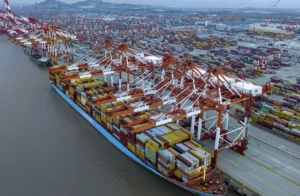
Is Vietnam really a clean “nearshoring” move for you, or is it just a different version of offshore manufacturing with new risks?
Bold statement: Vietnam is a powerful China+1 lever, but only if you design the supply chain, you can’t just swap the factory address and hope for the best.
To make your Vietnam program resilient as vietnam takes uk place as u.s largest trading partner keeps trending, follow this practical workflow.
Workflow: Map your BOM and critical components, shortlist factories by capability, run sampling and lab tests, negotiate Incoterms and payment terms, set QC plan and inspection checkpoints, choose freight mode and consolidation plan, build buffer stock policy, then lock a supplier scorecard with corrective-action rules.
If you execute that sequence, you’ll reduce late-stage surprises like capacity squeeze, inconsistent quality, or unexpected tariffs during peak season.

Where Vietnam fits in the wider U.S. trade partner ranking
When you zoom out to the full us trade partners ranking, Vietnam’s rise makes sense, but it doesn’t mean Vietnam replaces Canada, Mexico, or China across the board.
What you can take to the bank is that the “Vietnam lane” has become a core procurement and logistics channel, especially in manufactured consumer goods, which is why vietnam takes uk place as u.s largest trading partner keeps coming up in goods-trade conversations.
Looking for a Reliable Shipping & Sourcing Partner?
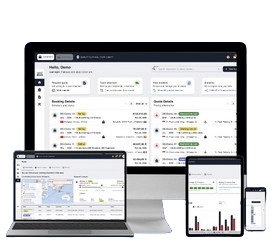
DocShipper Platform
One platform. Your entire supply chain
Sourcing, freight, customs & documents — all centralised, all visible, 24/7.
Comparing Vietnam with traditional U.S. partners like Canada, Mexico, and China
We once helped a buyer split production across Vietnam and Mexico, Vietnam for cost and scale, Mexico for speed, and that blend saved the season when a port delay hit their transpacific containers.
That’s the practical angle of vietnam takes uk place as u.s largest trading partner, Vietnam becomes a pillar, but you still need a network that fits your service level.
Here’s a concise comparison you can use when benchmarking Vietnam against other major partners.
| Partner | Typical advantage | Typical constraint |
| Vietnam | Cost-competitive manufacturing, deepening supplier base | Longer transit times, port and capacity peaks, origin documentation scrutiny |
| Mexico | Speed to market via ground freight, easier replenishment | Capacity and security variability on some corridors |
| Canada | Stable cross-border flows and integrated North American supply chains | Different category strengths, not a substitute for Asian mass manufacturing |
| China | Unmatched ecosystem breadth in many sectors | Higher policy risk and tariff uncertainty for some categories |
This is why “top trading partner” headlines don’t replace lane-by-lane strategy, you’ll still pick partners based on your service targets and risk tolerance.
DocShipper Advice
Benchmark Vietnam against Mexico, China, and Canada before locking annual freight or sourcing contracts.
How global trade deficits and reciprocal tariff debates shape Vietnam’s role
Direct tip: treat tariff volatility like a budget line you manage monthly, not a surprise you discover at customs entry.
As vietnam takes uk place as u.s largest trading partner becomes part of the policy conversation, you’ll see more attention on trade balances, enforcement, and origin integrity, especially when imports surge in sensitive categories.
To stay ahead, use this checklist to pressure-test your Vietnam lane against the most common risk triggers.
- Declared value consistency: align PO price, invoice value, and transfer pricing logic.
- Origin integrity: document substantial transformation when components come from multiple countries.
- Tariff scenario planning: model best, base, and worst-case duties into landed cost.
- Broker coordination: pre-align entry data formats to avoid last-minute corrections.
- Insurance coverage: confirm cargo policy matches Incoterms responsibility and claim process.
For a neutral macro lens on trade balances and policy spillovers, you’ll often see the OECD cited in broader discussions.
Implications for U.S. companies sourcing and investing in Vietnam
What changes for you when vietnam takes uk place as u.s largest trading partner becomes your category reality, not just a headline?
Bold statement: you’ll win in Vietnam by managing suppliers like an operation, not like a directory.
Here’s a practical step-by-step workflow we recommend for tightening execution across sourcing, logistics, and compliance.
Workflow: Pre-qualify factory, validate capacity and key subcontractors, negotiate Incoterms and lead times, set inspection plan and defect thresholds, lock packaging and labeling specs, plan consolidation and shipment cadence, coordinate export customs clearance, control shipment tracking milestones, then review supplier KPIs quarterly.
If you want a fast reality check on your next Vietnam move, you can always use Contact us to align freight modes, customs requirements, and supplier controls without overcomplicating the rollout.
DocShipper Alert
Stress-test your HS codes, origin proof, and tariff scenarios before scaling Vietnam volumes further.
What Vietnam’s rise means for the UK and for global trade dynamics
When you analyze the headline vietnam takes uk place as u.s largest trading partner, you quickly realize it’s not just about two countries switching positions. It reflects a deeper rebalancing of global trade, shifting production, investment, and geopolitical influence from Europe toward Southeast Asia.
You’ve probably noticed how supply chains have been relocating since the late 2010s. From our experience at DocShipper, this shift accelerated after trade tensions, Covid disruptions, and cost pressures forced you to rethink where you manufacture and source.
How Brexit and domestic headwinds weakened the UK’s trade position
A few years ago, one of our clients relocated part of its sourcing from Manchester to Asia because post‑Brexit customs checks were delaying shipments by two to three weeks. That’s the kind of friction that slowly erodes competitiveness and explains part of why vietnam takes uk place as u.s largest trading partner became a reality.
Brexit reintroduced customs formalities, regulatory divergence, and uncertainty for exporters. Even though the UK signed new trade agreements, you’ll find that additional paperwork, border controls, and rules of origin compliance increased operational costs.
According to the WTO, trade flows are highly sensitive to non‑tariff barriers, not just tariffs. When procedures become heavier, you feel it immediately in your landed cost and lead times.
Here’s a quick comparison to clarify the structural gap that widened:
| Factor | UK | Vietnam |
| Market integration | Left EU single market | Deep integration in ASEAN & multiple FTAs |
| Manufacturing cost | High labor and energy costs | Competitive labor structure |
| Supply chain role | Services & finance heavy | Export manufacturing hub |
| Trade momentum with U.S. | Stable or moderate growth | Rapid goods export expansion |
If you’re evaluating sourcing locations, you can’t ignore these structural differences.
Shifting investment and supply chains from Europe to Southeast Asia
Here’s the reality. Capital follows growth, and over the past decade Southeast Asia has absorbed a growing share of manufacturing FDI while parts of Europe stagnated.
When you look at the context behind vietnam takes uk place as u.s largest trading partner, you’ll see that multinational firms diversified production away from China and increasingly toward Vietnam. This “China+1” strategy became standard practice.
From our field operations, you’ll notice three practical reasons investors shifted toward Vietnam:
- Cost efficiency with rising productivity
- Access to trade agreements like CPTPP and EVFTA
- Industrial zones ready for electronics, textiles, and furniture
- Government incentives for export manufacturing
We’ve supported companies that once relied on Eastern Europe but moved assembly lines to Ho Chi Minh City to shorten U.S. shipping routes and lower unit costs. Transit times to the U.S. West Coast remain competitive, and ocean freight rates often undercut European lanes.
Before you relocate production, run through this quick checklist to validate your move:
- Confirm supplier compliance with U.S. import regulations
- Verify factory capacity and scalability
- Assess logistics infrastructure near ports like Hai Phong or Cat Lai
- Review labor standards and audit results
- Model total landed cost, not just EXW pricing
That’s usually where most importers get stuck, they underestimate indirect costs.
Strategic and geopolitical implications of Vietnam’s new status
What does it really mean when vietnam takes uk place as u.s largest trading partner? It signals a strategic pivot in global trade alignment, not just a commercial statistic.
Vietnam’s rise strengthens U.S. engagement in Southeast Asia while balancing China’s influence. At the same time, the UK focuses more on services and financial flows rather than goods trade dominance.
The shift also affects how you manage risk. When one country becomes a major export hub to the U.S., trade policy scrutiny increases. Anti‑dumping investigations, origin verification, and tariff reviews become more frequent.
According to UNCTAD analyses on global value chains, emerging economies that integrate deeply into manufacturing networks often gain leverage but also face compliance pressure. You’ll see this dynamic intensify as Vietnam’s trade surplus with the U.S. grows.
If you’re sourcing or investing in Vietnam today, here’s the strategic workflow we recommend:
Step 1: Map your exposure to U.S. tariff classifications and HS codes. Step 2: Validate country‑of‑origin compliance and documentation. Step 3: Diversify supplier base across regions inside Vietnam. Step 4: Implement third‑party quality control before shipment. Step 5: Monitor geopolitical signals and trade policy updates quarterly.
This approach keeps you proactive rather than reactive.
Conclusion
The story behind vietnam takes uk place as u.s largest trading partner is about structural transformation. Production capacity, trade agreements, cost competitiveness, and geopolitics converged to reshape U.S. goods trade.
If you’re sourcing internationally, this shift affects your strategy directly.
Here are the key takeaways you should keep in mind:
- Vietnam’s rise reflects long‑term manufacturing relocation trends
- Brexit and higher UK operating costs reduced goods trade momentum
- Southeast Asia offers scalable export platforms for U.S. markets
- Compliance, tariffs, and origin verification are becoming stricter
- You need a structured sourcing and risk management framework
Trade rankings will continue evolving. What matters for you is understanding where production ecosystems are strengthening and positioning your supply chain accordingly.
When you align your sourcing strategy with these global shifts, you don’t just follow the trend, you benefit from it.
FAQ | How Vietnam overtook the UK as America’s new key trading partner
In goods trade, Vietnam has effectively moved into the same “core group” as traditional U.S. partners for many manufactured products. While Canada, Mexico, and China still dominate overall volumes, Vietnam’s share has risen enough to rival and in some periods overtake the UK in the U.S. ranking for merchandise trade. For importers in sectors like apparel, furniture, and electronics, Vietnam now functions as a primary sourcing country, not a niche alternative.
Instead of relying on headlines, you can pull the numbers directly from public databases. The fastest route is to look up your product’s HS code and then check U.S. import statistics from Vietnam over the last 3–5 years. This lets you confirm whether Vietnam is already a high‑volume origin in your niche and how fast that volume is growing, which is more useful than a generic total‑trade figure.
The growth comes from a combination of manufacturing relocation, trade agreements, and buyer behavior. Many U.S. and global brands have shifted production runs from China or Europe into Vietnam to capture lower total landed costs and better factory scalability. As soon as large retailers lock seasonal programs in Vietnam and keep renewing them, your category’s trade lane can expand very quickly and stay on an upward trend.
Vietnam usually makes sense when you need to balance cost and scale against tariff risk and capacity constraints. If your China suppliers are hitting volume limits or facing higher duties, and your nearshoring lanes (like Mexico) can’t absorb all the demand, shifting part of your program to Vietnam can smooth out both risk and cost. The key is to treat Vietnam as a complementary pillar in your sourcing mix, not as a simple one‑for‑one replacement.
The biggest issues come from assuming Vietnam works “just like” their previous origin. Importers often copy old lead times, skip strengthening packaging for long‑haul sea freight, or neglect to tighten origin documentation when components come from multiple countries. Those shortcuts invite delays, extra inspections, and chargebacks. Taking the time to adapt your specs, QC plan, and paperwork flow to Vietnam’s conditions usually prevents most of these headaches.
You’ll want to run a small but structured test before you commit. That means sampling with two or three factories, running a limited production batch, and shipping it under real conditions to see how it behaves in transit and at customs. If quality, compliance, and costs stay consistent across that pilot, you have a strong signal that Vietnam can support your product at scale and become a reliable long‑term lane.
Vietnam’s exports to the U.S. are heavily focused on consumer and industrial goods that move primarily by sea. For most importers, this means planning around containerized flows, periodic peak seasons, and the need for solid booking discipline out of major ports like Hai Phong and Cat Lai. If your catalog overlaps with those export clusters, you should expect tighter space at origin during high season and build extra buffer into your freight and inventory plans.
Read more
Looking for more? Check out these articles.
Need Help with Logistics
or Sourcing in Vietnam ?
First, we secure the right products from the right suppliers at the right price by managing the sourcing process from start to finish. Then, we simplify your shipping experience - from pickup to final delivery - ensuring any product, anywhere, is delivered at highly competitive prices.
Fill the Form
Prefer email? Send us your inquiry, and we’ll get back to you as soon as possible.
Contact us