In short ⚡
Choosing freight company partners starts with defining what you need beyond a cheap rate: operational expertise on your cargo and routes, transparent pricing, solid network coverage, and strong crisis handling. Evaluate specialization, insurance options, customs and documentation support, real-time tracking, and clear service levels so you minimize hidden costs, delays, and risk.- Check experience with your product, Incoterms, and trade lanes.
- Verify cargo insurance scope, claim process, and liability limits.
- Assess customs brokerage, documentation pre-checks, and compliance.
- Demand itemized quotes with all surcharges and free-time conditions.
- Test tracking tools, communication speed, and escalation procedures.
- Watch for red flags like vague quotes, ultra-low rates, or no proof of coverage.
In this article, you will find practical checklists to vet freight partners, comparisons of service levels and provider types, specific guidance for Vietnam, and workflows for insurance, customs, vehicle moves, and international shipments so you can choose safer, more cost-effective freight solutions.
We hope you’ll find this article genuinely useful, but remember, if you ever feel lost at any step, whether it’s finding a supplier, validating quality, managing international shipping or customs, FNM Vietnam can handle it all for you!
What a freight company actually does for your business
If you’re choosing freight company options based only on price, you’ll miss what really moves the needle, control, risk, and time.
Here’s the thing, a freight company is not just “the truck” or “the vessel”. It’s the operator that orchestrates your shipment end-to-end, often through a freight forwarder model with multiple carriers and service partners.
You’ve probably dealt with suppliers who say “we shipped it already”, then send a blurry photo of a box at a warehouse.
That’s exactly where the right freight company services turn chaos into something you can manage.
DocShipper Info
Let our freight experts map your full process, from pickup to delivery, with clear responsibilities and zero grey zones.
Key roles in your supply chain and delivery
Last quarter, we saw a buyer approve EXW from a factory, then realize too late that pickup meant “figure it out yourself”. That’s the moment most importers get stuck when choosing freight company support.
In practice, a freight company plugs the gaps across your supply chain, from origin handling to final delivery.
To make it concrete, here are the core jobs you’re actually buying when you work with a freight company:
- Pickup coordination with your supplier, including booking slots, labels, and carton counts.
- Mode planning across air freight, sea freight, and trucking, based on lead time, cost, and cargo constraints.
- Packaging and compliance checks so your cargo doesn’t get rejected for bad marks, missing docs, or unsafe loading.
- Customs coordination so you keep custom clearance and paperwork easy.
- Carrier bookings, space protection, and schedule monitoring.
- Exception management when ports roll bookings, airlines bump freight, or your supplier misses cut-off.
You’ll notice fast that the best freight company isn’t the one with the fanciest website, it’s the one that prevents surprises before they become expensive.
DocShipper Alert
Pre-validate VINs, invoices, and permits before the vehicle reaches the port gate.
How freight company services help you save time and money
Direct tip: when you’re choosing freight company partners, ask them to explain where they save you money, not just what they “charge”. You want to hear operational levers, not marketing.
Real savings usually come from avoiding avoidable costs, storage, demurrage, wrong HS codes, rework at origin, or missed cut-offs.
According to the World Bank, border procedures and documentation quality directly impact lead times and total landed cost, so shaving a day off clearance can beat negotiating a few dollars off the rate.
Here’s a simple workflow you can use to see if a freight company actually runs operations or just resells space:
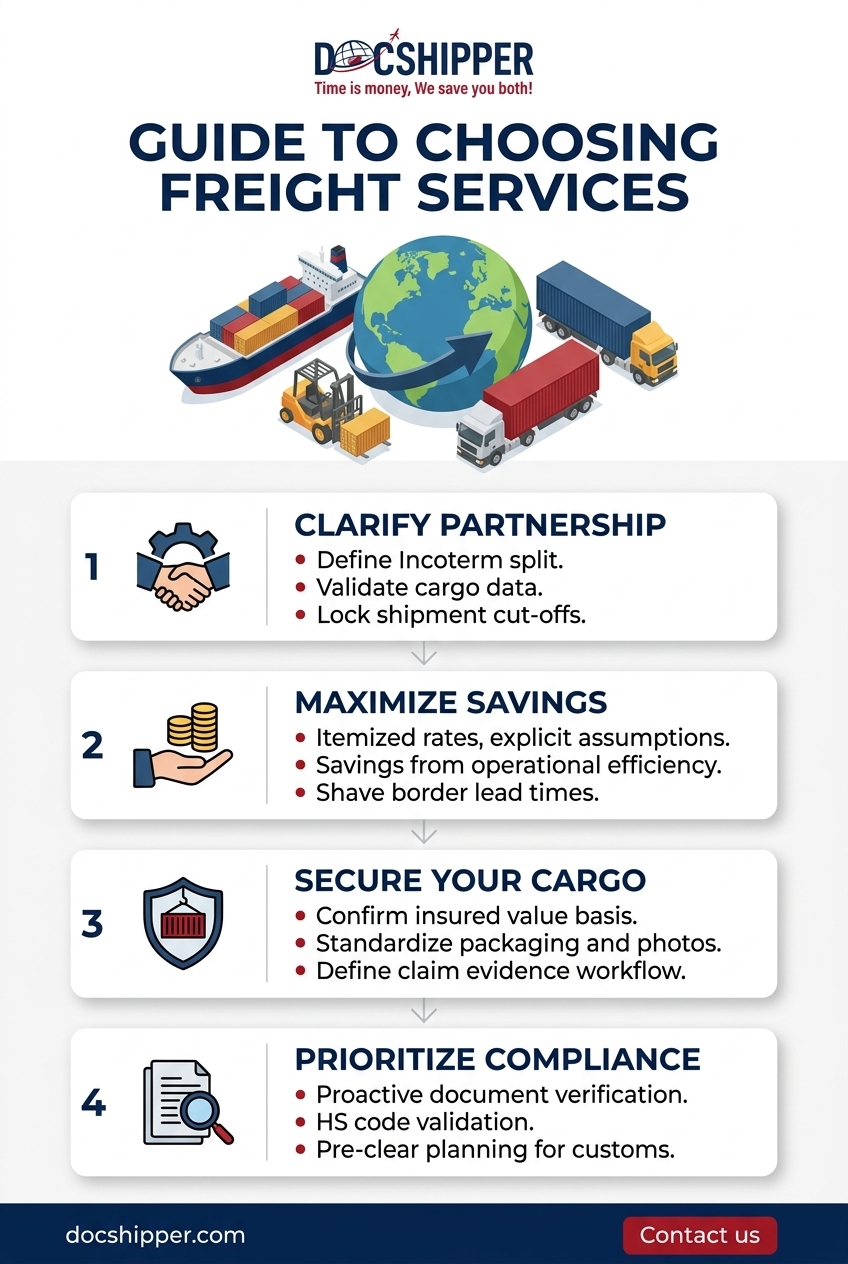
- Step 1: Confirm Incoterm and responsibility split (who pays origin, who clears, who delivers).
- Step 2: Validate cargo data, dimensions, weights, HS code, battery status, hazmat, and photos.
- Step 3: Choose mode and routing, then lock cut-offs and handover points in writing.
- Step 4: Pre-check documents, commercial invoice, packing list, COO if needed, permits.
- Step 5: Track milestones and escalate exceptions before they snowball.
To help you compare freight company services quickly, this table shows what “cheap” vs “well-managed” usually looks like in the real world:
| What you compare | Low-bid freight company | Operationally strong freight company |
| Quoting | Rate looks low, terms stay vague | Rate is itemized, assumptions are explicit |
| Planning | Books first available option | Proposes 2 to 3 routes with trade-offs |
| Documentation | Checks docs after cargo arrives | Pre-checks docs before pickup |
| Exceptions | Updates you late | Escalates early with options and costs |
DocShipper Advice
Request a structured quote review showing cost drivers, document checks, and exception handling steps.
Core factors to check before you choose a freight company
When you choose freight company support, you’re really choosing how much uncertainty you can tolerate.
We’ve seen importers accept a “best freight company” claim, then get hit with rolled sailings, surprise fees, and an agent who disappears when customs asks a question.
To keep this section practical, we’ll walk you through the five checks that consistently separate a reliable freight company from a risky one.
Experience, specialization, and industry knowledge
One shipment that stuck with us, a buyer moved mixed cargo with lithium accessories inside “regular cartons”. The freight company didn’t flag it, and the airline rejected the lot at the terminal. Choosing freight company expertise would’ve prevented a week of rework.
Bold statement: experience matters only if it matches your cargo, route, and Incoterm reality.
So when you’re about to choose freight company options, dig into specialization, not years in business.
Use this quick checklist to pressure-test competence in 5 minutes:
- They can explain Incoterms impacts on pickup, export clearance, and risk transfer, without guessing.
- They ask for HS codes, MSDS if relevant, and packing details before quoting.
- They know seasonal constraints on your lane (peak weeks, equipment shortages, port congestion patterns).
- They can share typical transit time ranges and what causes variability.
- They confirm who their origin partner is, and how escalation works.
DocShipper Advice
Ask technical questions before booking, and verify real case experience, not just years in business.
Cargo insurance and risk protection
What happens if your cargo gets wet in a container yard, or a forklift punches through a crate, and the carrier denies liability? That’s why choosing freight company risk protection is non-negotiable.
We’ve watched importers assume “carrier liability” equals insurance, then learn the hard way it often covers only a small fraction of the invoice value.
Direct tip: ask your freight company to explain, in writing, what’s covered, the claim process, and the documentation you’ll need on day one.
If you want to insure properly, you should align coverage with your Incoterm, packaging, and commodity risk.
Here’s the short workflow we recommend before cargo moves:
- Step 1: Confirm insured value basis (invoice, CIF, plus uplift).
- Step 2: Validate packing standard, photos, seals, and handling constraints.
- Step 3: Clarify exclusions, temperature, theft, improper packing, delay.
- Step 4: Pre-define claim evidence, survey, timestamps, and consignee notes.
DocShipper Alert
Secure proper cargo insurance aligned with value, Incoterm, and packing before departure.
Network strength, routes, and international reach
We once handled a case where the “freight company” won the quote, then outsourced every leg to unknown agents. The cargo changed hands three times, and nobody owned the delay. That’s a classic choosing freight company trap.
A strong network is less about logos, more about control at origin, handover points, and destination.
The WCO consistently emphasizes data quality and coordination across borders, and you feel that in real life when one missing detail triggers inspections and queue time.
To judge network strength quickly, compare these signals:
- Lane ownership: they ship your route weekly, not “on request”.
- Origin capability: real pickup scheduling, consolidation, and export handling.
- Destination capability: customs coordination and last-mile delivery planning.
- Alternatives: they can reroute when a port closes or space collapses.
DocShipper Info
Verify weekly volumes and real origin partners before trusting critical shipments.
Transparency of pricing and hidden surcharges
Direct tip: don’t accept a one-line quote if you’re serious about choosing freight company partners. If you can’t audit the price, you can’t control landed cost.
You’ve probably seen it, base freight looks attractive, then come the extras, documentation, terminal handling, peak season, GRI, detention, demurrage.
Ask for a rate format that forces clarity before booking.
Use this checklist to keep pricing honest without turning the negotiation into a fight:
- Request an itemized quote split by origin, main carriage, destination, and optional services.
- Confirm currency, validity date, and whether the quote assumes stackable cargo.
- Ask what triggers detention/demurrage and what free time is included.
- Get surcharges named explicitly, not “as per carrier”.
- Ask for a written example of the final invoice layout.
DocShipper Alert
Demand itemized pricing and a sample final invoice before confirming your booking.
Crisis handling, reliability, and customer support
When a vessel slips a week or customs flags a document, do you get a proactive plan or silence? That’s the real test when choosing freight company reliability.
Bold statement: everyone looks good when nothing goes wrong.
We’ve seen strong operators call within 30 minutes of an issue, share options, cost impact, and a recommendation, while weak ones simply forward a carrier email.
To evaluate crisis handling, ask them to walk you through a recent disruption and what they did, step by step:
- Detect: how they monitor cut-offs, gate moves, and customs holds.
- Escalate: who you contact, and who they contact, with response times.
- Decide: reroute, split shipment, upgrade mode, or reschedule pickup.
- Document: how they protect claims, notes, photos, and timestamps.
DocShipper Advice
Test their crisis response process with real scenarios before assigning high value cargo.
How a freight company supports commercial vehicle shipping
If you’re shipping pickups, vans, trucks, or other fleet assets, choosing freight company support becomes even more operational.
Commercial vehicles are bulky, high-value, documentation-heavy, and surprisingly easy to delay if one detail is off.
If your situation includes cross-border moves, you may also find this external resource useful for context: shipping commercial vehicles.
DocShipper Info
Work with specialists who manage documentation, handling, and port formalities end to end.
Why using a freight company for vehicles can cut costs
We’ve seen importers try to “DIY” vehicle shipping, only to get hit with storage because the port required an extra vehicle declaration they didn’t know existed. Choosing freight company expertise is often cheaper than learning by penalties.
Direct tip: cost control starts with choosing the right method, RoRo vs container, plus proper blocking and bracing if containerized.
Here are the most common cost levers a strong freight company applies for vehicle moves:
- Mode selection: RoRo for simplicity, container for protection and bundling parts.
- Load optimization: minimizing wasted cubic meters and avoiding non-stackable penalties.
- Port selection: choosing terminals that handle vehicles efficiently, with predictable processing time.
- Condition control: inspections and photos to avoid disputes at delivery.
DocShipper Advice
Compare RoRo and container options with a cost and risk breakdown before booking.
Time savings, smoother processes, and better customer service
What do you really gain besides “transport”? If you’re choosing freight company support for vehicles, you’re buying coordination across multiple parties that rarely sync naturally.
We once dealt with a fleet shipment where the supplier released vehicles in two batches, and the buyer’s receiving team wanted one delivery window. The freight company that won the job built a staggered plan and avoided double handling.
Bold statement: time savings come from fewer handoffs, not faster emails.
Use this lightweight workflow to keep vehicle shipments smooth from pickup to delivery:
- Step 1: Confirm VIN list, dimensions, operational status, and fuel/battery constraints.
- Step 2: Plan pickup windows and pre-book terminal receiving appointments.
- Step 3: Execute condition report at handover, photos, scratches, accessories.
- Step 4: Track milestones and pre-alert consignee with delivery requirements.
DocShipper Info
Align VIN lists, delivery windows, and terminal slots early to prevent double handling and delays.
Overcoming customs and paperwork hurdles
A vehicle can sit for days because one field on the invoice doesn’t match the VIN list. That’s why choosing freight company documentation discipline matters more here than with general cargo.
Direct tip: build your paperwork pack before the vehicle reaches the port, not after it’s already gated in.
This is the checklist we use to reduce customs friction for vehicle shipments:
- Commercial invoice aligned with VINs, unit values, and currency consistency.
- Packing list or unit list, including accessories and spare parts.
- Export docs from origin, plus any required certificates.
- Import permits or local approvals when the destination requires them.
- Pre-clear planning so you keep custom clearance and paperwork easy.
How to choose a freight company for international shipments
International shipping is where choosing freight company decisions become irreversible fast, because one mistake multiplies across borders, carriers, and regulations.
You’re not just booking transport, you’re managing compliance, timing risk, and cash flow tied up in inventory.
We’ll keep it practical, you’ll want a partner that anticipates rules before customs forces the lesson.
DocShipper Info
Have your shipment plan reviewed by a cross-border specialist before first booking confirmation.
Export rules, safety standards, and documentation
We’ve seen cargo miss a sailing because the supplier issued an invoice without the right consignee name, then refused to reissue for “accounting reasons”. A seasoned team handles that before cut-off, and that’s the difference when choosing freight company support.
Question: do they check documents proactively, or do they wait until the warehouse asks for them?
At a minimum, your freight company should validate the documents against route and commodity requirements before booking is confirmed.
Use this simple workflow to keep international shipments compliant:
- Step 1: Confirm Incoterm, exporter of record, and who files export declarations.
- Step 2: Validate HS codes, licensing needs, and any restricted party screening.
- Step 3: Pre-check invoice, packing list, and certificate needs (COO, fumigation, etc.).
- Step 4: Align labels, marks, and carton counts with documents.
DocShipper Advice
Implement a document pre-check workflow aligned with route, HS code, and exporter details.
Picking the right partner and service level
Direct tip: match service level to risk, not ego. If your product is seasonal or high-margin, the cheapest option can be the most expensive outcome, and you’ll feel it immediately after you finish choosing freight company terms.
We typically see three service levels in the market, and confusing them causes most disappointments.
Here’s a quick comparison to help you choose freight company service levels without overpaying:
| Service level | Best for | What you actually get |
| Basic forwarding | Low risk, flexible lead time | Booking and standard tracking, limited exception ownership |
| Managed logistics | Predictable replenishment | Planning, milestone control, doc pre-checks, clearer escalation |
| End-to-end control | High value, complex routes | Origin management, compliance support, risk planning, proactive recovery options |
DocShipper Info
Map your margin and timing risk to the right logistics model before signing.
Insurance and tracking for cross‑border moves
Bold statement: if you can’t track it and insure it, you don’t control it, and choosing freight company becomes a gamble.
We’ve seen claims rejected because the consignee signed “received in good order” without opening crates. That one line can undo weeks of protection work.
To keep cross-border moves safer, use this checklist before departure:
- Confirm who arranges coverage and how to insure at the right value.
- Require milestone tracking, pickup, gate-in, departure, arrival, out-gate, delivery.
- Agree on exception alerts and response times for delays or holds.
- Define delivery inspection rules, photos, notes, and escalation before signing POD.
If you want a second opinion on your route, service level, or risk plan, Contact us and we’ll pressure-test your setup without drowning you in jargon.
DocShipper Alert
Confirm coverage, milestone alerts, and POD inspection rules before cargo departure.
How to choose a freight company in Vietnam
When you’re choosing freight company partners in Vietnam, you’re not just comparing rates. You’re stepping into a fast-growing logistics market shaped by regional trade agreements, port congestion, and complex customs rules.
Vietnam has become a major manufacturing hub, especially for electronics, textiles, and increasingly commercial vehicles and machinery. If you don’t understand how the local system works, you’ll feel it quickly in delays, unexpected fees, or compliance issues.
Looking for a Reliable Shipping & Sourcing Partner?


DocShipper Platform
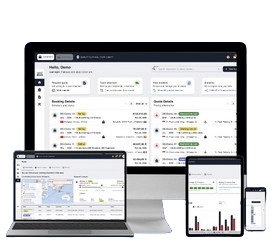
One platform. Your entire supply chain
Sourcing, freight, customs & documents — all centralised, all visible, 24/7.
Local regulations, routes, and port infrastructure
We once supported a client shipping construction vehicles from Hai Phong to West Africa. The supplier thought the biggest challenge would be ocean freight rates. In reality, the delay came from incomplete export dossiers and inspection requirements that weren’t anticipated during the booking stage.
When you’re choosing freight company services in Vietnam, you need a partner who truly understands local regulations, not just someone who can book space on a vessel.
Here’s what you should verify before committing:
- Customs brokerage license and experience with Vietnamese General Department of Customs procedures
- Knowledge of HS codes specific to your goods, especially vehicles and machinery
- Familiarity with export inspection requirements and conformity certifications
- Experience with main gateways like Hai Phong, Cat Lai, and Cai Mep Thi Vai
Vietnam’s port infrastructure is improving rapidly, particularly in Cai Mep where deep-sea terminals handle direct US and EU services. According to the World Bank Logistics Performance Index, Vietnam has significantly improved its logistics ranking over the past decade, but infrastructure gaps still exist in inland transport.
To keep control, follow this simple local validation workflow:
- Step 1: Confirm your product’s export eligibility and required documents.
- Step 2: Validate inland trucking capacity from factory to port.
- Step 3: Double-check port cut-off times and container yard procedures.
- Step 4: Align Incoterms responsibilities clearly in writing.
If your forwarder hesitates when you ask about cut-off times or customs inspection ratios, that’s your signal to dig deeper.
DocShipper Info
Validate licenses, port experience, and cut-off mastery before moving cargo through Hai Phong or Cat Lai.
Evaluating Vietnamese freight providers and their networks
Here’s the thing, not all freight companies in Vietnam operate at the same level. Some are strong locally but rely heavily on third parties overseas, which can create blind spots once your cargo leaves the country.
When you’re choosing freight company partners, you need to evaluate both their domestic capabilities and their international reach.
This comparison table will help you assess their structure:
| Criteria | Local Small Forwarder | Established Networked Forwarder |
| Customs expertise | Often strong locally | Strong, standardized procedures |
| International agents | Ad hoc partnerships | Verified global network |
| Rate negotiation power | Limited volumes | Better leverage with carriers |
| Tracking systems | Manual updates | Digital platforms and milestone alerts |
You should also ask about their membership in recognized logistics associations, such as FIATA, which often reflects adherence to international standards.
At DocShipper, we’ve seen shipments run smoothly in Vietnam but fail at destination because the overseas partner was weak. That’s why you must evaluate the entire chain, not just the departure port.
DocShipper Advice
Check overseas agents and digital tracking tools to avoid blind spots after departure.
Practical checklist to compare and choose the best freight company
When you’re serious about choosing freight company partners, you need a structured method. Otherwise, you’ll end up comparing apples to oranges and focusing only on price.
You’ve probably received quotes that look similar at first glance. Then the invoice arrives, and it’s a different story.
Questions to ask about services, technology, and tracking
Before you sign anything, pause and ask direct operational questions. This is where you quickly separate experienced freight forwarders from basic brokers.
When choosing freight company options, use this targeted checklist during your calls:
- Do you provide real-time tracking or only milestone email updates?
- Who handles customs clearance, in-house or outsourced?
- What Incoterms do you usually manage for my cargo type?
- How do you handle container demurrage and detention risks?
- Is there a dedicated account manager?
If answers are vague, that’s not a small issue. It often signals limited operational control.
DocShipper Advice
Use a standardized evaluation sheet to compare tracking, customs handling, and account management.
Comparing quotes, contracts, and service commitments
Let’s be honest, the cheapest offer is rarely the safest. We’ve seen clients choose a low quote for vehicle shipping, only to discover missing charges for terminal handling, documentation, and peak season surcharges.
When you’re choosing freight company proposals, compare them line by line.
This quick framework will help you:
- Base freight rate
- Origin charges and export customs fees
- Destination charges
- Fuel and peak season surcharges
- Insurance premium details
- Liability limits stated in contract
Pay attention to references to ICC Incoterms rules in the contract. Clear allocation of responsibilities prevents disputes later.
You should also check payment terms. If 100 percent prepayment is required without contractual safeguards, you’re taking unnecessary risk.
DocShipper Alert
Audit every line item and liability clause before approving payment terms.
Red flags that signal you should avoid a freight provider
Ever had a forwarder stop answering calls once the cargo was on the water? Unfortunately, it happens more often than you’d expect.
While choosing freight company services, watch for these warning signs:
- No physical office address or unclear company registration
- No proof of cargo insurance coverage
- Extremely low rates compared to market average
- Reluctance to provide written quotations
- Slow or inconsistent communication
A reliable partner will be transparent about liability limits under international conventions and won’t hesitate to document everything clearly.
DocShipper Alert
Verify registration, insurance proof, and written commitments before releasing your cargo.
Conclusion
Choosing freight company partners is not a box-ticking exercise. It’s a strategic decision that directly affects your cost structure, risk exposure, and customer satisfaction.
If you focus only on freight rates, you’ll miss the bigger picture. If you assess expertise, network strength, insurance coverage, and crisis management capacity, you’ll protect your shipments long term.
To wrap it up, here are the key takeaways you should remember:
- Verify local expertise and regulatory knowledge, especially in Vietnam.
- Evaluate the forwarder’s full international network, not just origin operations.
- Break down every quote to uncover hidden charges.
- Confirm cargo insurance scope and liability limits.
- Test responsiveness before trusting them with your shipment.
When you approach choosing freight company partners with structure and the right questions, you shift from reacting to problems to preventing them. And that’s exactly how you keep your shipping safer, cheaper, and under control.
FAQ | How to choose the right freight company for safer, cheaper shipping
A freight company typically acts as the orchestrator of your shipment, planning routes, managing documents, and coordinating multiple carriers. A carrier (airline, shipping line, trucking company) physically moves the cargo on its own equipment. A broker mainly connects you with carriers or forwarders and may not take operational responsibility. When you ask who will actually manage exceptions and speak to customs, you’re really checking whether you’re dealing with a true freight operator or just a middleman.
To get closer to your real spend, you need to look at the full “door-to-door” picture. Start from your agreed Incoterm, then map every cost you still own: origin handling, export customs, main transport, destination fees, delivery, insurance, and potential storage or demurrage. Ask the provider to show you a sample final invoice for a similar shipment, with all typical surcharges included. If they can’t or won’t, assume your final cost will be higher than the first number you see.
The biggest red flags usually show up before you book. If they avoid detailed questions about your cargo, refuse to put commitments in writing, or keep sending one-line quotes with no breakdown, you’re likely to face surprises later. Another warning sign is slow or inconsistent replies during the sales phase; if they’re already slow now, they won’t magically become responsive once your goods are stuck at a port. A reliable partner will be transparent and concrete from day one.
When prices look similar, compare how they plan and control the shipment, not just the rate. Ask each one exactly who will manage your file, how they monitor milestones, and what they do when a cutoff is missed or customs asks a question. Also check how clearly they explain Incoterms, insurance, and local regulations for your lane. The partner who can walk you through a recent disruption, step by step and with numbers, is usually the one with real operational depth, even if their quote differs by a few dollars.
For vehicles, protection is mostly about preparation and documentation. At minimum, you want a detailed condition report with photos at handover, clear instructions on how the vehicle will be secured (blocking, bracing, or lashing), and written procedures for handling scratches or damage on arrival. Make sure the freight company explains how they document loading, where the vehicle will be parked at terminals, and what the receiver must do before signing the POD. Without this paper and photo trail, insurance claims are much harder to win.
A fast way is to give them a concrete scenario: your product, origin, destination, volume, and Incoterm, then ask them to outline the main risks and typical pitfalls. Listen for specifics, such as seasonal congestion on your route, common customs issues for your HS codes, or local port practices at origin and destination. If they stay at the level of generic promises, they’re not ready to manage your shipments. If they immediately ask focused questions and mention lane‑specific details, you’re likely talking to a specialist.
Read more
Looking for more? Check out these articles.
Need Help with Logistics
or Sourcing in Vietnam ?
First, we secure the right products from the right suppliers at the right price by managing the sourcing process from start to finish. Then, we simplify your shipping experience - from pickup to final delivery - ensuring any product, anywhere, is delivered at highly competitive prices.


Fill the Form
Prefer email? Send us your inquiry, and we’ll get back to you as soon as possible.
Contact us