Freight Shipping between Vietnam and Sweden | Rates – Transit times – Duties and Taxes
If you underestimate the distance and compliance gap between Vietnam and Sweden, you usually pay for it in delays, storage fees, or paperwork corrections. On a route like freight vietnam sweden, where your cargo moves from major hubs such as Ho Chi Minh City or Hai Phong toward Scandinavian entry points, you need clarity on transit times, Incoterms, customs documentation, and duty exposure before you even confirm your supplier’s terms. The first thing we always tell you is simple, lock down your shipping method, responsibilities under FOB or CIF, and your import setup in Sweden before production ends, because that’s where most hidden costs start. In this Destination guide, you’ll get a clear breakdown of rates, transit times, customs clearance steps, duties and taxes, and how to structure your Vietnam to Sweden freight so you stay in control from booking to final delivery.
Which are the different modes of transportation between Vietnam and Sweden?
If your cargo is time-sensitive or high value, you should choose air freight from Tan Son Nhat Airport to Stockholm Arlanda, because you cut transit time drastically but accept a higher cost per kilo based on chargeable weight. If your goods are bulky, heavy, or not urgent, you should use sea freight from Port of Hai Phong or Cat Lai to the Port of Gothenburg, where container shipping keeps your unit cost under control.
You’ll notice fast that the real decision depends on your volume in CBM, your deadline, and whether you ship under FCL or LCL, because one wrong assumption can trigger demurrage or storage fees. If you’re unsure, you can always contact us, we monitor real-time capacity and pricing on the Vietnam Sweden corridor and help you choose the option that fits your cargo profile, and we’ll break down each mode in more detail below.
Need help with your shipment?
Need assistance with your shipment? Dont hesitate to contact us even for a simple question. Choose the option that suits you
Live chat with an expert Chat on WhatsApp Free Quote 24hHow can FNM Vietnam help?
Sea freight between Vietnam and Sweden
If you are planning sea freight Vietnam Sweden, the first thing you should clarify is volume and urgency. Sea transport makes sense when you ship larger volumes, heavy cargo, or when your timeline allows roughly 5 to 8 weeks door to door. For regular container shipping Vietnam Sweden route flows, ocean freight remains the most cost-efficient option compared to air, especially for Full Container Load (FCL) and consolidated cargo.
Here is what you need to understand about ocean freight Vietnam to Sweden. Most services are not direct. Your container usually transships in a major hub such as Singapore or a North European port before reaching Scandinavia. That means your shipping lead time by sea depends heavily on the container vessel schedule, the chosen service, and seasonal congestion. If you assume a fixed transit time without checking the actual estimated time of departure (ETD) and estimated time of arrival (ETA), you expose yourself to avoidable delays.
Sea freight is not ideal if you have urgent retail launches, strict installation deadlines, or temperature-sensitive cargo without proper planning. But if you can plan ahead and secure space early, sea shipping Vietnam to Sweden gives you predictable budgeting and scalable capacity. We always advise you to define your target Incoterm, your real delivery point in Sweden, and whether you need door-to-port and port-to-door service or strict port-to-port ocean freight before you even request a quote. That is where most costly misunderstandings begin.
Main ports to know in Vietnam and Sweden
When you organize maritime transport Southeast Asia to Scandinavia, your port choice impacts cost, inland trucking, and schedule reliability. You should focus on the main seaports in Vietnam and Sweden that are actually used for international container services.
In Vietnam:
- Ho Chi Minh City, Cat Lai / Cai Mep: Main southern gateway for export factories, best connectivity to Europe, frequent deep-sea services. Ideal for large FCL volumes.
- Hai Phong: Key port for northern industrial zones around Hanoi and Bac Ninh. Often requires transshipment for Europe-bound cargo.
- Da Nang: Regional option for central Vietnam, but fewer direct long-haul services, so plan for feeder or hub connections.
In Sweden:
- Port of Gothenburg: The primary container hub, strongest rail and road links to mainland Europe. Best choice for nationwide distribution.
- Port of Helsingborg: Strategic for southern Sweden and fast trucking into Denmark.
- Port of Stockholm: Relevant for Baltic-focused flows, sometimes served via feeder service to Nordic ports.
Your choice influences inland haulage costs significantly. If you ship to Gothenburg but your final warehouse is in northern Sweden, your inland trucking can quickly become the largest line item. If you pick a smaller Baltic port, you may face longer feeder connections and tighter vessel schedules. This is why we always align port strategy with your real delivery address, not just the ocean rate.
Transit times: How long does it take to ship from Vietnam to Sweden?
Your sea transit time Vietnam Sweden typically ranges between 45 and 55 days port to port, depending on origin, destination, and transshipment pattern. You should treat this as an operational estimate, not a guaranteed promise.
| Port of Loading (Vietnam) | Port of Discharge (Sweden) | Average Transit Time (Days) |
|---|---|---|
| Hai Phong | Malmö | About 52 days |
| Da Nang | Gothenburg | About 47 days |
| Ho Chi Minh City | Stockholm | About 45 days |
| Quy Nhon | Helsingborg | About 55 days |
In practice, your total shipping lead time by sea includes origin trucking, export customs clearance in Vietnam, transshipment waiting time, and import handling in Sweden. If your shipment moves during peak export season or before major holidays, you can expect space constraints and potential schedule slippage.
The key is to monitor the ETD and ETA accuracy of the selected carrier and check whether the service is direct or via hub. One extra transshipment can easily add a week. When we plan your shipment, we look beyond the advertised transit time and focus on the real vessel rotation and buffer time you actually need.
Should I choose FCL or LCL when shipping between Vietnam and Sweden?
Deciding on the best sea freight option for your Vietnam-Sweden shipments is crucial. It’s a balance between Full Container Load (FCL)and Less than Container Load (LCL), otherwise known as consolidation. The choice you make can significantly affect not just your shipping cost, but also delivery time, making it vital to your operations’ smooth running. So, let’s unravel these two options to empower you with knowledge, helping you make a strategic decision that aligns with your specific shipping needs. Are you ready to dive in? Let’s start sailing!
Full container load (FCL)
Definition: FCL, or Full Container Load, refers to shipping when a single client hires an entire container for their cargo. Perfect for heavier loads above 13/14/15 CBM, it's favored mainly for its cost-effectiveness and security, as the container remains sealed from Vietnam to Sweden.
When to Use: Consider, for instance, a manufacturer in Vietnam exporting 300 cartons of digital equipment to Sweden. Utilizing an FCL 20'ft container would keep the goods secure and undisturbed, ultimately mitigating the risk of damage during transit.
Cost implications: can be greatly beneficial with FCL shipping. When you acquire an FCL shipping quote, you'll pay for the whole container. Interestingly, the cost per unit shipped tends to decrease as the volume of your goods increases. In essence, more volume in a 20'ft or 40'ft container equals less 'cost per unit', making FCL container shipping a cheaper route for large volume shipments.
Less container load (LCL)
Definition: LCL (Less than Container Load) shipping is a method of transporting goods that involves consolidating multiple shippers' cargo into one single container. It suits businesses which don't have enough cargo to fill an entire container.
When to Use: Use LCL shipping when your cargo is less than 13-15 CBM (Cubic Meters). This option is particularly beneficial for businesses shipping smaller volumes as it offers price flexibility.
Example: Let's imagine you own a small business in Vietnam that manufactures bamboo toothbrushes. Your Swedish retail partner orders 1000 units every two weeks, which occupies 10 CBM per shipment. In this case, using an LCL shipment service is prudent as it allows you to only pay for the space used.
Cost Implications: With LCL shipping quotes, you pay only for the space your cargo occupies in the container. However, bear in mind that while the cost per unit shipped might be higher than Full-Container-Load (FCL), it's more cost-effective when shipping volumes are low. There may also be extra costs for handling LCL freight at the ports, as the process involves additional unpacking and re-packing inside the container.
Hassle-free shipping
Looking to ship between Vietnam and Sweden? FNM Vietnam, your dedicated freight forwarder, aims to simplify cargo shipping for your business. Our ocean freight experts factor in your shipping volume, budget, and speed requirements to assist you in deciding between consolidation or a full container. We're here to streamline your shipping process. Reach out to us for a free shipping estimate today!
Shipping rates: how much does a sea freight shipment cost from Vietnam to Sweden?
Your ocean freight rates Vietnam Sweden depend on container size, season, carrier, and whether you ship Less than Container Load (LCL) or Full Container Load (FCL). Below are indicative planning ranges that help you budget before requesting a detailed offer.
| Mode | Details | Indicative Rate Range |
|---|---|---|
| LCL | Freight rate per cubic meter (CBM) | USD per CBM, variable by volume band |
| FCL 20ft | Cost per container Vietnam to Sweden | USD per 20ft container, market dependent |
| FCL 40ft | Cost per container Vietnam to Sweden | USD per 40ft container, market dependent |
In reality, the base ocean rate is only one component. Your final budget includes terminal handling charges (THC), documentation fee and origin charges, possible bunker adjustment factor (BAF), and sometimes a peak season surcharge (PSS). That is why your total landed cost often differs from the initial headline rate.
How to estimate your sea freight cost before requesting a quote
If you want to know how to estimate sea freight cost Vietnam Sweden, start with four elements: total CBM, gross weight, chosen Incoterm such as FOB Vietnam to Sweden or CIF Sweden import from Vietnam, and exact ports.
For example, if you ship 8 pallets totaling 12 CBM under EXW supplier Vietnam, you must add origin pickup, export clearance, ocean freight per CBM, and destination charges in Sweden. If your LCL rate is quoted per CBM, you multiply the rate by 12. Then you add destination handling and customs clearance. Many importers focus only on the ocean line and later discover unexpected local charges on arrival.
Cheap quotes often exclude destination fees or assume unrealistic weight and volume. Always verify whether the offer is port-to-port ocean freight or includes DAP Sweden delivery. If you want a precise breakdown, you can send us a freight quote request Vietnam Sweden with your packing list and we respond within 24 hours.
Surcharges and hidden cost drivers to watch for
First, you will face destination charges in Sweden. These include THC, handling, and release of the Bill of Lading (B/L) or telex release. If you overlook them, your landed cost calculation will be incomplete.
Second, time-related charges such as demurrage and detention start when your free days expire. If your customs broker delays documents or your warehouse is not ready, you trigger container detention costs that escalate daily.
Third, market-driven surcharges like BAF or PSS fluctuate during high-demand periods. You cannot control them, but you can anticipate them by booking early and confirming validity dates in writing.
Step-by-step: how a sea freight shipment usually works on this route
When you book sea shipping Vietnam to Sweden, the process follows a clear operational chain. It looks simple on paper, but this route requires patience because of transshipment hubs and Nordic feeder connections. Most surprises happen between booking confirmation and cargo arrival, especially around documentation and schedule shifts.
- We confirm volume, Incoterm, and book space based on the selected container vessel schedule.
- Your supplier prepares cargo and we arrange pickup if you ship under EXW supplier Vietnam.
- We handle export customs clearance in Vietnam and deliver the container to port before the cut-off.
- The carrier issues the Bill of Lading (B/L) and confirms final ETD.
- Your container sails, often via transshipment hub, until reaching Sweden.
- Before arrival, we coordinate import handling in Sweden and customs clearance.
- After release, we arrange delivery under DAP Sweden delivery or make the container available for pickup.
Special transportation services
If your cargo does not fit standard containers or has specific constraints, you can use tailored sea solutions on this route.
- Out-of-gauge (OOG) cargo: For oversized machinery and industrial equipment that exceed standard dimensions.
- Project cargo by sea: For coordinated shipments of multiple heavy units requiring special planning.
- Hazardous cargo (IMO) shipping: For regulated goods that need proper classification and documentation.
- Reefer container shipping: For temperature-controlled goods between tropical Vietnam and Nordic climates.
- FCL vs LCL Vietnam Sweden: Choose FCL for higher volumes and control, LCL for smaller shipments with consolidation and deconsolidation at hub ports.
Each option requires specific documentation and booking conditions. If you underestimate cargo dimensions or misdeclare dangerous goods, you risk cargo refusal at port. We review technical details with you in advance so your shipment moves without last-minute disruption.
Air freight from Vietnam to Sweden
You choose air cargo Vietnam to Sweden when time matters more than ocean savings, when your goods are high value, seasonal, or urgently needed in Stockholm or Gothenburg. You avoid it when your shipment is bulky, low value, or flexible on timing. On this route, you are usually looking at a mix of direct flight vs transshipment, strict cut-offs, security screening, and cargo terminal handling on both sides.
You might think air is always 3 days, always too expensive, or priced on real weight only. None of that is fully true. Your invoice depends on chargeable weight calculation, available capacity, and surcharges like fuel surcharge air freight and security surcharge. The mistakes we see most often are underestimated dimensions, incomplete documents for customs clearance for air cargo, and suppliers missing the airport cut-off, which can easily trigger a missed uplift and rebooking fees.
Air Cargo vs Express Air Freight: How should I ship?
If you are comparing air cargo vs express courier Vietnam Sweden, you are really choosing between control and simplicity. With a standard air freight service, your shipment moves airport-to-airport under an Air Waybill (AWB), and you or your forwarder manage pre-carriage and delivery. With express air freight Vietnam Sweden, an integrator handles pickup to final delivery under one network.
The first thing we always tell you is this. If your shipment is structured, repeated, or above a certain volume, air cargo gives you more pricing logic and flexibility. If it is small, urgent, and you want everything bundled, express can make sense. The wrong choice usually shows up later as unexpected destination charges or a reweigh adjustment you did not plan for.
Should I choose Air Cargo between Vietnam and Sweden?
You should seriously consider air cargo once your shipment exceeds 1 CBM or around 100 to 150 kg. At that level, airport-to-airport shipping usually becomes more cost-efficient per kilo than express. This is especially true if you are moving B2B goods, palletized cargo, or using an air freight consolidation service on a regular basis.
Before requesting an air cargo quote Vietnam Sweden, you need your exact dimensions, gross weight, Incoterm such as FOB or EXW, preferred airport, ready date, and cargo type, especially if it involves dangerous goods by air (DGR) or temperature-controlled air freight. Many first-timers confuse airport-to-airport with door-to-door air freight, or forget about airport handling fees in Sweden. That is where you risk a budget gap at destination.
Should I choose Express Air Freight between Vietnam and Sweden?
You choose express if your shipment is under 1 CBM, relatively light, and you need an urgent shipment Vietnam to Sweden with minimal coordination. For samples, spare parts, or high-value goods under tight deadlines, express air freight Vietnam Sweden keeps things simple with integrated pickup, customs, and delivery.
The trade-off is control. You get simplicity, but you have less flexibility on pricing structure, reweigh policies, and declared Incoterms. Many shippers underestimate volumetric weight vs gross weight and assume everything is included, only to face a post-shipment remeasure invoice. Express is a good choice if you value speed and low admin. It is risky if your packaging for air freight is oversized, your values are high without clear paperwork, or your margins are tight per kilo.
Main airports to know in Vietnam and Sweden
When you plan freight Vietnam Sweden by air, airport choice directly impacts inland trucking, total cost, and real transit time. Here are the main international airports in Vietnam and Sweden you should focus on.
- Tan Son Nhat International Airport (SGN), Ho Chi Minh City – The primary cargo hub in southern Vietnam, close to major industrial zones. You will find frequent long-haul connections and solid capacity for palletized air cargo and high-value cargo shipping by air.
- Noi Bai International Airport (HAN), Hanoi – Key gateway for northern manufacturers. If your supplier is near Hanoi or Bac Ninh, trucking to SGN can add cost and time.
- Da Nang International Airport (DAD) – Useful for central Vietnam, but with fewer intercontinental frequencies, often involving transshipment.
- Stockholm Arlanda Airport (ARN) – Sweden’s main air cargo entry point. Strong infrastructure for import air freight handling Sweden and onward distribution across the country.
- Göteborg Landvetter Airport (GOT) – Strategic for western Sweden and industrial clusters. Sometimes more efficient if your final delivery is near Gothenburg.
- Malmö Airport (MMX) – Serves southern Sweden and the Öresund region. A practical option if your cargo is destined for Malmö, Lund, or nearby areas in Skåne.
- Visby Airport (VBY) – The main gateway to Gotland. Relevant for shipments heading to the island, though capacity and frequency are more limited than mainland hubs.
- Norrköping Airport (NRK) – Covers the eastern Sweden corridor between Stockholm and Linköping. A secondary option worth considering if your final destination is in that industrial belt.
If you pick the wrong airport for your final destination, you might save a little on the air leg but lose it on domestic trucking. That mismatch can create a hidden inland cost spike you did not anticipate.
Transit times: how long does air freight take from Vietnam to Sweden?
| Service type | Estimated air transit time Vietnam Sweden |
|---|---|
| Standard air freight service | Approximately 5 to 8 days |
| Express air freight | Approximately 3 to 5 days |
For air transit time Vietnam Sweden, you usually see around 5 to 8 days for standard cargo and 3 to 5 days for express, depending on capacity and routing. The key variable is whether you move on a direct flight or through one or two hubs. Your real air shipping lead time also includes export handling in Vietnam and import processing in Sweden.
Transit time changes with pre-flight cut-off, security screening, and seasonal congestion. If your cargo misses the planned uplift, you can lose several days at once, which often results in a rollover to next flight. Always confirm ready date, documentation status, and whether same-day uplift air cargo is realistically possible from your origin airport.
Shipping rates: how much does air freight cost from Vietnam to Sweden?
| Service type | Indicative cost per kilogram air freight |
|---|---|
| Standard air freight service | Typically USD 3 to 6 per kg |
| Express air freight | Usually higher, depending on size and urgency |
Your air freight rates Vietnam Sweden depend first on your chargeable weight, not just gross kilos. As a broad indication, standard cargo often ranges between USD 3 and 6 per kg, while express is generally higher due to integrated handling. The final cost also includes fuel surcharge air freight, security surcharge, and local airport handling fees.
If you want to know how to reduce air freight cost, start by optimizing packaging density and confirming dimensions before booking. Light but bulky cargo can quickly increase your bill through volumetric rules. That is where many shippers face a last-minute rate adjustment after reweigh at the terminal.
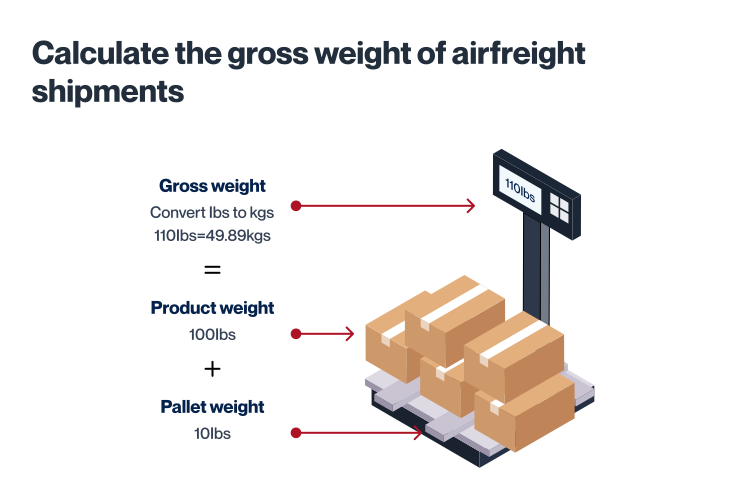
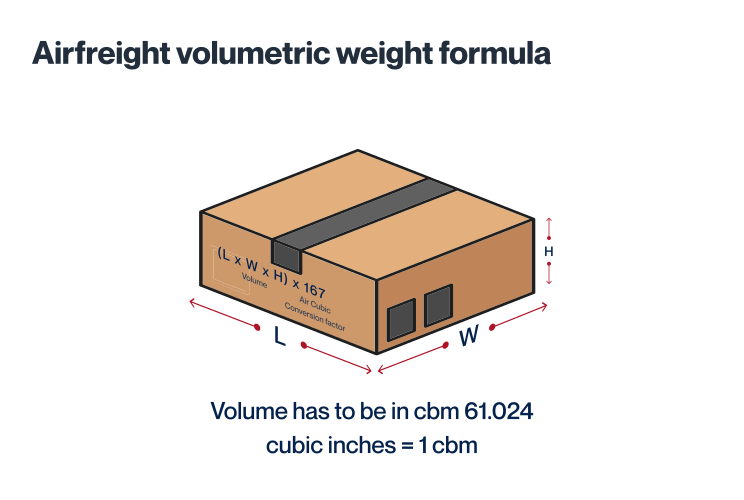
What is the difference between volumetric and gross weight?
When you request an air cargo quote Vietnam Sweden, the airline calculates your price based on the higher of gross or volumetric weight. Gross weight is what your shipment actually weighs on a scale. Volumetric weight reflects the space your cargo occupies in the aircraft. On long-haul routes like Southeast Asia to Scandinavia, space is limited, so volume matters as much as kilos.
- Gross weight: The real weight of your goods including packaging.
- Volumetric weight: Theoretical weight based on dimensions.
- Chargeable weight: The higher of gross or volumetric, used for billing.
- IATA volumetric formula: Standard method to calculate volume-based weight.
For air cargo, you calculate volumetric weight as: Length x Width x Height in cm divided by 6000. For express, you divide by 5000. Example, if your crate measures 120 x 80 x 75 cm, air cargo volumetric weight is 120 x 80 x 75 / 6000 = 120 kg. With the express divisor 5000, it becomes 144 kg.
Common mistakes happen when you ignore pallet height, loose packaging, or assume the airline will round down. Even a few extra centimeters can increase your chargeable weight tier. That is how you end up with a higher invoice than expected after measurement at the export air cargo process Vietnam stage.
Door to door between Vietnam and Sweden
When you’re shipping goods internationally, Door to Door service literally brings your cargo from one doorstep to another, handling every logistic hurdle in between. Ideal for convenience and control, this method in the Vietnam-Sweden route is particularly advantageous. Spoiler: you’re in for fewer headaches and more streamlined operations. So grab your shipping caps, because we’re about to dive deep into the hows and whys of Door to Door shipping.
Overview – Door to Door
With Door to Door shipping between Vietnam and Sweden, your logistics challenges melt away. This well-loved choice amongst FNM Vietnam’s clients provides seamless, end-to-end service, managing everything from pickup to final delivery. While it might be costlier than other options, your peace of mind is worth it, negating the stress, time, and complex paperwork typically involved. So, whether it’s critical machinery or fragile ceramics, trust in Door to Door shipping to deliver your goods smoothly and stress-free. Opt for convenience, embrace simplicity; let your business flourish.
Why should I use a Door to Door service between Vietnam and Sweden?
Ever felt like pulling your hair out trying to navigate the tricky world of international shipping? Here’s the cure – consider a Door to Door service between Vietnam and Sweden. There are five key reasons why this might just be the right move.
First, it simplifies logistics like a hot knife through butter. You don’t need to worry about the pick-up, storage, or delivery. The service provider handles this entire process, so you can stay ordeal-free and focused on your business.
Second, urgent shipment? With Door to Door service, the clock’s got nothing on you. The logistics company will work against the odds to ensure that your shipment is received timely. No more nail-biting while waiting for your precious cargo.
Third, if you’ve got complex cargo, Door to Door service is a match made in Heaven. Specialized treatment for your unique loads is a given, reducing the risk of damage and thereby saving you from hypertension.
Fourth, imagine sitting back in your comfiest chair while your shipment is trucked to your desired location. Convenience to this extent feels unreal, right? Wrong. It’s as real as it gets with Door to Door service.
Finally, stress is the last thing you need on your plate. By opting for Door to Door, you’re leaving the hassle at the door while your cargo takes a breezy trip from Vietnam to Sweden. So, breathe easy, boss.
In a nutshell, Door to Door service between Vietnam and Sweden is your one-way ticket to stress-free, convenient, and timely international shipping.
FNM Vietnam – Door to Door specialist between Vietnam and Sweden
Navigate the complexities of international shipping with ease! At FNM Vietnam, we manage your door-to-door shipments from Vietnam to Sweden effortlessly. Wave goodbye to the hassles of packing, transport, customs, and choosing the right shipping method. We are seasoned experts in this domain and provide a dedicated Account Executive for comprehensive assistance. Get a free quote within 24 hours, or speak with our consultants free of charge. Trust us for a stress-free shipping solution!
Customs clearance in Sweden for goods imported from Vietnam
When you handle customs clearance in Sweden for goods from Vietnam, you are deciding your total landed cost, your real delivery date, and who is legally responsible as Importer of Record. One wrong document in your customs declaration process can freeze your cargo at port or airport. We coordinate clearance with a licensed customs broker in Sweden so you stay compliant and in control.
On this route, you will usually face issues with HS code classification, missing certificate of origin under the EU Vietnam framework, or incorrect commercial invoice details for customs. Those are the moments that trigger inspections and extra storage. Here is how you calculate your duties correctly and how the customs clearance step-by-step Vietnam Sweden actually works in practice.
How to calculate duties & taxes when importing from Vietnam to Sweden?
To estimate your duty and tax estimation Vietnam to Sweden, you need four inputs: the country of origin Vietnam, the correct HS code classification, the customs value calculation method, and the applicable import tariff Sweden. You will notice fast that small errors in any of these shift your final invoice. Customs may reassess value or classification during a document check and physical inspection, which changes the amount due. The first thing we always tell you is this, do not trust a cheap freight quote that ignores duties, because your landed cost calculation Vietnam Sweden depends on these figures.
Step 0 – Quick checks before you calculate
Before running numbers, confirm these three points:
Importer of Record, who holds the EORI registration for importer in Sweden?
Incoterms and customs responsibility, are you under FOB, CIF, or DDP, and who controls clearance?
Low value or simplified regime, does your shipment qualify for a simplified path or standard single administrative document filing?
Step 1 – Identify the Country of Origin
Your country of origin Vietnam determines whether you can claim a preferential tariff in the EU and what proof customs will request. Swedish customs may require a valid certificate of origin or other preferential origin documentation before applying reduced duty. If the origin is unclear or inconsistent with your invoice, you risk a preferential duty rejection and reassessment.
The common mistake is confusing shipping country with origin. If your goods ship from a third country but are manufactured in Vietnam, origin still drives the customs duty rate Sweden. Get this wrong and you expose yourself to anti-dumping duty exposure or loss of preferential treatment.
Step 2 – Find the HS Code of your product
Your HS code classification decides your import tariff Sweden, possible restricted and prohibited goods Sweden import controls, and even import license requirements. If you misclassify, customs can reclassify during inspection and apply a higher rate, plus penalties. That is how a simple mistake turns into a costly reclassification.
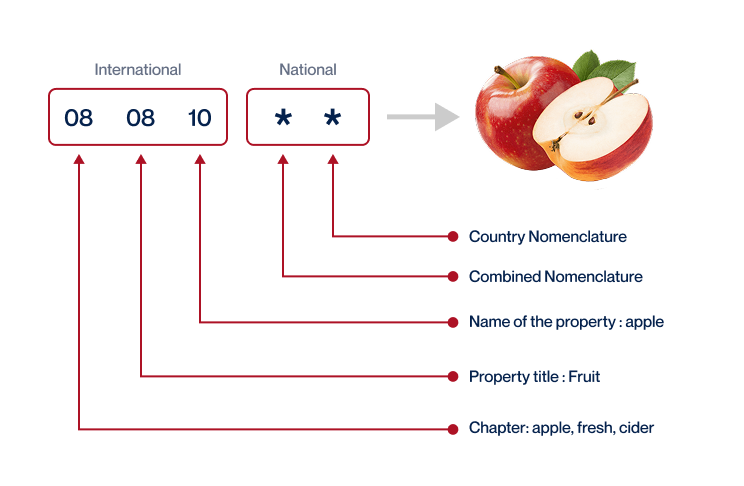
You can start with your supplier, then confirm through an official harmonized system code lookup in TARIC. Search by product description, compare explanatory notes, and match technical characteristics. If your product is borderline between two headings, ask for tariff classification assistance before shipping. Here’s an infographic showing you how to read an HS code.
Step 3 – Calculate the Customs Value
Sweden applies standard WTO customs valuation methods, and in most cases you will use the transaction value, meaning the price actually paid plus certain additions. Your base is not only the goods price, it may include freight and insurance depending on your Incoterms and customs responsibility. Under CIF, freight and insurance are already embedded. Under FOB, you must add international freight and insurance to reach the customs value.
You must also review assists, packing, commissions, or royalties that are conditions of sale. For example, if your goods cost 10,000, freight 1,000, and insurance 200, your customs value becomes 11,200 under the usual customs value calculation method. If you forget to include dutiable elements, you risk a post-clearance audit adjustment later.
Step 4 – Figure out the applicable Import Tariff
An import tariff is the percentage applied to your customs value to calculate duty. In Sweden, you check this through the EU TARIC database using your HS code and declared origin.
Follow this logic:
1) Open the official TARIC tool.
2) Enter your HS code classification.
3) Select Vietnam as origin and read the customs duty rate Sweden.
When reviewing results, check:
Preferential rate, is there a reduced duty with valid origin proof?
Additional measures, any anti-dumping or safeguard duty?
Product compliance for EU market, are there extra conditions before release?
If your customs value is 11,200 and the duty rate is 5 percent, your duty equals 560. That figure feeds directly into your landed cost calculation Vietnam Sweden. On this route, origin documentation often determines whether you pay full rate or preferential. If you want us to validate the rate before shipment, we can cross-check it with your documents.
Step 5 – Consider other Import Duties and Taxes
After duty, you calculate value added tax on imports. In Sweden, VAT is charged on the customs value plus customs duty and certain additional costs. If your customs value is 11,200 and duty 560, VAT applies to 11,760. This is often the biggest cash flow impact in your duty and tax estimation Vietnam to Sweden.
Then review other import taxes and charges. Certain goods may face excise duties or trade defense measures. If your product falls under controlled categories, you may also need prior authorization to avoid a clearance refusal at border.
Before shipment, you should:
Verify invoice accuracy, confirm all commercial invoice details for customs are complete.
Check packing list, ensure clear packing list requirements with weights and quantities.
Confirm freight documents, prepare correct freight documents required for customs.
Review compliance, validate EU conformity and any specific import conditions.
Step 6 – Calculate the Customs Duties
Your core formulas are simple. Duty = customs value × duty rate. VAT = taxable base × VAT rate, where the taxable base usually includes customs value plus duty.
If your customs value is 11,200 and duty rate 5 percent, duty equals 560. If VAT is applied on 11,760, you multiply that base by the applicable rate to get the VAT amount. Add both to reach your estimated border cost.
In practice, your customs broker in Sweden submits the single administrative document and pays duties on your behalf once you grant a power of attorney for customs broker. Payment timing affects release of goods after customs. If funds are delayed or documents incomplete, storage and demurrage can start accumulating quickly.
Step-by-step: how customs clearance usually works on this route
When you import from Vietnam into Sweden, the operational flow depends on whether you arrive by sea or air, which port of entry you use, and your Incoterms and customs responsibility. The sequence below reflects a standard commercial shipment where we coordinate with a Swedish agent. The key is anticipating where checks happen and where delays usually start.
1) Before departure, you align HS code classification, origin proof, and confirm the EORI registration for importer is valid.
2) Your supplier issues compliant commercial invoice details for customs and a precise packing list.
3) Freight forwarder prepares the required bill of lading or airway bill among the freight documents required for customs.
4) Upon arrival in Sweden, we or your appointed customs broker in Sweden lodge the electronic declaration through the EU system.
5) Customs performs a risk analysis, leading either to document release or a customs inspection process involving document review or physical check.
6) This is a moment of truth. If origin or value looks inconsistent, you may face a customs valuation challenge or request for additional proof.
7) Once duties and VAT are secured, customs authorizes release of goods after customs.
8) Goods move to your warehouse or, if needed, into a bonded warehouse Sweden or under a temporary import procedure depending on your strategy.
9) After release, customs may still conduct a post-clearance audit, so you keep your full import compliance checklist Sweden on file.
If you want to know how to avoid customs delays Vietnam Sweden, you focus on documentation consistency and origin proof before the vessel even departs. That is where most issues start, not at the border itself.
Contact Details for Customs Authorities
Vietnam Customs
Sweden Customs
Required documents for customs clearance in Sweden
When you import from Vietnam into Sweden, your paperwork needs to tell one clear, consistent story. Swedish Customs will compare your invoice, transport document, and declaration line by line. Most delays do not happen because the border is strict, they happen because values, weights, or product descriptions do not match. If you align everything before departure, you avoid the classic customs hold for discrepancies and keep control of your timeline.
Bill of Lading or Air Waybill
The Bill of Lading for sea freight or Air Waybill for air freight is the transport contract that proves who ships the goods and who receives them. Swedish Customs and your broker use it to confirm the consignee, Incoterm such as FOB or CIF, and the routing into the EU. For example, if you ship a container from Ho Chi Minh City to Gothenburg, the B/L must show the exact Swedish consignee that will act as Importer of Record. A common mistake is a mismatch between the consignee on the B/L and the one registered under the EORI number, which can trigger a release delay at arrival.
Packing List
The Packing List details how your goods are physically packed, cartons, pallets, net and gross weight, and dimensions. Customs and terminal operators use it to verify what is inside the shipment without opening every box. If you send, for example, 10 pallets of footwear from Vietnam, the quantities and weights must match the Commercial Invoice and the manifest. The mistake we see most often is rounding weights or forgetting pallet counts, which creates doubts and can lead to inspections under the EU import control system.
Commercial Invoice
The Commercial Invoice is the document that states what you sold, for how much, and under which terms. Swedish Customs calculates customs duties and import VAT based on the declared value, including freight and insurance when required by the Incoterm. If you ship machinery parts with an HS code, the description must be precise enough to justify that code and value. A frequent issue is undervaluation or vague product descriptions like “metal parts”, which can result in a value reassessment and penalties.
Certificate of Origin
The Certificate of Origin confirms where your goods were manufactured. For imports into Sweden, this matters because the EU applies the EU Vietnam Free Trade Agreement, which can reduce or eliminate duties if your goods meet origin rules. For example, if your textiles are genuinely manufactured in Vietnam and qualify under the agreement, you can claim preferential tariff treatment. The common mistake is assuming assembly equals origin, when in reality the product may not meet the required transformation rules.
CE Declaration of Conformity
The CE Declaration of Conformity states that your product complies with applicable EU directives on safety, health, or environmental protection. If you import electronics, machinery, toys, or certain construction products into Sweden, customs may request proof that CE marking is valid before release. For instance, importing electrical equipment from Vietnam requires a technical file and signed declaration kept by the responsible economic operator in the EU. Shipping goods with a CE mark but no supporting documentation can lead to a market surveillance hold after arrival.
EORI number of the importer
The EORI number identifies you as an importer within the European Union. Without a valid EORI linked to the Swedish or EU entity acting as Importer of Record, your customs declaration cannot be lodged. If your Swedish buyer is listed as consignee in Stockholm, that entity must have an active EORI before the goods land. The mistake that blocks shipments is assuming your freight forwarder can use their number on your behalf, which is rarely acceptable under EU customs rules.
Get Started with FNM Vietnam
Prohibited and restricted items when importing into Sweden
When you import into Sweden, you need to separate two concepts clearly. Restricted goods are allowed but only if you meet specific conditions, licenses, or certifications. Prohibited goods should not enter at all and can be seized or destroyed. The first thing we always tell clients is to check this before production, not when the container is already on the water under the EU customs framework.
Restricted products
- Food and agricultural products , veterinary or phytosanitary controls required.
- Animal products , health certificates and border inspection checks.
- Medicines and medical devices , marketing authorization and compliance documentation.
- Chemicals , subject to REACH registration or safety data requirements.
- Electronics and machinery , CE conformity and technical documentation needed.
- Dual use items , export control classification and possible license.
Prohibited products
- Counterfeit goods , infringing EU intellectual property rights.
- Illegal narcotics , strictly banned substances.
- Certain weapons , without proper authorization.
- Hazardous waste , restricted under EU waste shipment rules.
If you are unsure whether your product falls into one of these categories, you should verify the exact HS code and check Swedish and EU rules before shipment. Sending goods first and asking questions later can expose you to seizure, fines, or forced re export.
Trade agreements and preferential duties for imports from Vietnam to Sweden
When you import from Vietnam into Sweden, you are trading under the EU Vietnam Free Trade Agreement, in force since 2020. Under this agreement, a large share of EU tariff lines were liberalized at entry into force, and additional duties have been phased out progressively. In practice, this means many industrial products now enter the EU at reduced or zero customs duty, provided you can prove Vietnamese origin correctly.
You still need to check your exact HS code in the EU tariff database to confirm the current duty rate and whether a preferential rate applies. Preferential treatment is not automatic. You must provide a valid statement on origin or other required proof under the agreement. If your goods do not meet the origin rules, the standard EU Common External Tariff will apply. We often see importers assume all Vietnamese goods are duty free, which leads to a duty reassessment after clearance.
You should also be aware that some products can still face anti dumping duties or trade defense measures at EU level, depending on the sector. Before you confirm pricing with your supplier in Vietnam, check both the preferential rate and any additional measures so your landed cost in Sweden reflects the real scenario.
Your Next Step with FNM Vietnam
Additional logistics services
Warehousing
Searching for the perfect warehouse in Vietnam or Sweden? It can be puzzling! Even trickier, the storage conditions for items (like chocolates needing cool temps!) are critical. Our warehousing solutions eliminate your stress so you can focus on flourishing your business. For specifics, check out our Warehousing page.
Packing
Ensure your goods withstand their journey from Vietnam to Sweden with proper packaging and repackaging. This is critical to prevent damage and maintain product integrity. Having a reliable agent is like having a guard for your precious cargo! Let's say, a ceramics manufacturer's delicate wares, or a coffee exporter's moisture-prone beans; all require custom packaging solutions. Discover how our service adjusts to different product needs on our dedicated page: Freight Packaging.
Transport Insurance
Risk abounds in logistics. That's where cargo insurance comes in, to step up where fire insurance wouldn't. For example, if your shipping container ends up at the bottom of the sea, fire insurance won't help much. But with cargo insurance, your goods are protected from port to port. A preventative measure that pays off. Need more details? Check out our Cargo Insurance page.
Household goods shipping
Moving treasured possessions from Vietnam to Sweden? Let us handle your personal effects with expertise and adaptability. Be it a delicate vase or bulky furniture, our team ensures they're shipped with care that feels just like home. Picture the relief, when your grandmother's piano arrives safe and sound in Stockholm. Find out how we make it possible on our dedicated page: Shipping Personal Belongings.
Procurement in Thailand
Casting a global net for the ideal supplier can be a complex task. How do you handle language hurdles and unfamiliar administrative procedures? That's where FNM Vietnam steps in. We facilitate supplier search in Asia, East Europe, and beyond, thoroughly handholding you through the tricky procurement journey. Think of us as your guide easing language barriers and smoothing the process. For an in-depth dive into how our sourcing services can boost your business, follow the link: Sourcing services

Quality Control
Keeping your goods up to standard is key to successful shipping from Vietnam to Sweden. Quality Control is your sharp eye during production, catching subpar outputs early, like a sneaky flaw in your Hanoi-manufactured ceramics or Ho Chi Minh City tech gadget assembly. Avoid fretting over misalignments or broken pieces upon arrival in Gothenburg or Stockholm. More info on our dedicated page: Quality Inspection

Conformité des produits aux normes
Ensuring your goods meet regulatory requirements is crucial when shipping across borders. Our Product Compliance Services can be your ace in the hole - we conduct top-notch lab tests and offer certification, putting your mind at ease about meeting any destination-specific regulations. Think about the peace of knowing your consignment is not going to hit any compliance roadblocks on arrival – that's exactly what we provide.