In short ⚡
Logistics management is the system for planning, executing, and controlling the movement, storage, and flow of goods, information, and money so customers receive the right product, at the right time, in the right condition, while balancing service, cost, and risk across transportation, warehousing, customs, and inventory decisions.In this article, you will find how logistics management links to supply chain strategy, the core functions and KPIs to control, ways to turn operations into a competitive edge, and how to build a localized logistics strategy in Vietnam and Southeast Asia.
We hope you’ll find this article genuinely useful, but remember, if you ever feel lost at any step, whether it’s finding a supplier, validating quality, managing international shipping or customs, FNM Vietnam can handle it all for you!
What logistics management is and how it fits in your supply chain strategy
Logistics management is the day to day system you use to move, store, and control goods, plus the information that follows them, from supplier to customer.
Here’s the thing, when logistics management is treated like a “back office” task, you’ll notice fast that your supply chain strategy turns into firefighting.
From experience at DocShipper, the turning point usually comes after one painful shipment, a delayed booking, a missing packing list, or duties and taxes that weren’t budgeted, and suddenly everyone wants a real process.
Quick workflow we use to map logistics into your strategy:
Plan demand and service level → set Incoterms and responsibilities → choose mode (air freight, ocean freight, rail freight, trucking, multimodal transport) → book and dispatch → customs clearance and customs brokerage → warehousing and distribution → last mile delivery → tracking and tracing → review lead time, cost, claims
Checklist: what “corporate” logistics management typically covers
- Transportation planning, freight rate negotiation, quotation validation, carrier selection, and booking control
- Warehouse operations, inventory management, replenishment rules, and just in time constraints
- Import export compliance, HS code classification, tariff checks, and duties and taxes forecasting
- Shipping documentation, commercial invoice, packing list, bill of lading, and consignment visibility
- Consolidation, deconsolidation, loading, unloading, and damage prevention at handover points
DocShipper Alert
Let DocShipper audit your logistics setup before the next delay, missing document, or unexpected duty hits your margin.
Core definition of logistics management and key business objectives
At its core, logistics management is how you design and run the flow of cargo, shipment information, and money so your customers get the right product, at the right time, in the right condition.
In practice, your objectives split into service, cost, and control, and that’s where a solid logistics strategy starts paying off.
We’ve seen a classic scenario, you buy under FOB, your supplier loads late, the vessel cutoff is missed, and you pay a premium freight rate for a rushed rebooking.
Nothing “mystical” happened, logistics management simply wasn’t aligned with your lead time reality and your Incoterms responsibilities.
Business objectives you can manage directly through logistics management:
- Shorter lead time by tightening dispatch windows, consolidation plans, and carrier KPIs
- Lower landed cost by optimizing mode mix, packaging, and avoiding storage and demurrage surprises
- Higher reliability via tracking and tracing, exception handling, and predictable customs clearance
- Better cash flow by reducing inventory days and controlling documentation errors that block release
- Risk reduction by validating HS code, documents, and shipment handovers across borders
Mini comparison table: what you manage vs what you measure
| Logistics lever you control | What it impacts |
| Mode choice (air freight vs ocean freight vs multimodal) | Lead time, variability, inventory levels |
| Freight forwarding and carrier booking discipline | On time departure, rolled cargo, claims frequency |
| Customs brokerage, HS code and document accuracy | Clearance time, inspections, unexpected duties and taxes |
| Warehousing layout and inventory management rules | Pick accuracy, order cycle time, shrinkage |
Logistics vs. supply chain management: how they work together
Logistics management is the execution engine, supply chain management is the broader orchestration that includes sourcing, production, suppliers, and demand planning.
If you’re chasing a supply chain competitive edge, you need both to talk to each other, daily, not once a quarter.
We once stepped into a case where purchasing negotiated great unit prices, but chose EXW without noticing the export process complexity.
Result, the first consignment sat waiting for pickup documents and the commercial invoice corrections, and the “savings” evaporated in storage, rework, and missed sales.
How they connect in real operations, end to end:
- Supply chain sets service targets and sourcing plans, logistics management turns them into transport and warehouse capacity
- Supply chain decides supplier network and terms, logistics management aligns Incoterms, handovers, and documentation
- Supply chain forecasts volume, logistics management plans consolidation, deconsolidation, and distribution routing
Checklist: the handoffs that must be crystal clear
- Who owns booking, export clearance, and loading under your Incoterms
- Who issues and checks the packing list, commercial invoice, and bill of lading
- Who validates HS code, tariff exposure, and duties and taxes assumptions
- Who monitors tracking and tracing and triggers escalation on exceptions
When you want fewer surprises, align these handoffs with standard practices like those promoted by APICS terminology and process thinking, then operationalize them with your 3PL and freight forwarding partners.

Looking for a Reliable Shipping & Sourcing Partner?
How logistics management drives business growth and competitive advantage
Logistics management becomes your growth lever when it stops being “shipping” and starts being the system that protects margin, revenue, and customer trust.
That’s why we talk about logistics for business growth in practical terms, you either build repeatable execution, or you keep paying for urgent fixes.
Workflow: turning logistics into a competitive play
Define promise to customer → design transport and warehouse network → lock SOPs for documents and customs → select 3PL and lanes → run KPI cadence → re-tender freight rates → optimize inventory buffers
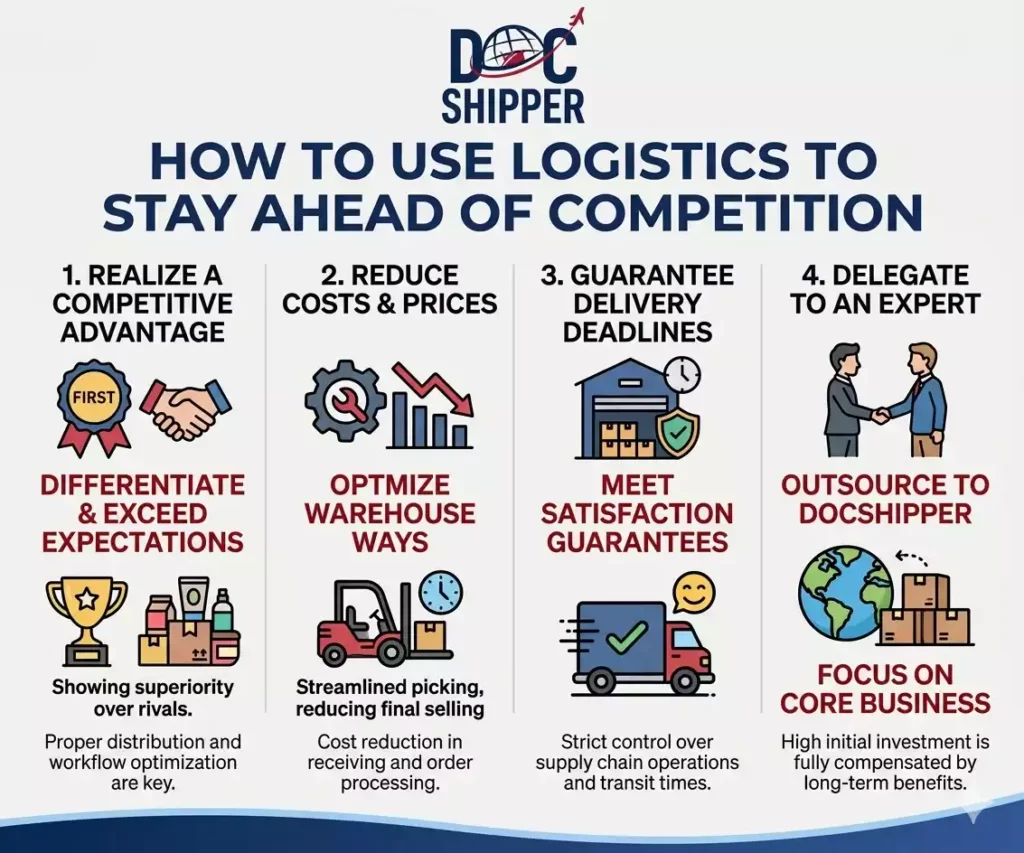
Cost, speed, and reliability: the three pillars of logistics competitive edge

Your logistics management performance will be judged on three things, cost, speed, and reliability, and you can’t maximize all three without tradeoffs.
The art is choosing the right balance to create a logistics competitive advantage, not just a cheaper freight rate.
We’ve handled launches where the marketing deadline was non negotiable, so we split flows, air freight for the first wave, ocean freight for replenishment.
Because the booking plan and customs clearance prep were ready, you avoided stockouts without permanently inflating transportation cost.
What each pillar really means operationally:
- Cost, landed cost, storage, detention, claims, rework, and the hidden cost of poor documentation
- Speed, order to delivery lead time, transit time, clearance time, and last mile delivery cycle time
- Reliability, on time departure and arrival, damage rate, fill rate, and exception resolution time
Table: common moves and their typical effects
| Move in logistics management | Upside | Watch-out |
| Consolidation into fewer shipments | Lower unit freight cost | Longer lead time, bigger impact if rolled |
| Switch ocean freight to air freight for peak | Faster delivery, fewer stockouts | Higher cost, needs tight packing list and invoice accuracy |
| Standardize customs brokerage and HS code master data | Predictable clearance, fewer holds | Requires governance and audits |
Checklist: your “3 pillar” control points
- Lane level freight rate benchmarking and quarterly quotation reviews
- Cutoff management, dispatch discipline, and carrier performance scorecards
- Pre clearance document checks, HS code logic, and tariff rule validation
DocShipper Advice
Optimize your cost, speed, reliability mix with lane benchmarking and structured customs control.
From logistics differentiation to brand loyalty and long‑term business value
Logistics management creates logistics differentiation when your customer feels the difference, fewer delays, cleaner tracking, fewer surprises at delivery.
Do it right and you don’t just ship boxes, you build a supply chain competitive edge that competitors struggle to copy.
One of the most telling stories we see is after you fix “small” things, like consistent labeling, predictable delivery slots, and proactive tracking and tracing.
Suddenly customer support tickets drop, reorders come faster, and you’re not discounting to apologize for late distribution anymore.
Where differentiation shows up, concretely:
- Accurate ETAs and proactive exception alerts, not silence until something goes wrong
- Fewer delivery failures thanks to better last mile delivery instructions and packaging
- Lower damages with tighter loading and unloading controls and clear handover points
- Faster returns and replacements because warehouse and transportation workflows are documented
Checklist: brand value signals powered by logistics management
- On time in full performance tied to customer promise, not internal convenience
- Clear documentation flow, commercial invoice, packing list, bill of lading consistency
- Visible tracking and tracing milestones from pickup to delivery
- Stable lead time that lets you reduce inventory without risking stockouts
When you want that kind of repeatability, we typically plug in as your freight forwarding and 3PL partner, aligning transport, customs clearance, and warehousing execution under one playbook.
If you’re ready to pressure-test your current setup, start with our DocShipper logistics services and we’ll map your gaps before they become the next “urgent shipment” crisis.
“`html
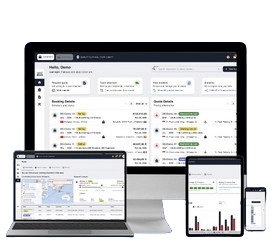
DocShipper Platform
One platform. Your entire supply chain
Sourcing, freight, customs & documents — all centralised, all visible, 24/7.
Essential functions of logistics management you must get right

If you want logistics management to create real value, you must control every operational lever across your supply chain. Weakness in one function will immediately impact cost, service level, and cash flow.
Below are the core functions you need to structure, monitor, and continuously optimize.
- Demand planning and forecasting: align sales forecasts with procurement and production to prevent stockouts and excess inventory.
- Procurement and supplier coordination: negotiate lead times, MOQs, and Incoterms while securing consistent quality.
- Inbound transportation management: control freight mode selection, consolidation, and transit time reliability.
- Warehousing and inventory control: optimize layout, picking strategy, safety stock, and turnover ratio.
- Order fulfillment and distribution: ensure OTIF performance and efficient last-mile execution.
- Customs compliance and trade management: manage HS codes, duties, certificates, and regulatory constraints.
- Reverse logistics: handle returns, refurbishment, and disposal while protecting margin.
You should treat these functions as an integrated workflow rather than isolated silos. At DocShipper, we manage them end-to-end so you avoid coordination gaps between suppliers, carriers, and customs authorities.
| Function | Main KPI | Business Impact |
| Transportation | Freight cost per unit | Direct margin improvement |
| Inventory | Inventory turnover ratio | Cash flow optimization |
| Warehousing | Order picking accuracy | Customer satisfaction |
| Customs | Clearance lead time | Reduced delays and penalties |
You cannot improve what you do not measure. Leading companies track OTIF, landed cost per SKU, and total logistics cost as a percentage of revenue, often targeting below 10% of sales depending on the industry.

Turning logistics into a strategic advantage in Vietnam and Southeast Asia
Southeast Asia offers massive sourcing and manufacturing opportunities, but operational complexity is real. If you do not structure your logistics correctly, infrastructure gaps and regulatory differences will erode your margins.
You need a localized yet integrated approach across Vietnam, Thailand, Malaysia, and neighboring markets.
- Multi-country supplier coordination: synchronize production schedules across different regulatory environments.
- Port and gateway optimization: select between Ho Chi Minh City, Hai Phong, Laem Chabang, or Singapore based on routing efficiency.
- Cross-border compliance management: manage ASEAN trade agreements and preferential tariffs.
- Mode selection strategy: balance sea freight, air freight, rail, and multimodal solutions.
- Risk mitigation planning: diversify routes to avoid congestion and seasonal disruption.
When you structure your operations around regional consolidation hubs, you reduce freight cost and improve delivery predictability. This is especially critical if you are exporting to Europe or North America under tight delivery windows.
| Strategic Lever | Operational Action | Value Created |
| Supplier diversification | Dual sourcing in Vietnam and Thailand | Reduced geopolitical risk |
| Freight consolidation | Container optimization and LCL grouping | Lower unit transport cost |
| Incoterm strategy | Shift from EXW to FOB control | Better visibility and margin control |
| Integrated 3PL management | Single point of coordination | Operational transparency |
At DocShipper, we operate as your single control tower in Asia, managing suppliers, inspections, freight, and customs under one coordinated framework. You gain visibility, predictability, and measurable performance improvements across your entire supply chain.
DocShipper Info
Outsource coordination to a single 3PL partner and turn KPIs into measurable margin gains.
Conclusion
If you want logistics management to become a growth engine rather than a cost center, you must approach it strategically. Every operational decision impacts profitability, service quality, and brand perception.
- Align logistics functions with your overall supply chain and business strategy.
- Track performance through clear KPIs such as OTIF, landed cost, and inventory turnover.
- Optimize transportation, warehousing, customs, and supplier coordination together.
- Leverage Southeast Asia with structured regional logistics planning.
- Work with an integrated partner like DocShipper to secure end-to-end visibility and operational control.
When you master these elements, your logistics management becomes a durable competitive advantage. And that advantage compounds over time.
“`FAQ | Logistics management: how smarter operations create a lasting competitive advantage
Logistics keeps you competitive by protecting both your margin and your promise to customers. When you control lead times, clearance, and delivery reliability better than your competitors, you can commit to tighter delivery windows, reduce stockouts, and avoid last‑minute premium freight. Over a year, that combination of lower hidden costs and higher service quality makes your offer harder to match, even if rivals copy your product or pricing.
A logistics competitive advantage is when your operations are so predictable and efficient that customers experience fewer delays, fewer stock issues, and fewer delivery surprises than with alternative suppliers. Concretely, it shows up as higher on‑time in‑full performance, more accurate ETAs, less damage, and smoother customs and returns. Because these benefits are embedded in your processes, they’re much harder for competitors to replicate than a temporary price cut.
Use logistics as a growth lever by linking your processes directly to revenue‑generating moves. For example, you can open new markets faster by designing export flows and customs routines ahead of your first orders, or you can support product launches with split shipments that secure initial stock without overcommitting inventory. Over time, the ability to promise reliable delivery into more countries, with controlled lead times, lets your sales team close deals your less organized competitors must walk away from.
A logistics strategy is the structured plan that defines how your transport, warehousing, and customs setup will support your business goals over the next 1–3 years. It covers which Incoterms you use, which regions you stock from, how you choose carriers and 3PLs, and what service level you promise to customers. Day‑to‑day shipping decisions then follow this playbook, instead of reacting case by case, so every booking and routing choice pushes in the same direction.
Customers feel your logistics in many subtle ways, not only in delivery dates. Clean documentation prevents customs issues and billing disputes, clear tracking reduces “where is my order?” inquiries, and stable lead times keep their own production or retail operations running smoothly. When claims and returns are handled quickly because your warehouse and carriers follow defined workflows, customers start to see you as a low‑risk partner they can rely on for critical orders.
Many firms assume “faster and cheaper shipping” is enough, but they overlook the basics that actually create differentiation, such as:
- Promising lead times without checking whether suppliers, carriers, and customs processes can consistently support them.
- Changing modes (for example, switching to air) without tightening packing lists, invoices, and HS codes, which leads to costly delays.
- Investing in tracking tools but not assigning clear ownership for monitoring exceptions and communicating with customers.
If you fix those gaps first, almost any improvement you add on top will be visible and valuable to your customers.
Read more
Looking for more? Check out these articles.
Need Help with Logistics
or Sourcing in Vietnam ?
First, we secure the right products from the right suppliers at the right price by managing the sourcing process from start to finish. Then, we simplify your shipping experience - from pickup to final delivery - ensuring any product, anywhere, is delivered at highly competitive prices.
Fill the Form
Prefer email? Send us your inquiry, and we’ll get back to you as soon as possible.
Contact us