

In short ⚡
Buy from Alibaba sell on Amazon by treating it as a full supply chain project, not simple product arbitrage: validate a profitable niche and landed cost, set up professional Alibaba and Amazon accounts, verify compliant suppliers, choose the right business model (usually FBA‑based private label or wholesale), and align packaging, Incoterms, freight, and customs with Amazon’s requirements.In this article, you will find step‑by‑step workflows, supplier vetting criteria (including China vs Vietnam), account setup guidance, common pitfalls like miscalculated landed cost, and practical checklists for FBA‑ready packaging, inspections, and freight strategy.
We hope you’ll find this article genuinely useful, but remember, if you ever feel lost at any step, whether it’s finding a supplier, validating quality, managing international shipping or customs, FNM Vietnam can handle it all for you!
What you must know before you buy from Alibaba to sell on Amazon
If you want to buy from Alibaba sell on Amazon without surprises, you need to think beyond product price.
Your real profit gets decided in the logistics and supply chain details, Incoterms, lead time, tariff classification, and how clean your paperwork is at customs clearance.
We’ve seen sellers negotiate hard on MOQ, then lose the margin on freight rates, poor packaging, or a shipment that gets held because the harmonized system code was wrong.
Here’s the thing, sourcing is not only “finding a supplier”, it’s building a repeatable import workflow that survives delays, peak seasons, and Amazon FBA requirements.
Quick workflow (what “good” looks like):
Product shortlist, supplier screening, sample and compliance checks, Incoterms selection, freight quotation, booking, inspection, export docs, bill of lading, customs declaration, duties and taxes, delivery order, FBA inbound.
What we handle at DocShipper (so your cargo moves, not your stress):
- Freight forwarding from China and Asia by air freight, sea freight, and multimodal transport.
- Freight broker support on quotation, booking, tracking, and traceability, plus freight insurance options.
- Customs clearance, tariff classification, and import compliance so your shipment doesn’t stall.
- Consolidation, deconsolidation, palletization, and packaging checks to reduce damage and FBA refusals.
Checklist (before you place your first deposit):
- Confirm the product is allowed on Amazon and in your destination country, including labeling compliance.
- Ask for the correct HS code proposal and verify duties and taxes impact on landed cost.
- Choose Incoterms intentionally, not by habit, so you control shipment risk and cost.
- Define packaging, carton marks, pallet requirements, and whether you need containerization.
- Lock a realistic lead time and transit time, then plan inventory management for FBA restock limits.
Is it legal to buy on Alibaba and sell on Amazon?
Yes, in most cases it’s legal to buy from Alibaba sell on Amazon, but legality isn’t the same as “safe to list.”
The line you cannot cross is intellectual property, restricted categories, and product compliance, that’s where sellers get burned.
From experience, a common scenario goes like this.
You find a “brandless” gadget on Alibaba, the supplier casually offers to print a famous logo, and your Amazon listing gets flagged within weeks, sometimes with funds held.
What “legal” really means in practice:
- IP rights: you must avoid trademarks, copyrighted designs, and patented features, even if the supplier says “no problem.”
- Product compliance: your product must meet destination-market rules, think labeling, materials, and safety standards.
- Accurate customs declaration: correct product description and harmonized system code reduce delays and penalties.
- Document trail: invoices, packing lists, and transport documents (including bill of lading for ocean shipping) must match reality.
One insider tip, if a supplier can’t clearly explain materials, battery specs, or certifications, you’re not “saving time,” you’re buying future risk.
For regulated categories, you’ll notice fast that Amazon asks for documentation at the worst possible moment, usually right when your inventory is stuck in a bonded warehouse or your FBA appointment is booked.
Operational workflow (keep it clean):
Pre-check Amazon category rules, verify compliance requirements, confirm labeling and packaging, align HS code and product description, choose Incoterms, then ship with traceable documentation end-to-end.
Authority reference: If you’re importing into the U.S., the U.S. Customs and Border Protection rules on truthful customs declaration matter a lot more than what a supplier promises in chat.
Business models you can use: private label, wholesale, and dropshipping from Alibaba
When people say buy on Alibaba sell on Amazon, they’re usually mixing three models that behave very differently once freight, warehousing, and last-mile delivery hit the picture.
Pick the model based on cashflow, risk tolerance, and how much control you need over packaging and compliance.
We once helped a seller who started with “simple wholesale,” then discovered their supplier changed packaging without warning.
Amazon rejected half the cartons at check-in, and the seller paid double handling to rework labels and carton marks, painful lesson.
| Model | Best for | Logistics reality | Big risk |
| Private label | Building a defensible offer and pricing power | More packaging control, more supplier coordination, often better long-term supply chain stability | QC, compliance, and longer lead time |
| Wholesale | Faster launch with existing product | Simpler sourcing, but you must manage palletization, carton rules, and inventory management tightly | Price wars, inconsistent packaging, authenticity claims |
| Alibaba Amazon dropshipping | Testing demand with low upfront inventory | Hard to meet Prime expectations, weak tracking, fragile last-mile delivery and returns process | Late deliveries and account health issues |
Where “alibaba to amazon fba” fits:
- Private label and wholesale work best with FBA because you can control inbound shipments, carton labeling, and delivery appointments.
- Dropshipping from Alibaba is rarely compatible with Amazon’s performance expectations, unless you use stocked inventory and reliable domestic fulfillment.
Checklist (choose your model fast):
- If you need predictable timelines and fewer customer-service fires, lean toward FBA with inventory in-country.
- If your product needs inserts, bundles, or custom packaging, private label gives you the control you’ll need.
- If your supplier won’t commit to consistent carton specs, avoid building an FBA plan around them.
Authority reference: Amazon’s own seller policies on shipping performance and drop shipping are the rules you’ll be judged by, not the supplier’s promises.
Step‑by‑step: from Alibaba product idea to your first Amazon FBA sale
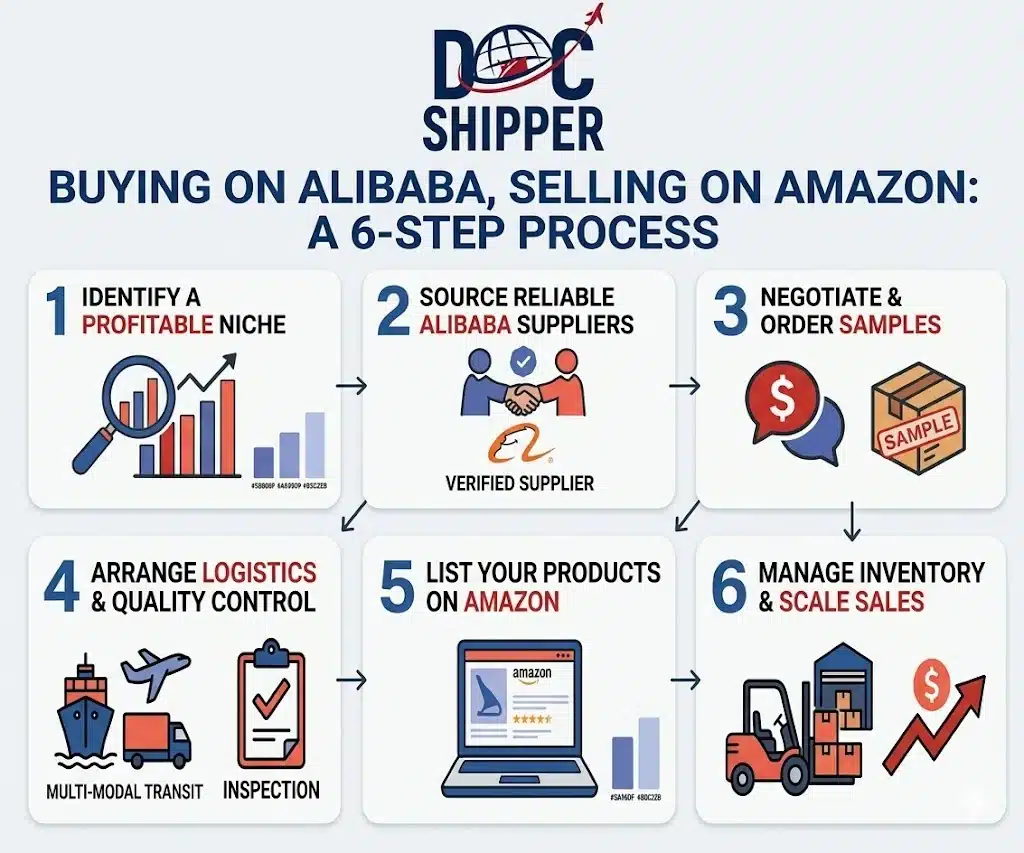
To buy from Alibaba sell on Amazon with predictable profit, you need a step-by-step system that connects product, margin, and logistics.
Otherwise, you’ll “win” the negotiation and still lose money after ocean shipping, customs clearance, and FBA prep costs.
We like to frame this as one continuous chain, sourcing, compliance, shipment, warehousing, then FBA inbound.
Break the chain anywhere and your launch date slips, your reviews suffer, and your cashflow gets stuck in transit time.
Step-by-step workflow (practical and repeatable):
Pick niche, validate numbers, request samples, negotiate MOQ and Incoterms, plan packaging, choose air freight vs sea freight, book cargo, inspect, ship, clear customs, deliver to FBA.
Checklist (your first FBA plan):
- Target landed cost, not ex-works price, include freight rates, duties and taxes, and Amazon fees.
- Decide your shipping mode early, air freight for speed, ocean shipping for margin, or multimodal transport to balance both.
- Build a buffer for delays, lead time always stretches during peak season.
- Confirm how you’ll prep units, factory, cross-docking warehouse, or a prep center near FBA.
Looking for a Reliable Shipping & Sourcing Partner?
How to find a niche product and validate demand, profit, and competition

You’re looking for a product that can absorb shipping, returns, and ad spend, and still leave margin after landed cost.
A quick real-world example, we saw a seller fall in love with a “cheap” kitchen item at $1.20 EXW.
After packaging upgrades, carton volume, and sea freight, the landed cost doubled, and the product couldn’t handle PPC.
What to validate before you message suppliers:
- True landed cost: product cost plus packaging, inspection, freight forwarding, customs clearance, and duties.
- Shipping sensitivity: bulky products get punished by containerization volume and FBA fees.
- Competition quality: if top listings have thousands of reviews and strong branding, you’ll need differentiation.
- Compliance risk: batteries, cosmetics, kids products, and anything ingestible can add complexity.
Mini workflow (fast validation loop):
Estimate dimensions and weight, simulate air freight and ocean shipping costs, calculate margin, check review landscape, then only shortlist products that survive the numbers.
Authority reference: Use U.S. International Trade Commission resources to sanity-check typical duty rates by HS code when you model your landed cost.
Turning Alibaba products into an Amazon FBA‑ready offer (branding, packaging, and listing basics)
This is where most “alibaba to amazon fba” plans either level up or collapse, because FBA-ready means your buy from Alibaba sell on Amazon product must arrive compliant, scannable, and damage-resistant.
Packaging isn’t aesthetics, it’s how you protect margin during shipment, deconsolidation, and FBA check-in.
We’ve dealt with cartons that looked fine at the factory, then failed after road transport to port and ocean shipping humidity.
The seller didn’t pay for freight insurance, and suddenly a “great” deal turned into a write-off.
What “FBA-ready” usually includes:
- Branding basics: consistent logo use, inserts if allowed, and clear product differentiation.
- Packaging engineering: drop resistance, moisture protection, and carton strength for palletization.
- Labeling: FNSKU, carton labels, suffocation warnings where required, and accurate carton marks.
- Inbound strategy: direct-to-FBA, or via a warehouse for cross-docking, consolidation, and prep.
Step-by-step workflow (from factory to FBA):
Approve sample, freeze packaging spec, confirm Incoterms, book shipment, run pre-shipment inspection, issue export docs, track cargo, clear customs, deliver to prep or FBA, confirm receiving.
Checklist (packaging and logistics alignment):
- Ask your supplier for carton dimensions and gross weight, then validate against your freight quotation.
- Decide whether to ship as loose cartons or palletized freight based on FBA and carrier requirements.
- Plan for warehousing if you need inventory buffering or if Amazon limits inbound quantities.
- Keep document consistency, commercial invoice, packing list, and bill of lading data must match.
Authority reference: ASTM-style packaging test approaches are a useful benchmark when you’re upgrading cartons for long transit time and rough handling.
“`htmlDocShipper Info
Align account setup, Incoterms, and FBA settings to avoid margin leaks and compliance blocks from day one.
How to set up and optimize your Alibaba and Amazon seller accounts
Before you buy from Alibaba sell on Amazon, you must structure both accounts correctly. If you skip this step, you create compliance and cash flow problems later.
Start with Alibaba by building a buyer profile that signals professionalism. Serious suppliers treat you differently when your account looks like a real business.
- Use your registered company name and professional email
- Verify your business license and contact details
- Complete your sourcing preferences and target volumes
- Activate Trade Assurance only negotiations
- Shortlist suppliers with Gold Supplier and verified factory badges
Then configure Amazon Seller Central the right way from day one. Amazon compliance is non negotiable.
| Amazon Setup Area | What You Must Do | Why It Matters |
| Account Type | Choose Professional plan | Access to FBA and advertising tools |
| Brand Registry | Register trademark early | Protect listing and stop hijackers |
| FBA Settings | Set shipping plan and prep method | Avoid warehouse rejection |
| Tax Settings | Complete VAT and tax interviews | Prevent payout blocks |
We always recommend aligning your Incoterm strategy with your Amazon FBA plan. If you use FOB or EXW incorrectly, you lose margin before your first sale.
If you need support structuring sourcing and freight together, you can work with DocShipper sourcing and logistics experts. We connect supplier negotiation, quality inspection, and FBA shipping in one workflow.
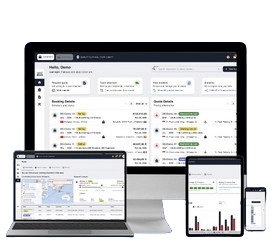
DocShipper Platform
One platform. Your entire supply chain
Sourcing, freight, customs & documents — all centralised, all visible, 24/7.
Finding safe Alibaba suppliers (including Vietnam) and meeting Amazon’s requirements
Your biggest risk when you buy from Alibaba sell on Amazon is supplier reliability. A cheap unit price means nothing if your shipment fails inspection.
Never choose on price alone, choose on process control and export experience. You want factories that understand Amazon FBA labeling and carton standards.
- Request business license and export license copy
- Verify factory audit reports
- Ask for recent shipment references to Amazon sellers
- Order pre production samples and compare versions
- Use third party inspection before balance payment
Vietnam is increasingly attractive for diversification. Many categories such as furniture, textiles, and electronics accessories are competitive.
| Criteria | China | Vietnam |
| Supplier Base | Very large and diversified | Smaller but growing fast |
| MOQ Flexibility | Often negotiable | Can be higher for small factories |
| Trade Experience | Highly experienced exporters | Export ready but less standardized |
| Lead Time | Stable and optimized | Can vary depending on materials |
Payment safety is critical when sourcing in Asia. Use structured milestones instead of sending 100 percent upfront.
- 30 percent deposit after signed Proforma Invoice
- 70 percent after inspection approval
- Trade Assurance or secured payment channel
- Clear specification sheet attached to contract
Amazon compliance must be integrated into your purchase order. That includes labeling, packaging strength, product certification, and sometimes lab testing.
We often coordinate inspections and lab tests before shipment to reduce Amazon rejection risk. Fixing a problem at origin costs far less than recalling inventory from an FBA warehouse.
DocShipper Alert
Calculate true landed cost, inspect goods, and lock clear Incoterms before paying the balance.
Common pitfalls when you go from Alibaba to Amazon FBA and how you avoid them
Many sellers think buy from Alibaba sell on Amazon is simple arbitrage. In reality, margin leaks happen at every stage.
Over 30 percent of new sellers lose profit due to miscalculated landed cost. You must calculate total cost before placing the order.
| Pitfall | Consequence | Prevention |
| Ignoring freight cost | Negative margin | Request freight quote before confirming MOQ |
| No inspection | High return rate | Book pre shipment quality control |
| Wrong Incoterm | Hidden port charges | Define EXW, FOB, or DDP clearly |
| No differentiation | Price war | Add bundle, improve packaging, refine branding |
Another common mistake is accepting supplier MOQ without negotiation. You can often reduce MOQ by adjusting packaging, paying slightly higher unit cost, or starting with trial order.
Cash flow mismanagement also kills growth. If you do not forecast reorder timing correctly, you stock out and lose ranking.
- Calculate production lead time
- Add inspection duration
- Include sea or air transit time
- Plan reorder when 50 percent stock is sold
Conclusion
You can successfully buy from Alibaba sell on Amazon if you treat it like a structured supply chain project. Profit comes from control, not luck.
- Set up professional Alibaba and Amazon accounts
- Verify suppliers and secure payments
- Integrate Amazon compliance into sourcing
- Calculate full landed cost before ordering
- Use inspection and freight strategy to protect margin
Control your sourcing, and you control your profit. When you need end to end support from Asia to Amazon FBA, we at DocShipper manage sourcing, inspection, and international freight under one operational framework.
“`FAQ | How to buy from Alibaba and sell on Amazon for predictable profit
You can often legally resell unbranded, generic products, but it becomes risky the moment there’s any logo, design, or packaging that might be protected. You must check for existing trademarks or patents on brand names, logos, and key features, and avoid products that imitate well‑known brands. For regulated items (toys, baby products, electronics, cosmetics), you’re also responsible for having the right certifications in your own company name, even if the supplier already sells them elsewhere.
Think of it in two parallel tracks: product and logistics. On the product side, you validate demand and margin, request samples, finalize your spec, and create the Amazon listing (with FNSKU labels generated). On the logistics side, you confirm Incoterms and shipping mode with the supplier, book freight, arrange pre‑shipment inspection, clear customs, and then send labeled units to FBA according to your inbound shipment plan. The key is to freeze the packaging and labeling details in writing before production, so what leaves the factory is exactly what Amazon expects at check‑in.
Start by excluding entire “problem zones” rather than chasing bargains. Avoid obvious look‑alikes of big brands, listings that casually offer to print famous logos, and products in categories where Amazon is very strict (health supplements, cosmetics, baby items) unless you’re ready to invest in compliance. Then filter for suppliers who can show real test reports (not just PDFs with blurred lab names) and who are willing to print your neutral branding instead of copying someone else. If the supplier can’t clearly state materials, safety standards, and test results, assume Amazon will eventually flag the product.
It can be very profitable, but only if you model every cost line before ordering. That includes ex‑works price, packaging upgrades, freight (air or sea), customs duties, port charges, FBA fees, and returns. Many “cheap” items lose money once you factor in volumetric weight and Amazon fees, especially bulky, low‑priced products. A practical rule is to aim for a healthy gross margin (after landed cost and Amazon fees) that can still survive PPC ad spend and occasional returns; if your numbers are tight in the spreadsheet, they usually collapse in real life.
You want a structure that protects both sides without locking your cash for months. Common practice is 30% deposit to start production and 70% after a passed pre‑shipment inspection, using Alibaba Trade Assurance or another secure method rather than a direct bank transfer to an unknown account. Attach a detailed specification sheet and packing requirements to the contract, so if quality or labeling doesn’t match, you have leverage before sending the balance. For first orders, avoid 100% upfront and avoid sending money outside the platform “to save fees,” that’s where most scams start.
Your first order should be big enough to test real demand and cover initial PPC, but small enough that a mistake doesn’t damage your business. In practice, that often means ordering the minimum viable quantity that still gives a realistic landed cost per unit, typically a few hundred units rather than thousands. You balance supplier MOQ, your cash flow, and Amazon restock limits, then plan to reorder as soon as you see consistent sales velocity. It’s usually smarter to pay a slightly higher unit cost on a small, low‑risk first batch than to chase the “best price” on a huge order you haven’t validated.
Read more
Looking for more? Check out these articles.
Need Help with Logistics
or Sourcing in Vietnam ?
First, we secure the right products from the right suppliers at the right price by managing the sourcing process from start to finish. Then, we simplify your shipping experience - from pickup to final delivery - ensuring any product, anywhere, is delivered at highly competitive prices.
Fill the Form
Prefer email? Send us your inquiry, and we’ll get back to you as soon as possible.
Contact us