
How to find international suppliers that boost margins and reduce risk

  • admin 16 Min
  • Published on May 13, 2022 Updated on May 23, 2026
img

In short ⚡

Find international suppliers by first clarifying product specs, target volumes, quality standards, and landed cost, then matching them with the best-value sourcing countries for your category and risk tolerance. Use a mix of online platforms, trade shows, agents, and strict verification (licenses, audits, samples, inspections) while controlling Incoterms, payments, logistics, and compliance.

In this article, you will find step-by-step workflows to define your sourcing goals, compare manufacturing countries, build and qualify a supplier longlist, structure audits and inspections, and manage logistics, payments, and total landed cost with overseas factories.

We hope you’ll find this article genuinely useful, but remember, if you ever feel lost at any step, whether it’s finding a supplier, validating quality, managing international shipping or customs,  FNM Vietnam can handle it all for you!

Free shipping quote 24h      I want to talk to a sourcing expert

How to clarify your sourcing goals before you search abroad

If you want to find international suppliers fast, don’t start with platforms, start with your target.

You’ll notice quickly that vague specs create vague quotes, and vague quotes turn into painful surprises once the goods land.

From experience at DocShipper, most sourcing projects get stuck right here, not because you can’t find factories, but because you haven’t defined what “good” looks like for your business.

Micro-story: we once supported an importer who thought they needed “premium packaging” for a cosmetic accessory.

The supplier delivered exactly what was asked, glossy boxes, but the box size increased carton volume and freight costs jumped, margins evaporated.

Same supplier, same product, different definition of success.

Workflow (step by step):

  • Step 1: lock product specs and must-have requirements.
  • Step 2: set realistic volumes and your target landed cost.
  • Step 3: define quality standards and acceptable defect rates.
  • Step 4: shortlist sourcing countries based on cost, risk, and lead time.
  • Step 5: decide how you’ll validate suppliers, samples, audit, inspection, then start outreach.

Checklist (before you contact suppliers):

  • Clear product drawing, spec sheet, or reference sample.
  • Target incoterm (EXW, FOB, CIF) and destination port.
  • Estimated order volume per month and per PO.
  • Packaging constraints (dimensions, master carton, labeling).
  • Quality plan (AQL level, tests, certifications if needed).
  • Payment terms you can accept (T/T, LC, milestones).

DocShipper Advice

Before contacting factories, validate your specs, volumes, and landed cost targets.
DocShipper helps you structure your sourcing brief so quotes stay accurate and margins stay protected.

wholesaleDefine your ideal product, volumes, and quality standards

To find international suppliers who can actually deliver, you need a spec that leaves no room for “interpretation.”

Factories quote what you write, not what you meant.

Start with the three things suppliers use to decide if they’re a fit.

  • Product definition: materials, dimensions, tolerances, finish, branding method, packaging.
  • Volumes: MOQ, trial order size, reorder forecast, seasonality.
  • Quality standards: what’s critical, what’s cosmetic, and how you’ll measure defects.

Micro-story: a buyer requested “stainless steel” parts and got 201 grade instead of 304.

The supplier didn’t “cheat,” the buyer didn’t specify grade, and the product rusted in coastal warehouses.

When you define quality, borrow language buyers and inspectors already use, AQL, critical vs major defects, functional tests.

That’s also where institutions like ISO matter, not as a logo, but as a clue about process maturity.

Quick comparison table (what suppliers need from you):

What you shareWhat it unlocksWhat goes wrong if missing
Detailed specs and drawingsAccurate quotation and lead timePrice changes after sampling
Annual volume estimateBetter unit cost and capacity planningLow priority production slot
Quality plan (AQL, tests)Consistent production and fewer disputes“That’s acceptable” arguments

Decide your best value sourcing countries by cost, risk, and lead time

Once you’re ready to find international suppliers, the next lever is choosing the right sourcing country, not just “the cheapest.”

That’s where best value country sourcing becomes a real strategy: total landed cost, reliability, and speed all count.

Micro-story: a client moved production to a lower-cost country, but the factory needed imported components.

Lead time doubled, stockouts started, and the “cheaper” option became the most expensive one.

Think in terms of manufacturing by country, because each region has strengths, constraints, and common hidden costs.

  • Cost: labor, utilities, raw materials access, export incentives.
  • Risk: political stability, payment habits, IP exposure, quality consistency.
  • Lead time: production queue, port congestion, transit time, customs complexity.

Here’s the thing, “best countries to outsource manufacturing” depends on your product category and your tolerance for operational complexity.

For example, vietnam outsourcing country searches are rising for good reasons, competitive labor, strong manufacturing clusters, and improving export infrastructure.

Best value sourcing countries snapshot:

Sourcing countries Often strong for Watch-outs
China Scale, supplier depth, fast iteration IP management, variable quality tiers
Vietnam Light manufacturing, furniture, textiles, assemblies Capacity peaks, component dependency
India Textiles, leather, engineering goods Lead time variability by region
Turkey Apparel, fast replenishment to EU Cost swings with currency changes

If you want, we can help you map your product to the right sourcing countries, then calculate true landed cost using the correct incoterms and transport mode.

That’s usually where the margin is hiding.

Where to find international suppliers online and offline

outsourcing

Now you can find international suppliers without gambling, because you know what you’re looking for and where it makes sense to source.

The key is using multiple channels, then verifying, because any platform can host both great factories and great storytellers.

Micro-story: we’ve seen a “factory” profile with beautiful photos and perfect English replies.

After a quick verification call and document check, it turned out to be a trading company outsourcing to three different workshops.

Workflow (step by step):

  • Step 1: build a longlist from online sources.
  • Step 2: filter by capabilities, certifications, and export experience.
  • Step 3: request comparable quotes using the same incoterm.
  • Step 4: validate legitimacy, then move to sampling.
  • Step 5: keep offline channels to cross-check credibility.

Checklist (to avoid fake or mismatched suppliers):

  • Business license and export registration match the company name you’re paying.
  • Product photos and videos show real production, not stock images.
  • Quotation includes tooling, MOQ, lead time, and incoterm clearly.
  • Willingness to support third-party inspection before shipment.
  • Clear escalation contact, not only a sales rep on chat.

DocShipper Info

Comparing platforms is not enough, verification is key.
We shortlist, verify, and audit suppliers to turn online profiles into accountable manufacturing partners.

Looking for a Reliable Shipping & Sourcing Partner?

We handle the entire sourcing process, supplier research, negotiation, production, and inspections, so you can focus on what matters most: growing your business.

Use B2B marketplaces, directories, and vietnam supplier search tools

To find international suppliers online, start with B2B marketplaces, but treat them like a discovery layer, not a trust layer.

You’re hunting for capability signals, not just the lowest price.

Micro-story: a buyer chose the cheapest quote from a directory listing and skipped the sample review to “save time.”

The first production batch had inconsistent color because the supplier switched dye lots to hit the price.

Use filters that indicate export maturity, verified audits, transaction history, and clear product specialization.

  • B2B marketplaces: broad reach, fast outreach, lots of noise.
  • Industry directories: narrower, sometimes higher intent, still needs verification.
  • Country-specific tools: useful when you’re deep into a region, including vietnam supplier search when Vietnam is your target sourcing country.

If Vietnam is on your shortlist, don’t rely on one platform.

Mix marketplace discovery with local registries and export community references, that’s where vietnam supplier search becomes practical instead of random.

When in doubt, we can run supplier verification, factory checks, and pre-shipment inspections so the “online supplier” becomes a real, accountable manufacturer.

That’s a big part of how we reduce your sourcing risk before the first container moves.

Leverage trade shows, sourcing agents, and your network

Offline is still one of the fastest ways to find international suppliers who are serious about export business.

You get to see product consistency, responsiveness, and how suppliers behave when they’re not hiding behind a chat box.

Micro-story: at a trade show, a supplier promised a 20-day lead time on the booth.

Five minutes later, their production manager admitted the real constraint, one key machine was booked solid for six weeks.

Trade shows and missions also help you understand manufacturing by country in a very tangible way, you see clusters, pricing logic, and quality expectations in one hall.

For event credibility and exhibitor standards, you’ll often see references to institutions like UFI, which signals organized international trade fair practices.

  • Trade shows: best for quick comparison, relationship building, and seeing ranges.
  • Sourcing agents: best when you need local language, factory access, and negotiation support.
  • Your network: best for honest feedback on lead times, payment behavior, and after-sales support.

Here’s what we recommend if you’re using an agent, make sure incentives align.

If they get paid by the supplier, you may get steered toward margin, not quality.

With DocShipper, you can combine sourcing support with logistics and compliance planning from day one, so your supplier choice matches your shipping constraints and incoterms strategy.

That’s how you protect margins while scaling up orders.

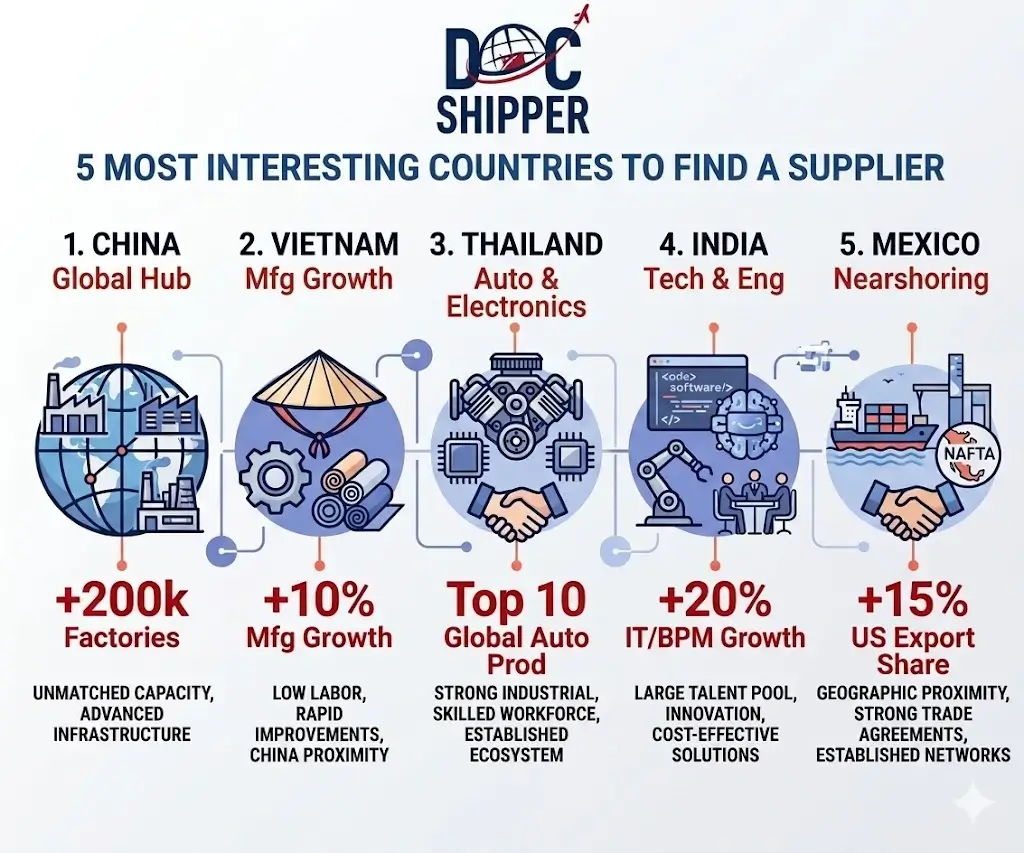
5 most intersting countries to find a supplier (1)

Best countries to outsource manufacturing by product type and budget

When you want to find international suppliers, you must align country selection with your product complexity and margin targets. You are not buying from a map, you are buying from an ecosystem.

Each country offers a different mix of labor cost, industrial clusters, raw material access, and export maturity. You should always balance unit price with hidden costs such as defects, delays, and compliance risks.

Country Best For Budget Level Key Advantages Main Risks
China Electronics, machinery, consumer goods Mid Strong supply chain clusters, scalability, speed IP risk, rising labor costs
Vietnam Furniture, textiles, electronics assembly Low to Mid Competitive labor, trade agreements Limited capacity for complex components
India Pharmaceuticals, textiles, engineering goods Low English-speaking, strong IT and pharma sectors Infrastructure variability
Turkey Garments, home textiles, appliances Mid Short lead time to Europe Currency volatility
Mexico Automotive, electronics, appliances Mid Nearshoring to US, USMCA benefits Security concerns in some regions

If your priority is the lowest possible cost, you will likely focus on South and Southeast Asia. If you value shorter transit times and easier communication, nearshoring might protect your cash flow.

At DocShipper, we help you compare total landed cost, not just EXW pricing. That includes freight, duties, inspection, and buffer stock strategy.

  • Map your product to the strongest industrial cluster
  • Compare labor cost versus productivity
  • Check trade agreements with your destination country
  • Evaluate geopolitical and currency stability
  • Estimate realistic lead times including peak season

DocShipper Info

The right country depends on product complexity and cash flow tolerance.
We calculate total landed cost scenarios to reveal where real savings outperform headline EXW prices.

DocShipper Platform

One platform. Your entire supply chain

Sourcing, freight, customs & documents — all centralised, all visible, 24/7.

How to qualify and compare overseas suppliers with confidence

Finding factories is easy, selecting the right one is where you protect your margins. You need a structured qualification process before sending deposits.

Start with documentation, then move to verification, then to testing. This staged approach reduces your exposure step by step.

Step What You Check Why It Matters
Business License Legal registration, scope Avoid trading scams
Certifications ISO, CE, FDA, etc. Compliance with your market
Factory Audit Production capacity, QC process Consistency and scalability
Sample Testing Quality, durability, specs Validate real capability
Reference Check Existing export clients Reliability proof

You should never rely only on catalog photos or online ratings. A pre-shipment inspection can reduce defect rates by up to 30 percent when properly implemented.

When we support you, we conduct on-site audits, negotiate MOQs, and secure clear technical specifications. That transforms supplier comparison into measurable data.

  • Request detailed quotation with Incoterms specified
  • Confirm production lead time in writing
  • Clarify payment terms before tooling
  • Verify subcontracting practices
  • Sign a manufacturing agreement with penalties

DocShipper Alert

Sending deposits without structured checks exposes you to costly surprises.
Our audits, inspections, and contract support reduce defect rates and secure measurable supplier comparisons.

How to manage logistics, payments, and compliance with foreign suppliers

Even the best factory becomes a liability if logistics and compliance are mismanaged. You must control the chain from factory gate to final warehouse.

Choose the right Incoterm based on your internal capabilities. FOB gives you freight control, DDP simplifies operations but reduces transparency.

Topic Best Practice Risk If Ignored
Incoterms Define responsibility clearly in contract Unexpected charges
Payment Use LC or staged T/T payments Cash flow loss
Freight Book early during peak season Capacity shortage
Customs Verify HS code and duties Delays and fines
Compliance Check labeling and safety rules Market rejection

You should always calculate your total landed cost before confirming an order. That includes product cost, freight, insurance, customs duties, inspection, and domestic transport.

At DocShipper, we integrate sourcing, quality control, freight forwarding, and customs clearance under one coordination team. You gain visibility and reduce communication gaps between factory and forwarder.

  • Align payment schedule with production milestones
  • Insure cargo based on CIF value plus margin
  • Prepare compliance documents before shipment
  • Track shipments with milestone reporting
  • Plan safety stock to absorb delays

DocShipper Advice

Logistics and compliance should be planned before production ends.
We align sourcing, freight, and customs so your incoterms, payments, and documentation protect cash flow.

Conclusion

You now understand that to successfully find international suppliers, you must think beyond price. Strategy, qualification, and logistics discipline define long-term success.

  • Select countries based on product fit and total cost
  • Audit and test suppliers before scaling orders
  • Control Incoterms, payments, and compliance documentation
  • Calculate landed cost, not just factory price
  • Work with an integrated sourcing and logistics partner to reduce risk

If you want to secure reliable manufacturers worldwide with operational support, you can explore our sourcing solutions at DocShipper. We help you turn global sourcing into a controlled and profitable system.

FAQ | How to find international suppliers that boost margins and reduce risk

There is no universal best country, only the best fit for your product, margin, and risk profile. As a rule of thumb, China is strong for complex, fast-iteration products, Vietnam and India work well for cost-sensitive light manufacturing, while Mexico and Turkey are better if you need shorter lead times to the US or EU. The smart move is to shortlist 2–3 countries, request comparable quotes (same specs and Incoterms), then compare total landed cost plus lead time, not just unit price.

Ask us anything!

Need Help with Logistics
or Sourcing in Vietnam ?

First, we secure the right products from the right suppliers at the right price by managing the sourcing process from start to finish. Then, we simplify your shipping experience - from pickup to final delivery - ensuring any product, anywhere, is delivered at highly competitive prices.

Component-15-2.png

Live Chat

Get instant assistance from our team—
just click and start chatting!

Live Chat Now
image

Fill the Form

Prefer email? Send us your inquiry, and we’ll get back to you as soon as possible.

Contact us
image
Component-15-2.png

Call us

Reach out to us on WhatsApp for quick, convenient, and personal support.

Call us
image
Component-15-2.png