How to make a product specification sheet for manufacturing in Vietnam (and avoid costly mistakes)

  • admin 18 Min
  • Published on July 5, 2022 Updated on May 30, 2026
img

In short ⚡

How to make product specification sheet when manufacturing in Vietnam starts with treating it as a factory-proof production contract that covers product, quality, and logistics in measurable terms. Structure it before sourcing, define technical data and compliance, then validate it with your supplier to lock quotations, sampling, mass production, and shipping conditions. Here are the key steps to build it effectively:
  • Define product objective, target market, price point, and customer expectations.
  • Translate concepts into numbers: dimensions, tolerances, materials, performance.
  • List compliance, standards, and required tests for each target market.
  • Specify packaging, carton size, palletization, labeling, and export documents.
  • Add drawings, photos, exploded views, and clear inspection acceptance criteria.
  • Implement version control and confirm feasibility with the Vietnamese factory before RFQ.


In this article, you will find detailed checklists, Vietnam-specific standards and testing requirements, step‑by‑step workflows from spec to shipment, and practical templates for both simple products and complex electronic builds.

We hope you’ll find this article genuinely useful, but remember, if you ever feel lost at any step, whether it’s finding a supplier, validating quality, managing international shipping or customs,  FNM Vietnam can handle it all for you!

Free shipping quote 24h      I want to talk to a sourcing expert

What is a product specification sheet and why it matters more in Vietnam

If you’re searching for how to make product specification sheet when manufacturing in vietnam, here’s the thing, you’re not really “writing a document”, you’re building a production contract your factory can’t misread.

In Vietnam, the spec becomes the reference for quoting, sampling, mass production, and even what gets accepted at inspection before your shipment is dispatched.

We’ve seen importers with a clean CAD file still lose weeks because the factory quoted one material grade, sampled another, then packed it for export like a different SKU entirely.

That’s why this single file influences your procurement timeline, quality control gates, and your freight plan, from palletization to containerization to final distribution.

  • During sourcing: it anchors comparable quotes and prevents hidden assumptions that inflate freight rates later (wrong carton sizes, wrong stacking).
  • During sampling: it tells the factory what “pass” means, so you don’t argue after the lead time is burned.
  • During production: it supports inspections, corrective actions, and claims if the consignment doesn’t match.
  • During shipping: it drives packaging specs that affect cubic meters, routing, and whether you’re paying for air freight or fitting a 40HQ.

Mini workflow (how it plays out in real life):

Spec sheet sent, factory quotes, sample built, pre-shipment inspection, loading, export customs clearance, bill of lading issued, shipment tracking, receiving, inventory management.

Checklist, sanity-check your spec sheet impact before you ship:

  • Does it define acceptance criteria for inspection before dispatch?
  • Does it lock packaging dimensions that affect freight and warehousing?
  • Does it state Incoterms responsibilities (labeling, export docs, loading)?
  • Does it call out compliance testing needed before import customs clearance?

DocShipper Info

Your spec sheet acts as a production contract, not a simple brief.
Need help aligning sourcing, QC and freight from day one, our team structures specs that factories cannot misinterpret.

Clear definition, purpose and who should write it

A specification sheet is the single source of truth that tells a Vietnamese factory exactly what to quote, prototype, and manufacture, down to tolerances, finishes, and labeling.

Think of a product specification sheet as the bridge between your idea and the factory’s SOP, without it, they’ll fill gaps with whatever their supply chain already buys.

You should own the content, even if your supplier “helps”, because the moment there’s a deviation, the factory will point back to what you approved.

From experience, the best results come when you write it with input from product, QA, and logistics, because packaging, pallet patterns, and handling constraints are not afterthoughts.

We once dealt with a buyer who let the factory “draft the spec”, the sample looked fine, but the mass production switched to a locally available resin to protect margin, and the first container failed a basic drop test on arrival.

Owner What they contribute Why it matters in Vietnam manufacturing specification
Buyer / Product owner Target function, use case, required features Prevents “equivalent” substitutions during outsourcing
QA / Compliance Test methods, AQL, certifications, documentation Reduces risk of import holds and rework before export
Logistics / 3PL Carton size, palletization, labeling, handling marks Controls freight cost, container fit, warehousing flow
Factory engineering Process feasibility feedback, tooling constraints Improves quote accuracy and lead time reliability

One practical tip, keep a version number and a change log, because once multiple quotes and samples exist, confusion spreads fast across procurement, production, and freight forwarding teams.

DocShipper Advice

Avoid costly substitutions and misquotes.
We review and reinforce your spec sheet with QA and logistics inputs before sampling starts.

How a strong spec sheet reduces risk

 with Vietnamese

freight forwarder

 manufacturers

When you’re learning how to make product specification sheet when manufacturing in vietnam, you’ll notice fast that “quality” is not a feeling, it’s measurable criteria written in your product spec sheet.

A strong sheet cuts risk in four places, quoting, sampling, production, and shipping, so you don’t pay twice in delays and transportation.

Here’s a scenario we see a lot, you ask for “matte black”, the factory samples a nice finish, then bulk output turns glossier because the topcoat brand changed, and your customer returns spike after last-mile delivery.

With a defined gloss range, coating thickness, and approved supplier list, that argument disappears.

It also protects you commercially, because it makes non-conformity clear before you release balance payment or approve loading the cargo.

For alignment, we often map inspection language to accepted practices like those referenced by ISO quality management principles, so your acceptance criteria doesn’t feel arbitrary to the factory.

  • Quote accuracy: less padding for uncertainty, better comparison across factories.
  • Sampling speed: fewer rounds, shorter lead time, fewer “what did you mean?” emails.
  • Production control: fewer material substitutions, tighter tolerances, repeatable output.
  • Shipping readiness: packaging and labeling right the first time, smoother customs clearance and brokerage.

Mini workflow (risk reduction loop):

Define measurable specs, confirm supplier understanding, approve golden sample, lock packaging, run inline checks, perform pre-shipment inspection, release shipment with freight insurance if needed.

Checklist, what “risk-proof” looks like:

  • Every requirement is measurable (numbers, methods, references), not subjective.
  • Approved sample references are documented (photos, codes, version).
  • Packaging specs match your shipping mode (airway bill vs bill of lading constraints).
  • Responsibilities are aligned to your Incoterms to avoid surprise charges at export.

DocShipper Alert

Vague specs lead to glossy finishes, rejected cargo and payment disputes.
Secure measurable criteria before approving production to protect margins and delivery deadlines.

Key elements your Vietnam product specification sheet must include

To master how to make product specification sheet when manufacturing in vietnam, you need to think beyond the product itself and include everything that touches cost, quality, and shipment execution.

A good product specification vietnam file reads like a factory playbook, build this, verify that, pack like this, label like that, and prove it with these documents.

We’ve watched a “perfect” product get stuck because the factory used the wrong carton markings, and the forwarder couldn’t consolidate it with other consignments at cross-docking.

So yes, your spec sheet is also a logistics document, quietly controlling handling, routing, and transit time.

Mini workflow (from spec to shipment):

Write core specs, add packaging and compliance, request quote, confirm tooling, approve sample, book transportation, verify export documents, ship, receive, distribute.

Checklist, essential sections in your vietnam manufacturing specification:

  • Product identity (SKU, model, revision, photos or drawings)
  • Materials and components (grade, supplier, acceptable alternatives)
  • Dimensions and tolerances (including critical-to-quality points)
  • Functions and performance requirements (test method included)
  • Packaging and labeling (carton size, palletization, barcodes)
  • Compliance standards and documentation (certs, declarations)

DocShipper Info

A complete spec also drives container fit and freight cost.
We integrate packaging, compliance and transport constraints into one factory-ready document.

Looking for a Reliable Shipping & Sourcing Partner?

We handle the entire sourcing process, supplier research, negotiation, production, and inspections, so you can focus on what matters most: growing your business.

Core product details: dimensions, materials, functions and tolerances

If you want a factory to quote correctly, your specification sheet must start with unambiguous, measurable core details, otherwise the quote is fiction.

This is where you prevent “close enough” engineering that ruins assembly fit, performance, or even container loading density because the product ended up bulkier than planned.

We’ve seen a buyer specify “stainless steel”, the factory quoted 201 to hit a target price, and the first batch corroded in a humid warehouse before distribution even started.

Write the grade, the finish, and the acceptable test evidence, and you won’t have to negotiate quality after the fact.

  • Dimensions: include units, drawing references, and critical measurements that affect mating parts.
  • Tolerances: define acceptable deviation, and call out CTQ dimensions explicitly.
  • Materials: grade, thickness, density, hardness, coating type, and approved alternates.
  • Functions: performance targets with test methods and pass/fail thresholds.
Spec line Weak (causes disputes) Strong (factory-proof)
Material “Stainless steel” “SUS304, brushed finish #4, thickness 1.2 mm, no substitution without written approval”
Dimension “About 100 mm” “100.0 mm ± 0.2 mm, measured with caliper, 3 points per unit”
Performance “Must be durable” “Drop test 1.0 m, 10 cycles, no crack, no functional failure”

Mini workflow (core specs build):

Lock drawings, define CTQ dimensions, specify materials with grades, set tolerances, attach test methods, confirm feasibility with factory, freeze revision for quoting.

DocShipper Advice

Do not rely on generic material names or rough sizes.
Define grades, tolerances and test methods precisely to avoid corrosion, misfit or costly rework.

Supporting information: packaging, labeling, testing and documentation

Your product specification sheet isn’t complete until it tells the factory how to pack, label, test, and document the goods for export.

This is the part that saves you from “everything looks fine” surprises when your forwarder measures cartons, or when customs clearance asks for missing compliance paperwork.

We once handled a shipment where the product was correct, but the cartons exceeded the agreed height by 4 cm, so the factory couldn’t palletize as planned, and the freight cost jumped because the container space was used inefficiently.

That was a packaging spec issue, not a manufacturing one.

For labeling and barcode structure, aligning with recognized frameworks such as GS1 often prevents downstream scanning problems in warehousing and last-mile delivery.

  • Packaging: inner pack, master carton, carton dimensions, gross/net weight, desiccant, drop test requirements.
  • Palletization: pallet type, max height, stacking pattern, stretch wrap, corner protection.
  • Labeling: carton marks, SKU, batch, COO, handling marks, barcode type and placement.
  • Testing: what to test, when to test (pre-production, inline, pre-shipment), and acceptance criteria.
  • Documentation: packing list fields, commercial invoice data, certificates, test reports, photos.
Logistics item What you specify Why it impacts shipment
Master carton size L x W x H, max tolerance, max gross weight Affects containerization, consolidation, freight rates
Pallet pattern Units per layer, layers per pallet, max height Controls handling, loading, unloading, warehousing space
Labels and marks SKU, batch/lot, COO, handling marks Prevents misrouting and speeds cross-docking and dispatch
Export docs Packing list, invoice fields, required certificates Smoother brokerage and customs clearance, fewer holds

Mini workflow (supporting info lock):

Define carton and pallet specs, confirm forwarder constraints, set labeling artwork, list required tests, list required documents, validate against Incoterms responsibilities, freeze spec for production.

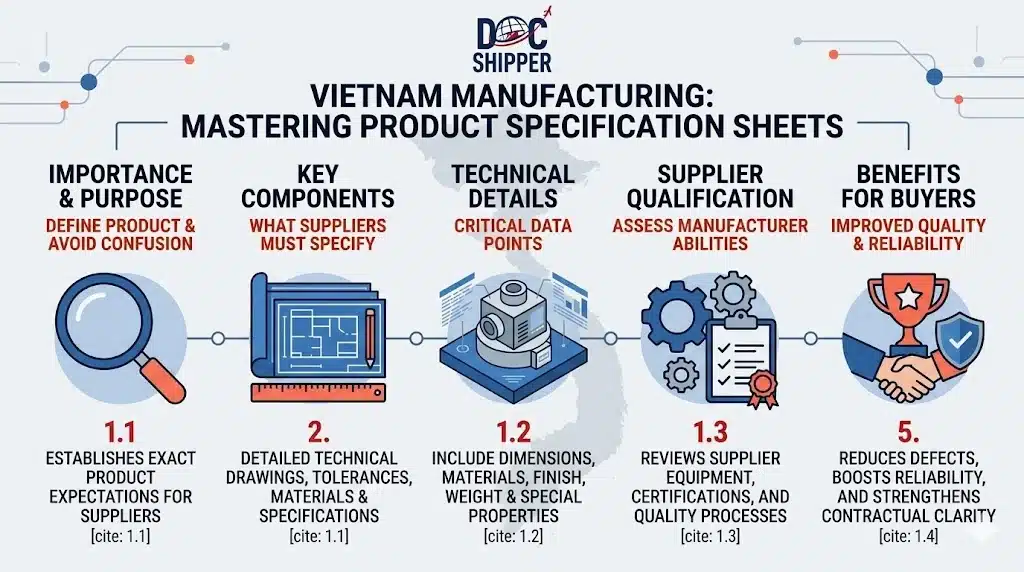
Vietnam Manufacturing - Mastering product specification sheets

DocShipper Info

Carton size, pallet pattern and export documents impact freight rates.
We align specs with forwarder and customs requirements before production is frozen.

Step-by-step process to build your specification sheet before sourcing in Vietnam

wholesaleYou cannot outsource clarity. You must structure your specification sheet before you contact any Vietnamese factory.

Below is a proven workflow we use at DocShipper when preparing sourcing projects in Vietnam.

  • Step 1: Define your product objective and target market
  • Step 2: Translate your concept into measurable technical data
  • Step 3: Identify compliance and testing requirements
  • Step 4: Define packaging and logistics constraints
  • Step 5: Add visual references and technical drawings
  • Step 6: Validate feasibility with a sourcing expert before RFQ

Start with commercial intent. You must clearly define your price target, positioning, and customer expectations.

If you skip this step, your factory will design the product for you, and that usually increases cost or reduces quality.

Then convert your idea into numbers. Vietnamese manufacturers think in tolerances, density, thickness, weight, and performance values.

Concept ideaSpecification translation
“High quality fabric”100% cotton, 180 GSM ±5%, combed yarn
“Strong plastic casing”ABS grade VH-0800, 2.5 mm thickness ±0.2 mm
“Water resistant”IPX4 tested according to IEC standard

You should always attach drawings. Even simple 2D sketches reduce misunderstandings by more than 60% in sampling phases.

Before sending your RFQ, run this checklist.

  • All dimensions specified with unit system clearly stated
  • Material grades and not just generic names
  • Tolerances defined for critical parts
  • Color references with Pantone codes
  • Packaging type and carton dimensions
  • Required certifications listed

If you need support validating technical feasibility, you can work with DocShipper sourcing experts before engaging factories.

DocShipper Platform

One platform. Your entire supply chain

Sourcing, freight, customs & documents — all centralised, all visible, 24/7.

Vietnam-specific requirements: standards, testing, and communication with factories

Vietnam has its own regulatory environment. You must understand both local requirements and export market standards.

Many products require conformity with QCVN standards if sold locally.

  • Electrical goods may require MIC approval
  • Food contact materials may require MOH declaration
  • Toys may require CR mark certification
  • Textiles may require formaldehyde content testing

If you manufacture for Europe or the US, Vietnamese factories will follow your target market regulations. But you must explicitly state them in your spec sheet.

Target Market Standards to Include in Spec
European Union CE, REACH, RoHS, EN standards
United States FCC, CPSIA, FDA, ASTM
Australia RCM, AS/NZS standards

Communication is another critical factor. Many Vietnamese suppliers operate in English, but technical misunderstandings still happen.

You should include in your specification sheet:

  • Annotated product photos
  • Exploded diagrams for assemblies
  • Clear quality acceptance criteria
  • AQL inspection level requirements

At DocShipper, we systematically align specification sheets with pre-shipment inspection protocols to avoid disputes.

Practical examples and templates: from simple product spec sheet to complex builds

Not all specification sheets have the same level of complexity. Your document must match your product risk level.

Below is a simplified comparison.

Product Type Spec Sheet Complexity Typical Pages
Simple textile item Basic material and sizing details 3 to 5 pages
Plastic consumer product Material grade, mold specs, tolerances 5 to 15 pages
Electronic device Full BOM, PCB layout, certifications 20+ pages

For simple products, your template can follow this structure.

  • Product overview and SKU code
  • Bill of materials
  • Technical drawings with dimensions
  • Color references
  • Packaging and labeling instructions
  • Compliance requirements

For complex builds, you should also include:

  • Full Bill of Materials with supplier references
  • Critical component tolerances
  • Testing protocols and pass criteria
  • Firmware or software version control
  • Revision history log

Every serious project must include a revision control system.

Without version tracking, factories may produce based on outdated files, and disputes become extremely difficult to resolve.

DocShipper Info

Simple product or complex build, your template must match risk level.
We design scalable spec sheet templates with strict revision control to prevent outdated production.

Conclusion

If you want to know how to make product specification sheet when manufacturing in Vietnam, focus on precision, compliance, and communication.

  • Define measurable technical data, not marketing descriptions
  • Include materials, dimensions, tolerances, and packaging
  • Clearly state target market certifications
  • Add drawings and inspection criteria
  • Implement strict revision control
  • Validate feasibility before mass production

Your specification sheet is your strongest protection against cost overruns and quality failures. When properly built, it becomes your contractual backbone with Vietnamese manufacturers.

If you need expert guidance to structure or audit your product specifications before sourcing in Vietnam, our team at DocShipper can support you from technical validation to factory negotiation and inspection.

FAQ | How to make a product specification sheet for manufacturing in Vietnam (and avoid costly mistakes)

A product specification sheet is a structured document that tells a Vietnamese factory exactly what to quote, sample, and mass-produce, from materials and dimensions to packaging and labeling. In practice it works as a binding production reference: if something goes wrong, you and the factory both go back to this file to decide whether the goods are acceptable, need rework, or justify a claim.

Ask us anything!

Need Help with Logistics
or Sourcing in Vietnam ?

First, we secure the right products from the right suppliers at the right price by managing the sourcing process from start to finish. Then, we simplify your shipping experience - from pickup to final delivery - ensuring any product, anywhere, is delivered at highly competitive prices.

Component-15-2.png

Live Chat

Get instant assistance from our team—
just click and start chatting!

Live Chat Now
image

Fill the Form

Prefer email? Send us your inquiry, and we’ll get back to you as soon as possible.

Contact us
image
Component-15-2.png

Call us

Reach out to us on WhatsApp for quick, convenient, and personal support.

Call us
image
Component-15-2.png