


Freight Shipping between Vietnam and Greece | Rates – Transit times – Duties and Taxes
If you underestimate the distance between Ho Chi Minh City and Piraeus Port, you’ll pay for it in delays, storage fees, or the wrong Incoterm. On the freight vietnam greece route, most issues don’t come from the ocean itself, but from poor planning around cut-off times, customs documentation, and who actually acts as the Importer of Record. You might be comparing sea freight vs air freight, checking transit times, or trying to forecast duties and VAT before placing an order, and that’s exactly where small assumptions create big gaps in your budget. In this Destination Guide, you’ll get a clear breakdown of transport options, transit logic, customs procedures, and taxes so you can structure your Vietnam to Greece shipment the right way from day one.
Which are the different modes of transportation between Vietnam and Greece?
If you’re shipping larger volumes or non-urgent cargo, you’ll usually choose sea freight from Cat Lai Port or Hai Phong Port to Piraeus Port, because your cost per CBM stays lower and you can move full containers under FCL or share space under LCL. If your goods are time-sensitive, high value, or light enough that chargeable weight works in your favor, you’ll move by air freight from Tan Son Nhat Airport to Athens International Airport, accepting a higher rate for much shorter transit.
The first thing we always tell you is simple, choose based on urgency, cargo profile, and how much buffer you have before demurrage starts at destination. If you’re unsure, you can contact us and we’ll check real-time capacity, carrier schedules, and rate levels on the Vietnam–Greece corridor, then we’ll go deeper into each option in the sections below.
Need help with your shipment?
Need assistance with your shipment? Dont hesitate to contact us even for a simple question. Choose the option that suits you
Live chat with an expert Chat on WhatsApp Free Quote 24hHow can FNM Vietnam help?
Sea freight between Vietnam and Greece
If you are planning sea freight Vietnam to Greece or container shipping Vietnam to Greece, the first thing you need to decide is whether ocean freight really fits your timeline and cash flow. For shipments above 10–15 CBM, or any regular FCL full container load, sea freight is usually the most cost-efficient option. You trade speed for price, but you gain stability and predictable capacity on this long-haul route.
On average, you should expect a shipping lead time by sea of roughly 3 to 5 weeks port to port. That makes sense for industrial goods, furniture, textiles, machinery, or bulk cargo. It does not make sense if you are trying to replenish stock urgently or launch a product with a tight deadline. Air freight will be faster, but your container shipping cost Vietnam to Greece will be dramatically lower by sea.
Here is what usually creates problems. You underestimate documentation, you pick the wrong Incoterms FOB CIF EXW DAP DDP, or you ignore the difference between your port of loading and port of discharge. Those small decisions can create unexpected destination charges or delays at Greek customs. When we handle ocean freight Vietnam Greece, we focus on the operational details from day one so you avoid surprises once the vessel sails.
Which Incoterms should you use?
When arranging international shipping Vietnam to Greece, your choice of Incoterms FOB CIF EXW DAP DDP directly affects cost control and risk. In real operations, we often see clients use FOB Ho Chi Minh to Piraeus because it gives you control over the main freight while your supplier handles export clearance in Vietnam. That balance works well if you want visibility on the freight rate per container and carrier selection.
CIF port of destination Greece can look convenient, but you should be careful. Your supplier chooses the carrier and insurance, and you often discover high local charges once the container arrives. This is where many importers face loss of cost control. If you want full visibility on the sea freight rates Vietnam Greece and destination handling, FOB or even EXW with a reliable freight forwarder Vietnam to Greece usually gives you better transparency.
If you are new to this route, avoid agreeing to DDP without understanding Greek customs obligations. Under DDP, your supplier becomes responsible for duties and VAT, but if paperwork is incomplete, you can still face customs clearance delays. We always recommend aligning Incoterms with who controls the main freight contract and who is ready to act as Importer of Record in Greece.
Main ports to know in Vietnam and Greece
When planning container shipping Vietnam to Greece, your choice of port of loading and port of discharge impacts transit time, inland trucking cost, and vessel frequency. You do not need every port on the map. You need the ones that actually move volume on this corridor.
- Port of Ho Chi Minh City, Southern Vietnam. The main export gateway for industrial goods and the most common origin for FOB Ho Chi Minh to Piraeus shipments. Strong carrier coverage and frequent departures.
- Port of Hai Phong, Northern Vietnam. Ideal if your factory is near Hanoi or in northern industrial zones. Choosing Hai Phong avoids costly domestic trucking to the south.
- Port of Piraeus, Greece. The primary hub for Asian imports, with strong feeder connections and rail access to Central Europe. Most sea freight Vietnam to Greece arrives here.
- Port of Thessaloniki, Northern Greece. Better if your cargo is destined for the Balkans or Northern Greece, reducing inland transport from Athens.
If you choose the wrong port to save a few dollars on ocean freight, you can easily lose that saving in inland haulage. That is why we always review your final delivery address before confirming the port strategy.
Transit times: How long does it take to ship from Vietnam to Greece?
The typical sea transit time Vietnam to Greece ranges between 22 and 32 days port to port, depending on origin, routing, and whether the service is direct or via transshipment.
| Port of Loading | Port of Discharge | Estimated Transit Time |
|---|---|---|
| Port of Ho Chi Minh City | Port of Piraeus | 24–28 days |
| Port of Hai Phong | Port of Piraeus | 25–30 days |
| Port of Ho Chi Minh City | Port of Thessaloniki | 26–32 days |
You should treat these figures as planning estimates, not guarantees. Your estimated time of departure ETD and estimated time of arrival ETA depend on carrier schedules and transshipment hubs, often in Singapore or the Middle East. During peak export periods in Asia, you can face rollovers and schedule shifts, which extend the real delivery date beyond the published transit time.
The key is to calculate from factory readiness to final delivery in Greece, not just port to port. That full door-to-door timeline is what protects your inventory planning.
Should I choose FCL or LCL when shipping between Vietnam and Greece?
Choosing between FCL and LCL, also known as consolidation, when shipping by sea from Vietnam to Greece is a vital decision that affects not just cost but delivery time too. This breakdown will help your business understand the differences and strategic advantages of each, arming you with the knowledge to make an informed choice that suits your specific shipping requirements. Let’s dive in and unravel the intricacies of these two primary sea freight options.
Full container load (FCL)
Definition: FCL or 'Full Container Load' is a term in fcl shipping where a shipment occupies an entire container, be it a 20'ft container or a 40'ft container.
When to Use: FCL is a practical option when your cargo volume exceeds 13-15 CBM. It ensures the safety of your goods as your container is sealed at origin and opened only at the destination.
Example: Suppose you're a furniture dealer, planning to ship 16 CBM of chairs and tables from Vietnam to Greece. Opting for an FCL container guarantees that your goods will stay in the same, untouched space from pickup to delivery, eliminating the chances of damage during transit.
Cost Implications: Though the upfront fcl shipping quote might seem steep compared to LCL or 'Less than Container Load', FCL becomes more cost-effective when shipping larger volumes. It also ensures fewer handling charges as the goods are not consolidated or deconsolidated along the path. Thus, the direct correlation between high volumes and reduced costs makes FCL a go-to option for shipments exceeding the mentioned volume threshold.
Less container load (LCL)
Definition: Less than Container Load (LCL) shipping is a practical solution for businesses that need to transport limited quantities of goods. This option involves sharing a container with other shippers, which makes it cost-efficient and flexible.
When to Use: LCL freight is an ideal choice when the cargo volume is less than 13, 14, or 15 cubic meters (CBM). Since your freight does not fill a whole container, it is combined with other shipments.
Example: Imagine a business in Vietnam sells artisan pottery, with an average monthly shipment quantity equivalent to 10 CBMs. Instead of paying for unused space in a full container, they choose LCL freight. Their products are then consolidated with other goods in the same container bound for Greece.
Cost Implications: While LCL shipping quote per CBM may be higher compared to Full Container Load (FCL), the overall spend is generally less if your shipment does not exceed the recommended volume. One should, however, be prepared for potential delays in delivery time due to the consolidation and deconsolidation processes, affecting the total lead time.
Hassle-free shipping
Looking to export from Vietnam to Greece? FNM Vietnam, your trusted freight forwarder, can make it easy. Our ocean freight specialists will assist you in deciding between consolidation or full container shipping, based on factors like your budget, shipment size, and delivery speed. We're here to democratize shipping and help businesses send cargo with simplicity and peace of mind. Ready to take the plunge? Contact us for a no-obligation, free cost estimation. Your hassle-free shipping journey starts with us.
Shipping rates: how much does a sea freight shipment cost from Vietnam to Greece?
If you are budgeting sea freight rates Vietnam Greece, you need to separate LCL and FCL logic. Below are indicative planning ranges for container shipping cost Vietnam to Greece, subject to market fluctuations.
| Shipment Type | Route | Indicative Cost Range |
|---|---|---|
| LCL 1–5 CBM | Ho Chi Minh to Piraeus | USD 60–120 per CBM |
| 20ft FCL | Ho Chi Minh to Piraeus | USD 1,200–2,000 per container |
| 40ft FCL | Ho Chi Minh to Piraeus | USD 1,800–3,200 per container |
Your final freight rate per container depends on season, carrier capacity, fuel costs, and whether you ship under FCL full container load or LCL less than container load. Keep in mind that ocean freight is only one part of your freight cost breakdown sea shipment. You still need to account for origin charges, terminal handling charges THC, documentation, and Greek import clearance before you know your real landed cost.
How to estimate your sea freight cost before requesting a quote
Before asking for a freight quote Vietnam Greece, prepare four elements: total CBM, gross weight, chosen Incoterm, and exact port of loading and port of discharge. Without these, any number you receive is just a rough guess.
For example, if you ship 8 CBM and 2,000 kg under LCL, ocean freight is charged per cubic meter. If the rate is USD 90 per CBM, your base ocean cost is 8 × 90 = USD 720. Then you add origin handling, documentation fee, terminal handling charges THC, and the customs clearance fee at destination. Suddenly, the total is very different from the ocean line alone.
This is where many importers get caught by cheap headline rates. A low ocean price can hide high destination charges or limited free time before demurrage starts. We always calculate your total landed cost before you commit, and we can provide a tailored quote within 24 hours based on your real cargo data.
Surcharges and hidden cost drivers to watch for
Once your container arrives in Greece, destination charges are the first surprise. These include local handling, terminal handling charges THC, delivery order fees, and sometimes higher-than-expected customs clearance fee at destination. If you bought under CIF, you often discover these only after arrival.
Next come time-related charges. Containers usually have limited free days at the port. If documents like the Bill of Lading B/L, telex release, or sea waybill are delayed, you can trigger demurrage and detention. These fees accumulate daily and can quickly exceed the original ocean freight.
Finally, market surcharges such as bunker adjustment factor BAF or peak season surcharge PSS can change your cost structure between booking and departure. You cannot always control these, but you can anticipate them with a forwarder who monitors the rate evolution on the Vietnam to Greece corridor.
Step-by-step: how a sea freight shipment usually works on this route
When you book sea freight Vietnam to Greece, the process looks simple on paper. In reality, each stage has timing constraints and documentation checks. This route requires patience because you coordinate factory readiness, vessel schedules, and Greek import procedures at the same time. Most surprises happen between cargo readiness and document release.
- We confirm your booking details, cargo specs, and chosen Incoterm, then secure space with the carrier.
- Your supplier delivers the goods to the port of loading, and export customs clearance is completed in Vietnam.
- The container is loaded on board, and the Bill of Lading B/L is issued with agreed release terms.
- The vessel sails, and we monitor ETA updates to anticipate any schedule change.
- Before arrival at the Port of Piraeus or Port of Thessaloniki, we prepare Greek import clearance documents.
- Once customs is cleared and charges are settled, the container is released for inland delivery.
Special sea freight solutions
Not all cargo fits standard containers. If you ship temperature-sensitive goods, reefer container shipping ensures controlled conditions throughout the voyage. For oversized machinery, out of gauge OOG cargo or project cargo by sea may be required, with specific lashing and vessel planning.
If your volume is small, LCL consolidation service allows you to share container space and reduce cost. If you fill most of a container, we will compare FCL vs LCL cost comparison to see which option protects you from damage risk and unnecessary handling. The right structure depends on your cargo profile, not just price.
Air freight between Vietnam and Greece
If you are looking at air freight Vietnam to Greece, you are usually balancing speed against cost. You choose air when your cargo is high value, time-sensitive, or when stockouts would cost you more than the freight itself. It is the fastest way to ship from Vietnam to Greece, but it is also stricter on documentation, cut-off times, and cargo preparation than most people expect.
You have probably heard that air freight always takes 3 days, is always too expensive, or that you pay only on actual weight. None of that is reliably true on this route. From experience, the real issues are miscalculating the chargeable weight, ignoring screening or last-minute cut-off changes, and sending incomplete export documents. That is where delays and unexpected costs usually start.
Air Cargo vs Express Air Freight: How should I ship?
When you compare air cargo Vietnam Greece with express air freight Vietnam to Greece, you are really choosing between control and simplicity. Standard air cargo service moves your goods on commercial flights under an air waybill AWB, often as part of a consolidation service air freight. Express courier services handle everything end to end with their own network and tracking.
The first thing we always tell you is this: look at your volume, your internal logistics capability, and how urgent the shipment is. If you need flexibility, palletized freight, or special handling like dangerous goods by air DGR or temperature controlled air freight, classic air cargo gives you more options. If you want a simple door to door air freight solution with minimal coordination, express might suit you better, as long as you understand the pricing logic.
Should I choose Air Cargo between Vietnam and Greece?
You should seriously consider standard air cargo once your shipment is above 1 CBM or around 100 to 150 kg. At that level, the air cargo cost per kg is usually more competitive than express, especially if you ship regularly from Tan Son Nhat International Airport or Noi Bai International Airport to Athens International Airport.
This option fits you if you are shipping B2B, using palletized air cargo or even a structured loose cargo shipment, and if you can manage booking, documents, and coordination. Before requesting an air freight quote Vietnam Greece, you should have ready your dimensions, gross weight, Incoterm such as FOB or CIF, the exact airport pair, cargo readiness date, and product type.
The common mistake is assuming airport-to-airport equals door to airport service or even full door-to-door. It does not. You must account for pre-carriage in Vietnam, customs clearance for air freight, and import handling in Greece. If you ignore minimum charges and airport handling charges, your budget can shift quickly, especially on smaller shipments.
Should I choose Express Air Freight between Vietnam and Greece?
Express makes sense if you have an urgent shipment Vietnam to Greece, small parcels below 1 CBM or under 100 to 150 kg, and no internal logistics team. You get integrated tracking with an air cargo tracking number, simplified paperwork, and faster handover at destination.
The trade-off is control. With express, you usually accept bundled pricing that includes transport and clearance, but you have less visibility on how fuel surcharge air freight, security surcharge air cargo, or remote area fees are calculated. If your carton is reweighed and remeasured, you may face a recalculated chargeable weight without much room to negotiate.
Express is a good fit if you value speed and simplicity over customization. It becomes risky if you underestimate volumetric weight vs gross weight or assume that every Incoterm detail is covered automatically. From experience, packaging that works for sea freight can be rejected for air due to IATA cargo regulations, so you must prepare accordingly.
Main airports to know in Vietnam and Greece
When you plan air freight Vietnam to Greece, the airport pair directly impacts your air shipping lead time, inland trucking cost, and risk of delay. Here are the main airports in Vietnam and Greece you should focus on:
- Tan Son Nhat International Airport in Ho Chi Minh City, the primary southern gateway, with the highest frequency of international cargo flights and strong export infrastructure.
- Noi Bai International Airport in Hanoi, key for northern factories and industrial zones, often used for electronics and high-value goods.
- Athens International Airport, the main cargo hub in Greece, offering the broadest connectivity and the most consistent import handling.
- Thessaloniki Airport cargo facilities, relevant if your final delivery is in northern Greece or the Balkans, which can reduce domestic trucking time.
If you choose an airport far from your supplier or final customer, you increase pre-carriage or on-carriage costs. You also expose yourself to missed flight connections if the cargo arrives late at the export terminal. The airport decision is not cosmetic, it shapes your total landed cost.
Transit times: how long does air freight take from Vietnam to Greece?
| Service | Estimated transit time | Notes |
|---|---|---|
| Standard air cargo | Approximately 5 to 10 days | Depends on direct flight vs transshipment air cargo and flight frequency |
| Express air freight | Approximately 3 to 6 days | Includes integrated handling and priority uplift |
The typical air transit time Vietnam to Greece ranges from 3 to 10 days, depending on whether you use express or consolidated cargo. A direct flight vs transshipment air cargo setup can easily add one or two days if the cargo connects through a major hub in Europe or the Middle East.
What really changes your timeline is the cut-off time at origin, security screening, and available capacity during peak seasons. If your cargo misses the booked flight because of late delivery to the terminal, you face a rollover to the next flight, which can add several days. Always confirm the ready date, airport pair, and cargo type before you lock your production schedule.
Shipping rates: how much does air freight cost from Vietnam to Greece?
| Service | Estimated range per kg | What influences it most |
|---|---|---|
| Standard air cargo | Commonly around 3 to 10 USD per kg | Chargeable weight, consolidation, airport pair |
| Express air freight | Higher than standard cargo, varies by courier | Dimensional weight, urgency, remote delivery |
If you are asking how much does air freight cost from Vietnam to Greece, you must first look at the chargeable weight calculation. Airlines charge based on the higher of gross or volumetric weight, not just what the scale shows. That single factor usually explains most pricing gaps between two similar shipments.
Then come dimensions, packaging density, and urgency. A light but bulky shipment will increase your air cargo cost per kg because it occupies more aircraft space. Add fuel surcharge air freight, security surcharge air cargo, and airport handling charges, and the final figure can shift quickly. The airport you choose in Vietnam and Greece also changes pre-carriage and last-mile costs, so your quote is never just about distance.
Step-by-step: how an air shipment usually works on this route
When you book air freight Vietnam to Greece, the process follows a clear operational chain. Once you see the logic, it becomes easier to control timing and cost. The key is aligning production, documentation, and flight schedules so nothing blocks your cargo at the terminal.
- You confirm shipment details, including dimensions, weight, Incoterm, and cargo type, so we can issue an accurate air freight quote Vietnam Greece.
- We book space with the airline and share the cut-off time and required export documentation for air cargo, including commercial invoice and packing list.
- Your supplier delivers the cargo to the airport warehouse or we arrange pick-up, depending on whether you choose airport-to-airport or door to door air freight.
- The cargo goes through security screening under IATA cargo regulations, and the air waybill AWB is issued once accepted by the airline.
- The shipment flies, sometimes via transshipment, and you track it using the provided air cargo tracking number.
- On arrival in Greece, we manage customs clearance for air freight and coordinate import handling at destination airport before final delivery.
The moments where delays usually happen are incomplete documents, incorrect HS codes, or cargo arriving after the airline cut-off. That is when storage fees or a missed flight uplift can increase both time and cost. If you plan each step in advance, you keep control of your timeline.
What is the difference between volumetric and gross weight?
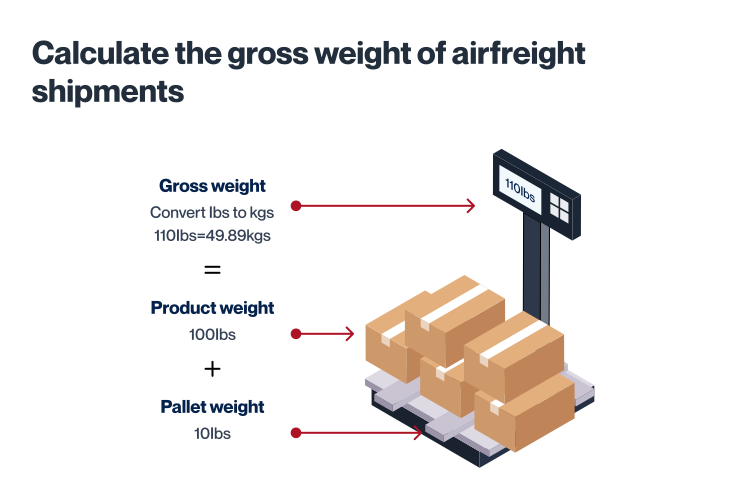
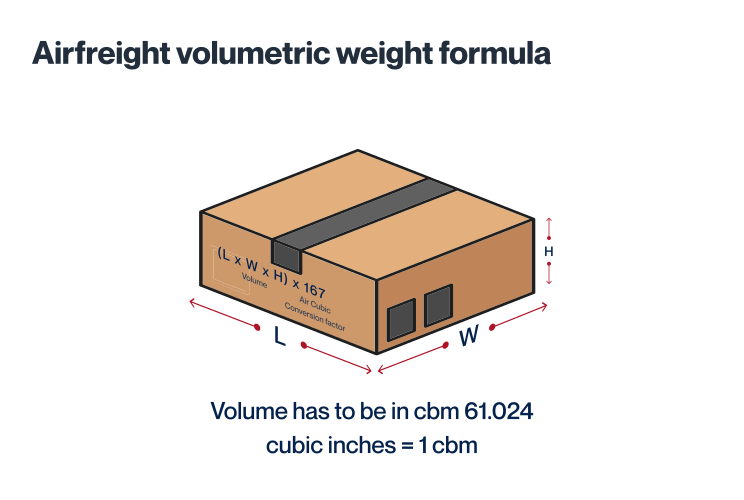
If you want to control your air freight budget, you must understand volumetric weight vs gross weight. Airlines charge you based on the higher of the two, which they call the chargeable weight. That is why two shipments with the same actual weight can have very different invoices.
- Gross weight: the real physical weight of your goods, including packaging and pallets.
- Volumetric weight: a calculated weight based on the space your cargo occupies in the aircraft.
- Chargeable weight: the higher value between gross and volumetric weight.
To apply the dimensional weight formula, you multiply length × width × height in centimeters, then divide by 6,000 for standard air cargo or 5,000 for express. For example, a package of 100 cm × 100 cm × 100 cm equals 1,000,000 cubic cm. Divided by 6,000, the volumetric weight is about 167 kg for air cargo. Divided by 5,000, it becomes about 200 kg for express.
Many shippers focus only on the scale weight and ignore dimensions. That is how you end up with a higher-than-expected invoice. If you optimize packaging and reduce empty space, you directly reduce your chargeable weight and your total freight cost.
Door to door between Vietnam and Greece
Door to Door shipping paints a full-cycle solution for businesses, transporting goods straight from Vietnam to Greece with no fuss for you. Imagine skipping the logistics nightmare and swiftly reaching your Greek client’s doorstep! From timely delivery to customs clearance, this shipping method has it all. Intrigued by the prospect? Let’s dive in!
Overview – Door to Door
Sweating over the complex shipping process between Vietnam and Greece? Door-to-door shipping is here to ease your troubles. This stress-free option covers everything, from initial pickup in Vietnam to final delivery in Greece, tackling customs clearance, paperwork, and even transportation struggles. While a bit costlier, its comprehensive coverage ranks it as FNM Vietnam’s most popular service. As for drawbacks, shipping times can vary due to numerous factors. But weigh it against the peace of mind you’ll enjoy, and you’ll see why numerous businesses trust this method. Crack open the secret to stress-free shipping with our complete guide below.
Why should I use a Door to Door service between Vietnam and Greece?
Ever thought shipping goods was as tricky as threading a camel through a needle’s eye? Think again! With Door to Door service between Vietnam and Greece, it’s a walk in the park! Here are five compelling reasons why you might want this service on speed dial:
1. Ease Stress in Logistics: Shipping isn’t just trading seals and signatures; it’s logistics on steroids! A door to door service conducts the pickup, transport, and delivery seamlessly, navigating through all complex procedures and paperwork. That’s a major load off your business mind!
2. Timely Delivery for Urgent Shipments: If your shipment is as urgent as ‘a groom running late for his wedding,’ this service is your knight in shiny armor! It guarantees time-efficient transport, leaving no room for behemoth delays.
3. Specialized Care for Complex Cargo: Got fragile or specialty items? No worries! Door to Door services are like ‘nannies for your goods,’ providing expert care and handling, ensuring they reach in mint condition.
4. Complete Handling of Trucking: Imagine your goods being chauffeured straight to the final destination without you lifting a finger. Appealing, right? This service takes care of every mile, making trucking a no-brainer for you.
5. Sheer Convenience: The sum of these perks equals undisputed convenience. You wouldn’t turn down a chauffeured ride in a top-notch limo, so why refuse the equivalent for your precious goods?
In essence, door to door service is your trustworthy ally in the wild world of shipping, offering a fuss-free, efficient, and precise solution tailored for your needs.
FNM Vietnam – Door to Door specialist between Vietnam and Greece
FNM Vietnam offers a comprehensive, door-to-door shipping solution from Vietnam to Greece. We tackle the complexities of freight forwarding so you don’t have to; managing everything from packaging and transit to customs processes. Choose from a variety of shipping methods based on your unique requirements, all overseen by a dedicated Account Executive. With our commitment to efficiency, expect a free estimate within 24 hours or instant consultation over the phone. Lean back and let FNM Vietnam seamlessly move your goods across borders.
Customs clearance in Greece for goods imported from Vietnam
When you handle customs clearance in Greece for goods from Vietnam, you directly affect your landed cost calculation, your release timing, and who is legally responsible as the Importer of Record Greece. The way you prepare your required import documents and structure your Incoterm will decide whether your cargo clears in days or sits under customs control. We coordinate the full import customs Greece from Vietnam flow for our clients, including the broker, declaration, and follow-up until release.
You will quickly notice that most issues come from small upstream mistakes, wrong HS code classification, missing certificate of origin, or inconsistent commercial invoice requirements. On this route, a mismatch between the invoice and the Bill of Lading often triggers a customs risk assessment and delays. In the next sections, you will see exactly how to calculate duties and how the import declaration process works step by step.
How to calculate duties & taxes when importing from Vietnam to Greece?
If you want to know how to calculate import duties from Vietnam to Greece, you need four core inputs, your country of origin rules, the correct HS code classification, the customs value calculation method, and the applicable customs tariff Greece rate. You will also need to confirm how VAT on imports Greece is applied on your specific product.
Your final assessment may differ from your estimate because customs can adjust your declared value, reclassify your HS code, or deny a preferential origin treatment if documentation is incomplete. This is where many “cheap” quotes fall apart, they ignore VAT base calculation or additional measures. If you want predictable landed cost, you must understand the import duty calculation Greece logic before you ship, otherwise you risk a clearance delay and unexpected cash outflow.
Step 0 – Quick checks before you calculate
Before you open any tariff tool, confirm three points:
Importer of Record, do you or your supplier hold the EORI number for importer in Greece?
Incoterm, are you shipping under FOB, CIF, or DDP, and who controls the customs declaration submission?
Low-value threshold, does your shipment qualify for a simplified or low-value procedure under EU rules?
Step 1 – Identify the Country of Origin
Your country of origin rules determine whether you qualify for preferential origin treatment or pay full third-country duty. If your goods are genuinely manufactured in Vietnam and supported by a valid certificate of origin, you may access reduced tariffs under EU arrangements.
Do not confuse origin with shipping country. If your goods transit through another country but are produced in Vietnam, origin remains Vietnam. Customs may request proof, and if documents are weak, you face a retroactive duty claim after a post clearance audit. Origin also affects exposure to trade defense measures such as anti-dumping duties, so you should verify it before pricing your product.
Step 2 – Find the HS Code of your product
Your HS code classification drives your duty rate, VAT base, and whether additional controls apply. One digit can change your customs duties and taxes Greece import outcome or trigger licensing requirements. This is not a paperwork detail, it is a pricing decision.
You can start with your supplier’s reference, then verify it using an official harmonized system code lookup tool such as the EU TARIC database at TARIC consultation. Check the product description carefully, compare material, function, and technical specs, and confirm the 8 or 10 digit code used for EU imports.
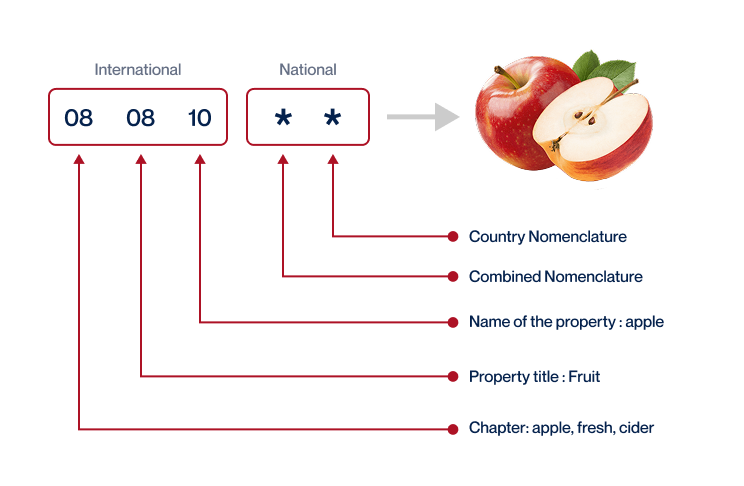
If your HS code is wrong, customs can reclassify your goods during the customs inspection process, leading to a higher duty rate, penalties, or blocked release. From experience, this is one of the most common clearance delay reasons on this route. Here’s an infographic showing you how to read an HS code.
Step 3 – Calculate the Customs Value
Greek customs generally assess duties based on the CIF value for customs purposes, meaning Cost, Insurance, and Freight up to the first EU port or airport. Under the standard customs value calculation method, you start from the transaction value and add elements that are not already included.
If you buy goods for 10,000 USD under FOB Ho Chi Minh and you pay 1,000 USD freight and 200 USD insurance to Piraeus, your customs value becomes 11,200 USD. If you ship under CIF Piraeus, freight and insurance are already embedded in the invoice price, but you still need to verify that no commissions, assists, special packing, or royalties should be added. Incorrect valuation often leads to a value uplift by customs during control.
Step 4 – Figure out the applicable Import Tariff
An import tariff is the percentage applied to your customs value to determine the basic customs duty. Greece applies the EU Common Customs Tariff, so you must check the EU system, not a local standalone list.
Use the official TARIC tool. Step 1, enter your confirmed HS code. Step 2, select Vietnam as country of origin. Step 3, review the duty rate and any additional measures shown in the results.
When you read the result, look for:
Preferential rate, does a reduced rate apply with valid origin proof?
Additional codes, are there anti-dumping or safeguard measures?
Conditions, are there document requirements linked to the rate?
If your customs value is 11,200 USD and the tariff shown is 5%, your base duty is 560 USD. That is the core of your import duty calculation Greece. On this route, footwear, textiles, and certain industrial goods often require extra attention, so you should double-check product notes. If you are unsure how to interpret a tariff line, a licensed customs broker in Greece can validate it before shipment.
Step 5 – Consider other Import Duties and Taxes
After customs duty, you must calculate VAT on imports Greece. VAT is generally applied to the customs value plus duty and certain additional costs up to the first EU entry point. If your customs value is 11,200 USD and duty is 560 USD, VAT will apply on 11,760 USD, not just on the product price.
Beyond VAT, some goods face excise or trade defense measures. For example, specific steel or chemical products may be subject to anti-dumping duties, which significantly change your total customs duties and taxes Greece import exposure. If you ignore these measures, you may face a cash flow shock at clearance.
Before shipping, you should:
Verify additional measures in TARIC for your HS code.
Check document conditions linked to preferential rates.
Prepare an import compliance checklist covering invoice, origin, and transport documents.
Confirm VAT deferment options with your accountant if applicable.
Step 6 – Calculate the Customs Duties
The formulas are straightforward. Duty = customs value × duty rate. VAT = taxable base × VAT rate, where the taxable base usually equals customs value plus duty.
Using the earlier example, customs value 11,200 USD and duty rate 5% gives 560 USD duty. If VAT applies on 11,760 USD, you multiply that by the applicable VAT rate to get the VAT amount. This is the backbone of your landed cost calculation when importing from Vietnam.
Once calculated, you or your representative submit the customs declaration submission electronically using the single administrative document SAD format. Duties and taxes must be secured or paid before the customs release procedure. If payment is delayed, or documents are incomplete, your cargo may stay under customs control, generating storage or demurrage costs.
Step-by-step: how customs clearance usually works on this route
When you ship from Vietnam to Greece, the step by step customs clearance Greece process follows a structured sequence, but the timing depends on the port or airport of entry, your Incoterm, and whether you ship FCL, LCL, or air freight. You will see that most delays occur at document validation and during risk assessment. If you prepare properly, clearance can be smooth. If not, a document discrepancy can freeze the file quickly.
1. You prepare the required import documents, including commercial invoice requirements, packing list for customs, Bill of Lading for customs clearance or air waybill for customs purposes.
2. Your customs broker in Greece receives a power of attorney for customs clearance and validates your EORI number and importer profile.
3. We review HS code, origin proof, and customs value before cargo arrival to reduce customs risk assessment flags.
4. Upon arrival at Piraeus port or the relevant airport, the import declaration process is initiated electronically using the single administrative document SAD.
5. Customs perform automated risk analysis, which may result in green light release or selection for document or physical customs inspection process.
6. If inspection is required, goods may be moved to a customs bonded warehouse until control is completed.
7. Duties and VAT are calculated and secured, then the customs release procedure is granted once payment conditions are met.
8. After release, you arrange final delivery. Keep records carefully because Greek customs can initiate a post clearance audit months later.
If you are planning your first shipment, or scaling volumes, understanding how long does customs clearance take in Greece depends less on geography and more on document accuracy. When we coordinate this route, we focus on upstream verification, because that is where time and money are really won or lost.
Contact Details for Customs Authorities
Vietnam Customs
Greece Customs
Official name: Hellenic Republic Ministry of Finance – Customs and Excise Service
Official website: https://www.gov.gr/en/
Required documents for customs clearance in Greece
When you import from Vietnam into Greece, customs issues rarely come from the border itself. They come from documents that do not match. Your shipper name, consignee, HS code, values, and Incoterm must be identical across every file. Most delays we see between Ho Chi Minh and Piraeus happen because one line differs and triggers a manual check under the EU customs system. If you align everything before departure, you avoid storage, demurrage, and unnecessary stress.
Bill of Lading
The Bill of Lading is the transport document issued by the carrier that proves your cargo was loaded on board. Greek customs and your broker use it to confirm the shipper, consignee, cargo description, container number, and Incoterm. Example, if you ship 1x40HC from Cat Lai Port to Piraeus Port, the B/L must show the same company name and address as your Commercial Invoice. A common mistake is releasing cargo with a different consignee name than the one registered under the EORI, which can lead to clearance being blocked.
Packing List
The Packing List details how your goods are physically packed, cartons, pallets, net weight, gross weight, and dimensions. Customs in Greece use it to verify consistency with your declared HS code and to assess inspection risk. For example, 100 cartons of bamboo lamps must show total gross weight and package count matching the Bill of Lading. If your weights differ from the manifest, you risk a physical inspection and storage charges at port.
Commercial Invoice
The Commercial Invoice is the document that states what you sold, for how much, and under which Incoterm. Greek customs calculate duties and VAT based on this value, including freight if you ship under CIF. Example, if you declare 10,000 USD for textiles under HS code 6204, that amount must reflect the real transaction and match the payment trail. Under-declaring value to save duty can trigger a post-clearance audit and heavy fines.
Certificate of Origin
The Certificate of Origin proves that your goods were manufactured in Vietnam. It is essential if you want to benefit from reduced or zero customs duties under the EU–Vietnam Free Trade Agreement. Example, furniture produced in Binh Duong with valid origin documentation can enter Greece at a preferential tariff instead of the standard EU rate. A common mistake is shipping without the correct origin statement format, which means you lose the preferential tariff and pay full duty.
CE Declaration of Conformity
The CE Declaration of Conformity confirms that your product complies with relevant EU directives for safety, health, and environmental protection. Greek customs may request it for electronics, machinery, toys, or electrical goods before releasing cargo into free circulation. Example, if you import LED lighting from Vietnam, you must have technical documentation supporting the CE marking. If your CE marking is unsupported or misused, customs can suspend release and you face market withdrawal risk.
Your EORI number (Economic Operator Registration Identification)
The EORI number is your company’s registration for customs operations within the European Union. You cannot lodge an import declaration in Greece without a valid EORI linked to the correct legal entity. For example, if your Greek company acts as Importer of Record, its EORI must appear on the declaration and match the invoice consignee. Using the wrong entity or an inactive EORI can delay clearance and generate storage and demurrage costs.
Get Started with FNM Vietnam
Prohibited and restricted items when importing into Greece
When you import into Greece, you need to distinguish between restricted and prohibited goods. Restricted means your cargo is allowed but only with licenses, certifications, or inspections. Prohibited means the goods should not enter the EU market at all and may be seized. If you misclassify your product, you expose yourself to seizure or fines under EU import controls.
Restricted products
- Food and agricultural products, require health certificates and sanitary controls.
- Animal and plant products, subject to phytosanitary or veterinary checks.
- Electronics and electrical equipment, must comply with CE and RoHS rules.
- Cosmetics and chemicals, may require REACH registration and labeling compliance.
- Medical devices, need EU conformity assessment and documentation.
- Dual-use items, export control license if potential military application.
Prohibited products
- Counterfeit goods, violation of EU intellectual property rights.
- Illegal narcotics, strictly banned under EU law.
- Weapons and ammunition, unless specifically authorized.
- Hazardous waste, prohibited under international conventions.
- Products made from protected species, banned under CITES rules.
If you are unsure about your HS code or product category, you should request a binding tariff information decision or confirm requirements with your broker before shipping. Shipping first and checking later often leads to blocked containers and unexpected re-export costs.
Trade agreements and preferential duties for imports from Vietnam to Greece
If you import from Vietnam into Greece, you benefit from the EU–Vietnam Free Trade Agreement, in force since August 2020. Under this agreement, a large share of EU tariff lines have been progressively reduced, and many Vietnamese industrial goods already enter the EU at 0% customs duty, provided you meet origin rules. The first thing we always tell importers is simple, without valid proof of origin, you pay the standard EU tariff.
You must ensure your product meets the specific origin criteria defined for its HS code, and that your Vietnamese supplier issues the correct origin statement or certificate. For textiles, footwear, furniture, and electronics, preferential access can significantly reduce landed cost compared to MFN rates. However, if origin documentation is incomplete or incorrect, customs will deny preference and you face retroactive duty recovery. Before you confirm pricing with your supplier, you should verify the applicable EU tariff, preferential rate, and any anti-dumping measures affecting your product category.
Your Next Step with FNM Vietnam
Additional logistics services
Warehousing
Discovering reliable warehousing can seem like scaling Mt. Olympus. Especially when goods require specific conditions, like temperature control for your Vietnamese coffee beans. No need to sweat it, we've got you covered with a network of dependable warehousing solutions across Vietnam and Greece. Get sorted at our one-stop shop Warehousing.
Packing
The right packaging determines if your goods arrive safe at Greek ports from Vietnam. Getting a reliable partner who nails down the specifics, from palletizing to using crates for fragile items, is key. Just imagine avoiding those costly product damages and delays. Check out our dedicated page, Freight Packaging, for the full scoop.

Transport Insurance
Think of cargo insurance as your lifeline when unpredictable events strike during shipping. It's different from fire insurance, which only protects against, well, fire. Imagine this, your shipment gets caught in tempestuous seas resulting in damage or loss, cargo insurance got you covered. Or suppose it's pilfered during transit; again, cargo insurance steps in. This is proactive risk management, ensuring your goods arrive safely regardless. To safeguard your business interests further, visit our dedicated page: Cargo Insurance.
Household goods shipping
If you're moving from Vietnam to Greece (or vice versa) and have fragile or bulky items to ship, you'll need some extra care. We specialize in Personal Effects Shipping, expertly handling your valuable possessions - from Grandma's delicate china to that bulky but essential dining table. Rest easy knowing we've got it covered. Want in-depth information? Visit our dedicated page: Shipping Personal Belongings.
Procurement in Thailand
Looking to manufacture in Asia or East Europe? FNM Vietnam simplifies the entire sourcing journey for you. We hunt down the perfect suppliers and streamline the procurement process, all whilst breaking down language barriers. Imagine your business expanding globally with ease and confidence. More info on our dedicated page: Sourcing services

Quality Control
Keeping your goods in check before shipping from Vietnam to Greece is invaluable! Quality inspections eliminate nasty surprises like faulty items or non-compliance issues. Just imagine, a batch of bespoke ceramic vases arriving, unblemished and meeting EU standards, all thanks to meticulous inspections before their sea voyage. Dodge loss, gain peace of mind! More info on our dedicated page: Quality Inspection

Conformité des produits aux normes
Recognizing the labyrinth of regulations during international shipping is crucial. Our Product Compliance Services go the extra mile to ensure your goods adhere to stringent rules. We employ advanced lab testing to gain imperative certifications, ensuring a smooth journey for your goods and zero hiccups at the customs check. A real-world example? Consider a toy manufacturer shipping their goods: without the correct safety compliance, delays could emerge. With our services, rest easy knowing stability is at the heart of your operations.