In short ⚡
Find Vietnam fabric suppliers by combining precise technical briefs with multi-channel sourcing and strict vetting. Start with clear fabric specs (construction, GSM, finishing, certifications, MOQ), then search via B2B platforms, Vietnam directories, trade shows, and industrial zones, always verifying whether you’re dealing with a factory, wholesaler, or trading company before committing.In this article, you will find workflow checklists, comparisons between Vietnam and China, sourcing channels, vetting criteria, negotiation tactics, sampling stages, and best practices to scale reliable fabric orders from Vietnamese textile suppliers.
We hope you’ll find this article genuinely useful, but remember, if you ever feel lost at any step, whether it’s finding a supplier, validating quality, managing international shipping or customs, FNM Vietnam can handle it all for you!
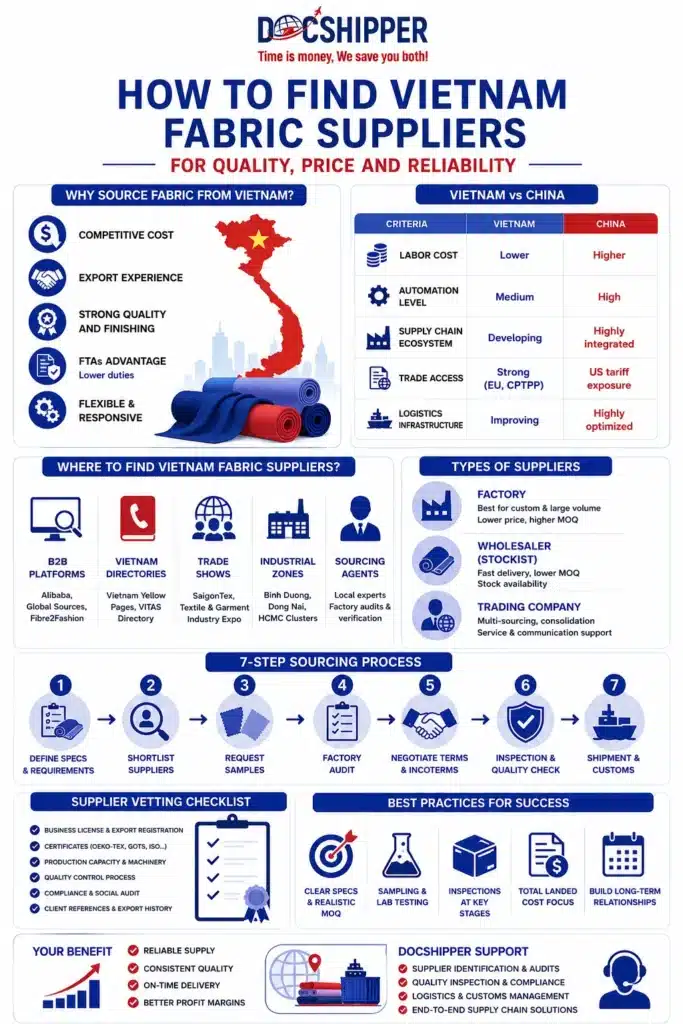
Why you should source fabric from Vietnam instead of other countries
If you’re trying to find vietnam fabric suppliers that can deliver consistent quality without the usual sourcing headaches, Vietnam often surprises you, in a good way.
You’ll notice fast that the ecosystem is mature enough for scale, yet still flexible when you need special finishes or smaller development runs, especially in key textile clusters.
Here’s a simple workflow we use with clients at DocShipper to validate Vietnam as a sourcing country before you spend a cent on sampling.
Vietnam sourcing workflow
- Map your fabric specs, fiber content, construction, GSM, finish, performance tests.
- Shortlist 8–12 vietnam textile suppliers, mix factories and fabrics wholesale players.
- Request lab dips or handloom samples first, then bulk samples.
- Run compliance checks, certificates, social audits, restricted substances.
- Do a pre-production meeting, then pre-shipment inspection before first shipment.
Checklist, before you commit to a fabric supplier in Vietnam:
DocShipper Info
DocShipper maps specs, audits mills, and secures QC plans so your first order starts on solid ground.
Key advantages of Vietnam’s textile industry for global brands
When you find vietnam fabric suppliers in the right tier, you get a practical mix: competitive pricing, export know-how, and factories that understand international documentation.
From experience, the best vietnam fabric manufacturers are the ones that can talk like a QA team, not just like sales.
Quick story, because this happens more than you think.
A buyer came to us after selecting a vietnam fabric factory purely based on a low quote, only to learn their “OEKO-TEX” claim was outdated, one email later, the certificate didn’t match the mill name, and the customer’s compliance team blocked the order.
Vietnam also benefits from a structured industry network, you’ll see many mills align with expectations promoted by VITAS, the Vietnam Textile and Apparel Association, especially on export readiness and market requirements.
That alignment saves you weeks when you’re pushing a launch calendar.
In practical terms, the advantages you’ll feel on a project look like this:
- Export experience, fewer surprises on packing lists, HS codes, and shipping marks.
- Strong dyeing and finishing for fashion basics, workwear, home textiles, depending on the cluster.
- Supplier responsiveness during development, lab dips, shade bands, strike-offs.
- Multiple sourcing routes, direct fabric manufacturers in Vietnam, or vietnam fabric wholesale intermediaries for speed.
And yes, you can absolutely source fabrics wholesale in Vietnam if you need quick availability rather than custom production.
Just treat “in-stock” claims carefully, you’ll want roll-by-roll verification.
Cost, quality and lead time comparisons with China and other hubs
To find vietnam fabric suppliers intelligently, you need to compare Vietnam against China, India, and regional hubs on what actually hits your margin, delivered cost, defect rate, and time-to-market.
Here’s the thing, Vietnam doesn’t always win on raw price, it often wins on execution stability for mid to premium programs.
We’ve seen buyers save money in China on the ex-works price, then lose it on rework, shade inconsistencies, or delayed vessels when the timeline is tight.
In Vietnam, the “second order” tends to go smoother if you lock specs and QC early.
| Criteria | Vietnam | China | Other hubs (India, Indonesia, etc.) |
| Best fit | Balanced programs, reliable repeats, export-ready mills | Huge variety, massive capacity, aggressive pricing on many categories | Strong on specific categories, varies widely by region and mill |
| Lead time consistency | Often stable when specs are frozen and capacity is reserved | Can be fast, but congestion and scheduling swings happen | Can be longer, also depends on port and inland logistics |
| Quality risk on first order | Moderate, improves quickly with clear QC plan | Low to high depending on supplier tier and oversight | Moderate, needs strong technical follow-up |
| MOQ flexibility | Good options via wholesalers and smaller mills | Often higher on custom runs, but many options exist | Varies, sometimes flexible, sometimes high |
| Communication | Generally smooth with export-focused vietnam textile suppliers | Strong, but you may manage more “yes culture” risk | Varies, depends heavily on team and structure |
If you’re debating where to place production, don’t compare only the quote.
Compare landed cost, defect allowance, and what a one-week delay does to your sales plan.
How to define your sourcing needs before you contact Vietnam fabric manufacturers
You can’t find vietnam fabric suppliers efficiently if you’re still vague on construction, performance, or compliance, that’s when suppliers quote “approximate” specs and you end up arguing during production.
This is the moment where most importers get stuck, not in Vietnam, but in their own brief.
We handle this upfront with a short internal spec pack, then we approach fabric manufacturers in Vietnam with fewer questions and tighter negotiation leverage.
It also helps you filter out sales teams that don’t actually control a mill.
Checklist, your sourcing brief before outreach:
- Fabric type, construction, fiber content, GSM, width, shrinkage tolerance.
- Color method, reactive, disperse, pigment, yarn dyed, and shade requirements.
- End use and performance tests, pilling, abrasion, colorfastness, bursting/tear strength.
- Compliance targets, chemical restrictions, labeling, traceability expectations.
- Target MOQ per color, annual volume, and delivery cadence.

DocShipper Advice
Let DocShipper structure your brief and pre-qualify mills before you request quotes.
Looking for a Reliable Shipping & Sourcing Partner?
Clarify fabric types, end use, certifications and order quantities
Before you find vietnam fabric suppliers, lock the “non-negotiables”, what fabric is it, what does it have to survive, and what certifications your customer will ask for.
Suppliers can’t quote accurately if you only say “cotton jersey”, you’ll get five different qualities and five different prices.
Here’s a real scenario we’ve seen.
A brand requested “organic cotton” from a vietnam fabric manufacturer, but forgot to specify transaction certificate needs, so the mill offered organic fiber without chain-of-custody paperwork, and the brand failed retailer onboarding.
When you write your spec, include the pieces that impact both production and compliance:
- Construction details, knit or woven, weave/knit structure, yarn count, filament vs spun.
- Finishing, brushed, peached, calendared, waterproof, antimicrobial, flame retardant.
- Certifications, request exact scope and validity, not just logos in a PDF.
- MOQ and sampling plan, lab dips, strike-offs, bulk approval, tolerance thresholds.
Keep your numbers realistic.
If you ask for 30 colors with tiny quantities, even the best fabric supplier will price in risk and delays.
Decide between fabric manufacturers, wholesalers and trading companies
To find vietnam fabric suppliers that match your timeline, you need to choose the right channel, direct vietnam fabric factory, vietnam fabric wholesale, or a trading company that consolidates multiple mills.
This decision affects everything, pricing transparency, QC control, and how fast you can replace a failing supplier.
We once supported a buyer who insisted on direct factory only.
The factory looked great, but their MOQ was too high, a local fabrics wholesale partner solved it in 48 hours by sourcing the same construction from a smaller mill, with proper roll inspection.
Use this comparison when you’re deciding how to buy:
| Option | When it works best | Main risk | How to control it |
| Direct vietnam fabric factory | Custom development, stable repeat orders, price leverage at volume | Higher MOQs, stricter planning, slower for urgent small runs | Capacity booking, clear QC plan, enforce sampling gates |
| Vietnam fabric wholesale / stockist | Fast delivery, smaller quantities, testing a new market | Stock not matching claim, mixed lots, shade variation | Roll-by-roll checks, shade band approval, verify lot numbers |
| Trading company | Multi-material sourcing, need English support and consolidation | Less transparency, margin layers, unclear accountability | Request mill identity, audit trail, and inspection rights |
Whatever route you choose, keep the transaction steps tight.
At DocShipper, we can help you shortlist vietnam textile suppliers, run factory verification, manage sampling, and coordinate inspections and shipping so your first order doesn’t turn into an expensive lesson.
Where to find reliable Vietnam fabric suppliers online and on the ground
If you want to find Vietnam fabric suppliers efficiently, you need to combine digital research with on-site validation. Relying on one channel only increases your sourcing risk.
You should structure your search around verified platforms, trade fairs, and industrial clusters known for textile manufacturing.
- B2B platforms, Alibaba, Global Sources, Fibre2Fashion
- Vietnam-specific directories, Vietnam Yellow Pages, VITAS member directory
- Trade shows, SaigonTex, Vietnam Textile and Garment Industry Expo
- Industrial zones, Binh Duong, Dong Nai, Ho Chi Minh City clusters
- Sourcing agents, local partners who conduct factory audits on your behalf
You should always verify whether the supplier is a factory or a trading company before moving forward. Many listings online mix both profiles.
| Channel | Advantages | Risks |
| B2B Platforms | Fast comparison, wide selection | Fake factories, limited transparency |
| Trade Shows | Direct contact, sample review | Travel cost, time investment |
| Industrial Visits | Real capacity validation | Requires local coordination |
| Sourcing Agent | On-site audit, negotiation support | Service fees |
At DocShipper, we combine supplier scouting, factory visits and compliance checks so you avoid intermediaries posing as manufacturers. You gain access to a pre-qualified supplier network with verified production capacity.
DocShipper Info
We audit mills, verify capacity, and confirm legal status before you engage or transfer any deposit.
DocShipper Platform
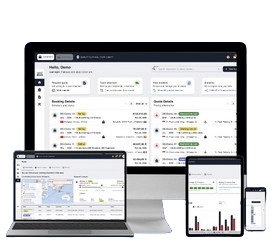
One platform. Your entire supply chain
Sourcing, freight, customs & documents — all centralised, all visible, 24/7.
How to vet Vietnam textile suppliers for compliance, quality and capacity
Finding a supplier is easy, validating one is where your margin is protected. You must assess compliance, quality systems and real production output before placing any deposit.
Start with a structured due diligence checklist focused on risk mitigation.
- Business license and export registration verification
- Factory audit report, social and environmental compliance
- Certifications, OEKO-TEX, GOTS, ISO 9001, ISO 14001
- Production capacity per month in meters or tons
- Quality control process, inline and final inspection
- Client references and export markets history
You should also request recent bulk production photos and conduct a video factory tour. If possible, perform a third-party audit before mass production.
| Evaluation Criteria | What You Should Verify | Red Flag |
| Compliance | Valid certificates and audit reports | Expired or unverifiable documents |
| Quality | Lab testing reports, fabric GSM accuracy | No test reports available |
| Capacity | Number of looms, dyeing lines | Vague production numbers |
| Financial Stability | Years in operation, export clients | New entity with no history |
We regularly conduct on-site inspections in Vietnam to validate machinery, warehouse stock and workforce size. This prevents you from engaging with brokers pretending to own factories.
DocShipper Alert
Request audits, verify machinery, and confirm real output before committing to bulk production.
Best practices to negotiate, sample and scale orders with Vietnam fabric factories
Once you shortlist suppliers, your negotiation strategy will determine your profitability. You should approach discussions with cost breakdown clarity and realistic volume projections.
Focus on total landed cost, not only unit price.
- Request detailed quotations, fabric cost, dyeing, finishing, packaging
- Clarify MOQ per color and per composition
- Negotiate payment terms, 30 percent deposit and balance after inspection
- Define Incoterms clearly, FOB Ho Chi Minh or CIF destination
- Agree on sampling timeline and approval process
You should always test with a pilot order before scaling. Sampling is not a formality, it is your technical validation stage.
| Stage | Objective | Key Action |
| Sample Development | Validate color, shrinkage, texture | Lab test and wash test |
| Pilot Order | Test bulk consistency | Pre-shipment inspection |
| Scale Production | Secure stable supply | Framework agreement |
At DocShipper, we supervise sampling, manage quality inspections and coordinate freight from Vietnam to your warehouse. You reduce disputes and production delays while keeping leverage in negotiation.
DocShipper Advice
DocShipper manages sampling, inspections, and freight coordination to secure smooth scale up from Vietnam.
Conclusion
If you want to successfully find Vietnam fabric suppliers, you must combine structured research with operational control. Every stage from supplier search to shipment impacts your margin.
- Use both online platforms and on-ground verification
- Differentiate factories from trading companies
- Audit compliance, certifications and production capacity
- Negotiate based on total landed cost, not only unit price
- Start with sampling and pilot orders before scaling
- Secure inspections and clear Incoterms before shipment
With the right sourcing strategy and professional supervision, Vietnam can become a reliable fabric hub for your business. We help you control risk, secure quality and scale confidently in the Vietnamese textile market.
FAQ | How to find Vietnam fabric suppliers for quality, price and reliability
Start by narrowing your search to Vietnam-based companies that already export. Use platforms like Alibaba, Global Sources or Fibre2Fashion but always filter by country and check whether they show a real factory address in Vietnam. Then cross‑check the company name on VITAS or Vietnam Yellow Pages to see if they appear as a textile manufacturer. Finally, send a very specific fabric brief to 8–10 shortlisted suppliers and see who replies with technical answers rather than generic sales pitches.
For wholesale quantities and faster turnaround, you’ll usually work with local stockists or trading companies, not big mills. Ask potential partners directly if they keep “ready goods” in stock, what minimum length they can ship per color, and how often they refresh inventory. Always request current stock lists with roll numbers and photos of the actual warehouse shelves so you’re not buying from a catalog that’s out of date.
The “best” factory is the one that’s already strong in your exact category. Look at what they currently export, for example knit basics, workwear twills, upholstery, technical outdoor fabrics. Ask for 2–3 recent references in the same end use and copies of test reports for those programs. A strong vietnam fabric manufacturer will immediately know which existing quality in their range is closest to your brief and propose it, rather than offering everything they make.
You need to work backwards from your destination country’s rules. Confirm the correct HS code and any duties with your customs broker before you place the order, then tell the Vietnamese supplier exactly which fiber content and finishes will appear on documents. Make sure the proforma invoice and packing list match your broker’s requirements word‑for‑word (descriptions, composition, origin). If you use a freight forwarder, share all fabric specs upfront so they can flag any certificates or testing you might be missing before shipment.
Vietnam is particularly attractive when you care about repeatability and smoother second and third orders. Labor is still competitive, but the real advantage is mills that are set up for export and used to handling documentation, testing and audits for international brands. If you’re ready to invest a bit more time on the first order (clear specs, inspections, documented procedures), Vietnam tends to give you fewer surprises on lead times and quality drift over the life of a program.
Treat every contact as unverified until you see proof. Ask for a scan of their Vietnamese business license showing manufacturing or trading in textiles, and check that the legal name matches their bank account and certificates. If they claim OEKO‑TEX, GOTS or ISO, verify those certificate numbers on the official websites. For higher volumes, it’s worth paying for a basic on‑site audit or video tour of the factory floor, including weaving/knitting, dyeing, finishing and warehouse areas, before you ever send a deposit.
Think in terms of phases. For market testing or small runs, use a reliable vietnam fabric wholesale source to move quickly and learn what sells. Once volumes stabilize, transition your best‑selling qualities to a direct factory relationship to improve price and control. If you don’t have people on the ground, a local sourcing agent can bridge the gap, auditing factories, checking wholesale stock quality, and coordinating sampling so you’re not guessing from another continent.
Read more
Looking for more? Check out these articles.
Need Help with Logistics
or Sourcing in Vietnam ?
First, we secure the right products from the right suppliers at the right price by managing the sourcing process from start to finish. Then, we simplify your shipping experience - from pickup to final delivery - ensuring any product, anywhere, is delivered at highly competitive prices.
Fill the Form
Prefer email? Send us your inquiry, and we’ll get back to you as soon as possible.
Contact us