In short ⚡
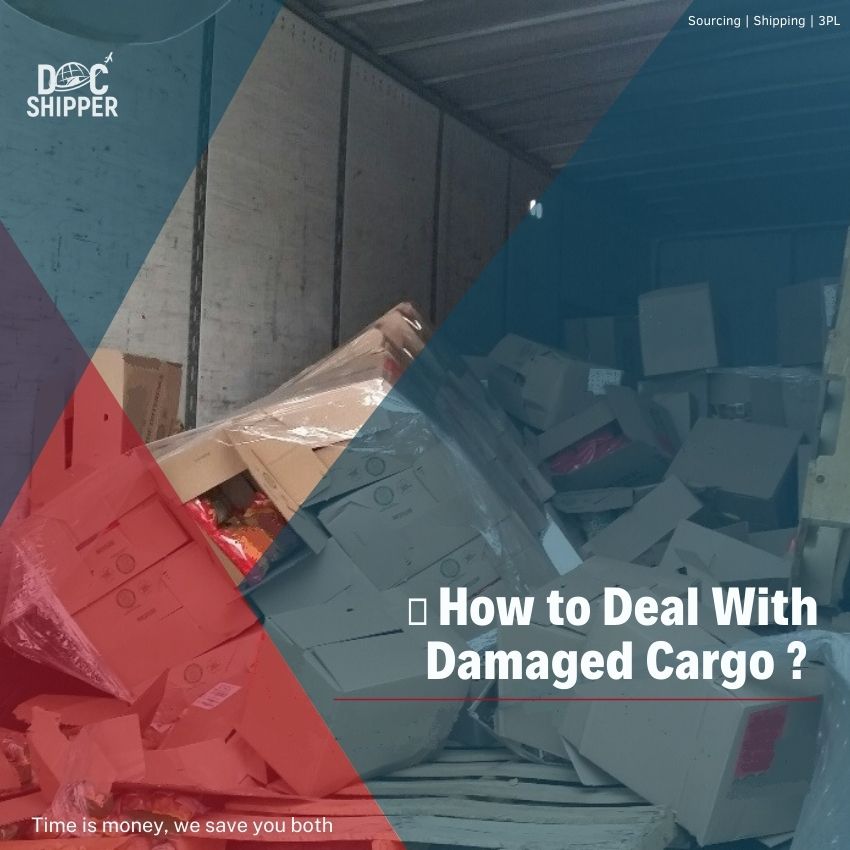
How to deal with damaged cargo effectively means acting within the first 24–48 hours: stop unsafe unloading, document everything with photos and videos, segregate affected stock, notify your forwarder, carrier and insurer in writing, and build a structured cargo damage report that clearly shows condition, quantities, causes and losses so liability and compensation can be established.In this article, you will find practical prevention tactics, inspection checklists, first 48‑hour action steps, guidance on working with forwarders and carriers, and detailed advice on insurance claims and long‑term supply chain improvements.
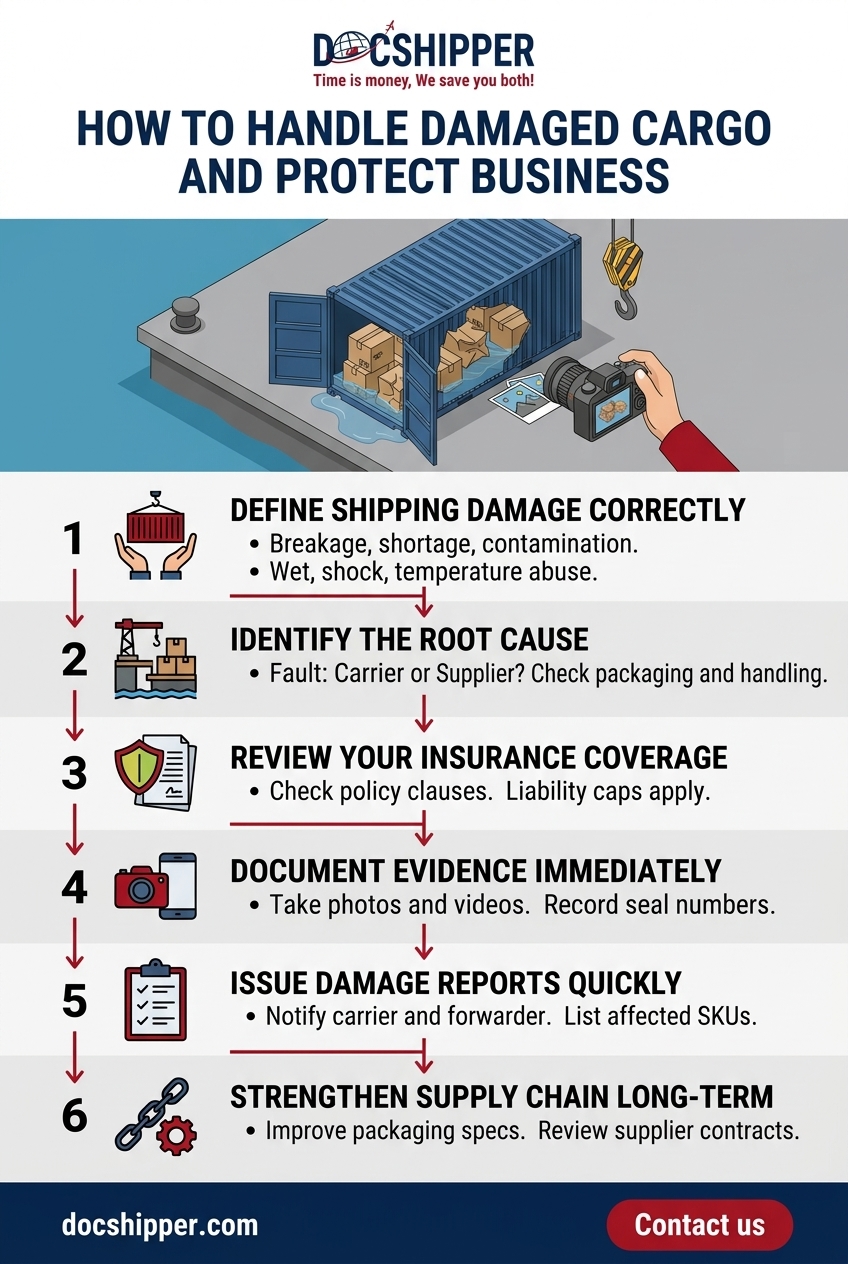
We hope you’ll find this article genuinely useful, but remember, if you ever feel lost at any step, whether it’s finding a supplier, validating quality, managing international shipping or customs, FNM Vietnam can handle it all for you!
Understand what counts as shipping damage and who is responsible
To master how to deal with damaged cargo, you first need to define what “damage” actually means in international logistics, because your claim lives or dies on definitions.
In practice, “shipping damage” covers more than broken cartons, it also includes shortage, contamination, temperature excursion, and even wrong delivery that disrupts your inventory control and last-mile delivery.
Here’s the thing, when you don’t name the event correctly, you’ll notice fast that carriers, insurers, and suppliers will each try to push it into the category that makes them least responsible.
Typical types of cargo damage and loss (breakage, theft, wrong containers)
Last quarter, we handled a container where the consignee swore it was “just a damaged shipment”, then we checked the packing list and realized six cartons were missing, that’s a shortage, not only cargo damage.
When you’re learning how to deal with damaged cargo, you should separate “physical damage” from “loss” and “misdelivery”, because the documents and timelines differ.
To make the classification easy, use this quick field list before you write your cargo damage report.
- Breakage: crushed cartons, cracked products, pallet collapse, water-stained goods.
- Wet damage: rain ingress, container sweat, seawater exposure, leaking drums.
- Shock and vibration damage: scuffing, internal component failure, denting without carton tears.
- Theft/pilferage: cut seals, re-taped cartons, “light” pallets, missing high-value SKUs.
- Wrong container / wrong cargo: mis-stuffed container, swapped container numbers, wrong consignee delivery.
- Temperature abuse: reefer setpoint mismatch, defrost issues, door-open events.
If your goods moved by ocean shipping, don’t forget the BL details, we often see “clean” documents that don’t reflect reality once the doors open.
Use this internal reference when you need it: BL.
Common causes of damaged shipment in practice (carrier vs supplier fault)
Tip from the field: before you blame the carrier, look for signs of pre-shipment weakness, because many damaged cargo cases start at the factory, not at sea.
When you’re figuring out how to deal with damaged cargo, you’ll want to isolate whether the root cause happened during cargo handling, containerization, or pack-out.
Here’s a simple comparison we use with clients to stop arguments and start evidence-based decisions, and we align it with common carrier practices referenced by the IMO cargo securing guidance.
| What you see | Likely source | What proves it |
| Cartons crushed uniformly at bottom, pallets “mushroomed” | Supplier packaging/palletizing | Pallet spec mismatch, weak cartons, no corner posts, overstacking photos at loading |
| One side heavily damaged, scrape marks, forklift punctures | Terminal/warehouse handling or road haulage | Fork holes, external pallet tears, CCTV request, delivery notes with remarks |
| Water lines high on cartons, salt residue, rust on container floor | Carrier equipment or voyage exposure | Container condition report, photos of roof/door gaskets, surveyor report |
| Seal intact but shortage inside | Supplier short-shipped or mispacked | Stuffing video, carton count at loading, reconciliation vs packing list |
| Wrong SKUs, wrong labels, wrong destination marks | Supplier picking/labeling error | QC records, barcode scans, factory dispatch note, buyer PO comparison |
If you suspect factory-side issues, don’t wait for the next order, lock in a pre-shipment inspection or in-process checks so you’re not repeating the same cargo damage loop.
We’ve built a dedicated option here: quality control service.
DocShipper Advice
Book a pre shipment inspection and secure objective evidence before cargo leaves the warehouse.
How liability works between shipper, carrier, insurer and supplier
Who pays, really?
When you apply how to deal with damaged cargo correctly, you map liability across four players: the shipper (often your supplier), the carrier, your insurer, and the supplier under contract and Incoterms.
Here’s a workflow we use to avoid missed deadlines and “not our problem” dead ends.
- Step 1: Identify the transport leg where the damage likely happened, ocean shipping, air freight, or inland trucking.
- Step 2: Check Incoterms to confirm when risk transfers, for example under FOB risk typically shifts once the goods are on board, but your contract wording still matters.
- Step 3: Separate carrier liability (limited, condition-based) from cargo insurance (broader if you bought good coverage).
- Step 4: Preserve recourse, issue written notice quickly, keep packaging, and avoid disposing of goods before insurer/carrier confirmation.
- Step 5: If it’s supplier fault (mispack/short-ship), trigger a commercial claim using PO specs and QC evidence.
Bold reality: if you don’t have the right insurance, you’re often stuck negotiating pennies with a carrier whose liability is capped and full of conditions.
If you want to set yourself up properly, review your insurance position before the next shipment, not after the container arrives looking like it survived a storm.
DocShipper Alert
Review your cargo insurance now to avoid negotiating pennies after a major loss.
Prevent damaged cargo before it happens
Most guides on how to deal with damaged cargo start after the incident, but the cheapest claim is the one you never file.
You’ve probably dealt with suppliers who say “we’ve shipped this for years” while using thin cartons, random pallets, and zero bracing, then everyone acts surprised when you get shipping damage.
From experience, prevention is a supply chain management decision, not a warehouse detail, you write the rules, you audit them, you enforce them.
Plan packaging, palletizing and container loading to minimize risk
We once saw a 20’ container of ceramic parts arrive with perfect outer cartons but shattered contents, the supplier used single-wall cartons and no internal cushioning, and the vibrations did the rest.
To apply how to deal with damaged cargo proactively, treat packaging as an engineering spec tied to your freight rate, product fragility, and mode, not as “supplier choice”.
Use this short checklist before you approve a supplier’s packing method, it prevents the most common cargo damage patterns.
- Carton strength matches stacking plan and humidity exposure, not “whatever is available”.
- Inner protection is designed for shock and vibration, especially for electronics and fragile goods.
- Pallet spec is consistent (size, entry, quality), and stretch wrap plus strapping are used correctly.
- Weight distribution is even, no “heavy on one side” loads that collapse or shift.
- Container loading plan exists, with count by pallet/carton and a photo standard.
If your supplier can’t execute to spec, you can outsource the finishing step locally, including crating, palletizing, and export-ready labeling via a packing service.
Use blocking, bracing and monitoring tools to protect freight in transit
Direct tip: if you can push a loaded pallet with one hand, your container will rearrange itself somewhere between consolidation and deconsolidation.
When you want to know how to deal with damaged cargo before it happens, you invest in cargo securing, because most ocean shipping damage is movement, not impact.
Here are practical tools that give you outsized results without overcomplicating operations.
- Blocking and bracing: dunnage, airbags, timber bracing, anti-slip mats for palletized freight.
- Edge and corner protection: prevents strap cuts and carton crush on long transit times.
- Desiccants and moisture control: reduces container sweat and mold risk in humid lanes.
- Shock and tilt indicators: creates accountability and supports a cargo damage report later.
- Seal discipline: high-security seals, seal logs, and photo evidence at each handoff.
If you insure your cargo, monitoring data can also strengthen your narrative when you’re insuring your cargo and later need to show a temperature or shock event.
Keep this resource handy: insuring your cargo.
DocShipper Info
We help you implement blocking, bracing, and monitoring solutions that strengthen both protection and future claims.
Specific tips for importers in Vietnam to reduce cargo damage
Vietnam lanes have their own rhythm, and yes, you’ll feel it when your container transits through busy gateways and the inland leg involves tight delivery windows.
To apply how to deal with damaged cargo in a Vietnam context, you reduce handling touches, tighten paperwork, and choose facilities that can manage cross-docking without chaos.
This is the moment most importers get stuck, because a damaged cargo Vietnam case often mixes three issues at once, trucking handling, bonded warehouse rework, and rushed unloading.
Use this quick table to choose risk controls that actually fit Vietnam operations.
| Risk point | What happens in practice | What you can do |
| Inland drayage and tight ramps | Forklift hits, pallet edge crush | Specify forklift access, insist on pallet guards, require POD remarks for any impact |
| Humidity and storage conditions | Mold, carton softening, corrosion | Desiccants, moisture barrier, faster deconsolidation, covered staging area |
| Customs and inspection holds | Extra handling, seal breaks, delays | Prepare HS code and docs cleanly, use a trusted customs clearance service |
If you’re preparing a vietnam cargo damage claim, these prevention records also become evidence, loading photos, seal logs, and handling notes are what move a file forward.
DocShipper Advice
Optimize drayage, warehousing, and customs handling to reduce damage exposure and strengthen your claim file.
Inspect cargo at loading and before signing delivery documents
The fastest way to win at how to deal with damaged cargo is to catch issues before you sign anything, because once documents are “clean”, everyone suddenly forgets what happened.
You don’t need a full-time team on every container, but you do need a repeatable inspection habit at loading and at delivery.
We’ve seen importers lose valid compensation simply because the POD was signed with no remarks, even though the goods were visibly damaged.
DocShipper Alert
Train your warehouse team to inspect and remark properly before any document is signed.
How to document container loading with photos and videos
We once reviewed a dispute where the supplier insisted the container was “properly stuffed”, then a 30-second loading video showed the opposite, no bracing, gaps everywhere, and a rushed door close.
When you’re serious about how to deal with damaged cargo, you document loading like you’re building a case file, because one day you might be.
Use this checklist as your minimum “stuffing evidence pack”, it’s simple but it changes outcomes.
- Container exterior: CSC plate, container number, dents/holes, door gasket condition.
- Pre-loading interior: floor condition, smell/moisture signs, cleanliness, reefer settings if applicable.
- During loading: pallet counts, carton condition, bracing placement, dunnage use, gap control.
- Close-out: final wide shot, seal close-up, seal number against documents, time stamp.
Pair that evidence with your commercial docs, packing list, cargo manifest, and letter of credit constraints if you’re shipping under LC.
What to check on arrival (seal, weight, condition, POD/BOL notes)
Question to ask yourself at the gate: does the seal number match, and does anything look “too clean” for the trip it just made?
To execute how to deal with damaged cargo on arrival, you focus on three things, integrity, quantity, and documentation, before you rush into unloading.
Here’s a practical arrival workflow that your warehouse team can follow without improvising.
- Step 1: Photograph container doors, seal, and any dents before breaking the seal.
- Step 2: Verify seal number vs BL and release documents, then record who broke it and when.
- Step 3: Check gross weight indicators, obvious load shift, odors, moisture, or spilled contents.
- Step 4: Unload in a controlled zone, keep damaged packaging, separate salvageable vs unsalvageable stock.
- Step 5: Write clear remarks on POD and delivery note, never sign “clean” if you see cargo damage.
If you’re unsure which notes matter most, start with the BL description and discrepancies, a “clean” receipt can undercut your damaged cargo claim leverage later.
Act immediately when you discover cargo damage
When damage shows up, your clock starts, and how to deal with damaged cargo becomes a 24 to 48-hour discipline.
You’ve probably felt that sinking moment when a warehouse calls saying “some boxes are crushed”, and you already know the carrier will ask for proof, timing, and documentation.
Move fast, stay organized, and don’t let anyone dispose of evidence “to save space”.
Step‑by‑step actions in the first 24–48 hours
We once saw a consignee throw away wet cartons immediately, then the insurer asked for inspection and the whole cargo damage case weakened overnight.
To follow how to deal with damaged cargo correctly, you need a clean sequence that protects your rights and your inventory.
Here’s the operational workflow we recommend for the first two days.
- Hour 0–2: Stop unloading if damage suggests load shift or safety risk, isolate area, start photos and video.
- Hour 2–6: Mark and segregate affected SKUs, record batch/lot numbers, count shortages, keep packaging.
- Hour 6–12: Notify your freight forwarder and warehouse management team in writing, request carrier notice and survey if needed.
- Hour 12–24: Draft initial cargo damage report, attach evidence, list suspected causes and affected quantities.
- Hour 24–48: Mitigate losses, re-pack, dry, rework, or move to bonded warehouse if required, but document everything you change.
If you want us to help coordinate the forwarder, carrier, and evidence trail, you can Contact us and we’ll tell you exactly what to collect first.
Taking photos, videos and creating a strong cargo damage report
Bold rule: no photos, no leverage.
When you’re applying how to deal with damaged cargo, your goal is to produce a cargo damage report that a carrier, insurer, or supplier can’t easily dismiss as “unverifiable”.
Use this short structure so your report reads like a professional incident file, not a complaint email.
- Shipment identifiers: BL number, container number, seal number, booking reference, shipment tracking details.
- Condition evidence: wide shots, close-ups, time-stamped unloading sequence, damage per pallet/carton.
- Quantity reconciliation: expected vs received, shortages, wrong SKUs, note any damaged cargo.
- Document remarks: POD notes, delivery receipt comments, warehouse receiving report.
- Loss estimate: unit value, salvage value, rework costs, disposal fees, delays impacting inventory control.
If your case involves damaged cargo Vietnam or a vietnam cargo damage claim, this report becomes your anchor document for every follow-up, with the carrier, with the supplier, and later with freight insurance.
Work with your freight forwarder and shipping line
When you’re figuring out how to deal with damaged cargo, your freight forwarder and the shipping line quickly become central players. If you handle this stage poorly, you risk losing time, money, and even your right to claim.
You’ve probably felt that frustration when emails start bouncing between the forwarder and the carrier. Here’s the thing, if you structure the communication properly from day one, you stay in control.
Looking for a Reliable Shipping & Sourcing Partner?


DocShipper Platform
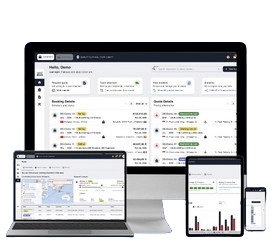
One platform. Your entire supply chain
Sourcing, freight, customs & documents — all centralised, all visible, 24/7.
How your forwarder can help investigate shipping damage
Last year, we supported an importer who received electronics with internal moisture damage after a long ocean transit. The supplier blamed the carrier, the carrier blamed “inherent vice,” and the client was stuck in the middle trying to understand how to deal with damaged cargo without solid evidence.
Your forwarder can coordinate a structured investigation instead of emotional back‑and‑forth emails.
In practical terms, you should expect your forwarder to:
- Request container movement history and terminal handling reports.
- Obtain the mate’s receipt and verify any pre‑loading remarks.
- Coordinate a joint survey with an independent surveyor.
- Clarify Incoterms responsibilities between you and your supplier.
According to FIATA best practices, proper documentation flow between forwarders and carriers is critical in claims management. If your forwarder doesn’t push for documents quickly, you lose leverage.
At DocShipper, we typically follow this workflow with you:
- Day 1: Collect photos, delivery notes, and BOL copies from you.
- Day 2: Send formal notice of damage to the carrier.
- Day 3–5: Appoint surveyor and request technical reports.
- Within 7 days: Consolidate preliminary liability analysis.
This structured approach helps you avoid missing legal notice deadlines.
DocShipper Info
Work with a proactive forwarder who structures investigation and carrier communication from day one.
When and how to involve the carrier in a damaged cargo claim
Should you contact the carrier directly, or go through your forwarder? The answer depends on your contract of carriage and who issued the Bill of Lading.
If the ocean carrier issued the BOL in your name, you must send a formal notice of claim directly to them within the contractual timeframe. If your forwarder issued a House B/L, then your contractual link may be with the forwarder.
You’ll want to involve the carrier immediately when:
- The seal is broken or different from the BOL.
- The container shows visible structural damage.
- There’s clear evidence of mishandling at terminal level.
- The cargo is partially missing or stolen.
Under the Hague-Visby Rules framework recognized in many jurisdictions, carriers’ liability is limited per package or per kilogram. That means your claim strategy must be realistic from the start.
From experience, the biggest mistake you can make is signing a clean delivery note while thinking you’ll “sort it out later.” Once you sign without reservations, your position weakens significantly.
Deal with insurance and formal damage claims
If you really want to master how to deal with damaged cargo, you must understand insurance mechanics. This is where many importers get stuck, especially when cargo is lost, stolen, or incorrectly shipped.
Insurance doesn’t pay automatically. You need to protect your rights from the first notification.
Notifying your insurer and protecting your rights
The moment you suspect damage, notify your insurer in writing. Even if the loss seems minor, early notification protects your coverage under most marine cargo policies.
Many policies require notice “as soon as reasonably practicable.” That wording sounds flexible, but in practice delays can jeopardize compensation.
To protect yourself, you should:
- Send written notice within 24–72 hours.
- Avoid disposing of damaged goods without insurer approval.
- Mitigate further loss, such as separating wet cargo.
- Keep all packaging and seals as evidence.
The International Chamber of Commerce, through its Incoterms Committee, emphasizes how risk transfer under Incoterms directly affects who must insure the goods. If you bought under CIF, the supplier arranged insurance, but you still need to coordinate the claim carefully.
This is the stage where you must stay disciplined and document everything.
DocShipper Alert
Notify early, preserve evidence, and follow policy terms to secure full compensation.
What to include in a cargo damage claim file
We once handled a case where the insurer rejected a claim simply because the commercial invoice copy was missing. That’s how strict the process can be when you’re learning how to deal with damaged cargo.
Your claim file should be complete and logically structured.
Before you submit, use this checklist to make sure nothing is missing:
- Commercial invoice and packing list.
- Bill of Lading or Air Waybill.
- Insurance certificate.
- Survey report from independent inspector.
- Photos and videos of damage.
- Delivery note with damage remarks.
- Formal claim letter stating amount claimed.
Present the documents in chronological order. You’ll make the claims handler’s job easier, and that speeds up your reimbursement.
Calculating losses, recoveries and possible extra compensation
Calculating your loss is not just about counting broken units. You need a clear loss methodology.
You should normally distinguish between:
- Physical damage value, based on CIF or invoice price.
- Salvage value of partially usable goods.
- Extra costs such as inspection, storage, or re-export.
- Potential loss of profit, if covered by your policy.
For example, if 30 percent of your shipment is unsellable and the rest is discounted, your recoverable amount equals the difference between expected sales value and actual net recovery.
Marine cargo insurance typically follows principles aligned with the Institute Cargo Clauses used globally. You must check whether you’re covered under Clause A, B, or C, because coverage scope changes dramatically.
If you calculate carefully and justify each number, your negotiation position becomes much stronger.
Learn from incidents and strengthen your supply chain
Understanding how to deal with damaged cargo is important. Preventing repeat incidents is even more critical for your long‑term margins.
Every damage case contains operational lessons. The key is extracting them instead of moving on too fast.
Analyzing root causes to avoid repeat damaged shipments
After one recurring breakage issue with ceramic tiles, we conducted a full root cause review with the client. The issue was not the carrier, but weak internal carton reinforcement at factory level.
You should approach each incident with a structured analysis.
Here is a simple framework you can apply:
- Identify where the damage occurred, factory, loading, sea transit, or last mile.
- Review packaging specifications versus actual execution.
- Check container stuffing photos and load distribution.
- Compare weather and route conditions.
The World Trade Organization frequently highlights how supply chain resilience depends on traceability and documentation. If you don’t document properly, you can’t improve systematically.
Improving supplier selection, contracts and incoterms
Here’s a direct tip: never separate sourcing strategy from logistics risk. If your supplier consistently cuts corners on packaging, you will keep dealing with damaged cargo.
You should review your contracts and ensure they clearly define:
- Packaging standards and pallet specifications.
- Liability for improper loading.
- Inspection rights before shipment.
- Chosen Incoterm and risk transfer point.
Sometimes shifting from EXW to FOB gives you more control over container loading. In other cases, moving to FCA with a nominated forwarder protects you better.
This is where proactive supply chain design saves you from future claims.
When to change shipping mode or partners after recurring damage
Repeated damage is a signal.
If you experience frequent humidity damage in ocean freight, you may need to reconsider container type, desiccant usage, or even switch to air freight for high‑value goods.
You can evaluate your options using this comparison:
| Option | Pros | Cons |
| Change carrier | Better equipment quality, improved routes | No guarantee if root cause is packaging |
| Upgrade packaging | Long-term stability | Higher unit cost |
| Switch to air freight | Reduced transit risk, faster delivery | Higher freight cost |
If the financial impact of recurring losses exceeds freight savings, your decision becomes obvious. You protect your margin first.
Conclusion
Mastering how to deal with damaged cargo means acting fast, documenting precisely, and coordinating all parties without delay. You can’t afford emotional reactions or vague communication.
Here are the key takeaways you should remember:
- Document everything at delivery and notify parties immediately.
- Involve your forwarder and carrier with formal written notice.
- Notify your insurer early and protect evidence.
- Prepare a complete and structured claim file.
- Analyze each incident to strengthen your supply chain.
If you apply these principles consistently, you’ll turn cargo incidents from costly surprises into controlled, manageable events. And that’s exactly how you protect your business in international trade.
FAQ | How to deal with damaged cargo and protect your business
Start by freezing the discussion and focusing on evidence, not opinions. Document the visible damage, check seal numbers, and compare what you received with the packing list. Then map the clues: uniform carton crush or poor packaging usually points to supplier fault, while fork holes, container dents, or water lines often indicate carrier or terminal issues. Share this evidence with both sides at the same time and ask them to comment in writing. This forces the conversation into a fact-based investigation instead of a blame game and gives your insurer a clearer picture of where liability sits.
You’re in a weaker position, but not necessarily out of options. Act immediately: take photos, list the affected SKUs, and reconstruct the timeline from arrival to discovery. Then, send a written notice to your forwarder, carrier, and insurer explaining why the damage may have been latent (for example, internal moisture, hidden breakage inside sealed cartons). Attach warehouse records showing the goods were not handled heavily after receipt. You may not recover the full amount, but a well-documented late discovery is still better than silence.
Responsibility depends on both Incoterms and what your contracts say. Under FOB, your supplier is usually responsible until the goods are loaded on board; after that, the risk transfers to you (and your insurer, if you bought coverage). Under CIF, the supplier arranges insurance and transport, but that doesn’t mean they pay for everything automatically: the insurer steps in according to the policy, and you still have to submit a proper claim. The key is to check who arranged the carriage, who holds the Bill of Lading, and how risk transfer is worded in your purchase contract.
Treat it like an investigation summary rather than a complaint email. Clearly identify the shipment (BL, container, seal, invoice), describe what you found on arrival (where, when, who was present), and link each type of damage to specific evidence such as photos, videos, and warehouse notes. Quantify the impact with exact units, values, and any salvageable portion, and explain what you did to mitigate further loss (segregation, re‑packing, drying, etc.). A concise, structured report shows that you managed the incident professionally and makes it harder for carriers or insurers to dismiss your claim.
The most common errors happen in the first 48 hours. Importers sign clean PODs, throw away damaged packaging to “free space”, or repair/rework products before anyone inspects them. Another frequent mistake is notifying the forwarder but forgetting to send formal written notice to the carrier or insurer within the time limits in the contract and policy. Finally, many claims arrive incomplete, missing key items like the insurance certificate, a clear loss calculation, or photos that link the damage to that specific shipment. Avoid these traps and your chances of recovery increase dramatically.
You’ll need to build a pre‑shipment evidence trail. That means keeping packing specifications, photos or videos of stuffing, and any third‑party inspection reports that show how cartons were stacked, braced, or labeled. If you can demonstrate flimsy cartons, over‑stacking, lack of dunnage, or incorrect palletization before the container left the factory, it becomes much easier to argue that the root cause is supplier-side. This kind of documentation is powerful leverage when you negotiate a commercial settlement or ask the supplier to reinforce packaging on future orders.
In theft or wrong‑delivery scenarios, treat the case as a loss/misdelivery incident, not only physical damage. Immediately freeze the situation: don’t move the container further than necessary, record seal numbers, check container IDs against the BL, and notify your forwarder, carrier, and insurer in writing the same day. Ask your forwarder to pull movement records and terminal logs, and request a formal survey if the container was opened or swapped. For wrong containers, you’ll also need to coordinate return or re‑routing arrangements and document all extra costs so they can be added to the claim or commercial negotiation.
Read more
Looking for more? Check out these articles.
Need Help with Logistics
or Sourcing in Vietnam ?
First, we secure the right products from the right suppliers at the right price by managing the sourcing process from start to finish. Then, we simplify your shipping experience - from pickup to final delivery - ensuring any product, anywhere, is delivered at highly competitive prices.


Fill the Form
Prefer email? Send us your inquiry, and we’ll get back to you as soon as possible.
Contact us